
‘Examining Arts Leadership’ with The New Art School Modality and Hauser & Wirth Learning

‘Examining Arts Leadership’ with The New Art School Modality and Hauser & Wirth Learning
In fall 2024, Hauser & Wirth Learning launched a new partnership with The New Art School Modality, an innovative and alternative art school model that offers free participation to students via hybrid, online and in-person modules worldwide.
Over the course of two years at Hauser & Wirth 18th Street, students connected for in-person classes with a variety of artists, arts practitioners, professors, writers, curators and researchers who led as course faculty.
The manifesto below is the outcome of collective study in the New Art School Modality’s ‘Examining Arts Leadership’ course. The month-long course held at Hauser & Wirth 18th Street (10 October – 14 November 2026) was taught by Professors Carol Becker, Mia Locks, Stefano Harney, Sofía Hernández Chong Cuy, Sandra Jackson-Dumont, Fred Moten, Kym Pynder and Justin Randolph Thompson. It was an exercise in sustained detour, or an insurgent feminist movement away from the myth of the charismatic leader and toward leadership as relation, as an infrastructure of trust, as selfless service and practical decay, and as rhythm and arrhythmia.
The course divests from the fantasy of the leader as a heroic position. Professor Jackson-Dumont spoke about the ‘glass cliff’ thesis, whereby women are over-represented in precarious leadership positions and become scapegoats for institutions on the precipice of change. ‘I am a reluctant leader, an ambivalent leader,’ shares Professor Pynder, but ‘I’m addicted to systematic change, things that will outlast you when you step away.’ Well-attuned to the perils of visibility, the faculty are disinterested in personal credit, and see leadership as a site where change might be enacted collaboratively. Professor Locks calls herself the leader of a ‘limited-life organization’—one intended to be temporary, not to outlast its usefulness.
This notion of leadership as the practical decay—rather than the preservation—of the institution is taken up by Professors Moten and Harney. They look to the word and practice of Robert E. Lee, former Chief Lieutenant of the Black Panther Party, who said, ‘You want to do some organizing, you just walk out on your front porch, look to your left, and see how many neighbors you got. And you go and knock on the door, and start chatting. And that spreads!’ Moten and Harney see leadership as the work of involvement, of chatting [to conspire, conspirare, is, after all, to breathe together], of tarrying, of the disorganization of the self in service of others. Professor Thompson likewise talks about how serving the community, which can often be time-consuming and frictious, is paradoxically the most restful and regenerative activity.
The faculty’s enumeration of the qualities of leadership—as the disappearance of the self, as the rehearsal of new relations, as the sustenance of community rather than the usurpation of power—are summed up in Professor Jackson-Dumont’s list:
Leadership is not a role; it is a rhythm.
Leadership is not a spotlight; it is a lantern.
It is not a badge; it is a blueprint.
The future is not inherited; it is co-created.
Leadership is not inherited; it is authored.
You don’t have to be fearless; you just have to be faithful.
You’re not replicating; you’re reimagining.
Professor Thompson evokes the value of a practice which produces tools that can make other tools. The participants in this course had reactions in this spirit spanning a range of media and methods. A reverberation of the course (leadership’s rhythm) may be heard in Abdel-Alim Amine Slimani’s poem below. It proliferates and opens onto other outcome projects that variously declare leadership as a diffuse illumination, as supportive infrastructure, as collective curation, as pedagogical reform, and as endless transformation and creation.
Raindrops of Shared Space
by Abdel-Alim Amine Slimani

Rim Lee, ‘The Arts Leadership as a Ways of Being not Ways of Doing’
‘But the walls are tired of the single voice’
The podium is a lonely island,
scaffolded by static air and heavy wood,
where leadership is mistaken for a monologue
spoken down to a room that has always understood.
But the walls are tired of the single voice.
The plaster cracks under the weight of the crown.
We did not come to be managed;
we came to tear the stage down.
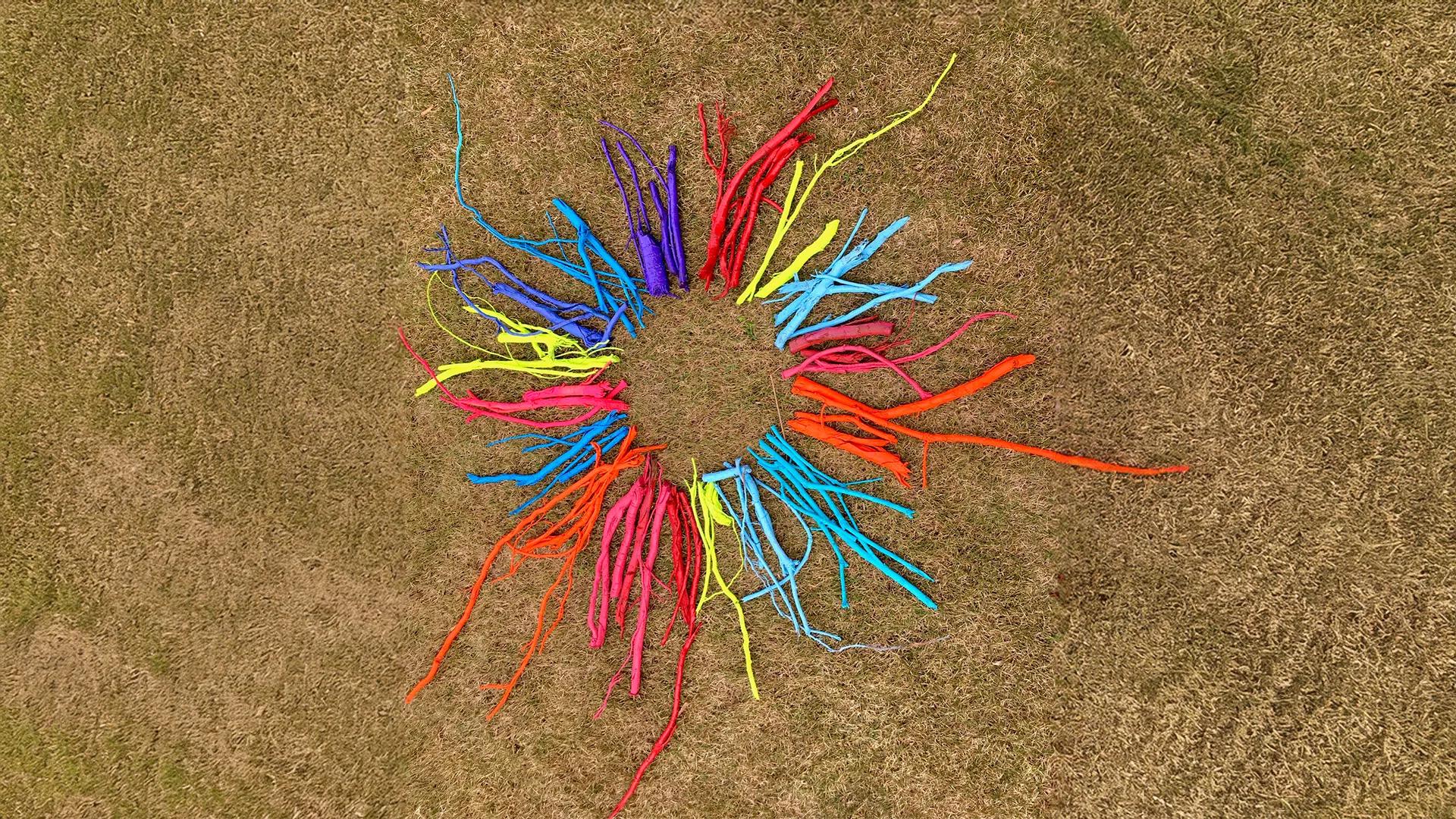
Christine Schroder, ‘Roots over Routes’
‘to letting the soil breathe?’
How do we pivot from policing the culture
to letting the soil breathe?
How do we move past the shallow "outreach"
of inviting people only when it’s time to leave?
True stewardship is a quiet, decentralized art—
not a conductor waving a baton in the light,
but a facilitator stepping back into the dark,
letting the collective rhythm take flight.
To do this, we must practice three small, heavy things.

Thomas James, ‘Exiting the Forest, Into a Sea of Open Arms’ exhibition
‘co-curating the rooms we build,’
First, shared authority.
We must yield the keys to the archive,
co-curating the rooms we build,
allowing the neighborhood to keep its memories alive.
‘The project mentioned above is an exhibition I curated in London. The show was the first production from the newly formed collective a ‘vibrant form’ which consisted of 21 artists, cultural workers and creative practitioners. This show's curation was more than just a concept I conjured up through research and interest, it required me to work slowly and organically alongside the group to create a presentation everyone would be pleased with as well as take ownership of. As the curator, it was my job to craft the concept, so I met with all 17 artists multiple times as well as created materials such as an intake form and a document describing the methodology and framework I would utilize to work with the artists. This was useful because the artists got to know my process and they could hold me accountable — as well, I was to hold them accountable to a manifesto created and agreed upon by the entire group. This project took every once of patience and organizational skill I had because I was in Baltimore for the majority of the organizing of the show and since I was crafting the concept after engaging with everyone deeply, it required a trust from both sides that is not usual when curating an exhibition. Moreover, the gallery we were working with offered us almost no support, so we really had to rely on one another to ensure that tasks were completed. This included marketing and comms, raising funds, finding sponsors, transporting artworks, installing the exhibition and invigilating. I was a clear leader in this effort as the curator, but also as one of the more experienced event and exhibition organizers. Transparency, efficiencies and flexibility were all key to the projects success.’—Thomas James

Meghan DeRoma, ‘Hoist Spell’
‘We must not run from the heat of the spark’
Second, experimental friction.
We must not run from the heat of the spark,
nor fear the challenging dialogue on the floor;
friction is the only way a cold room gets warm,
the only way we open the heavy door.
And third, institutional humility.
A grace that is rarely taught in the schools—
the willingness of an organization to sit in silence,
to listen, to unlearn its own rules.
Dina Cline, Katherine Clarke Langlands, and Joy Ray, ‘Someone Has to Go First: A Field Guide to Covert Leadership’
‘This is a polyphonic call.’
This is a polyphonic call.
A space where the mic is passed, not owned,
where power is a current, not a stone.
We build not to govern the imagination,
but to set it free,
together,
in the undercommons of what we are yet to be.
About The New Art School Modality
Founded by Romi Crawford, The New Art School Modality explores and brings to life new forms of teaching, learning, art production and impact. The school is grounded in an ethos of collaboration, experimentation and improvisation. It offers a revised version of the art school model, methods and procedures, one that has fewer institutional protocols. There is intentionally less handholding and the apparatus is reduced. All of this as a nod to prior historical moments when making art and being an artist were less reliant on costly infrastructures. The New Art School Modality courses are hybrid, online and in-person. Unlike other art schools, it is not place based or centric. The New Art School Modality is supported by the Terra Foundation for American Art.


