
Profiles
A Personal Alphabet
From The Forgotten Her Story, Anna Maria Maiolino and Tania Rivera trace the lines, materials and memories that have formed the artist’s language
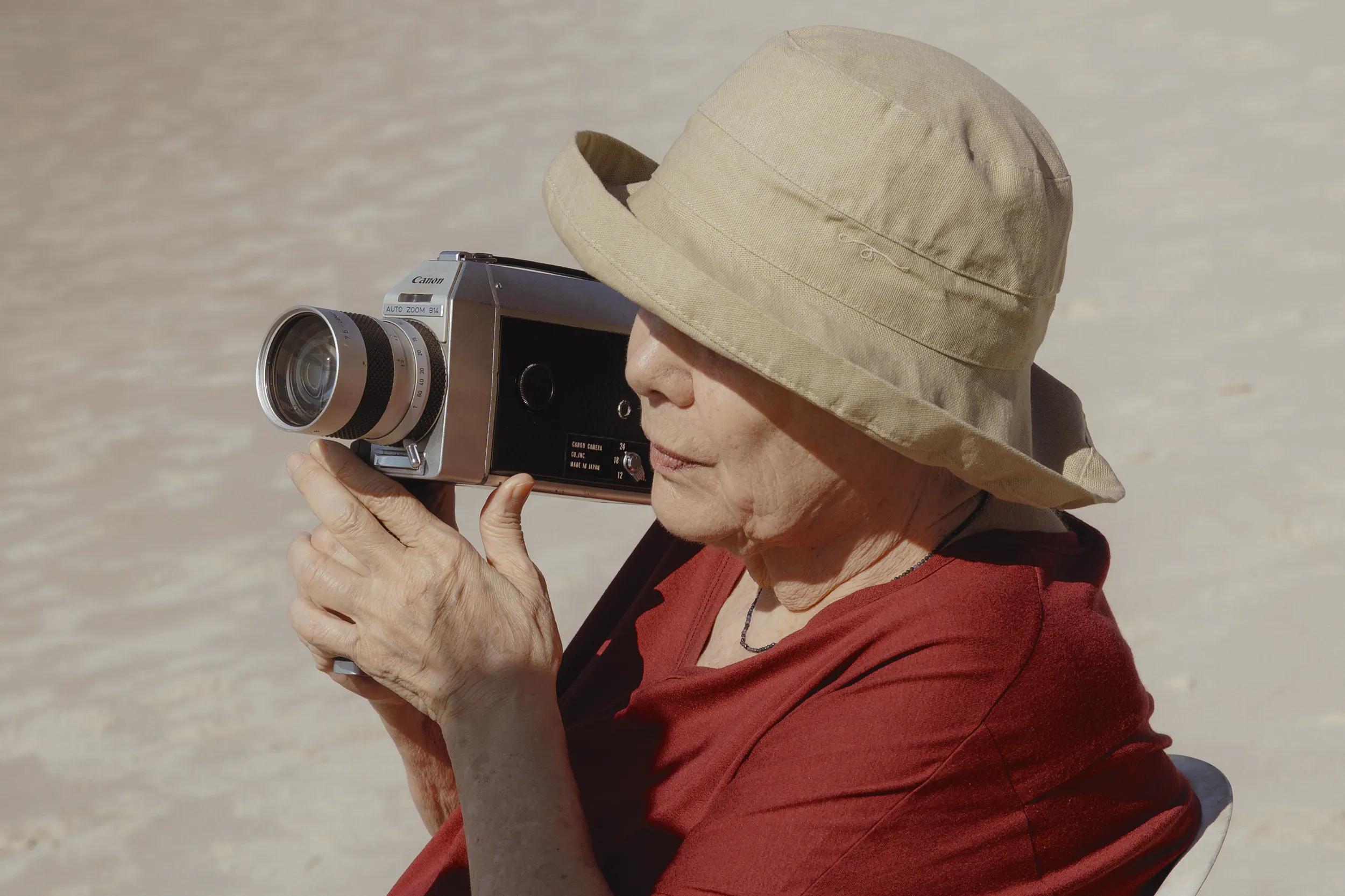
Anna Maria Maiolino on the beach in Rio de Janeiro, 2025. Courtesy The Forgotten Her Story. Photo: Giovanna Aguiar
Born in Italy in 1942 and based in Brazil since 1960, Anna Maria Maiolino has embraced an artistic language shaped by migrations across geographic, political and linguistic borders. Working across drawing, printmaking, poetry, film, performance, installation and sculpture, she has continually returned to an enduring set of concerns: the body, language, memory, displacement and the ties that bind one person to another. Throughout her work, lines become maps, gestures become writing and ordinary materials become carriers of personal and collective histories. Whether through the repeated handling of clay, the excavation of paper or poetic reflections on migration and belonging, Maiolino has created a body of work grounded in transformation.
Here, Ursula presents an excerpt from ANNA—And the Infinite Line, a forthcoming documentary from The Forgotten Her Story, an ongoing research initiative dedicated to recovering and amplifying the histories of women whose cultural impact has been overlooked or obscured. In this exclusive excerpt, Maiolino is joined by writer and curator Tania Rivera for a conversation that moves between philosophy and family history, artistic process and daily ritual, and traces the threads that run through Maiolino’s life and work, revealing an artist for whom making is inseparable from thinking.
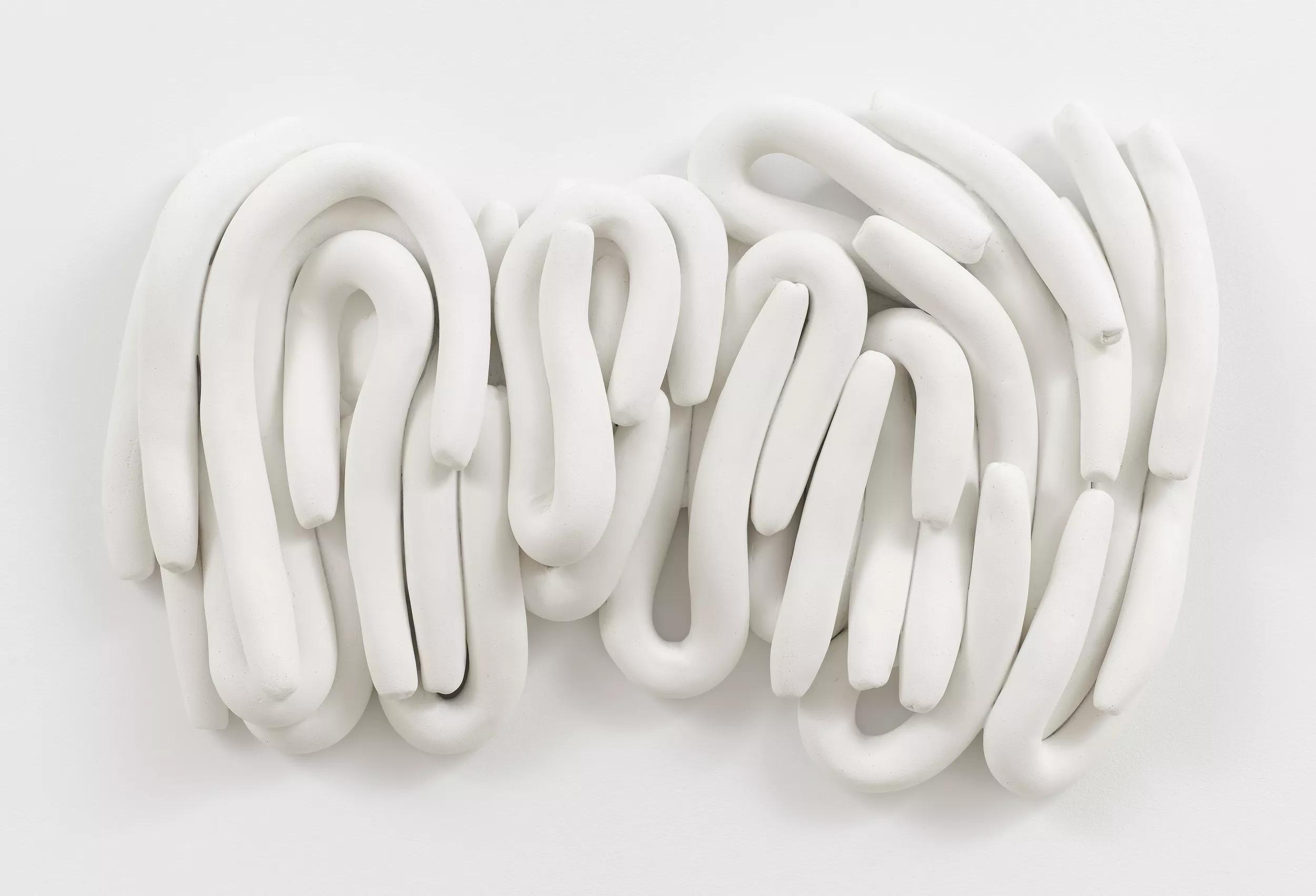
Anna Maria Maiolino, Untitled, 2018. Marble powder and white cement. Unique, 17 3/8 × 27 1/2 × 3 7/8 in. Photo: Sarah Muehlbauer
TANIA RIVERA: Years ago, you told me a story—a poetic reverie: a line emerging from your navel, projecting itself toward the horizon. From that image I imagined it: from every navel, a cord extending outward, reaching for that same line. At some point, they intersect. And together, they form a mesh.
ANNA MARIA MAIOLINO: How beautiful. Imagination is something incredible. What would become of us without the stories we tell? Images speak beyond words, because that image of the thread emerging from the navel and reaching to the horizon is a spoken image. But have you thought of the real image? The thread that goes directly, the umbilical cord, the one that joins you to your mother at the moment of your birth.
TR: And which is transformed into that thread of Por um fio, that comes out of your mother’s mouth, passes through yours and continues to the mouth of your daughter, Verônica.
AMM: You are a thinker, someone who perceives the world I inhabit—the metaphors, the symbolic—which always have their origin in something real, but which transform.
TR: You are always telling stories, aren’t you, Anna? And these stories keep changing along your own trajectory. You return to works that were left unfinished and keep transforming them, while your own life transforms too. There is this temporal movement, and also a spatial movement.
Thinking about the line, which is so important in your work, it seems that through it you are remaking, at every moment, your place in the world. A kind of soft geography. And these loose threads are among us. The thread, the line, often connects two bodies in your work—a man’s body and a woman’s body, eventually. And there are gestures that these lines call forth: gestures that move through the world through your work.
AMM: The eye is a dictator.
Trailer for ANNA—And the Infinite Line (2026) from The Forgotten Her Story
“Imagination is something incredible. What would become of us without the stories we tell?”—Anna Maria Maiolino
TR: Your line is rarely straight. Even when it seems straight, in works like Mapas Mentais, your Mental Maps, it takes some curves. You also tear the paper to make holes and you excavate the place of the other. Various poetic concepts that are titles of your works, like A Sombra do Outro or Entre o Dentro e o Fora, bring a sense that something is being excavated: a sculptural work that creates holes, that creates internal spaces, internal spacings. And I think there is a whole way of thinking about the relationship with the other here—a way of thinking about the self, the other and the world.
AMM: The other exists in my work. When it is not a collectivity, it is a repetition of the same that forms groups, but we are all different; we are human. Nature repeats itself, but always in different ways.
Then comes the story of [Gilles] Deleuze, his thinking on repetition and difference. For me, it was as though my father himself were speaking. It was something as simple and domestic as making two plates of spaghetti and the sauce. I was so surprised, because Deleuze brought the everyday into his philosophy, the daily lives of the peasants of the Mediterranean Basin. I saw all of them.
Working with art also creates thought. Even if you don’t mean to, if you are attentive, you are thinking. And thought gives form.
In Italy, you cannot make a certain sauce with a certain type of pasta. Each sauce has its own pasta, its own form, because the flavor expresses itself better that way. So this is content and form. I come from a culture that carries, in everyday life, this question of form and content.
TR: I think, in fact, when you say that, the idea of form and content begins to change. The dichotomy transforms as you create an encounter between form and content, perhaps even a dialectic. The form, or perhaps the mind itself, suspends the line between what’s mental and what would be material. I think your work suspends this dichotomy. It lives in that in-between place.
AMM: On the seesaw, alternating between form and content. There is a difference, I think, between feminine and masculine production. Even when the masculine is a great thinker and makes incredible works, there is always a question of the power that the man possesses.
TR: Yes, I think that the care you bring is fundamental to your work. It connects with the feminine world, but not only that; it also carries a kind of subversion, even a violence, toward the hegemonic grammar of narrative. Anna, you’ve set out to construct your own personal alphabet.
AMM: Which is very pretentious, isn’t it?
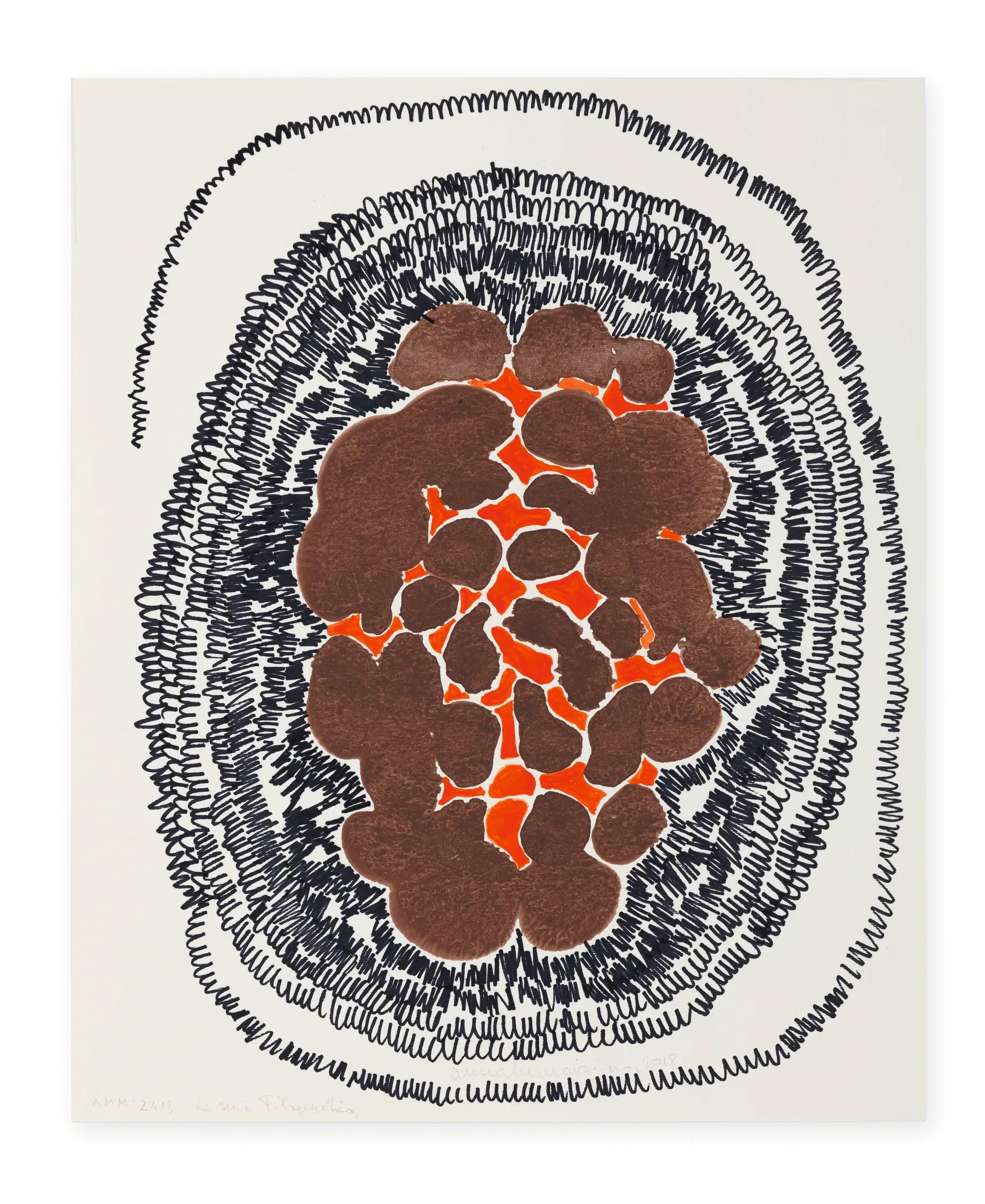
Anna Maria Maiolino, Untitled, 2018. Acrylic ink on paper, 16 × 13 1/4 in. Photo: Roger Edwards
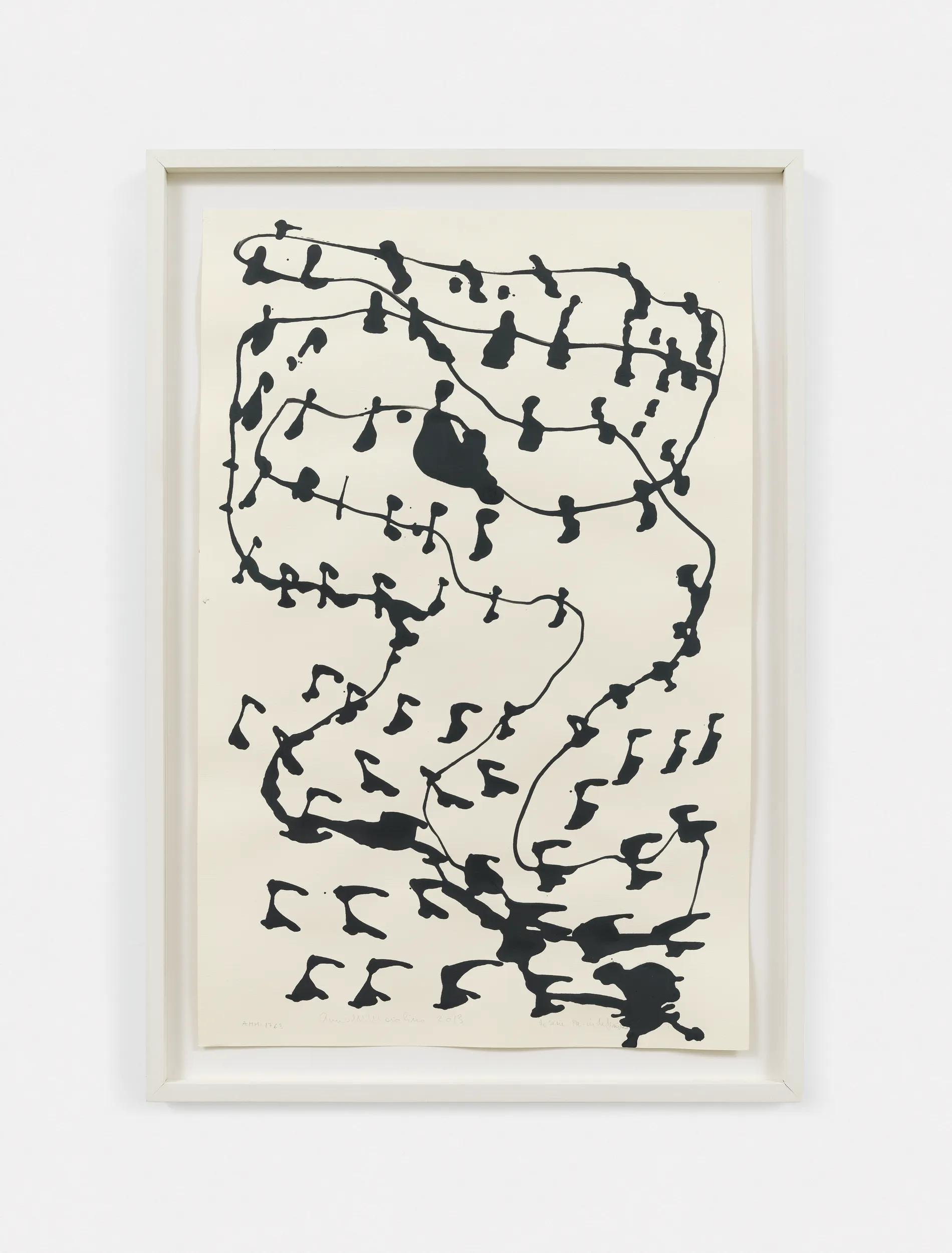
Anna Maria Maiolino, Untitled, 2013. Acrylic ink on paper, 28 3/8 × 18 1/2 in. Photo: Sarah Muehlbauer
“You subvert the meaning of ‘without importance’ and transform the word ‘obvious’ into precisely a force of political resistance.”—Tania Rivera
TR: But of great simplicity at the same time, because your alphabet is not made only of letters, is it? It is made of lines, without a doubt, but also of matter, of body, in an infinite combination. Your alphabet is not only words, but it is also something that is written with the gesture itself.
AMM: It is funny, because it also connects to culture.
TR: So, when you create an alphabet, you are not completely without resources. Your grammar of images refers, very frequently, to the everyday world, to the domestic. In an interview for the journal Arte & Ensaios of the School of Fine Arts at the Federal University of Rio de Janeiro, you recalled a critic who had said that you dealt with very obvious things—the everyday, a very obvious feminine world. And you responded: “‘Obvious,’ in the dictionary, also means ‘to resist.’ It means resistance.” You subvert the meaning of “without importance” and transform the word “obvious” into precisely a force of political resistance.
AMM: There is a whole history behind each word.
TR: Your alphabet not only mixes line, letter, matter and body; it also mixes various languages. I think there is a mixture that truly makes you what you are: a person who, after all, is an immigrant who built an entire trajectory on this mental map of the world. And the displacement keeps transforming the alphabet itself. I think this becomes very palpable in your poetic writing. Your writing is one of the ways this alphabet presents itself in the world. You recount how it began in New York, with drawings between pauses, but also with a certain poetic writing that you continue to this day.
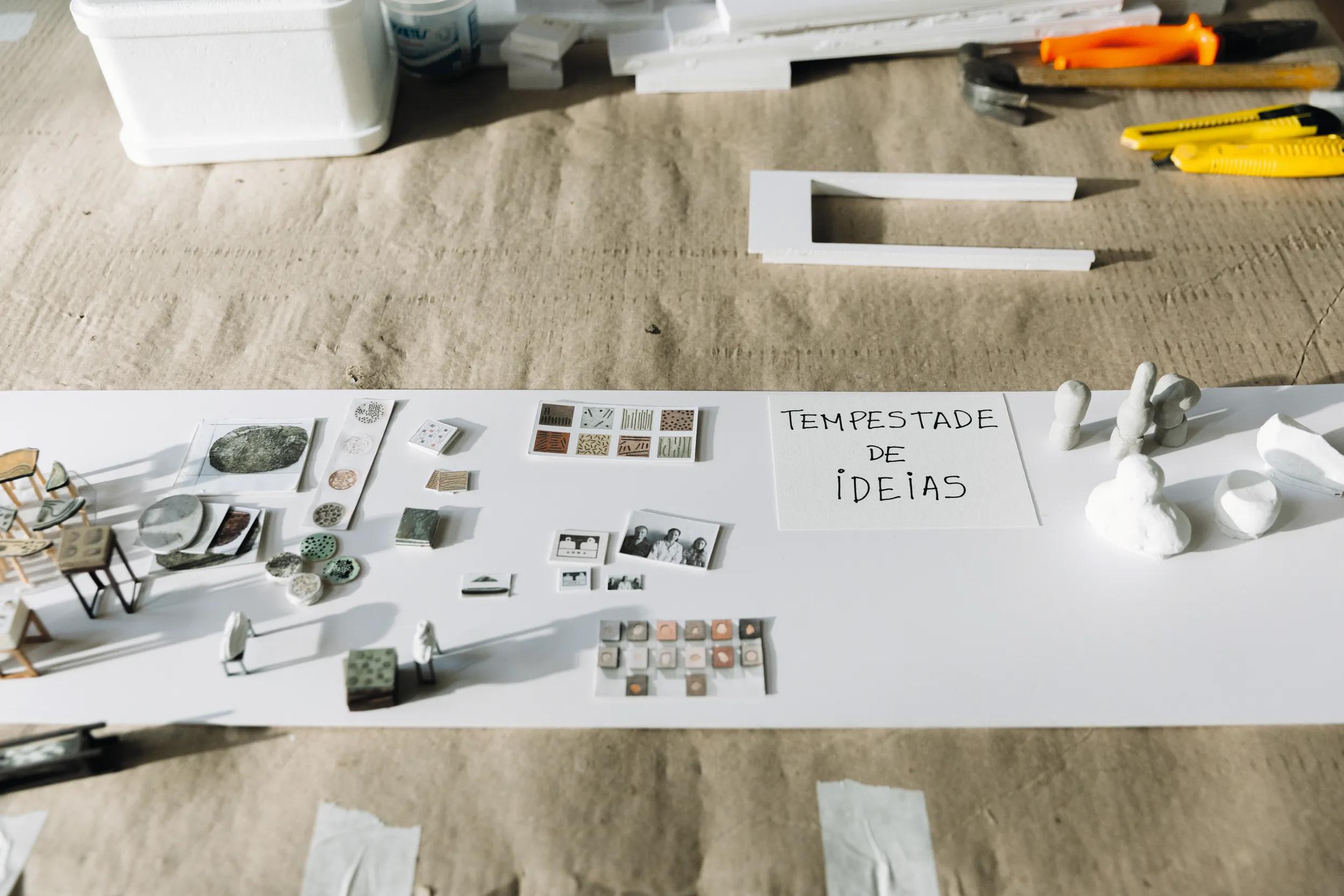
Maiolino’s studio in Rio de Janeiro, 2025. Courtesy The Forgotten Her Story. Photo: Bruna Bento
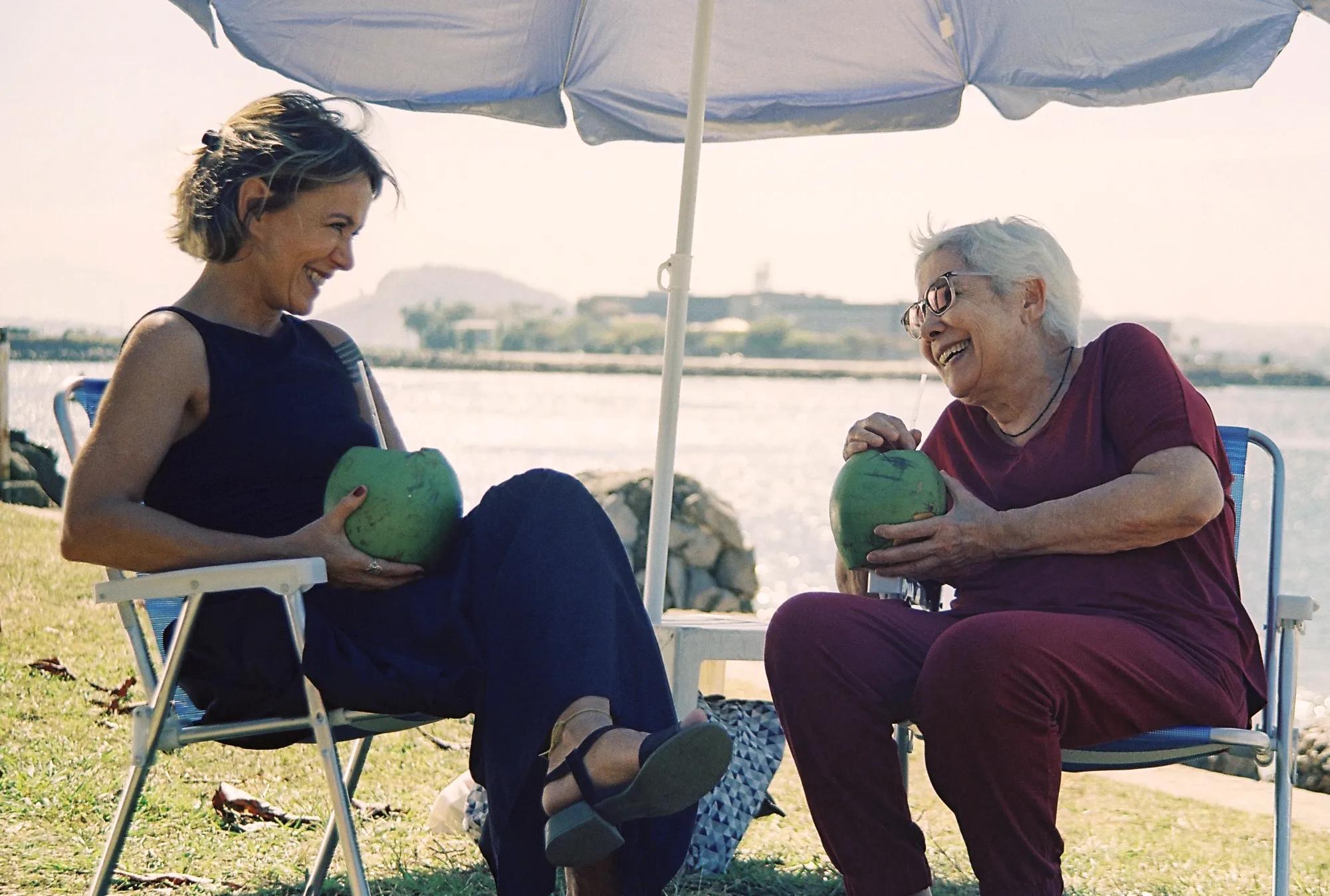
Maiolino and Rivera in Rio de Janeiro, 2025. Courtesy The Forgotten Her Story. Photo: Giovanna Aguiar
AMM: It began as a written record of thought, so much so that it later became poetry, and then the Super 8 film. I always say it’s a mental storyboard. Afterward, you can do everything the other way around. I change quickly; I do it another way. But it has been incredible—it gives me a great deal of room. The drawings, the Mental Maps, came from there. From those notes. The Mental Maps are visual poems. And when I think of visual poetry, I always ask: “Where did it come from? ” Without even noticing, I drank from the breast of our concrete poets. You take in nourishment you don’t even perceive. I find that so wonderful in art: Nobody falls from a parachute. Someone always gave you the first push.
TR: Georges Bataille says, “What I thought, I did not think alone.”
AMM: Sometimes, very unconsciously, you have that awareness of “I am going to do this.” If you follow your feelings, your passion, you don’t even notice.
TR: So, poetry is in all of your work, in each element of it, not only in your poems. One thing transforms into another. I really like what you say about the storyboard, which seems to be the origin of many of your works. Everything is built within a narrative composed of scene, matter and gesture. It is very difficult, in your work, to classify things in the traditional way.
AMM: It is a feminine mess.
TR: It is a subversive mess, a mess-subversion of already established lines, of the grid of traditional thought. It had to be your alphabet, your own line.
AMM: For me, when I did things “properly,” it was a subversion of my own soul, because I was always a rebel.
–
The documentary feature film ANNA—And the Infinite Line will premiere at Artecinema, the international festival of films on contemporary art, in Naples in October. The full film will be available to watch on The Forgotten Her Story website in the near future.
“Anna Maria Maiolino: ANNA—And the Infinite Line” opens at Hauser & Wirth New York 18th Street on September 10 and remains on view through October 31.
–
Anna Maria Maiolino is one of the most important artists working in Brazil today. Her deeply formative migration from postwar southern Italy to a politically unstable South America, as well as her linguistic passage from Italian to Portuguese, engendered an enduring fascination with identity.
Tania Rivera is a psychoanalyst, essayist and curator who works in a multidisciplinary field, moving between psychoanalysis, philosophy and arts. She is the author of many books, including Arte e Psicanálise (2002) and Lugares do Delírio (2023). She was the editor of Hélio Oiticica: cartas 1962–1970 (UFRJ, 2023).