
Exhibition Learning Notes: ‘Martin Creed’
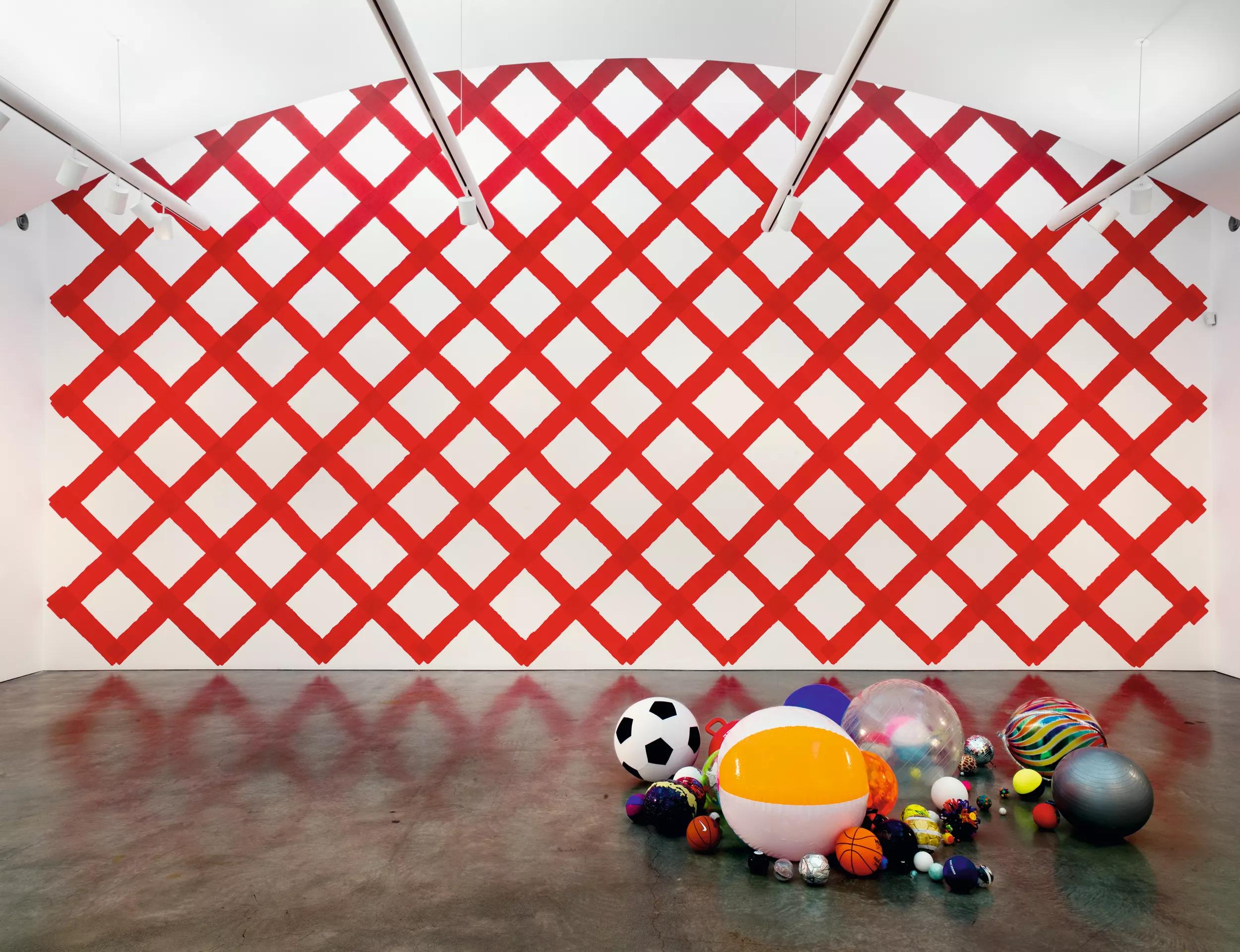
Installation view, CCS Bard Hessel Museum, Annandale-on-Hudson/NY, 2007 © Martin Creed. All Rights Reserved, DACS 2026. Photo: EPW Studio –Ellen Page Wilson
Exhibition Learning Notes: ‘Martin Creed’
This resource has been produced to accompany the exhibition ‘Martin Creed’ at Hauser & Wirth Menorca from 25 April – 7 June 2026.
Click here to download a PDF of this resource.
About Martin Creed
Martin Creed (Wakefield, United Kingdom, 1968) is a visual artist, performer, composer, and ‘punk poet’ who has been awarded the Turner Prize. His work often starts from everyday actions and materials to explore ideas such as rhythm, repetition, and the way we perceive what surrounds us, inviting viewers to observe situations or objects more closely, in particular those that usually go unnoticed.
His conceptual works may use very simple elements to pose questions about what a work of art can be and how we relate to space and objects. In addition to his visual practice, Creed is also a musician, and in 1994 he founded the band ‘Owada’ (currently ‘Martin Creed and his band’).
What does the exhibition look like?
The exhibition presents Martin Creed’s ‘Work No. 3891: Half the Air in a Given Space’, an installation that consists of filling a room with balloons until they occupy half of the available air. In this gesture, Creed renders visible an otherwise imperceptible substance, using simple, everyday materials. The balloons act as a provisional container that gives form to space, transforming it entirely and elevating the ordinary into something unexpected, while engaging perception and the relationship between artwork and environment, as visitors subtly reshape its volume through their movement.
Upon entering the installation, visitors move among the balloons, quickly losing a fixed sense of space. The work remains in continuous flux, shifting in response to the movement of bodies within it, so that each encounter is singular. At the same time, the balloons evoke associations of childhood, play and celebration, lending the work an immediacy that is both accessible and quietly disarming. As Creed has stated, his intention is ‘to make the air visible’ while leaving space for people, creating a participatory experience that invites reflection on how we perceive and inhabit the spaces around us.
The exhibition includes a gallery featuring paintings executed directly onto the walls, fully integrated within the architecture of the space. These interventions follow a minimal approach, grounded in simple systems that organise form and colour according to predetermined criteria. In this way, the work does not appear as an independent element, but as an active component of its surroundings, subtly reshaping the perception of space.
Their formal restraint directs attention towards the sensory experience of colour and its relationship to the environment, while repetition establishes a visual rhythm akin to musical structure. Colour assumes a central role, and order and pattern—recurring concerns in Creed’s practice—serve to structure the viewer’s gaze. Through these essential means, the artist creates an experience that invites a reconsideration of how space is perceived, inhabited and understood.
What are the major themes of his works?
Everydayness
Everydayness is a central element in Martin Creed’s work, as many of his proposals emerge from a direct observation of daily life and its most ordinary objects. Through the use of simple, recognisable materials, his practice remains closely aligned with lived experience, avoiding any sense of distance from the familiar. Within this framework, his work invites a reconsideration of what is often taken for granted, presenting it anew through subtle shifts in arrangement and context.
These slight displacements—at once familiar and unexpected—gently transform perception, opening up alternative ways of seeing the most commonplace aspects of everyday life.
Order and chaos
Order and chaos create two central axes within Martin Creed’s practice, which, as a form of conceptual art, seeks to trace patterns within the apparent disorder of everyday life. His interest in rhythm—both in its physical dimension, through music and sound, and on a more conceptual level, linked to balance and harmony—acts as a guiding principle through which he observes, selects and organises ordinary elements.
From this, Creed develops simple systems that lend a provisional structure to chaos, bringing into focus repetitions and relationships that might otherwise remain unnoticed.
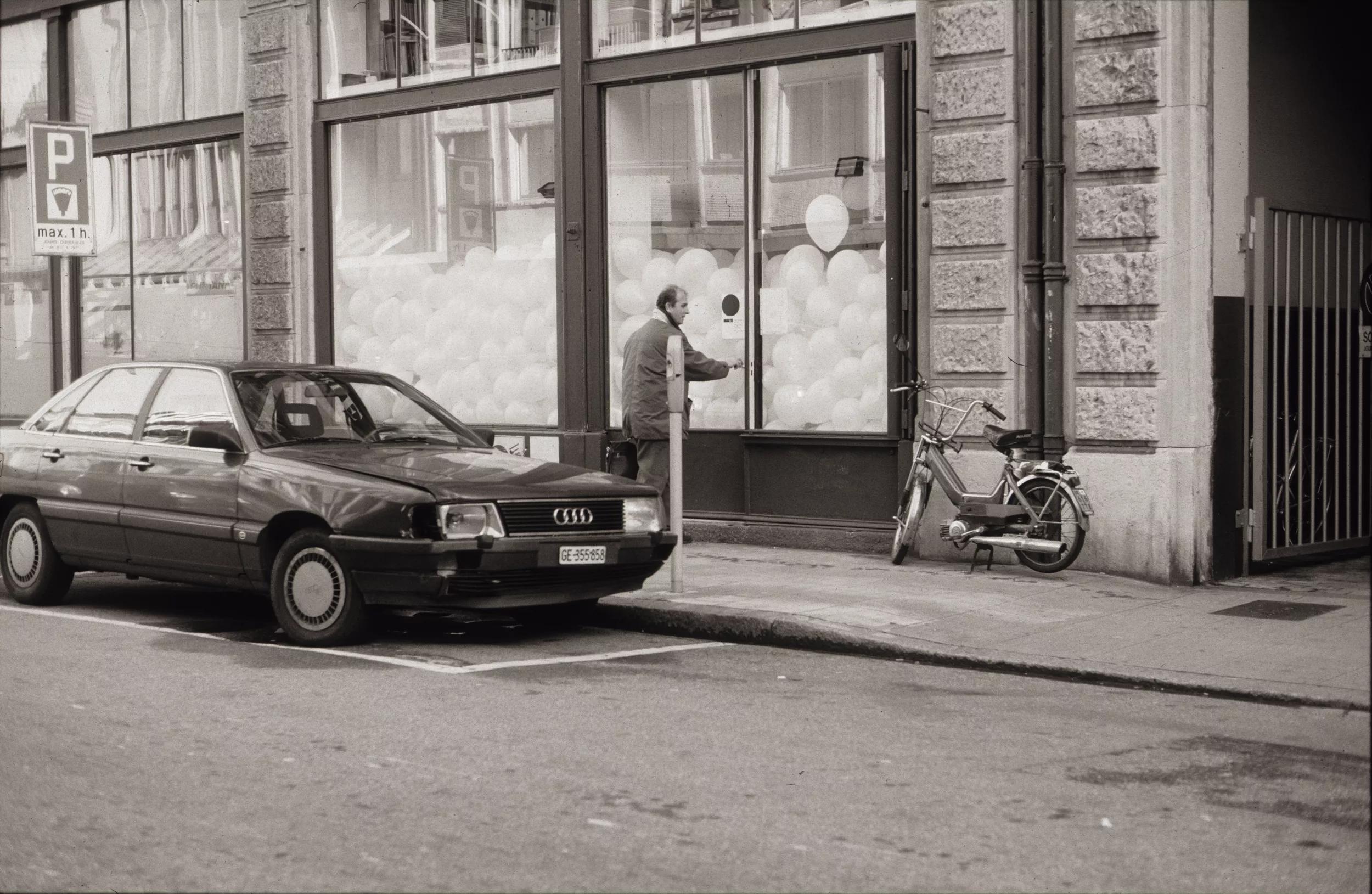
Installation view, Galerie Anelix B & L Polla, Geneva, 1998 © Martin Creed, VEGAP, Illes Balears, 2026
Repetition
Repetition is a central element in Martin Creed’s practice, which he often frames in terms closer to composition than to visual art, reflecting the recurring presence of rhythms, sequences and patterns drawn from a musical language. This use of repetition not only structures his works formally, but also introduces a more personal register. As Creed has remarked, ‘I think I like repeating things. It’s familiar and comforting. The world is a difficult place to live in, so something that is reliably happening again and again is a comfort.’
Play and Humour
Play and humour are key elements in Martin Creed’s practice, often emerging through a disarming lightness that can feel quietly unexpected. Working with everyday objects placed within an artistic context, many of his pieces adopt an intentionally absurd, playful or subtly ridiculous tone. In doing so, his approach unsettles the seriousness that often surrounds art, opening up a more direct and accessible relationship with the viewer. Humour becomes a way of experiencing the work differently, while also gently challenging assumptions about what art can be and how it might be understood.
Participation and Experience
Participation and the body play an essential role in Martin Creed’s practice, reshaping the ways in which viewers relate to artistic space. His installations invite entry and movement, allowing the presence of visitors to alter the form and volume of the work itself. In this way, the viewer is no longer a detached observer, but becomes an active participant within the work. Immersed in a physical and sensory experience, each encounter unfolds in real time, shaped by movement, proximity and the shared presence of others.
Glossary
Conceptual Art
Art that focuses on the idea or message more than on the materials or appearance.
Immersive
A type of art experience where viewers feel physically and emotionally involved, often surrounded or enveloped by the work.
Installation
A type of art that transforms a space and often surrounds or immerses the viewer, rather than being just an object on display.
Patterns
Repeated structures or sequences that organise the elements of a work.
Performance
A live artistic action in which the artist intervenes in the space with the public as a spectator. The work becomes the artist's action in situ.
Rhythm
A visual or sonic organisation based on repetition and sequence, akin to musical composition.
Sensory Experience
A mode of experience shaped through the direct engagement of the senses—such as sight, touch and movement—emerging through the viewer’s interaction with the work.
Questions for Discussion
Can something invisible, like air, become the main subject of an artwork, and how successfully does Martin Creed achieve this? Is the piece more about filling space or about limiting it?
How does your body become part of the artwork when you enter the installation? Do you feel like a participant, a performer, or still an observer?
If the artwork ‘Half the Air in a Given Space’ depends on movement and change, can it ever be considered finished? Or is it always in progress?
The wall paintings use repetition and patterns. How do these visual rhythms compare to music? Can you ‘feel’ a rhythm in the space?
Can chaos be designed? How does Creed balance structure and randomness?
Practical Activities
Choose an everyday object and decide what makes it ‘valuable’ using your own criteria (for example, how often you use it, how much time you’ve spent with it, or how important it feels to you). Without changing the object itself, find a way to show this value—through a short text, a label, or a simple action. Present it to others and observe how their perception changes. Reflect on whether the object feels different, or if it is the way you frame it that gives it meaning.
Create a visual or physical composition using repetition by arranging simple elements like coloured paper, tape, or stickers according to a clear rule (such as alternating colours, repeating shapes, or forming stripes). Think of yourself as a composer, building a sense of rhythm through consistent placement and pattern. Focus on how each repeated element contributes to an overall flow across the surface. Once your composition is complete, step back and observe it from a distance, considering how the repetition affects your perception—does it feel calm, structured, chaotic, or musical, and how does your eye move through the pattern?
Design an interactive artwork that invites participation by allowing people to move, touch, or change elements within it, using clear but open-ended instructions rather than controlling the outcome. Focus on creating conditions for interaction so the piece cannot exist without audience involvement. As participants engage with the work, observe how each person transforms it differently and how unpredictability shapes the experience, noticing how the artwork shifts over time through their actions.
Create an installation that makes something invisible perceptible (like air, silence, or time). Use simple materials—paper, light, or sound—to represent it. Once finished, invite others to interact with your piece and observe how their presence changes it. Reflect on whether the ‘invisible’ element becomes more noticeable through your work.
Supplementary Research


