

Conversations
The Structure of Painting
Rediscovering a lost conversation between Jack Whitten and Henry Geldzahler.
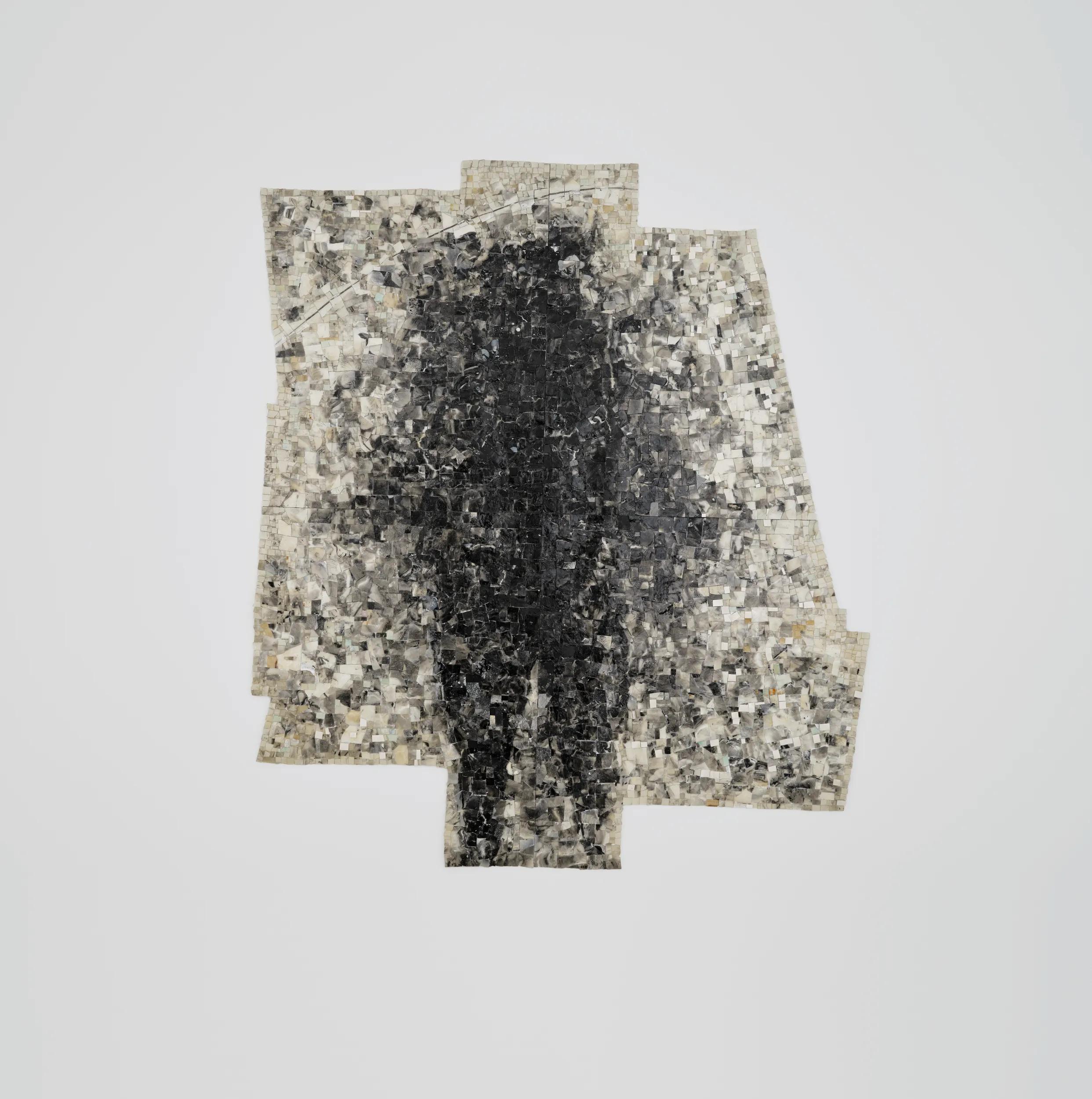
Jack Whitten, Natural Selection, 1995. Acrylic and ink on unstretched canvas, 95 3/4 × 84 1/8 in. ©️ 2026 Jack Whitten Estate / Artists Rights Society (ARS), New York Photo: Kitmin Lee
Few curators shaped the course of postwar American art as profoundly as the Belgian-born Henry Geldzahler (1935–1994). As a longtime curator at the Metropolitan Museum of Art, he combined institutional influence and a genuine camaraderie with artists to help define a generation. Among the artists he most steadfastly championed was Jack Whitten (1939–2018), whose painting Delta Group II (1975) he acquired for the museum’s collection in 1975. Eight years later, Geldzahler organized “Jack Whitten: Ten Years, 1970–1980” at the Studio Museum in Harlem, Whitten’s first major institutional survey.
On the occasion of “Jack Whitten: The Numinous,” an exhibition opening on September 30 at Hauser & Wirth Downtown Los Angeles, Ursula presents a previously unpublished conversation, recorded in Whitten’s TriBeCa studio on March 31, 1983, in the lead-up to the Studio Museum exhibition. In this excerpt, their exchange moves from African sculpture and the structural logic of the grid to abstraction, Black identity, color, Cézanne, John Coltrane and the stakes of modern American painting. The enduring friendship and shared intellectual commitment between the two men permeates the conversation. Following Geldzahler’s death in 1994, Whitten dedicated his painting Natural Selection (1995) to his memory.
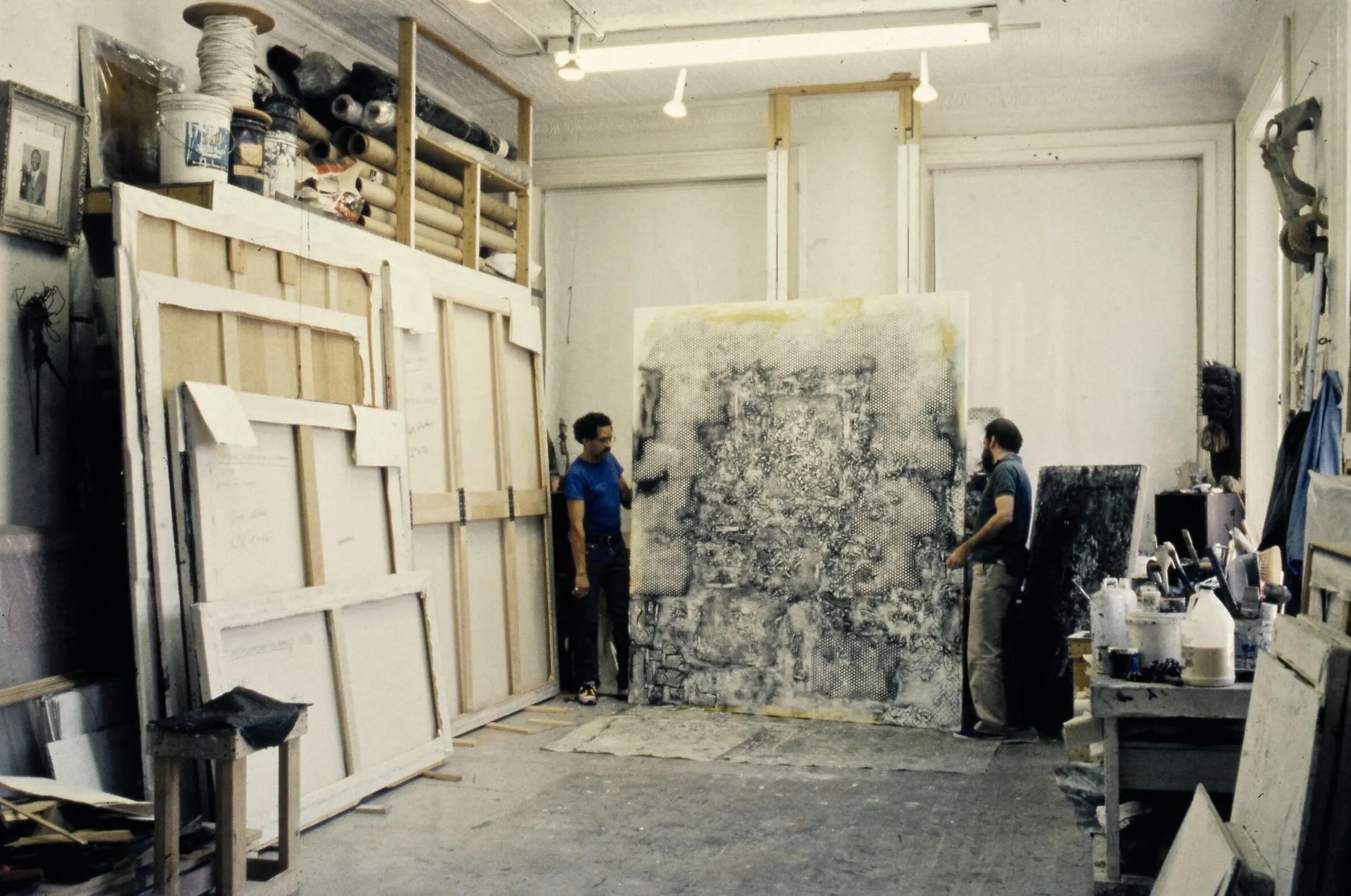
Whitten in his studio at 36 Lispenard Street, TriBeCa, New York, 1989. ©️ 2026 Jack Whitten Estate / Artists Rights Society (ARS), New York
Henry Geldzahler: Are you prepared to talk about Black art, and Black American artists?
Jack Whitten: Well, I think we have to include it. There’s no way I can see out, doing a show like this at the Studio Museum, without considering that. It’s not something we can bypass.
HG: Can I start by saying that your work between 1970 and 1980 can be looked at outside of any context of being work by a Black American; it’s American painting of that decade. And there are sources that you know about that aren’t necessarily available to your average viewer. What would you say they are?
JW: This is something that I’ve thought about but I wasn’t prepared for you to ask today. No, it’s not obvious what I’m saying. But I want to take it all the way back to Africa, African woodcarving. I want to take it back to that. That’s the source of these works. I do these pieces in the summer; you see these woodcarvings over there? That’s my summer involvement.
HG: Can we photograph a few of those for the show?
JW: I don’t know if I want to use them in the show.
HG: No, I mean for the catalogue.
JW: Yeah, they could be. Because these pieces taught me about African art. I use African art as a prototype.
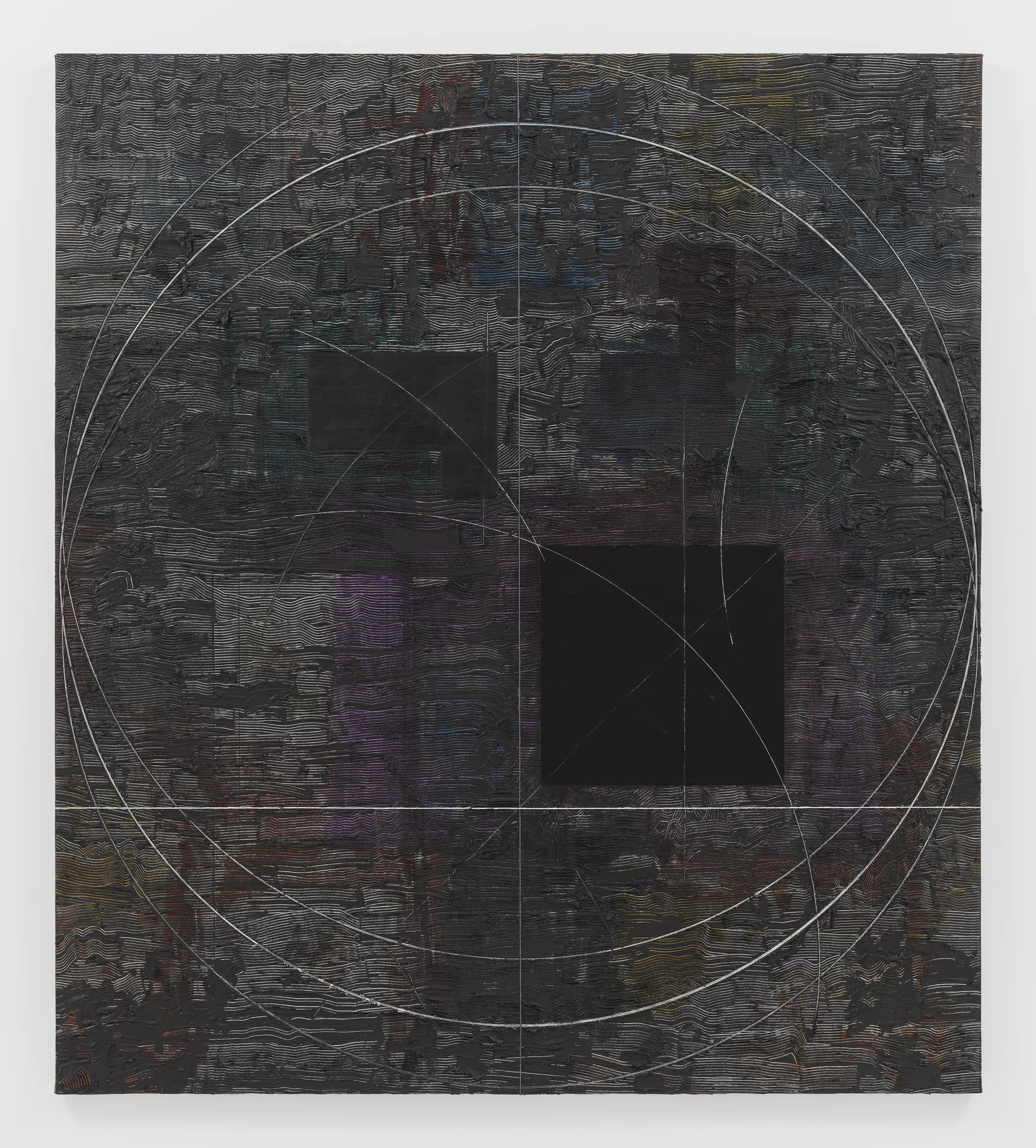
Jack Whitten, Atromitos I (ΑΤΡΟΜΗΤΟΣ I), 1980.Acrylic on canvas, 94 × 84 in. ©️ 2026 Jack Whitten Estate / Artists Rights Society (ARS), New York. Photo: Sarah Muehlbauer
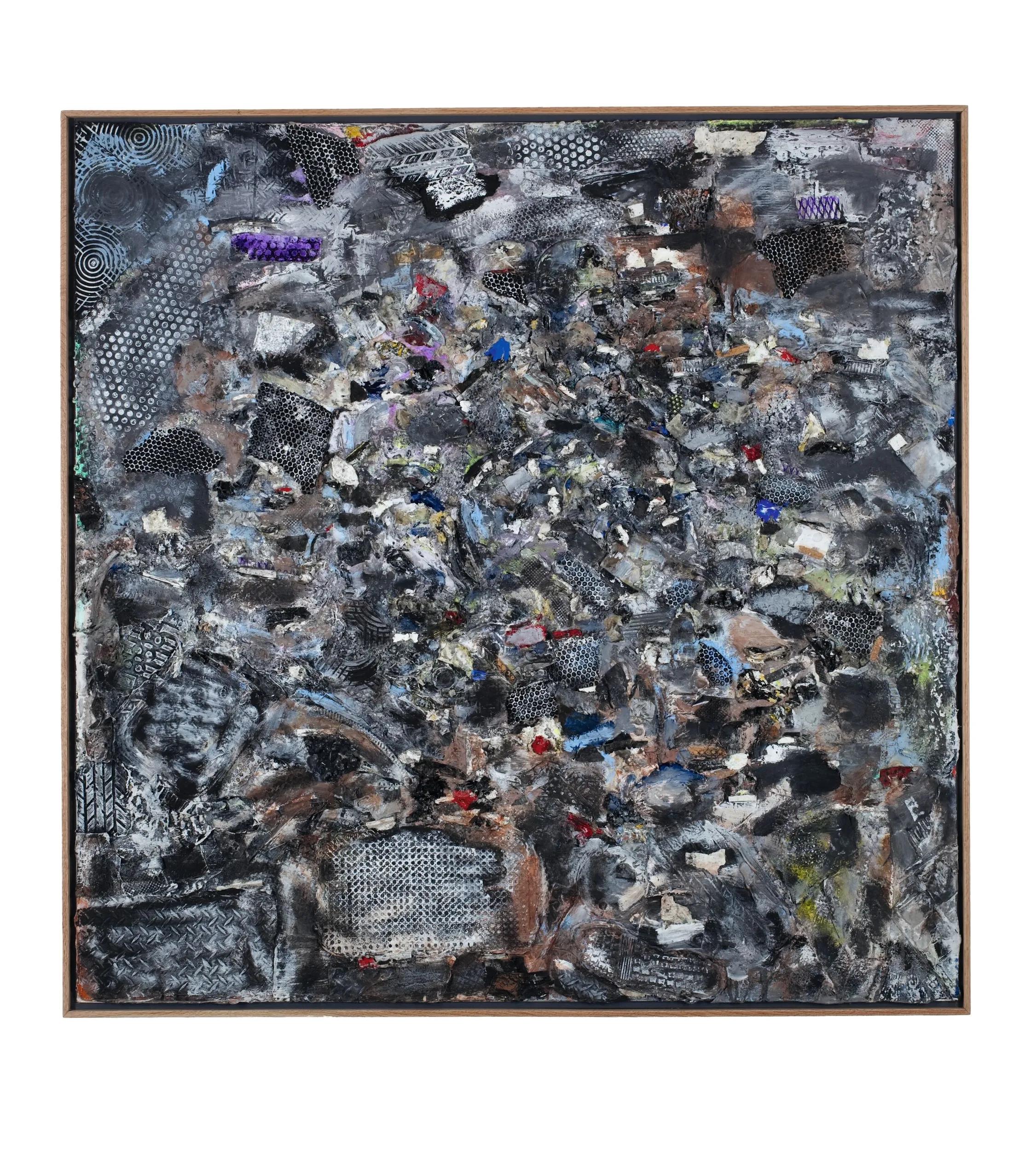
Jack Whitten, Spiral: A Dedication to R. Bearden, 1988. Acrylic with cast acrylic on canvas, 67 1/4 × 67 1/4 in. ©️ 2026 Jack Whitten Estate / Artists Rights Society (ARS), New York. Photo: John Berens
HG: Let me ask you another question: Is the pull toward African art intellectual or is it elemental?
JW: It’s structure. What I mean by structure is, those African carvings, in a plastic concept, it’s based on a grid. Can you see that?
HG: Yeah. No, I’m asking a different question. Are you involved with African sculpture because you think you should be or because you’re pulled by underground forces that you have no control over?
JW: No. I got involved with doing these sculptural pieces because it was the best way for me to learn about African sculpture. I read books on African sculpture that weren’t telling me anything.
HG: I’m still asking another question. Is your interest in African sculpture an unconscious pull toward something that has meaning to you or is it an intellectual idea that “I should come to terms with African sculpture because there is a world of Afro-American”—
JW: It’s nothing like that. I don’t see it as an unconscious element at all. I see it as a God-given, innate sensibility. It’s mine.
HG: So the question then becomes how do you come to terms with the best of African sculpture, and how does that translate into contemporary American painting?
JW: I [think] I’m working with the same thing that exists structurally in African carving. It’s about perception.
HG: And where does color come in?
JW: Now that’s something else. I think color, and my use of color, is something that I’ve picked up along the way over the past twelve years. I’ve been dealing with America, living here in America, living with European culture.
HG: Whenever you begin to think about a new way of painting, you strip the color and go back to the black and white and forget about the color, which is what painters do. The Cubists did it.
Jack Whitten, The Fourth Chakra, 1985, reworked 2008, Acrylic and oil on canvas, 89 1/2 × 89 1/2 in. ©️ 2026 Jack Whitten Estate / Artists Rights Society (ARS), New York. Photo: Sarah Muehlbauer
“I’ve always said that color has a tendency of getting in my way. I’ve tried to skirt around the seductive nature of color.”
— Jack Whitten
JW: Yeah. It’s done out of necessity.
HG: It’s like drawing fi rst and then the color is not added but [is] thought through after the basic structure is arrived at.
JW: I’ve always said that color has a tendency of getting in my way. I’ve tried to skirt around the seductive nature of color.
HG: Except for that orange painting [Golden Spaces (1971)], I can hardly think of a painting of yours where there’s any color. I mean there’s color in the painting, but it isn’t dominant.
JW: Right, color becomes more of a dominant thing there. That’s probably due to the infl uence of the Color Field school at that time. Even though I still call them “energy fi elds,” I would acknowledge that debt to Color Field and Expressionist painting.
HG: Who specifically?
JW: Nobody specifically as much as how the ideas connected with what I was doing. See, I was connected with it through what I used to call in the ’60s “Light Sheets.” I had a conversation once with John Coltrane, must have been, let’s see, my brother Tommy was alive. It had to be around 1965–66, somewhere in there, [at] Club Coronet in Brooklyn. He was playing with Eric Dolphy and for about two weeks straight I was going out there every night to hear him. That’s when I fi rst heard of this business about Coltrane equating his sound to sheets. Like things coming in waves, a sound that comes in a wave, you know, which accounts for that sound you hear in his music—as we say , “Trane-ing in.” It’s about that sound coming in waves.
HG: Does it also recede or just come in?
JW: It passes. But he catches it when it comes by and he’ll grab as much of it as he can . And I think plastically here, as far as sound is concerned, when you hear that out of Coltrane, I was sensing that in light. Like in physics, like a sheet of light passing. That’s how I was seeing light.
HG: In physics, in the 20th century, there’s been a big argument about whether light is particles, waves and rays or quanta—little tiny moments that add up to a wave but can only be perceived as waves. So the notes become waves.
JW: Right. So I’m picking up on light in that sense. That’s why I refer to those paintings as “energy fi elds.” Because I often thought of them as two poles that create a magnetic fi eld and light is trapped in that fi eld—that’s the energy. I think we should go over [African sculpture] a little bit more because I don’t think I made myself clear about the connection that I associate with that.
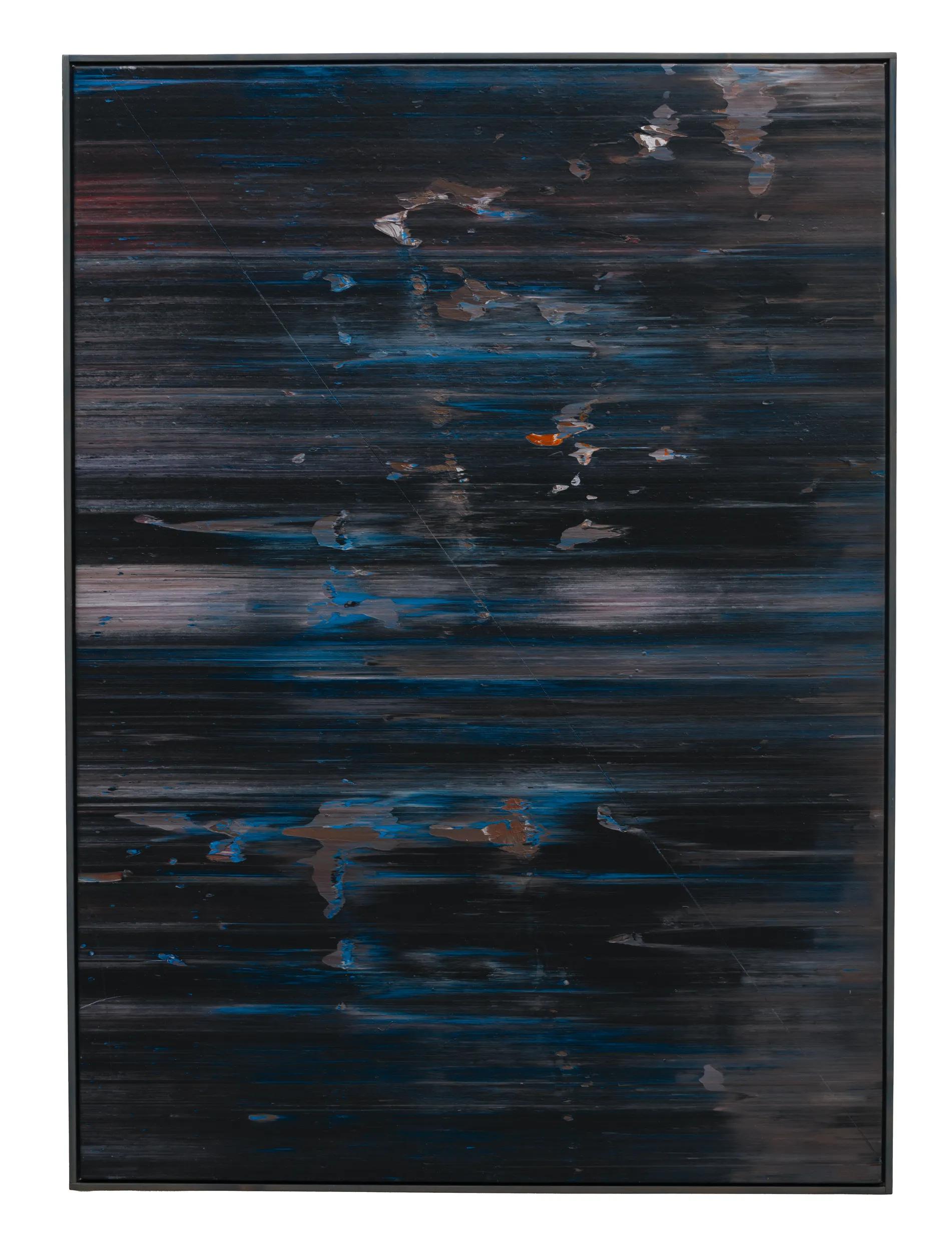
Jack Whitten, April's Shark, 1974. Acrylic on canvas, 72× 52 in. ©️ 2026 Jack Whitten Estate / Artists Rights Society (ARS), New York. Photo: Jeff McLane
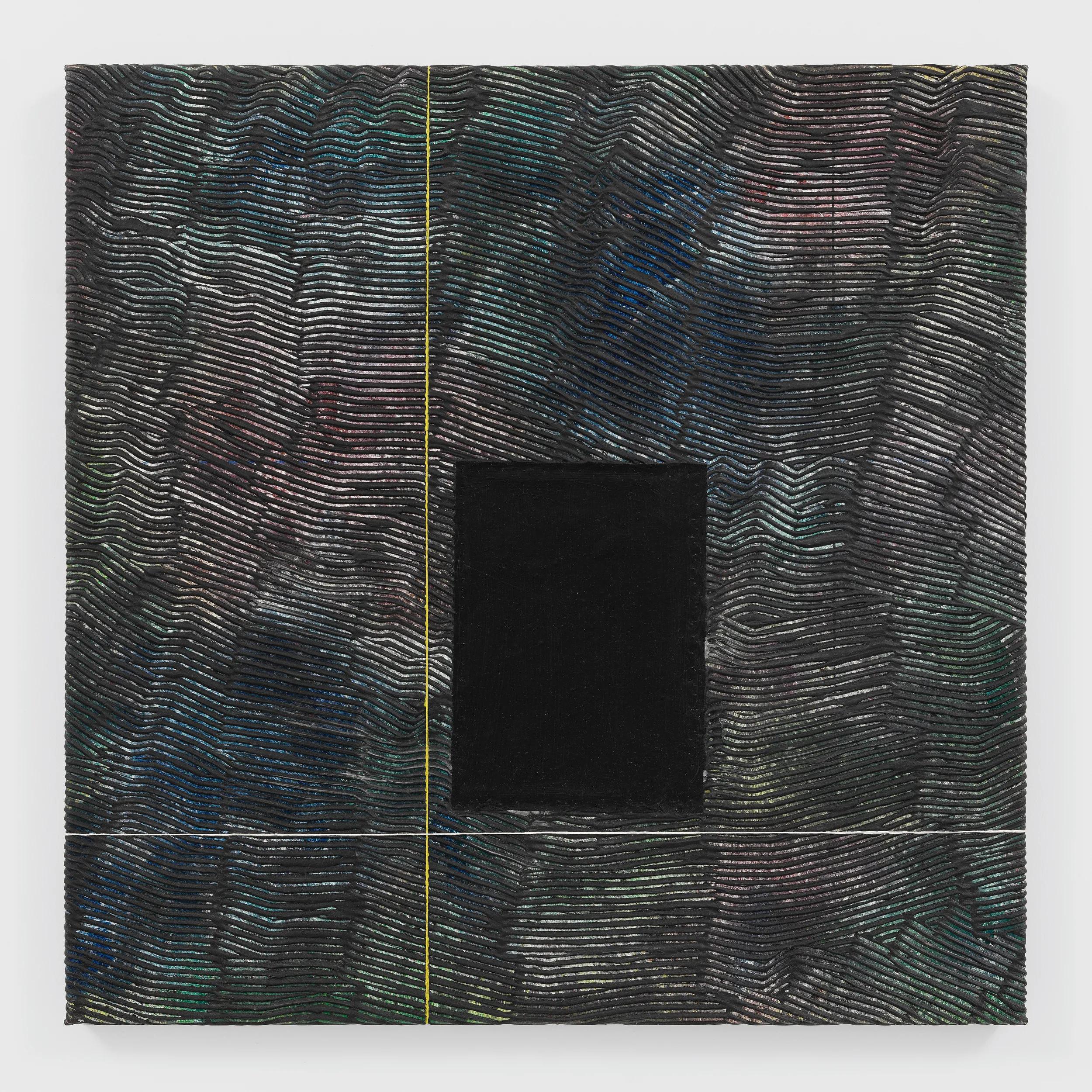
Jack Whitten, Psychic Intersection #I, 1980. Acrylic and string on canvas, 21 1/8 × 21 1/4 in. ©️ 2026 Jack Whitten Estate / Artists Rights Society (ARS), New York. Photo: Sarah Muehlbauer
“Whenever you begin to think about a new way of painting, you strip the color and go back to the black and white and forget about the color, which is what painters do. The Cubists did it.”—Henry Geldzahler
HG: Well, it’s structural.
JW: It’s structural, man. I think that’s the basis of what I’m doing now. That grid, again, I see the grid as a DNA particle of visual perception.
HG: It’s the building blocks.
JW: It’s the building blocks. And it’s in African sculpture—that’s where it starts […] so that’s the connection that I’m making. Now, that’s not going to be so obvious to someone off the street. But I can’t deal with that. I have to go with things that extend my own feelings, for myself. I can’t get involved with the man from the street about that. If they pick up on it, great. If they don’t, tough titty.
HG: As far as contemporary American painting goes, is there a connection with Black artists, or is the connection with American art?
JW: Look, I tell everybody when this comes up, I say, “Hey man, I’m Black,” and that’s obvious, and the buck stops here. We have to go to the word “sensibility.” If I’m in London, all I have to do is look at the way people dress, the way they talk, the food they eat, their settings, that’s [their] sensibility. It’s got to come out. It’s got to come out through the work somehow.
HG: But you take William T. Williams or Bob Thompson or any of a hundred Black artists that we know about, and I think your work has a strong relationship to African sculpture on the one hand and a general sense of American painting on the other.
JW: Oh yeah, I’m American. I’m American but I happen to be Black. But I don’t seek to install political imagery into the works.
HG: It’s not overlaid, it’s under. . . .
JW: At times, I’ve dealt with political usage in, like, color symbolism.
HG: How would you say you do that?
JW: I have paintings where I’ve dealt with red, black, green; red, white, blue. . . .
HG: What does red, black, green mean?
JW: It’s the Third World colors. It’s used as a rally cry and as a symbol for Third World nations. And [these colors were] also used by Black Nationalists in the ’60s and early ’70s. And I got the idea really from a student out at Queens College. I was teaching an art survey class and I did two or three weeks with them of studio art, and I was explaining the use of color and how color works in painting. And I was [saying things] like, “Oh, you’ve got to make it work, you’ve got to make color say something.” And this kid, she looks up at me and she says, “Oh, you mean like red, black and green,” and I said “Yeah, like red, black and green.” And it struck me, you know, it’s like color that’s saying something, but it’s symbolic in its interpretation and it’s political, right. So I played around with that idea.
HG: In the twentieth century, do you admire Brâncuși? Who do you admire among international figures in the arts?
JW: Twentieth-century artists, oh man. Cézanne is my master. I think in talking about what we’ve been dealing with in Western art—and if we go back to the word “Modernist principles,” we have to go back to Cézanne.
HG: Cézanne began it all again.
JW: Yeah. I think he is really like the grandfather. When I mentioned the grid in my involvement with African stuff, it’s a natural for me. Because when I say I was “pre-Cubist,” I can go all the way back to African woodcarving—
HG: But it enters the Western tradition through Cézanne.
JW: It enters [with] Cézanne. Picasso capitalizes on it.
HG: It’s interesting, too, in terms of the flowing of African sculpture into Europe. Whether Cézanne was aware of it or not, that’s when the missionaries were beginning to bring stuff back.
JW: You know, a lot has been said especially about Picasso’s use of African sculpture. But when I go to Cézanne, I’m sensing there—when we say grid—there’s something basically humanistic about that, that it is something that is opened up to everybody. But it just takes a certain amount of getting through the developments to see it. It’s just that in African sculpture it’s so pronounced; it hits you right in the face. But it’s a humanistic thing. I think I’m correct when I call it the DNA particle of seeing.
–
The conversation is an excerpt from the transcript of an unpublished conversation preserved in the Henry Geldzahler Papers at Yale University’s Beinecke Rare Book & Manuscript Library. It has been lightly edited for spelling and grammar.
“Jack Whitten: The Numinous” opens on September 30 at Hauser & Wirth Downtown Los Angeles.