

Perishable Goods
Ina Jessen on Dieter Roth’s radical use of the edible to upend art history
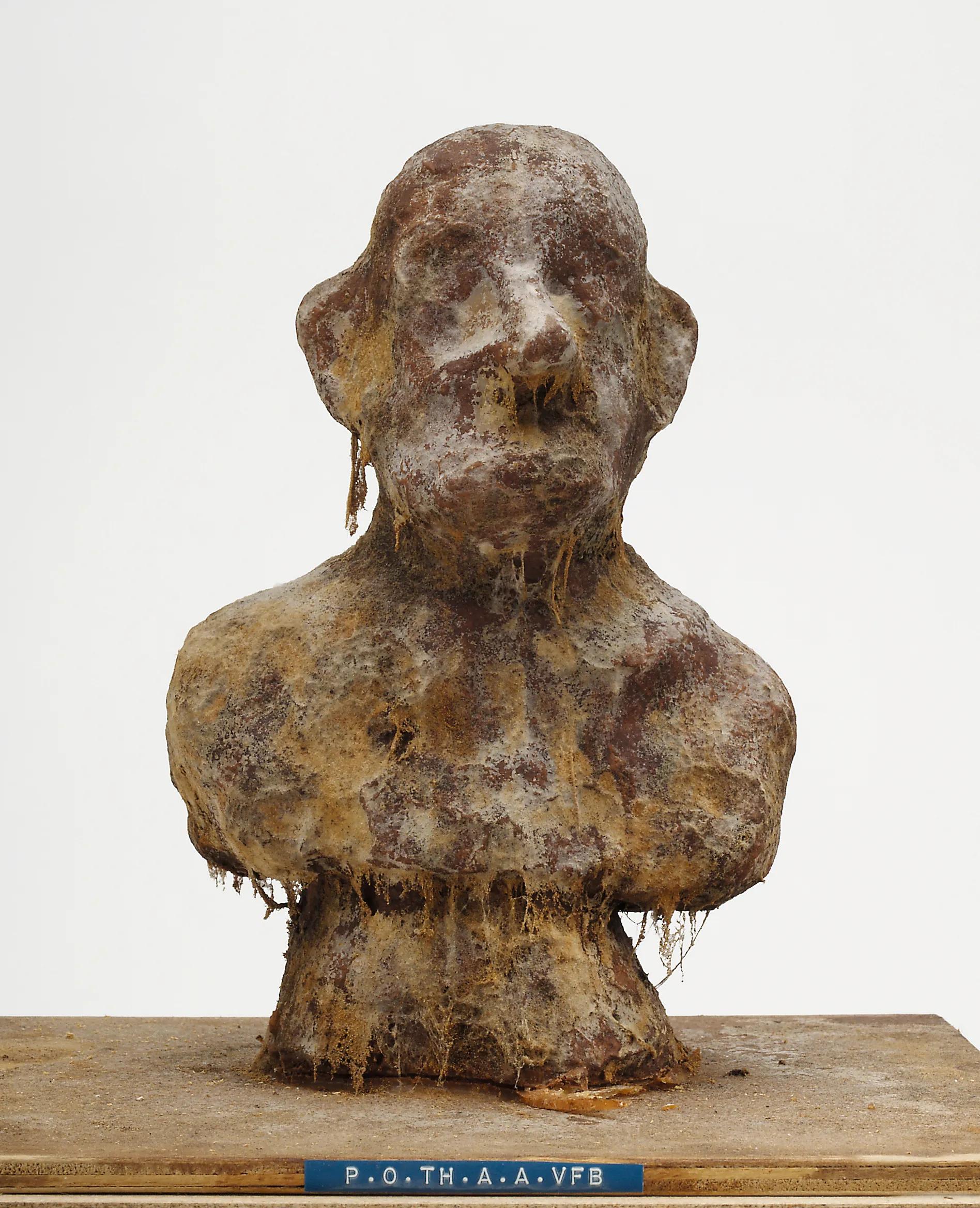
Dieter Roth, P.O.TH.A.A.VFB (Portrait of the Artist as Vogelfutterbüste), 1968. Multiple of chocolate and birdseed on wooden board, 8 1/4 × 5 1/2 × 4 3/4 in. © Dieter Roth Estate. Courtesy Dieter Roth Foundation, Hamburg and Hauser & Wirth
In the history of modern art, the use of food as a raw material marked a radical break with the traditional idea of art as a thing made to last. While sculpture had historically been created from durable substances such as marble or bronze, artists from the 1960s onward increasingly turned to the organic and the ephemeral.
The German-Swiss-Icelandic artist Dieter Roth (1930–1998) was one of the most radical innovators in this shift toward material transience. His work consistently rejected the idea of static, timeless artwork, preserved for eternity through museum conservation. Instead, Roth conceived of the artwork as a living process, constantly transformed by time, environmental conditions and microbiological activity.
Following his Op Art and kinetic objects of the 1950s and early 1960s—which were influenced by Swiss Constructivism, among other movements—Roth broke with his formal, graphic and Constructivist oeuvre. While teaching at the Rhode Island School of Design in the mid-1960s, he began to question traditional techniques and material conventions. During one of his printmaking experiments, he took chocolate figurines wrapped in tinfoil and crushed them in an etching press.
He increasingly used organic materials such as chocolate, sugar, cheese, spices and sausage. These were chosen primarily for their iconographic potential and their material properties: malleability, fragility and the capacity to react to temperature and humidity. For Roth, decomposition—whether through mold or insect infestation—was not a defect but a necessary quality. He comically referred to the insects that colonized his works as his collaborators.
Roth categorically rejected the iconographic over-interpretation of materials that he found in the work of contemporaries like Joseph Beuys, who imbued chocolate with Christian metaphors of transubstantiation. Instead, Roth was fascinated by variance—the smell, the changing surface, the physical instability of the medium. The artwork was not a timeless object but a processual event. A poignant example is his P.O.TH.A.A.VFB (Portrait of the Artist as Vogelfutterbüste) (1968), a chocolate bust covered with birdseed and placed outdoors to be consumed by birds. By incorporating decay into its conception, he subverted the traditional monumentality of the portrait bust. While portraiture has historically served to heroize sovereigns or renowned individuals, Roth surrendered his self-portrait to eventual dissolution. As if the concept of memento mori were not sufficiently evident in the material itself, the young artist portrayed himself as an old man.
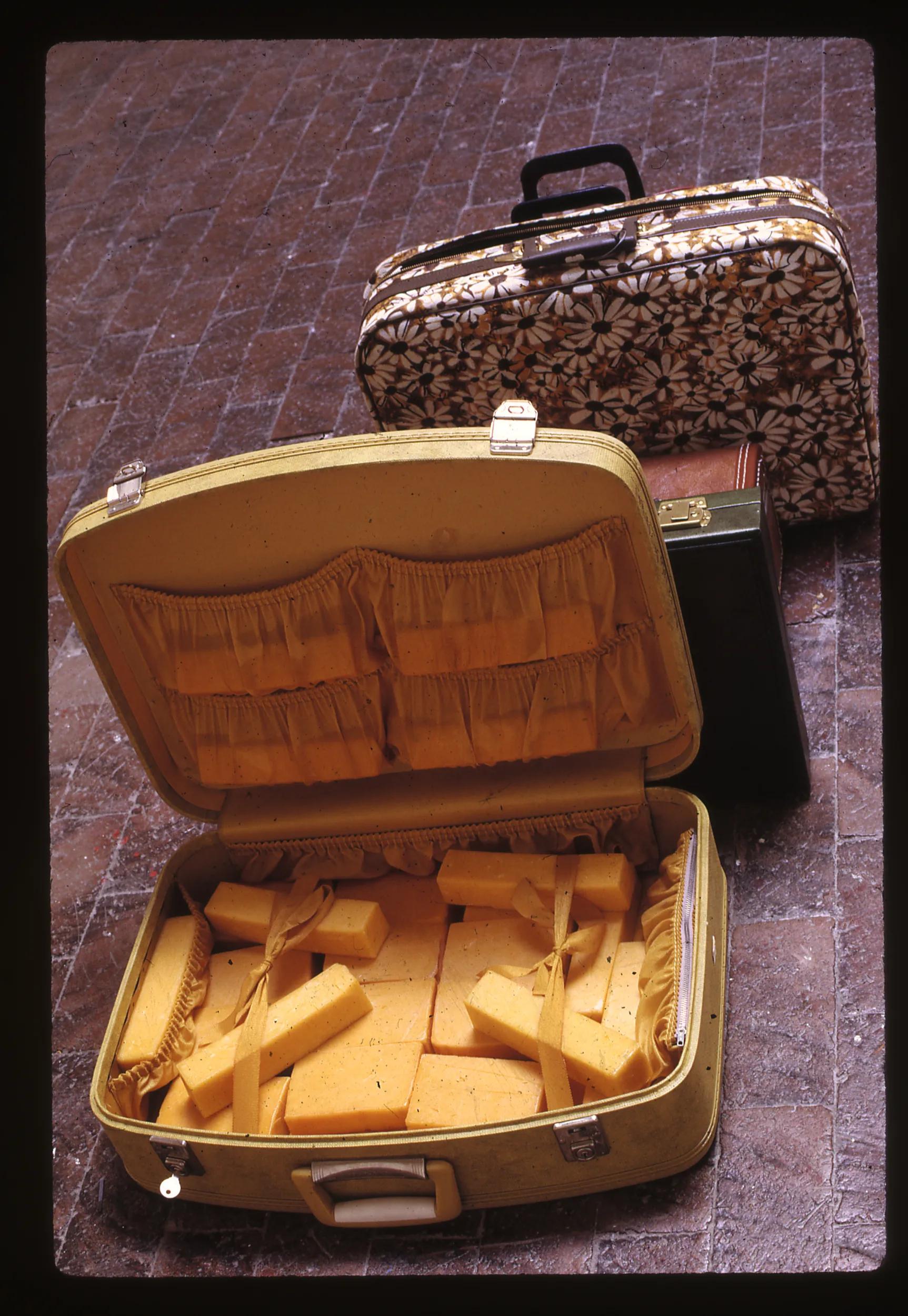
Dieter Roth, Staple Cheese (A Race), 1970. Thirty-seven suitcases stuffed with cheese. Installation view, Eugenia Butler Gallery, Los Angeles. Courtesy Estate of Eugenia P. Butler
Roth’s monumental installation Schimmelmuseum (Mold Museum, 1991–2004) in Hamburg marked a culmination of the so-called Eat Art movement and stood as a major expression of his anti-static philosophy. Staged across two floors, the Schimmelmuseum subjected sugar and chocolate objects—as well as works made from fruit and cheese—to decomposition over many years. Roth’s Sugar Tower, Lion-Self-Tower and four bust prototypes—Lion-Self, Self, Hybrid and Sphinx—exude a distinctive material presence. The appearance of the degrading sugar is glittering, colorful and paradoxical, creating a tension between the sweetness of the material and the morbid signs of its decay, including cobwebs and insect shells. This work also underscores the dissolution of singular authorship, as it involved the collaborative efforts of his son Björn Roth (1961–2026), as well as friends and assistants from Hamburg, Iceland and Switzerland.
Roth also pioneered cheese, such a quintessential symbol of Swissness, as a characteristic medium. A product of aged milk, cheese exists in a permanent state between solidification and liquefaction—the ideal substance for a work permitted to rot and perish. For the viewer, this meant a physically as well as an aesthetically challenging experience, as the cheese transformed and produced a pungent odor.
Roth’s first cheese work was a portrait of the art dealer Carl Laszlo in 1963. Roth coated a chipboard with Gorgonzola, projected a solarized portrait of Laszlo onto the surface and painted in the shaded areas. He intended the work to annoy Laszlo, comically positing that his irritation would make him turn green and blue in the face, like the cheese. The infamous installation Staple Cheese (A Race) at the Eugenia Butler Gallery in Los Angeles in 1970 pushed Roth’s ideas to an extreme. By filling thirty-seven suitcases with aromatic soft cheeses, he created a site of intense biological activity. The resulting seepage and maggot infestation were so severe that he was summoned by the health department for “unauthorized fly breeding.”
In both the Schimmelmuseum and Staple Cheese, the pungent scent of aging organic materials became a central, space-filling experience. This olfactory dimension acted as an invisible presence that lingered long after the visual impact had faded. The physical consistency of the materials—ranging from viscous to crumbly—served as a kind of catalytic influence for subsequent generations of artists, such as Jason Rhoades (1965–2006), who honored Roth by documenting the decomposition of cheese-filled backpacks over a period of two years.
The use of transformative materials expands the reception of art into an explicitly multisensory dimension. The artwork is no longer experienced primarily through sight but engages the viewer through the entanglement of smell and texture, involving the body in the work’s creation and eventual decay. Roth’s works trace a transition from order to choreographed chaos. The visual presence of mold, the alteration of the materials and the accompanying odor form a cohesive, multisensory narrative of ephemerality. Through smell and intensified sensory perception, the viewer is transformed from a distant observer into a participant within the biological system of an artwork.
The work of Dieter Roth marks a decisive departure from traditional concepts of art toward a profound aesthetics of flux. By refusing to conserve his materials, Roth challenged the viewer to recognize the passage of time and the transience of being as integral to the artistic experience.
–
A collection display room of works by Dieter Roth is on view at Tate Modern, London, from August 2026. The room includes multiples, prints, drawings and a Gewürzfenster (Spice Window).
–
Ina Jessen is a curator, Professor of Art and Design History at HAW Hamburg and the scientific liaison for the Dieter Roth Foundation. She is a spokesperson for the international working group Materiality(ies) of the Ulmer Verein and a board member of the Otto Dix Stiftung (Vaduz).