

Fiction
From Triage: Chapter IX
An exclusive preview of Triage, a new book by Claudia Rankine
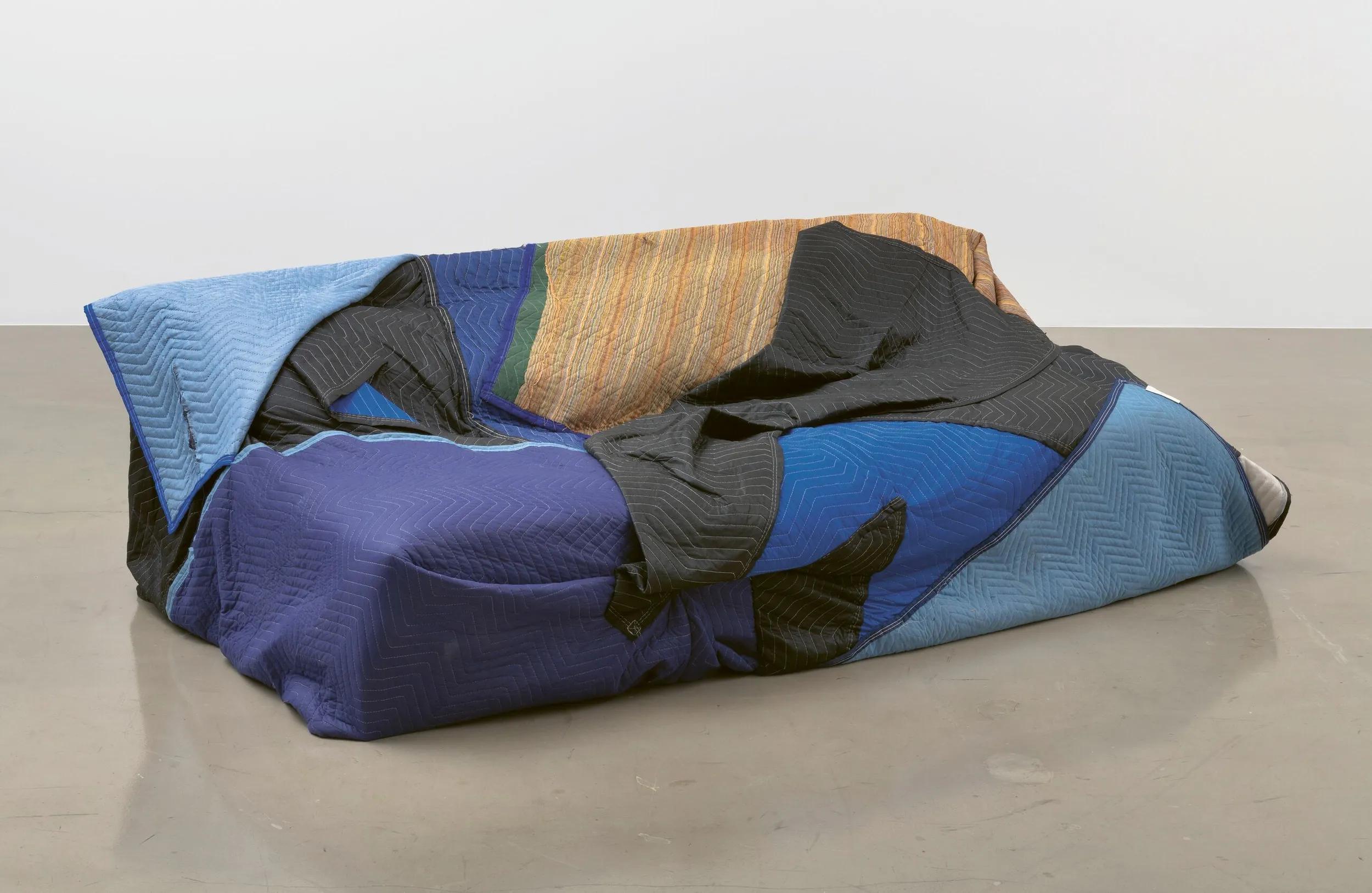
Martine Syms, 6 Year, 2023. Photo: Robert Wedemeyer. Courtesy Sprüth Magers
The months passed not unlike the time before the theorist’s reappearance. Each day the morning news reminded me why the mutilated couch held my attention as a structure rejecting its function. Investigations into these refusals offered me a way to critique our modes of governance, the decisions and legislation that altered our sense of a livable life. These reshaped structures suggested the daydream without the dream. I was reminded of Jack Halberstam’s call for unworlding, the collapse protesting repair, the repair of reinstatement, and I felt some kind of way in my nowhere. I sat pivoting left to right, right to left. The desk chair as an object was designed for one. Its ergonomic lines conformed to bodies one at a time, with the claim of alignment.
Smoke rose from a single chimney across the street. The whiteness of the sky met the imperial white paint on the facade of the facing building. I knew no one who lived there and no one entered the repeated balconies. Where was anyone? The apocalypse scripted a survivor. I sometimes desired the company of others in their most distant form, the possibility of another, their unspoken invitation, their arrival and departure built into the destroyed and deconstructed structure of a thing. The artists’ couches mostly withhold the possibility of rest the couch as furniture might offer to one or to many. Only through their refusal of this rest can we enter meaning differently. I scanned the images pinned to the right of my desk. The couch, no matter its transformation, resisted the complete erasure of its original function. It owned memory.
But even when a couch, like the one circled in a Martine Syms exhibition years before, kept its original shape and intention, it could also manage, by virtue of its location, to discourage use. In the gallery, Syms’s couch was placed in front of her video titled She Mad as an invitation. However, maybe because it was covered by blue padded moving blankets, many assigned it the untouchable status of art object. A black leather couch or bench would have read differently.
The moving blankets implied narratives of displacement, departure or unwrapped arrival that did not encourage usage. Those blankets said, “I am art object!” Okay. In deference, even Syms’s mentor Darby English remained fixed in his role as viewer and stood the entire length of the video. Others did the same.
Paging through Syms’s book Shame Space, I began to understand how sitting on Syms’s couch would have made me feel. I wouldn’t have wanted to be admonished within the collapse. Fear would have reintroduced tension impeding collapse. Syms wrote: “11/02/2015. Lately I feel like I am holding my breath until school is over. Then I remember we have six more weeks and I’ll die if I do that.”
I’ll die if I do that. This desire to jump time, our responsibilities to it, in order to land somewhere else was familiar to me. The cost of inaction could be too much. But not because of the death part, because of the life part. I was haunted, or hunted, now that I think of it, by Syms’s phrase.
No amount of stillness allowed escape from the life happening. Time exposes one and yet stillness is not its antidote. I’ll die if I do that. There are lines from Antigone that I recall, most likely incorrectly. We must act on what lies before us. Indecision is how a short road becomes a long one. Indecision is also a way to hold one’s breath. Though it nagged me that the theorist tended to frame, shame and judge others within their quietude and though I remained attracted to forms of stillness, there were arguments to be made against inaction when airstrikes, war, starvation keep others on the move.
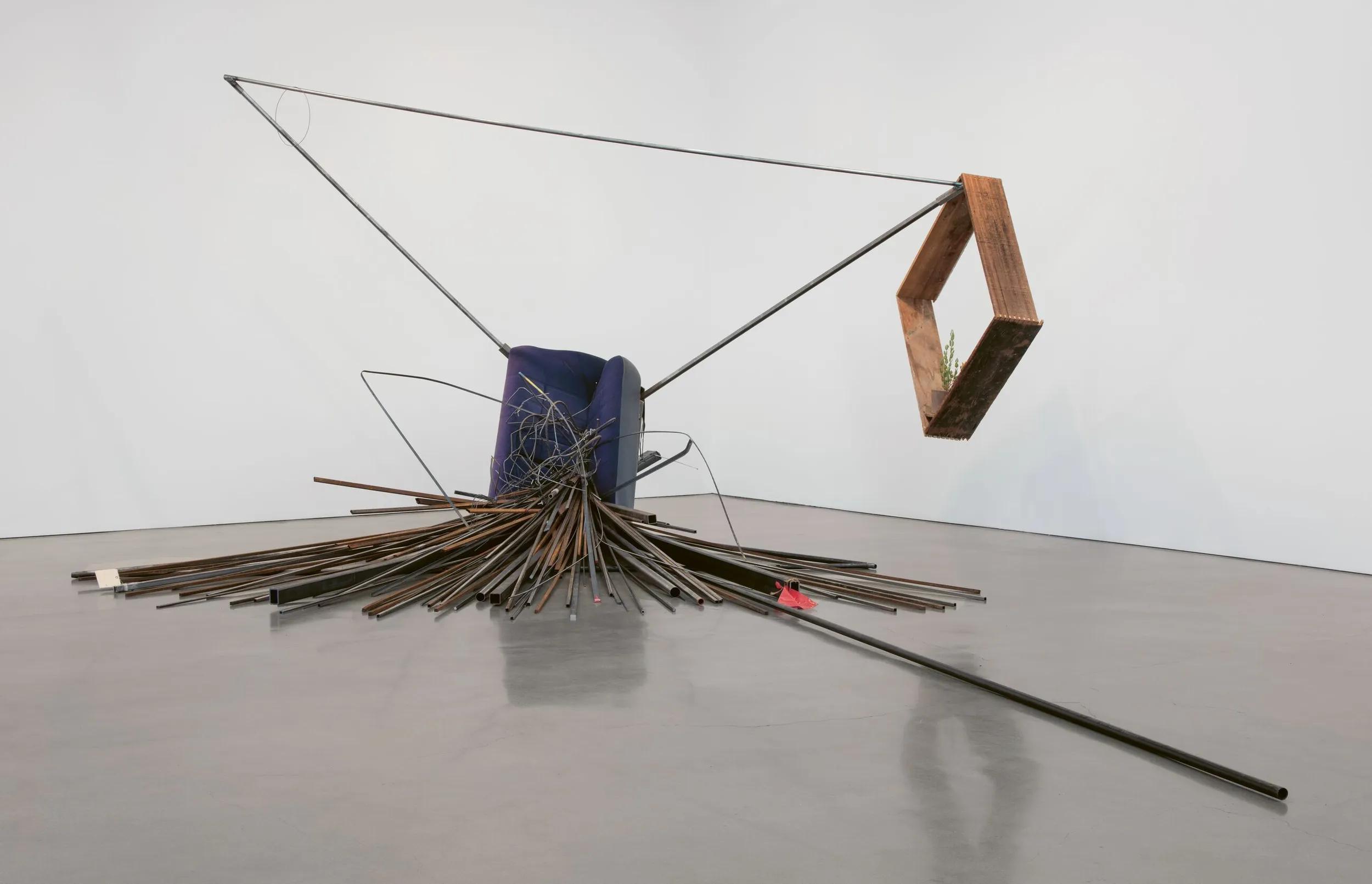
Abraham Cruzvillegas, Autoconcanción IV, 2016. Photo: Brian Forrest. Courtesy Abraham Cruzvillegas and Regen Projects
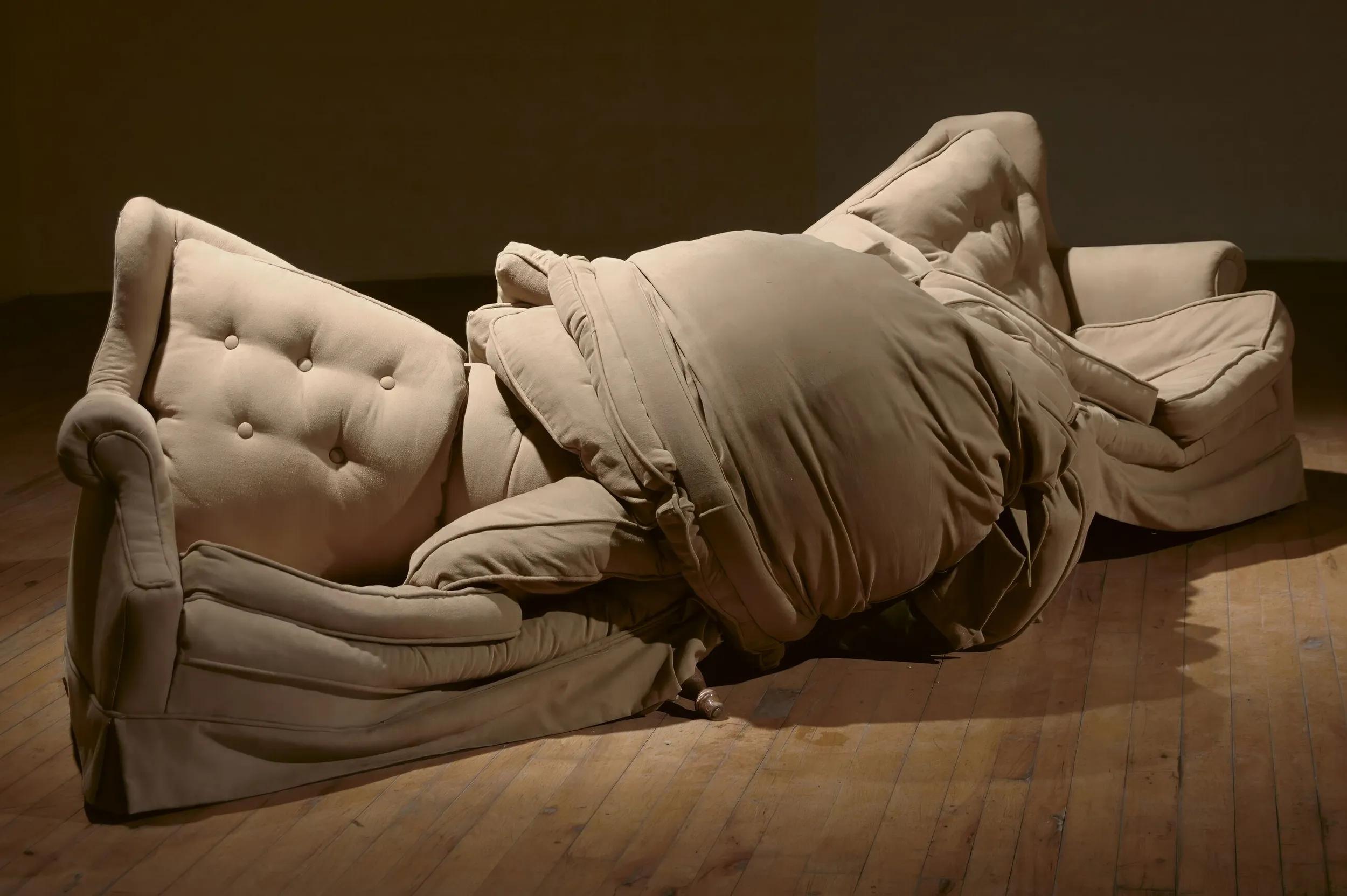
Michael Beitz, Knot, 2009. Courtesy Michael Beitz
The Mexican artist Abraham Cruzvillegas’s practice, self-defined as “autoconstrucción, autoconfusión and autodestrucción,” externalizes what it is to live with a sense of precarity always. Injuries, present, remembered or imagined, both limit and risk movement, but what if one’s dailiness was only defined by chaos? What if a trembling would always sound at the edge of things? What if precarity just meant constant adjustment? What if having been pushed or forced or having slipped, one needed somehow to be reassured that one had not yet reached the ground, even if one were certain one was falling?
What if there was no landing, only diasporic movement, wind whistling in an ear as it passes through? What if the threat of the complete collapse came and went depending on the whims of others like atmospheric shifts, what if being unsettled would be lifelong, like a limp or a pain, arthritic?
To the letting down, I whisper, gentle now.
A photo of a couch remains taped to the edge of my computer. The sculpture belongs to the artist Michael Beitz. His alteration of the familiar is restful. Even as I worry it no longer can hold my human form, I still imagine myself in its remaindered, skewed seating at either end. One day I will write about its disfigured embrace. Its role for now is to be there as a reminder of the possible. It seems to say even as life is not as it should be, one might be able to make this ruined world work without repair. This was never the world of the win. I have not had the easiest life, but I’ve found new clarity. And though I am twisted, tangled and ruined, I am still holding my place, if barely. Despair does not always find me. Some days as my eyes rest in this knotted image, I recall my mother’s body. She was off-kilter, touching on all that can be touched without holding anyone, including herself. Still her cratered spaces resounded, seared, though she herself would never hear or see it. Consequently, once she had been broken down, shattered, within her history of violent collisions, and once she had gathered up what had been hollowed out, she never could settle herself. She stood by and watched history repeat as it maimed all around her. She stood by in the vileness of all that. She stood by. Never was she able to lacerate herself in order to change enough to either do something, just do something, or just sit, be here, in the wreck with me, never. Alone, cut loose, we create our alibi.
–
Claudia Rankine is an award-winning poet, playwright and essayist. She is the author of five poetry collections, including Citizen: An American Lyric, and several plays. Her essay collection Just Us appeared in 2020, and her forthcoming project Triage will be published by Graywolf in 2026. She co-founded the Racial Imaginary Institute and teaches in NYU’s Creative Writing Program.