

Films
The Shape of Time
Cristina Iglesias on water, memory and the unseen
- 1 September 2026
‘Cristina Iglesias: Water’ (2026) Directed by Maria Sosa Betancur
- Related Artist
- Cristina Iglesias
Over more than four decades, Cristina Iglesias has created immersive sculptural environments that draw together architecture, geology, literature and the natural world. For the latest installment of Material, our recurring series exploring an artist’s relationship with a single material, we visited Iglesias at her studio in Torrelodones, outside Madrid. Water has long flowed through her practice—not simply as a material but as a way of thinking about time, memory, transformation and the unseen. Ahead of her forthcoming exhibition at Hauser & Wirth in New York, she speaks about the ideas that have shaped her work from the beginning.
When I think about water I think about the idea of the sea as a surface that holds light and color, but also the mystery of the depth—that connection with depth that the sea and any concavity with water have. In the Basque Country, where I was born, I have this memory of the sea changing. San Sebastián is on the Atlantic coast and can be temperamental. It is so connected to the weather conditions, like everywhere, but Basque weather can change from morning to evening five times.
My idea of landscape is very attached to that. I think it has affected how I want to create pieces that produce an atmosphere. That feeling is very connected to where I come from.
I was also very aware of the tides and how tidal movements change the dimensions of time and space—and how we, as human beings, relate to this change. I love to feel the rain at the same time as I look at the sea, a sensation of being surrounded by water.I love to dive and swim. I think about depth and how diving is a way of losing your sense of dimensions. I sometimes wondered if I could achieve this in a sculpture, evoke that sense where looking up makes you dizzy and makes you lose some control of where you are. When you use the form of a labyrinth—even the simplest, smallest labyrinth—it gives you the sensation of getting lost, the idea of wanting to go farther and not being able to.
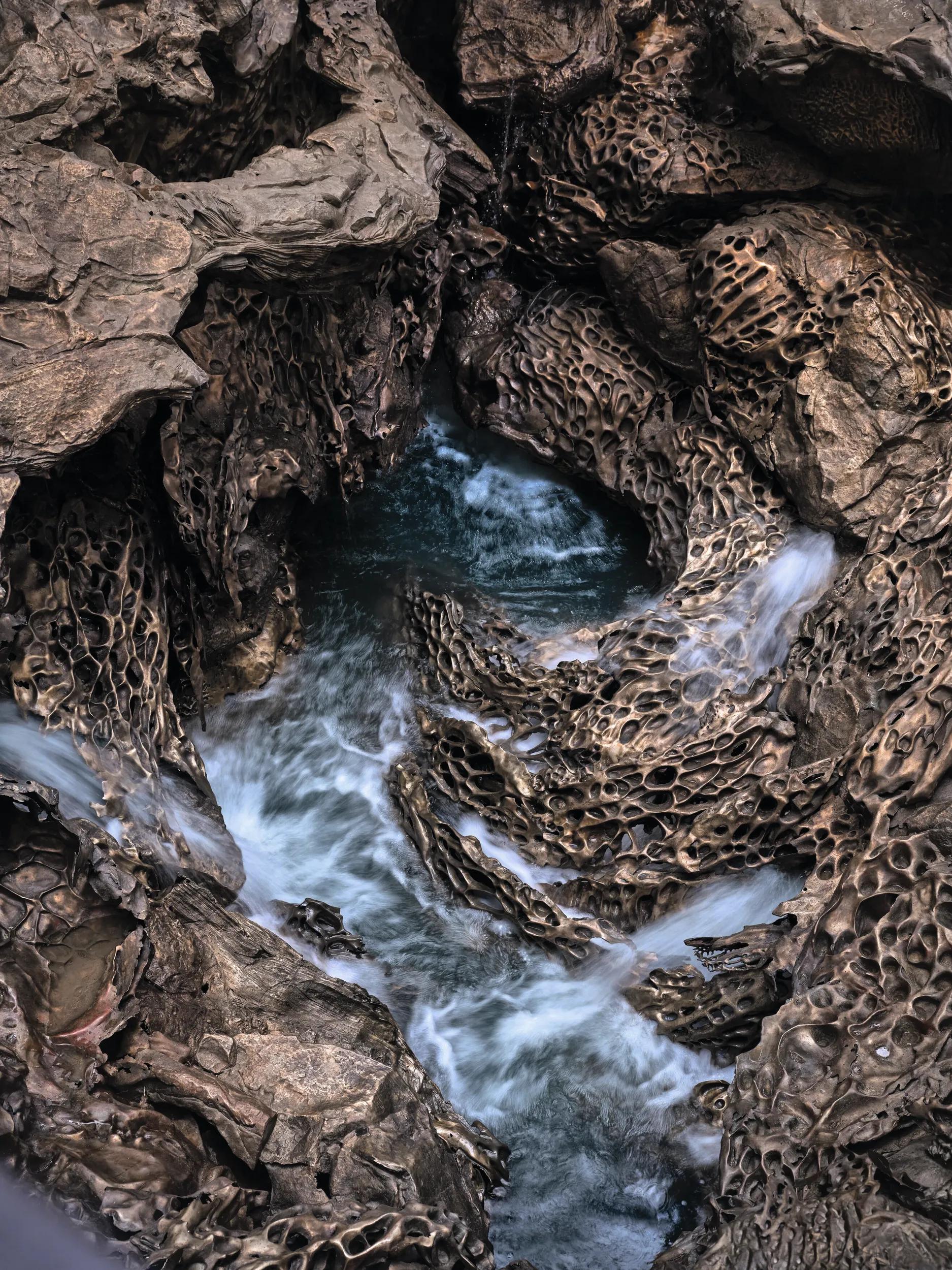
Hondalea (Marine Abyss), 2021 (detail). Bronze, hydraulic mechanism and water, 33 1/2 × 37 1/2 × 36 ft. Permanent installation, Lighthouse on Santa Clara Island, San Sebastián, Spain © Cristina Iglesias. VEGAP, Madrid / ARS, New York 2026
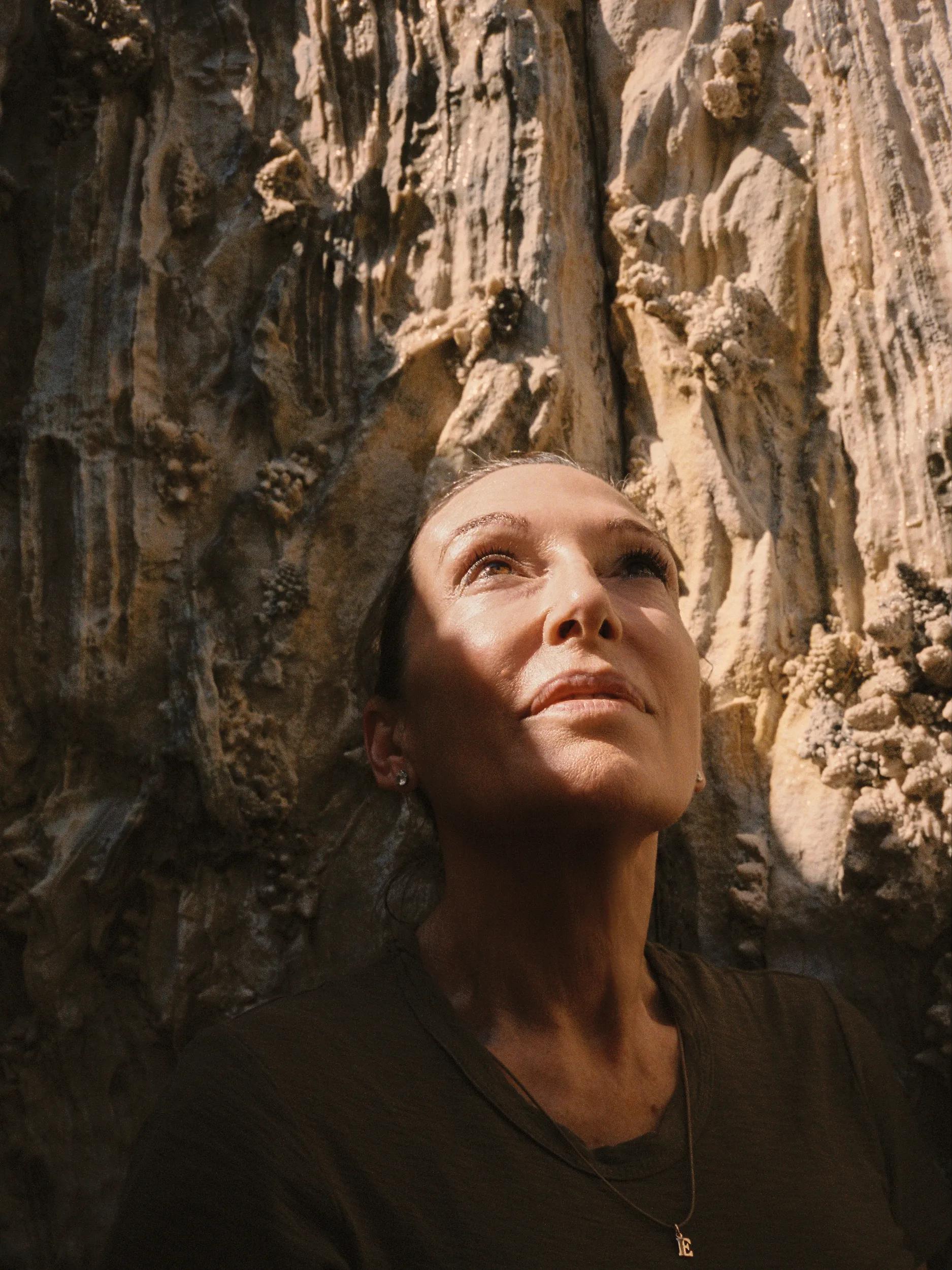
Cristina Iglesias with Chambre Minérale Humide (2022). Photo: Yago Castromil
I’m interested in creating places for people to gather and places to be alone with oneself. Working with water allows me to play with time. Water runs. In my case, I work with running water to an extreme. I create sequences.
Deep Fountain (1997–2006) was the first time I made a large-scale work using water as a material, allowing the viewer to feel time with it, the way time passes. I created a shallow surface with a crack running down the middle transversal, where the water disappears and appears again. Situated in front of the Royal Museum of Fine Arts in Antwerp’s central square, it becomes, when it’s full, a mirror of the building and the city. When it’s empty, it reveals a surface that resembles fictional vegetation. You might wait for it to repeat, to be the same, as you do when you look at the sea, the tidal movements of the water. But you see it in different states when you come into the museum and when you go out.
Water leaves traces. For example, in the littorals along the ocean coast, the rocks carry the imprint of the water in them, memories of the water. Erosion makes forms, creates holes. Geological time deals with memory but also with the unknown, with what is below the surface, making you conscious of that unknown.
This is what I try to bring to the experience of some of the pieces I construct, like Hondalea (2021) in San Sebastián. The word hondalea is from old Basque and it means “sea abyss.” The work is located inside a lighthouse on Santa Clara Island, where we excavated the interior base. After a journey by boat, you arrive at the island and the ecosystem it has preserved and you find yourself at the top of a small mountain. Inside the lighthouse, I constructed a bronze form that resembles a deep marine cave that seems connected with caves that go down toward the sea. You immediately connect bronze with the idea of ancient underwater treasures. Gold bronze also ages with water very well and with great complicity, turning into greens or blues. Water exists in my pieces with other materials that hold the water or that canalize it or that specifically contrast the liquidity and transformation of water. The effect of the sound of water with the metal interests me. I think sound affects us enormously.
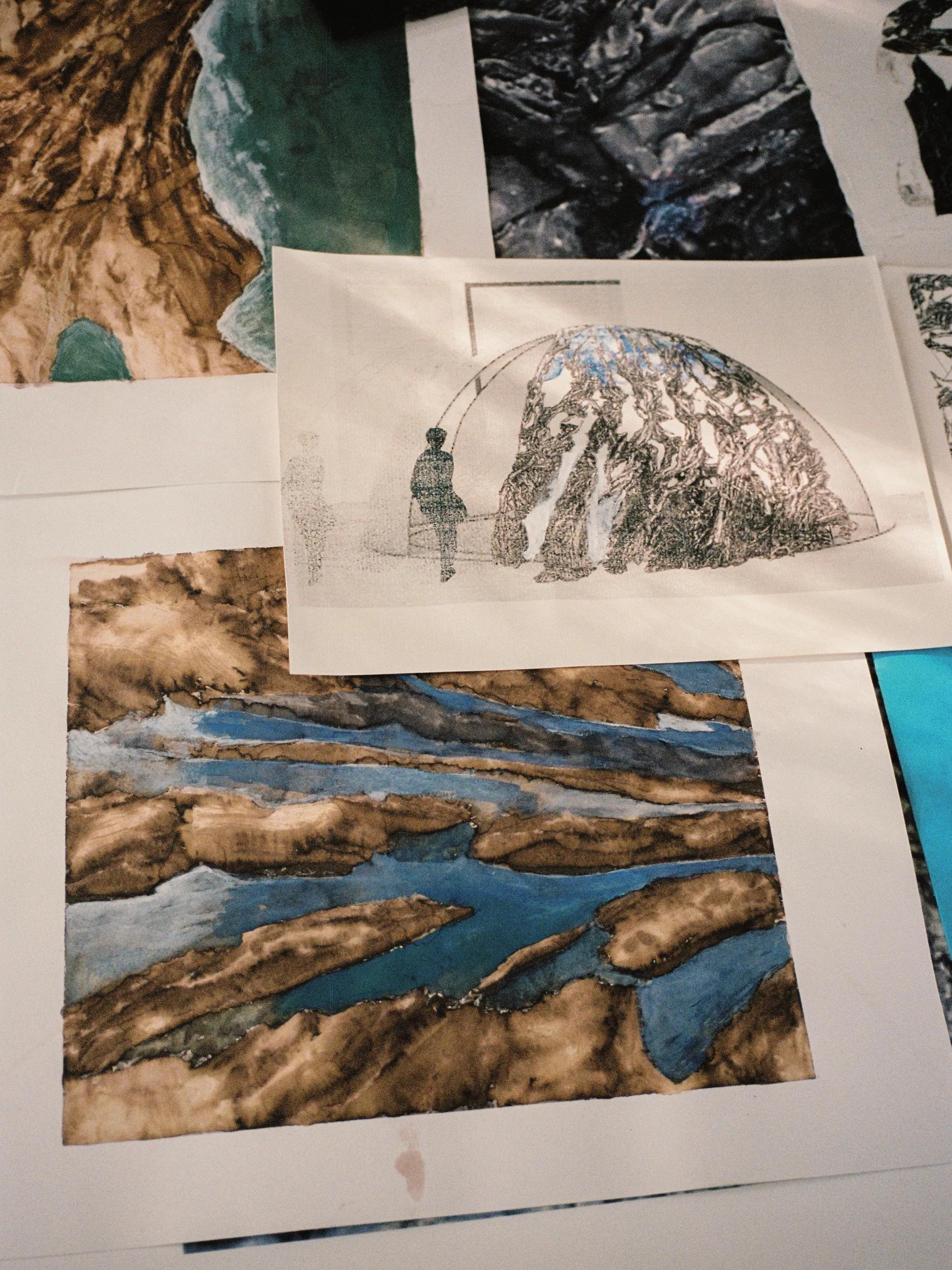
Drawings inside Iglesias’s Torrelodones studio. Photo: Yago Castromil
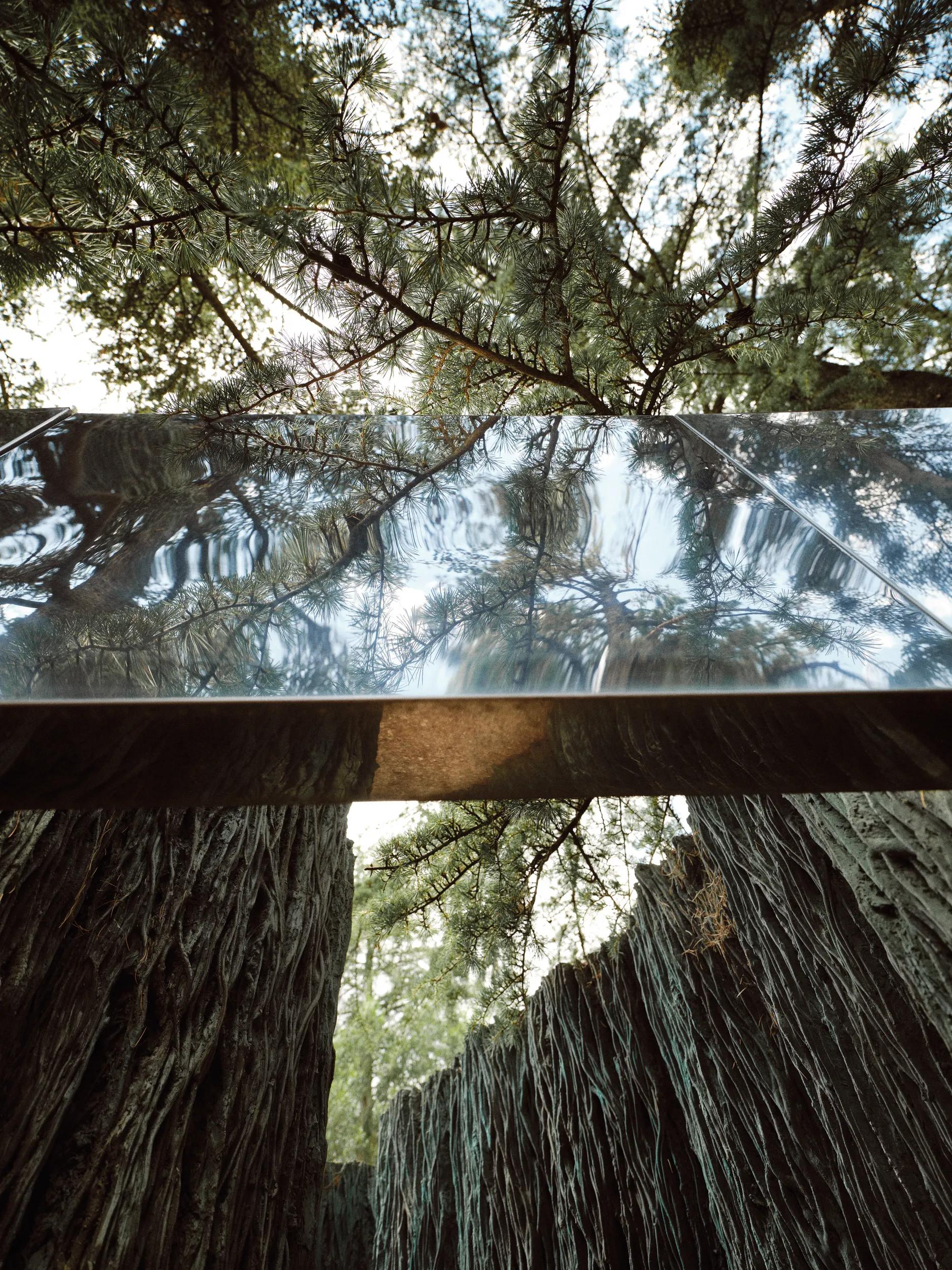
A view of Vegetal Room XV (Double Passage), 2008. Bronze powder, polyester resin and stainless steel, 15 1/2 × 18 3/4 × 9 1/4 ft. Photo: Yago Castromil
The responsibility of constructing landscape is quite serious. I collaborate with hydraulic engineers to realize the mechanics of it. Under everything we construct, there is nature, there is water. In New York’s Madison Square Park, for example, a river, now underground, once ran through the area toward the Hudson, and I followed that same course with my piece Landscape and Memory (2022). Again, it is about the unseen. It is about playing with illusion, creating forms that look deeper than they are. Water helps me to create illusions of depth.
I continue to return to the idea of taking care of what lies beneath, remembering that nature is present and that we must care for it. Taking care of the oceans means taking care of the world and of the ecosystem. I created Estancias Sumergidas in 2010 at the bottom of the Sea of Cortez in collaboration with marine biologists from La Paz and researchers from the Scripps Institution of Oceanography. Espíritu Santo is the nearby island where we installed the work seventeen meters below the surface. It’s an architecture that creates estancias—rooms to be inhabited by nature. With the biologists we chose a place where the currents were best for the creation of life. The last time I could dive there was four years ago and it was so full of life. The piece was part of a program of creating marine refuges. It is a symbol and a lab for the growth of marine life.
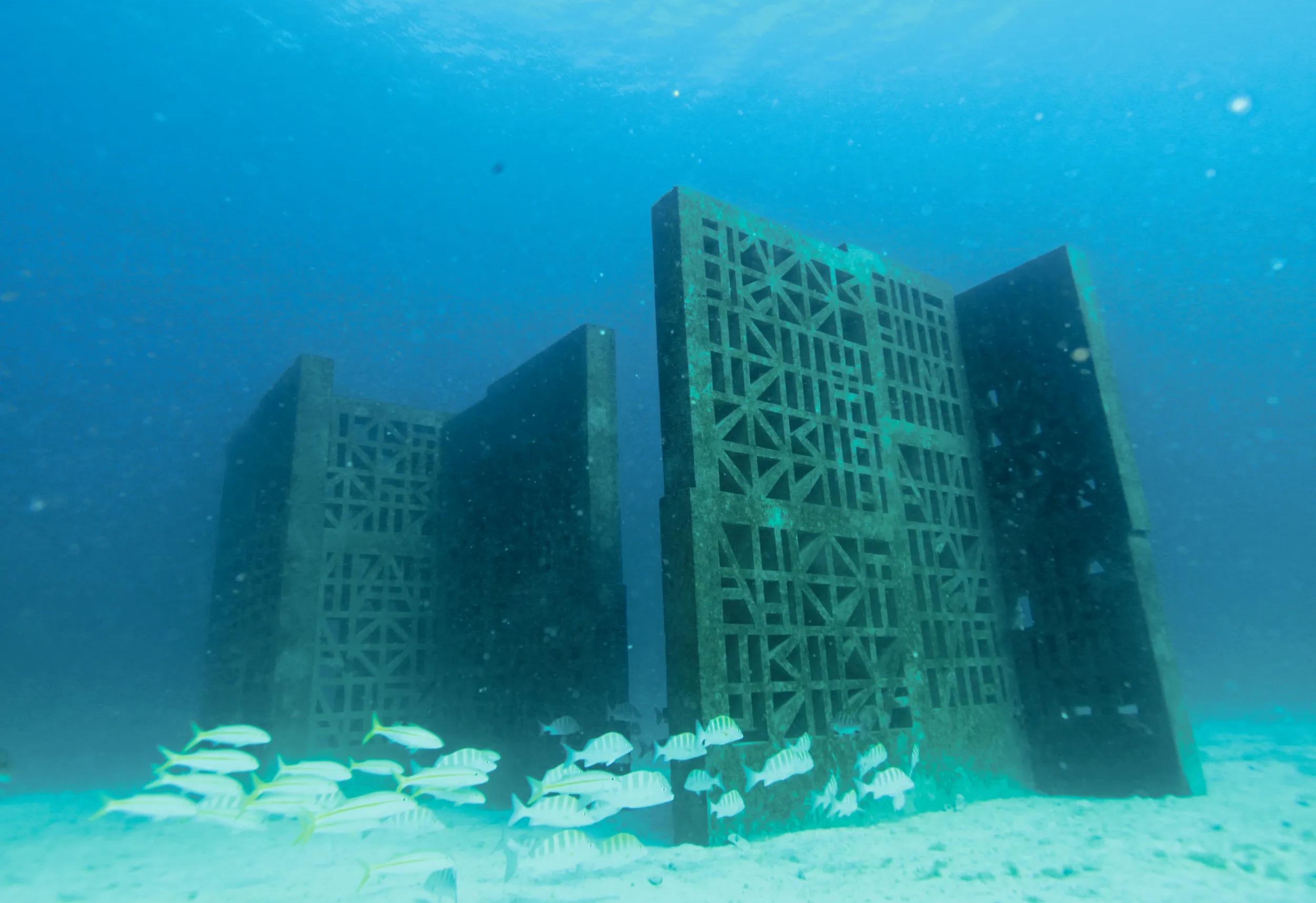
Estancias Sumergidas, 2010. Stainless steel rods and concrete, Estancia I: 8 3/4 × 24 1/2 × 13 ft, Estancia II: 8 3/4 × 24 1/4 × 12 1/2 ft. Permanent underwater installation at Isla Espíritu Santo, Mar de Cortés, Baja California, México
I am interested in ideas of growth and how nature behaves, how forms
are made, how matter develops. Roots connect with the underground but start growing and can become a tree. Or they can become something more abstract. I’m not so interested in painting or making a sculpture of a tree. I’m more interested in making a sculpture that represents that growth. And showing how, in that growth, there might be a part that’s unpredictable. A form can suddenly grow into something you were not expecting. Nature improvises just as we do.
I mix my ways of making. For example, we can carefully 3D scan a landscape, a rock. Then we create wax models and make casts from them. With those waxes, I transform and create forms. I use them as textures that have the imprint of reality, but I can create a total fantasy with those imprints. In my latest sculptures, I mix imprints that come from real nature and others that come from ideas of growth that I designed in 3D.
I have always been interested in science fiction as a literary form that addresses what you do not know, things that could be. I would like my pieces to appear as if they have always been there but at the same time as if they come from somewhere else, from another time or another planet.
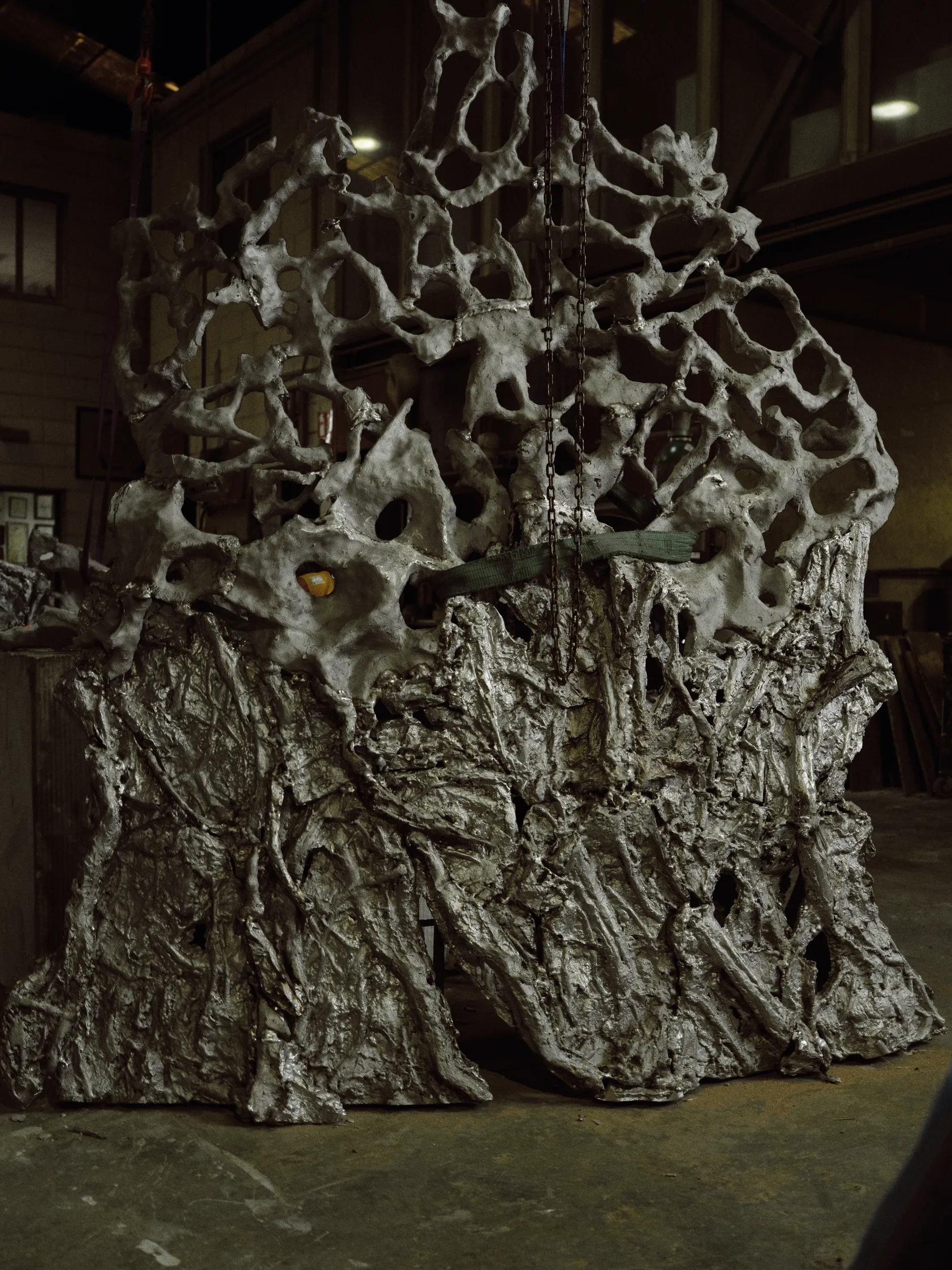
Works in progress at the foundry Esfinge Esculturas Y Fundiciones, Madrid. Photo: Yago Castromil
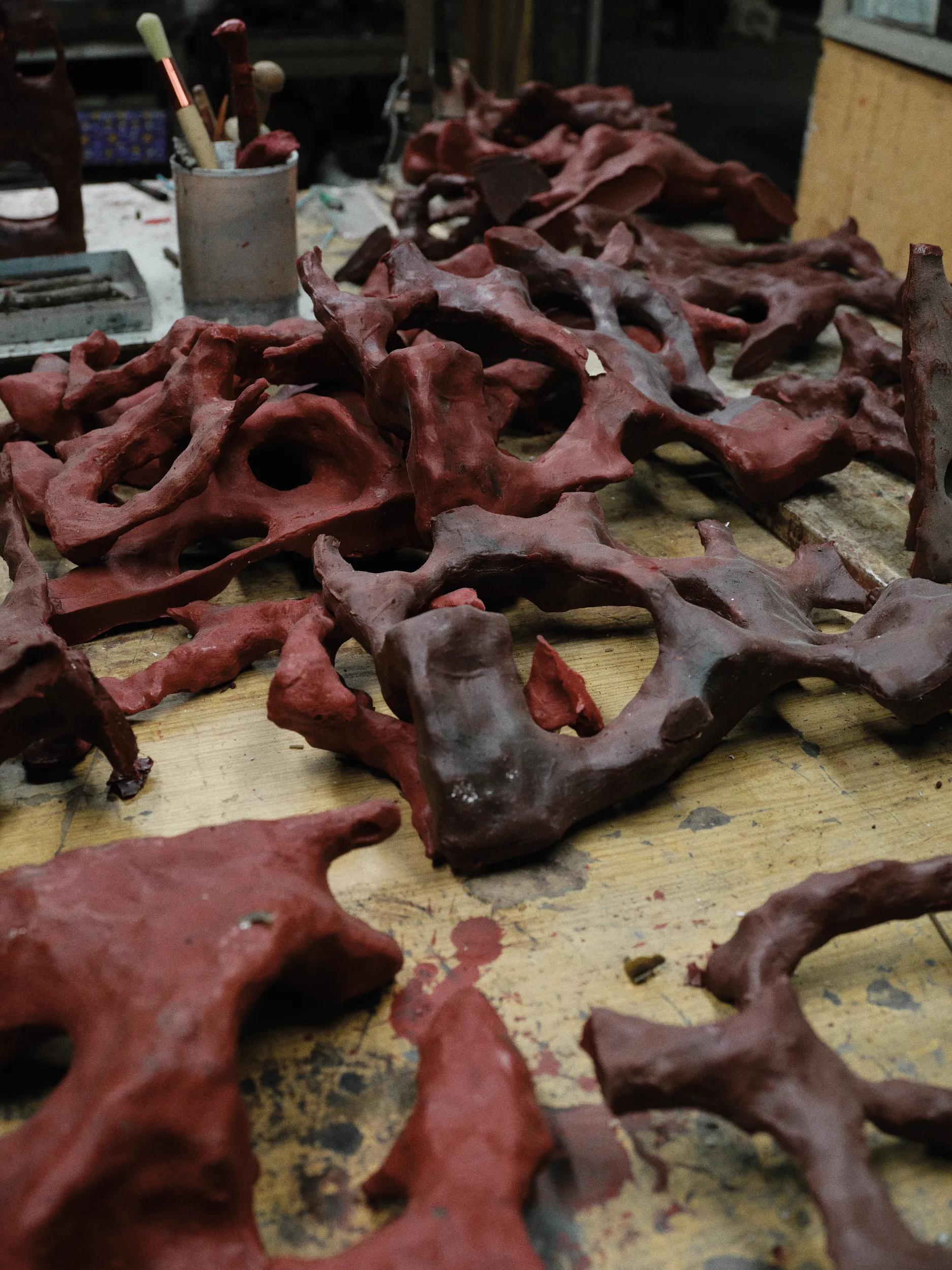
Works in progress at the foundry Esfinge Esculturas Y Fundiciones, Madrid. Photo: Yago Castromil
This is a moment in my life that is very active and very concentrated. We just came back from installing a permanent work in Stockholm. And now we are busy with a piece that we will install next spring in London, as well as a solo exhibition that I’m preparing for Hauser & Wirth. I’m planning a major museum exhibition in Paris that will include the work Wet Labyrinth (with Spontaneous Landscape) (2020–22), which deals with real nature that surrounds the viewer and the fictional nature inside the room. I am also taking part in a show for the next Architecture Biennale in Venice.
My latest works somehow connect with pieces I did in the past, but in new ways. They deal more with transformation. You can see how matter transforms from very abstract into more geometric and crystalline forms. Nature has a tendency to organize itself. But you also have a sense of it being a non-organized system, in ways that cannot be understood.—As told to Francis Till
–
“Cristina Iglesias” opens November 3 at Hauser & Wirth New York 22nd Street.