
Glenn Ligon’s First Solo Exhibition in South Korea, ‘Black Moons’
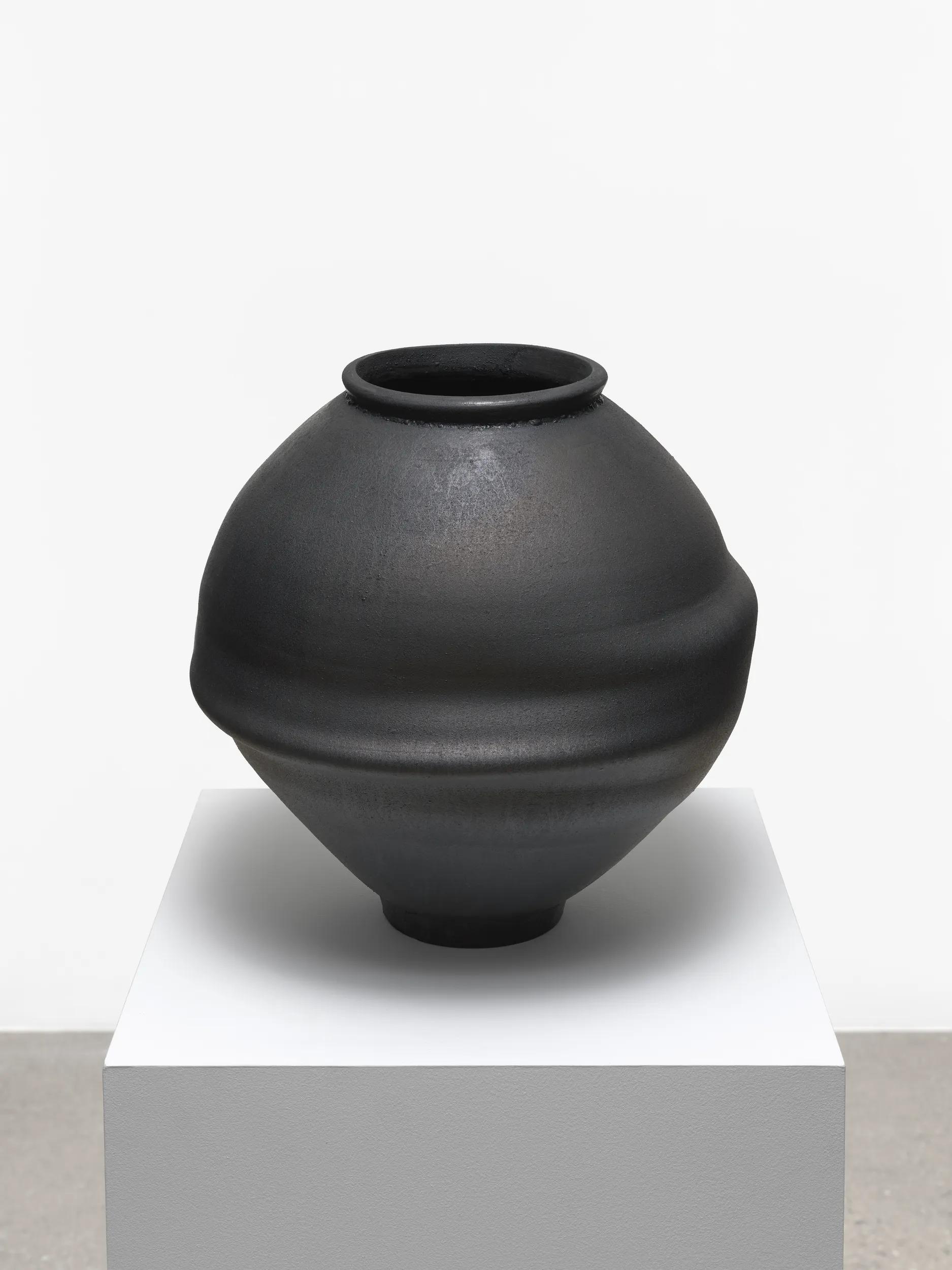
Glenn Ligon, Untitled (detail), 2019, Installation of nine glazed porcelain vessels, Overall dimensions variable © Glenn Ligon. Courtesy of the artist, Hauser & Wirth, and Thomas Dane Gallery. Photo: Ron Amstutz
Glenn Ligon’s First Solo Exhibition in South Korea, ‘Black Moons’
Celebrated American conceptual artist Glenn Ligon presents ‘Black Moons,’ his first solo exhibition in South Korea, with support from Hauser & Wirth at the Amorepacific Headquarters. At APMA Cabinet, the presentation pairs the artist’s monochromatic moon jars, which directly engage with Korean craft heritage, with landmark text-based paintings from his Static and Redacted series, offering a profound reflection on, in Ligon’s words, ‘the things that can be said and the things that cannot be said, or the things that are difficult to say, or that remain opaque despite a desire to be clear and explain…’
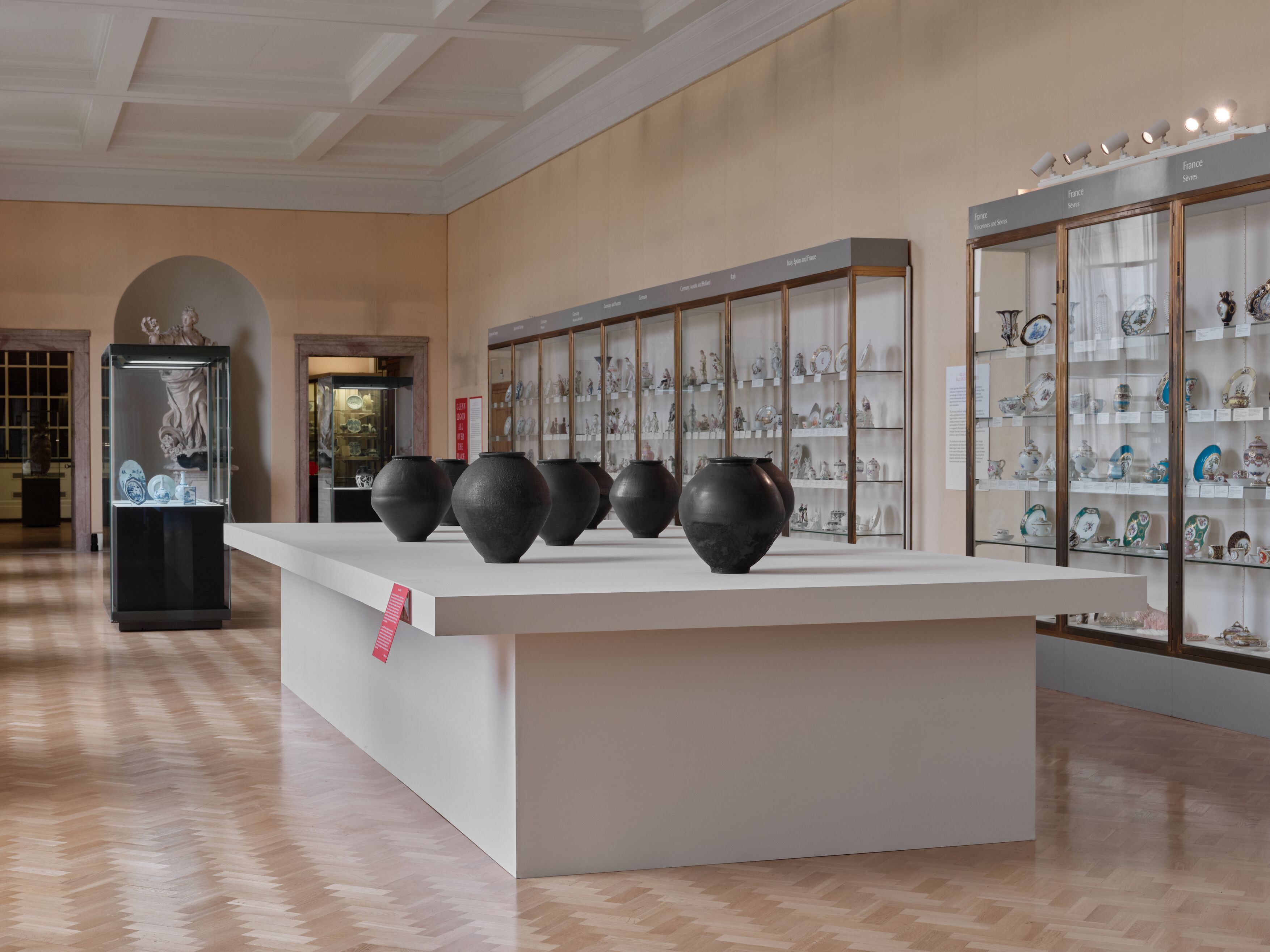
Installation view, ‘Glenn Ligon: All Over The Place,’ The Fitzwilliam Museum, University of Cambridge, 2024. Photo: Thomas Adank
The exhibition centers on a striking group of ceramic sculptures. These moon jars debuted in an exhibition titled ‘In A Year with a Black Moon’ at Rat Hole Gallery in Tokyo in 2019. Inspired by Joseon Dynasty (1392–1910) white porcelain moon jars (daeho), Ligon subverts material expectations by rendering his vessels in shades of deep charcoal black. Developed through an intense three-year collaboration with a Japan-based Korean ceramicist, the process involved experimenting with unique clays and firing temperatures to transform the medium. The resulting black moon jars feature a naturally uneven, spontaneous silhouette, honoring the traditional Joseon aesthetic of naturalism and asymmetry over rigid perfection. By exploring these dark tones and rich textures, Ligon expands the boundaries of traditional ceramics to create vessels that exist simultaneously as objects of formal beauty and powerful carriers of cultural critique.
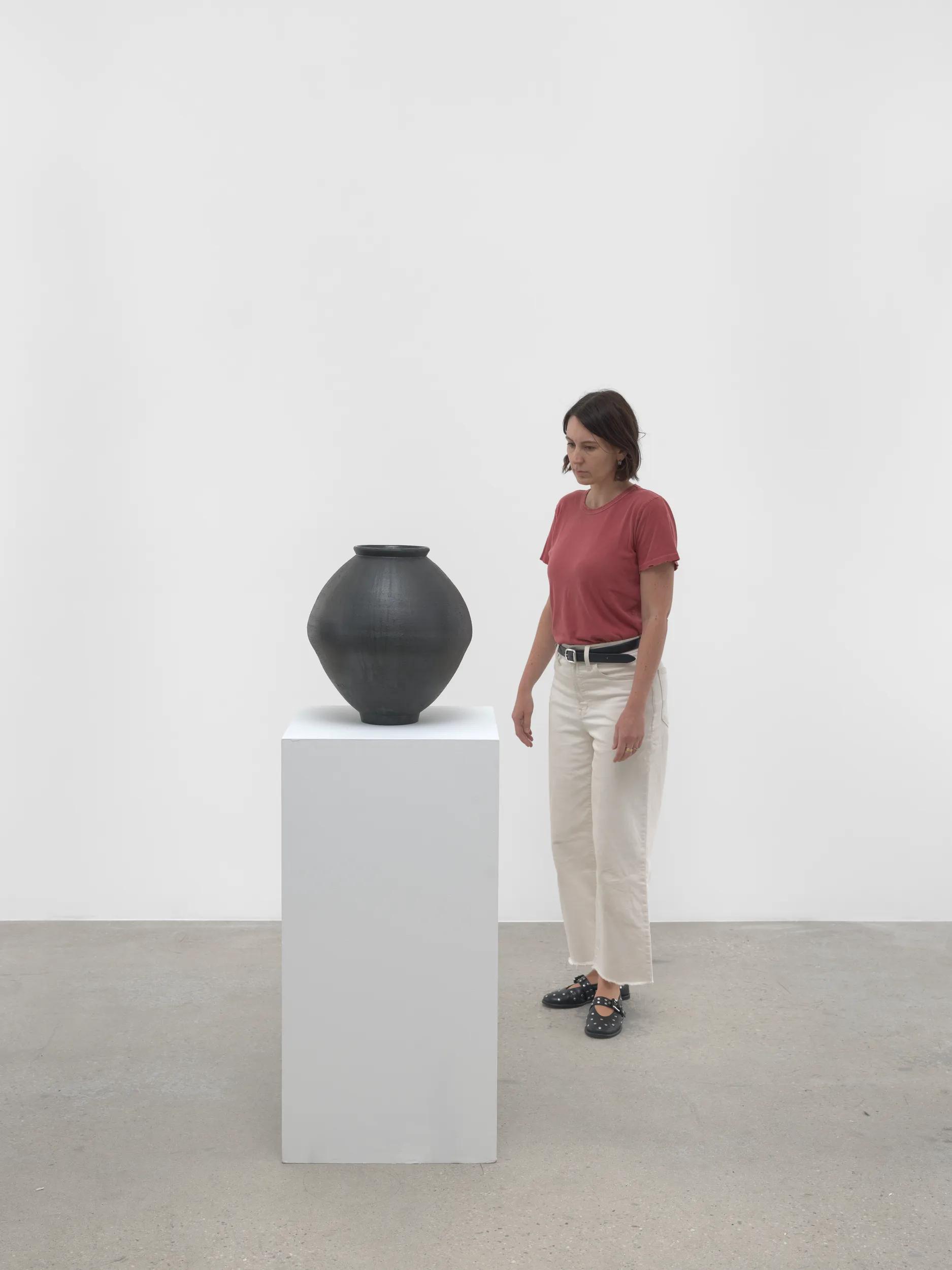
Glenn Ligon, Untitled (detail), 2019, Installation of nine glazed porcelain vessels, Overall dimensions variable © Glenn Ligon. Courtesy of the artist, Hauser & Wirth, and Thomas Dane Gallery. Photo: Ron Amstutz
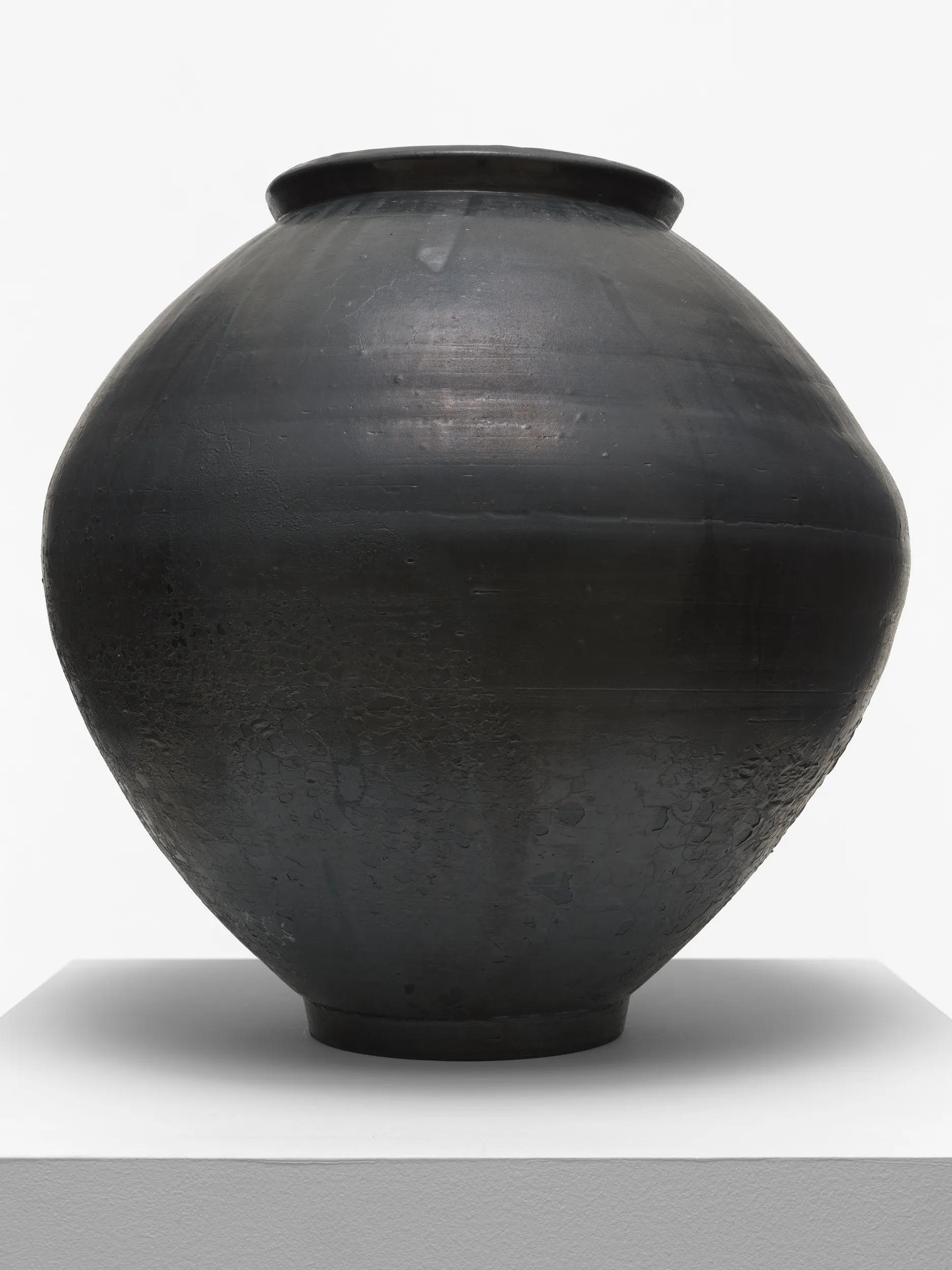
Glenn Ligon, Untitled (detail), 2019, Installation of nine glazed porcelain vessels, Overall dimensions variable © Glenn Ligon. Courtesy of the artist, Hauser & Wirth, and Thomas Dane Gallery. Photo: Ron Amstutz
Shown alongside the ceramics are large-scale paintings from Ligon’s Static and Redacted series, which translate his longstanding focus on language into new forms of visual abstraction.
The Static series evolved out of Ligon’s iconic Stranger paintings, sharing their foundation in James Baldwin’s 1953 essay ‘Stranger in the Village.’ Through varying degrees of legibility on the commanding surfaces, Ligon evokes the conditions of hypervisibility and invisibility inherent to the Black experience, exploring the inability of language to fully articulate issues surrounding race, citizenship and subjecthood. To create the Static paintings, the artist stencils Baldwin’s prose onto a gesso foundation with white oil stick, later covering the letters with black pigment. Heavily layered and overlapped, the stenciled lettering becomes systematically unreadable. The resulting canvases visually mirror the chaotic white noise of a disrupted broadcast signal, questioning whether language in our ‘post-truth’ world can still function to describe our current cultural moment. As Ligon remarks, ‘The essay (Stranger in the Village) is not only about race relations, but it is also about what it means to be a stranger anywhere.’
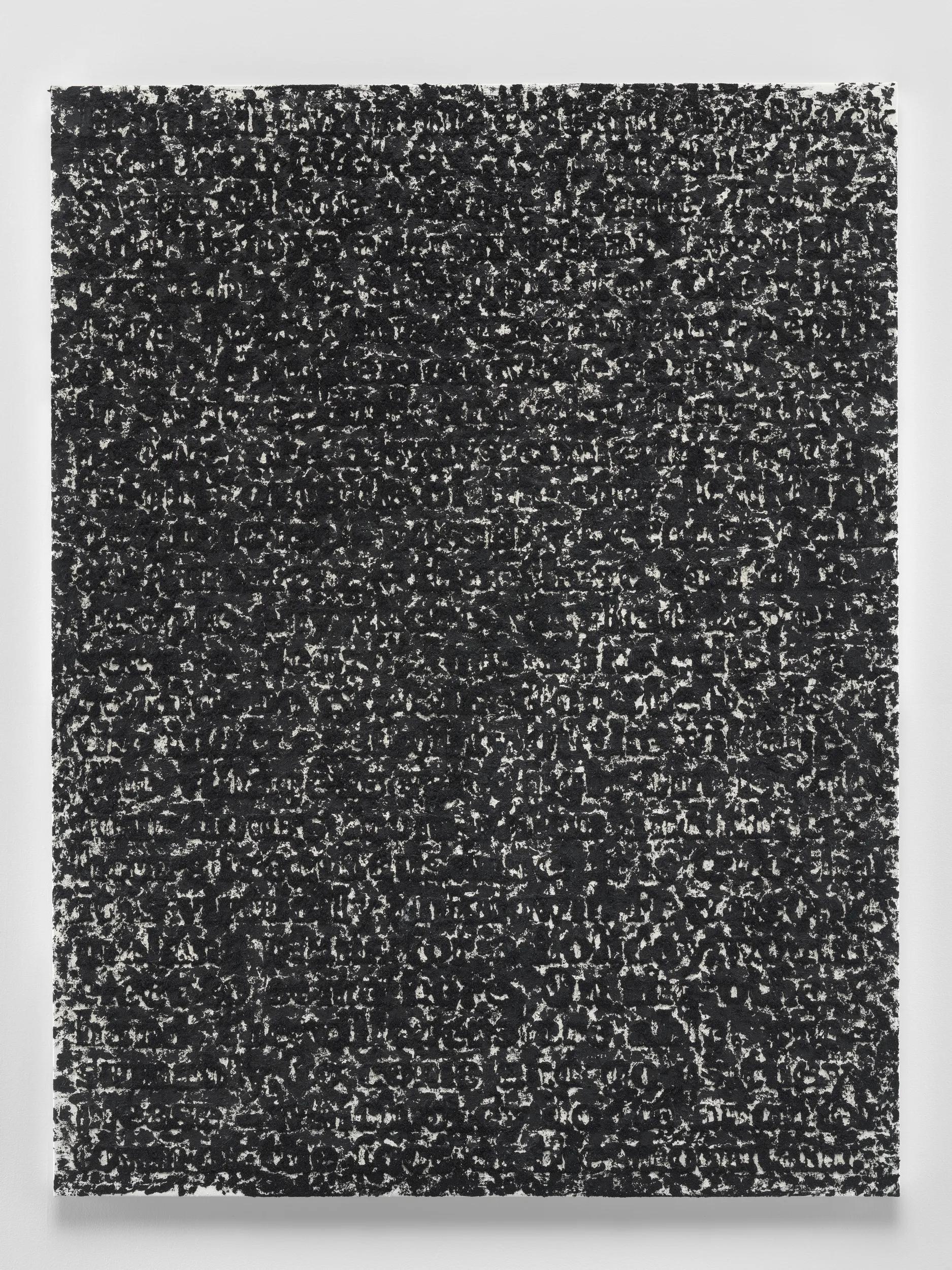
Glenn Ligon, Static #6, 2023, Oil stick, coal dust and gesso on canvas, 170.2 x 129.5 cm / 67 x 51 in © Glenn Ligon. Courtesy of the artist, Hauser & Wirth, and Thomas Dane Gallery. Photo: Ron Amstutz
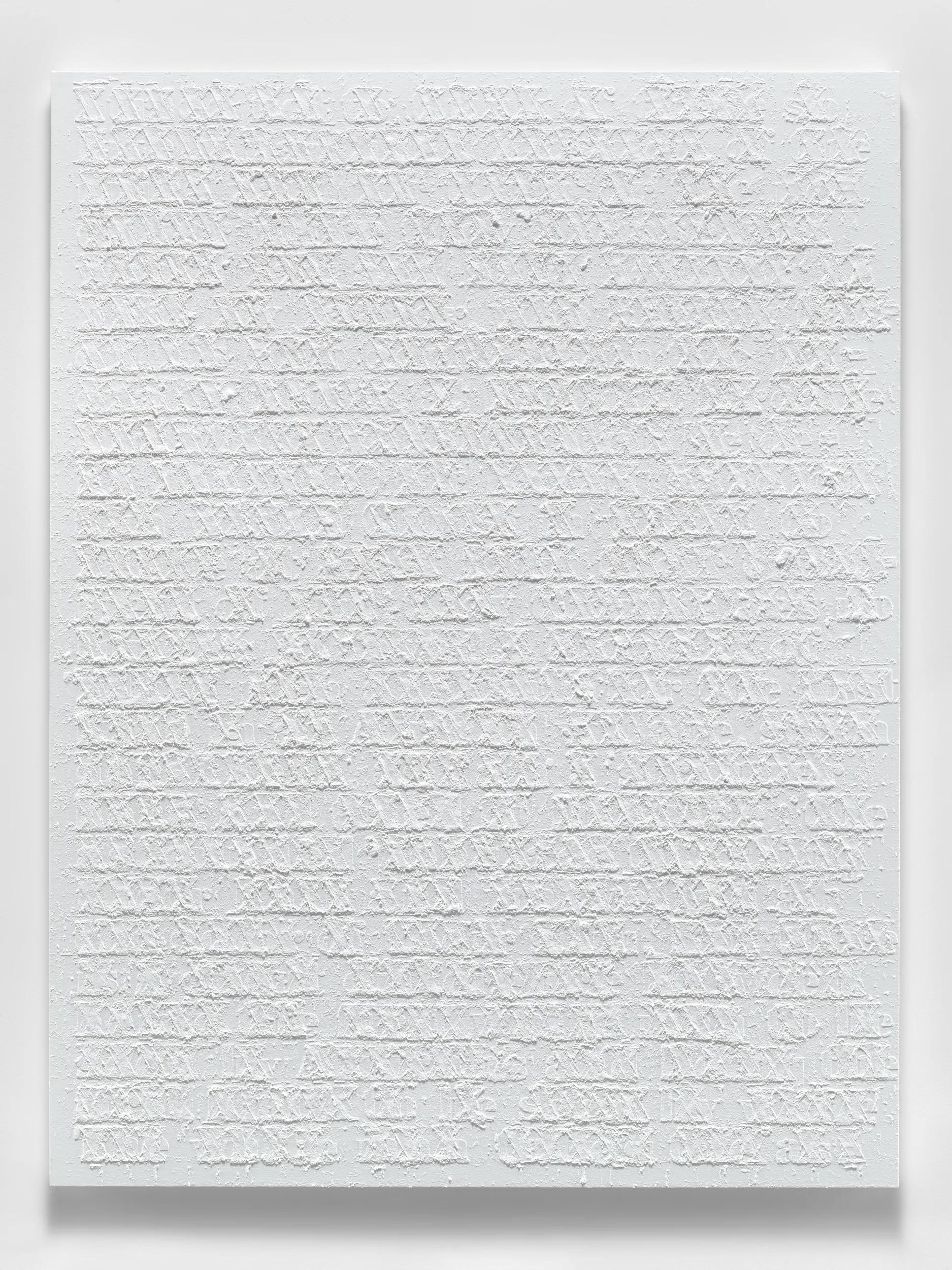
Glenn Ligon, Redacted #13, 2026, Oil stick and gesso on canvas, 170.2 x 129.5 cm / 67 x 51 in © Glenn Ligon. Courtesy of the artist, Hauser & Wirth, and Thomas Dane Gallery. Photo: Ron Amstutz
This deliberate tension between text and texture carries into the new painting from his Redacted series. Here, Ligon recontextualizes the texts by crossing out every letter with a recurring ‘X’ pattern. While this dense repetition dissolves the text into a rhythmic, non-linear composition, the ‘X’ motif itself introduces layers of meaning, simultaneously invoking institutional censorship, historical erasure and potent symbols of political identity.
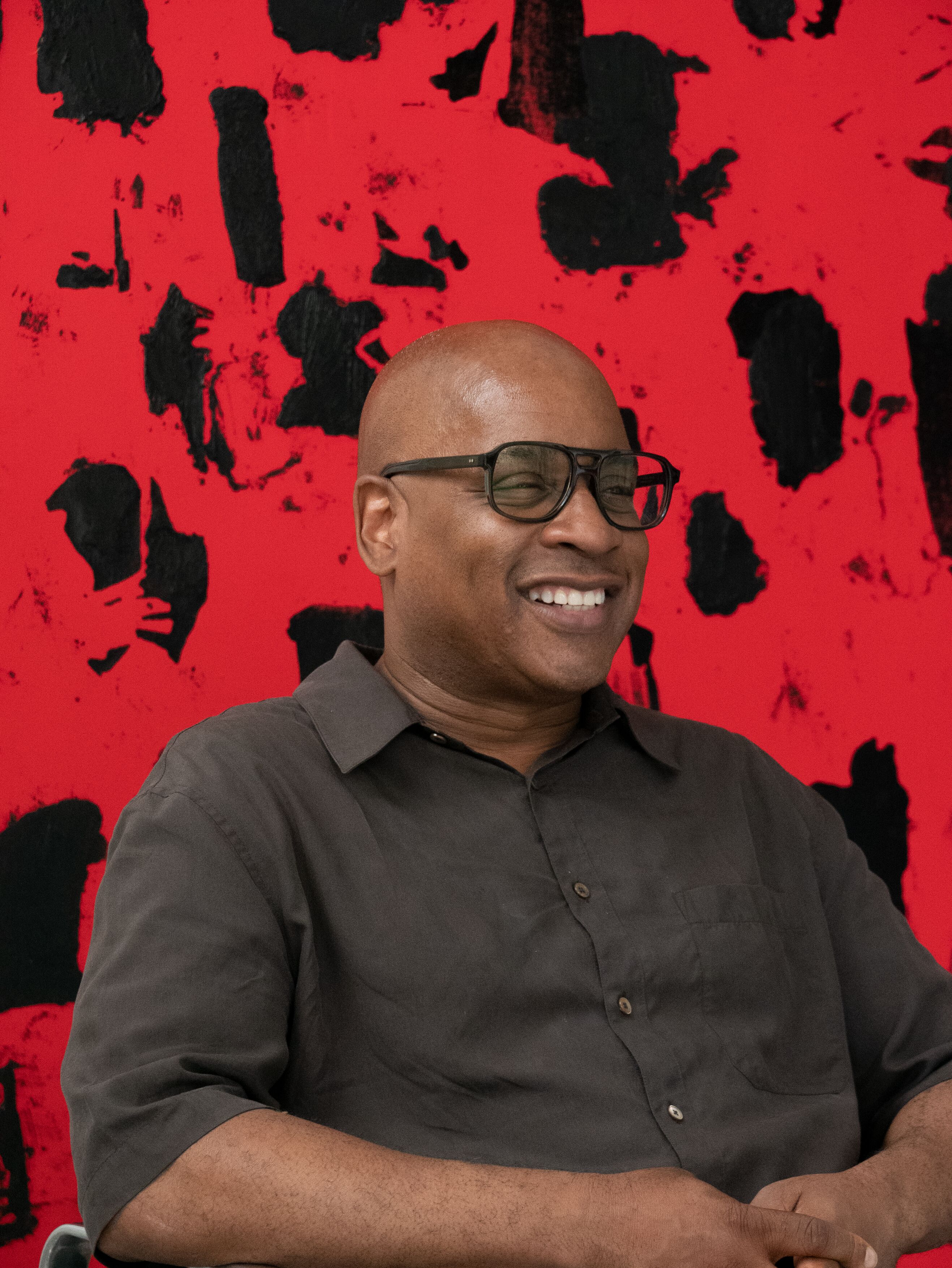
Glenn Ligon © Glenn Ligon. Courtesy of the artist, Hauser & Wirth, and Thomas Dane Gallery. Photo: Paul Mpagi Sepuya
About the artist
Glenn Ligon (b. 1960) is an artist living and working in New York. Throughout his career, Ligon has pursued an incisive exploration of American history, literature and society across bodies of work that build critically on the legacies of modern painting and conceptual art. He earned his BA from Wesleyan University (1982) and attended the Whitney Museum Independent Study Program (1985). In 2011, the Whitney Museum of American Art held a mid-career retrospective, ‘Glenn Ligon: America, organized by Scott Rothkopf,’ that traveled nationally. Important solo exhibitions include ‘Break It Down,’ Aspen Art Museum, Aspen, CO (2025); ‘All Over the Place,’ The Fitzwilliam Museum at the University of Cambridge, England (2024), ‘Post-Noir,’ Carre d’Art, Nîmes (2022); ‘Glenn Ligon: Call and Response,’ Camden Arts Centre, London (2014); and ‘Glenn Ligon – Some Changes,’ The Power Plant Center for Contemporary Art, Toronto (traveled internationally) (2005). Select curatorial projects include ‘Grief and Grievance,’ New Museum, New York (2021); ‘Blue Black,’ Pulitzer Arts Foundation, St. Louis (2017); and ‘Glenn Ligon: Encounters and Collisions,’ Nottingham Contemporary and Tate Liverpool (2015). Ligon’s work has been shown in major international exhibitions, including the Venice Biennale (2015, 1997), Berlin Biennial (2014), Istanbul Biennial (2019, 2011) and Documenta XI (2002).
–
‘Black Moons’ is on view at APMA Cabinet, Seoul, from 14 August to 5 September 2026.
Glenn Ligon's solo exhibition ‘Sit So Your Back Isn’t Against The Door’ will open at Hauser & Wirth Downtown Los Angeles on 30 September 2026.
Related News


1 / 5