
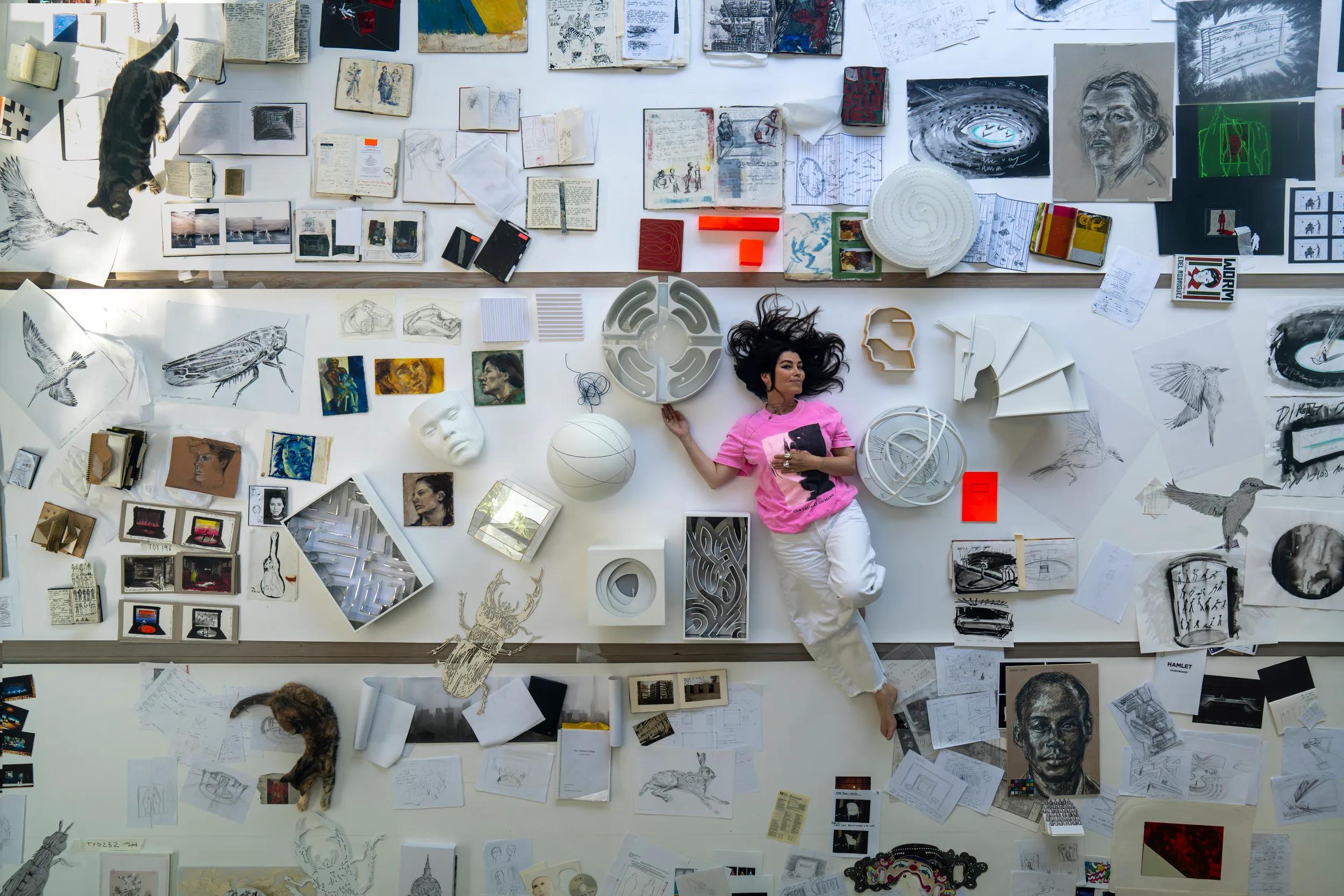
Portrait of Es Devlin. Photo: Daniel Devlin.
Book Launch & Talk: Es Devlin and Sarah Douglas on the release of ‘A Concise Atlas of Es Devlin’
Ursula Magazine is pleased to host a special book launch and talk celebrating the release of ‘A Concise Atlas of Es Devlin,’ from Thames & Hudson, with artist Es Devlin and Ursula Global Advisor Sarah Douglas.
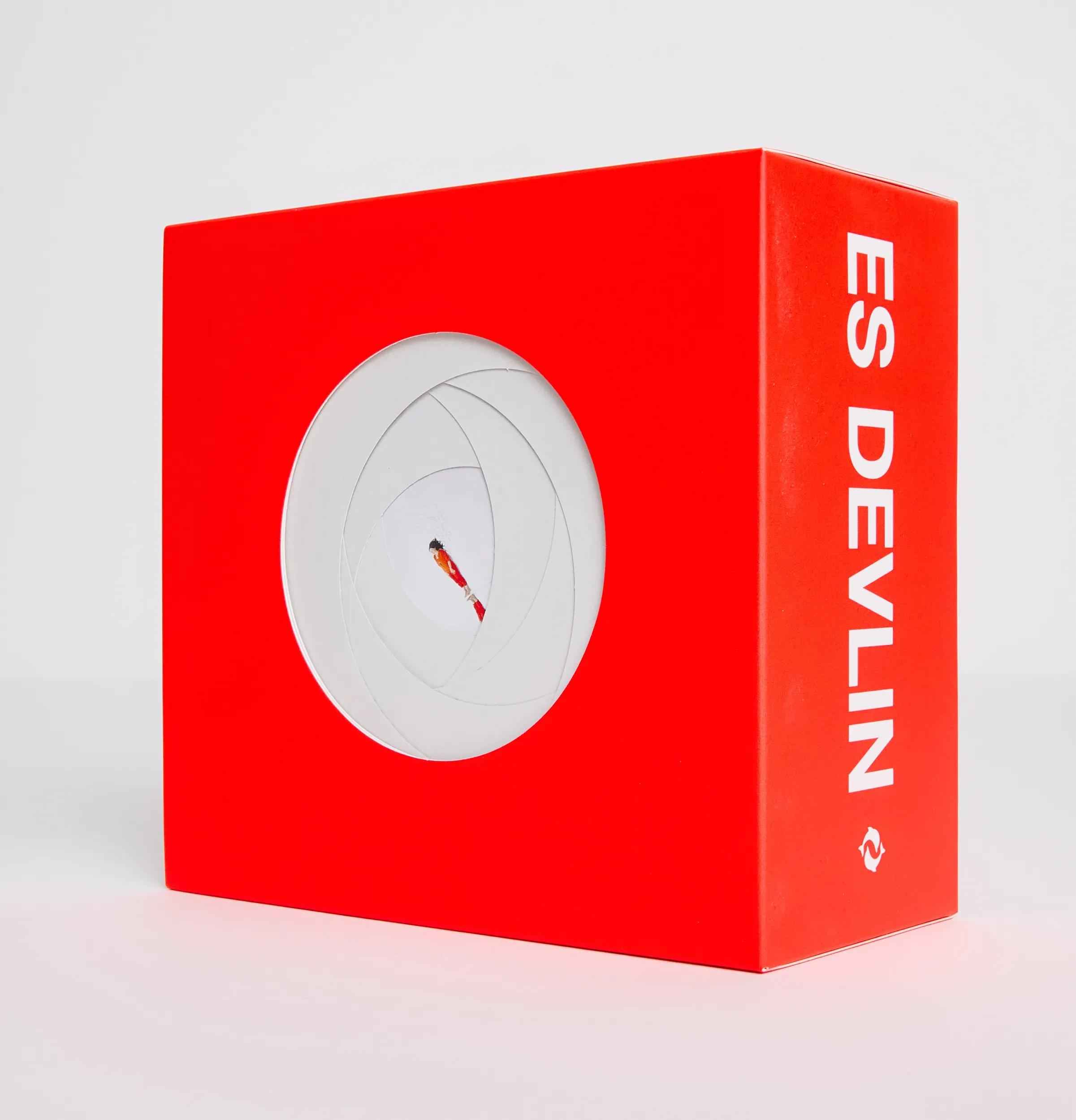
‘A Concise Atlas of Es Devlin’ brings all of the artist’s work together in one compact sculptural cube-shaped 1,000 color page volume to coincide with Devlin’s major retrospective at the Design Museum, London. Devlin’s protean work is rooted in a lifelong practice of reading and drawing. From sketches in the margins of texts—including poetry, drama, song lyrics, opera libretti, climate reports, and endangered species lists—emerge the technically advanced, collectively imagined universes for which she is globally renowned. Fragile miniature paintings, paper cuts, and small mechanical cardboard models form the seeds of some of the most iconic, large-scale, multidisciplinary cultural manifestations in recent times, from public sculptures and installations outside Tate Modern and the Lincoln Center, to kinetic stage designs at the Metropolitan Opera, Olympic ceremonies, Super Bowl halftime shows, and monumental illuminated stage sculptures for globally celebrated musicians.
Devlin’s work is at once deeply personal and inherently collective. Over the past decade, her art practice has engaged with biodiversity, linguistic diversity, and collective AI-generated poetry. She views the audience as a temporary society and encourages profound cognitive shifts by inviting public participation in communal choral works.
Following the award-winning success of ‘An Atlas of Es Devlin,’ originally published in 2023 with a retrospective exhibition at the Cooper Hewitt, Smithsonian Design Museum in New York City, ‘A Concise Atlas of Es Devlin’ is both contracted in size while expanded in extent, featuring 30 new projects from her recent output, showcasing an artist committed to exploring the limits of the visual arts. Spanning over thirty years of creativity, the tome features Devlin’s personal commentaries on each work, as well as interviews with her collaborators, including Hans Ulrich Obrist, Bono, Benedict Cumberbatch, Pharrell Williams, Carlo Rovelli, Brian Eno, Sam Mendes, Alice Rawsthorn, Neil Tennant, and Abel “The Weeknd” Tesfaye, among many others.
Copies of ‘A Concise Atlas of Es Devlin’ will be available for purchase at the event, and Es Devlin will sign books after the talk.
This event is free; however, due to limited seating, reservations are required.
About Es Devlin
Es Devlin (born London 1971) is genre-defying artist whose work spans sculpture, performance, drawing, language, and light. Devlin views an audience as a temporary society in which new perspectives can be rehearsed. Her luminous public artworks invite participation in communal choral works at major sites and institutions including V&A Museum, Trafalgar Square, Tate Modern, Serpentine, National Portrait Gallery,
Imperial War Museum, and Lincoln Center Plaza. Her practice has been documented in retrospective exhibitions at the London Design Museum, Cooper Hewitt Smithsonian Design Museum, Casa Bradesco São Paulo, Futura Seoul, Powerhouse Parramatta, Sydney, and ArtScience Museum Singapore. Her kinetic stage sculptures in theaters, opera houses, arena, and stadia have redefined the art of performance design in collaboration with the world’s most celebrated musicians. A fellow of the Royal Academy of Music, Devlin serves as Visiting Professor of Contemporary Theatre at the University of Oxford. Instagram: @esdevlin
About Sarah Douglas
Sarah Douglas is Global Advisor to Hauser & Wirth’s magazine, Ursula, a consultant at the Steve Jobs Archive, and an agent for Martino Gamper. She was previously Editor-in-Chief and Creative Director for Wallpaper*, and prior to that Art Editor at The Architects’ Journal. Sarah is on the board of trustees of Studio Voltaire in London, the ITS Arcademy in Trieste and is committed to supporting the next generation of artists, designers and creative thinkers. She has hosted talks and panel discussions around the world such as at COP26 and Salone del Mobile, and judged numerous global art and design competitions including the London Design Medals.
About Thames & Hudson
Thames & Hudson was established by Walter Neurath who was born in Vienna, Austria, in 1903. He left that city, where he ran an art gallery and published illustrated books with an emphasis on education, arriving in London in 1938. He initially worked as production director of Adprint, a business established by fellow Viennese émigré Wolfgang Foges. Neurath and Foges went on to pioneer the concept of what is today known as book packaging, in which book ideas are conceived, commissioned, produced, and sold to publishers in different markets in their own languages and under their own imprints (co-editions) in order to create large print-runs and lower unit production costs. Neurath’s concept was the first sign of many innovations that through Thames & Hudson he would later introduce to the world of publishing.
Wishing to take co-edition book packaging further and recognizing the need to amortize the high production costs of illustrated books, Neurath established his own publishing house, incorporating offices in London (at 244 High Holborn) and New York in the autumn of 1949. Thus arose the company name, Thames & Hudson, the rivers represented by two dolphins symbolizing friendship and intelligence, one facing east, one west, suggesting a connection between the Old World and the New. Eva Neurath, who had arrived in London in 1939 from Berlin (she was at that time married to Wilhelm Feuchtwang) and worked alongside Neurath at Adprint, co-founded the company as partner.
Among the ten titles that were published in Thames & Hudson’s first publication season in 1950, English Cathedrals, with photographs by Swiss Martin Hürlimann (who went on to create over twenty titles for the company), was the first and most successful. A testament to the company’s strong belief from the very start in the longevity of books, it remained in print until 1971. Also appearing in the first year of publication was Albert Einstein’s Out of my later years, an early indication of the publication programme’s breadth.With the gradual and successful expansion of the list, which grew from ten titles in 1950 to 144 in print in 1955, the company outgrew its High Holborn offices and moved in 1956 to a Georgian townhouse at 30 Bloomsbury Street, just off Bedford Square, then the epicentre of London publishing activity. The company remained at that address, eventually expanding to five houses, until 1999.
About Ursula Magazine
Ursula is a quarterly magazine published by Hauser & Wirth that celebrates the artistic achievement and creativity of the gallery's artists and those beyond. Through the printed magazine, digital content platform and live programs, Ursula champions artistic practices that challenge and interrogate the future, highlighting a diverse range of contemporary culture that Hauser & Wirth finds compelling. Featuring stories from the worlds of art, design, film, books, food, and sustainability, Ursula invites readers to think critically, ask questions, and engage with the ideas shaping our world. Written in a sophisticated yet accessible style, Ursula appeals to a broad, inquisitive readership, from dedicated insiders to curious observers. ‘It has always been our mission to make the gallery a home for our artists where other thinkers, writers, and visionaries can also gather and engage,’ gallery President Iwan Wirth told Artnet News. ‘Now Ursula will be an editorial home as well, a truly global magazine that reflects our philosophy.’

