
Essays
Upright, But Only Just
Phyllida Barlow unsettles the grandeur of Wolterton
By Clare Lilley
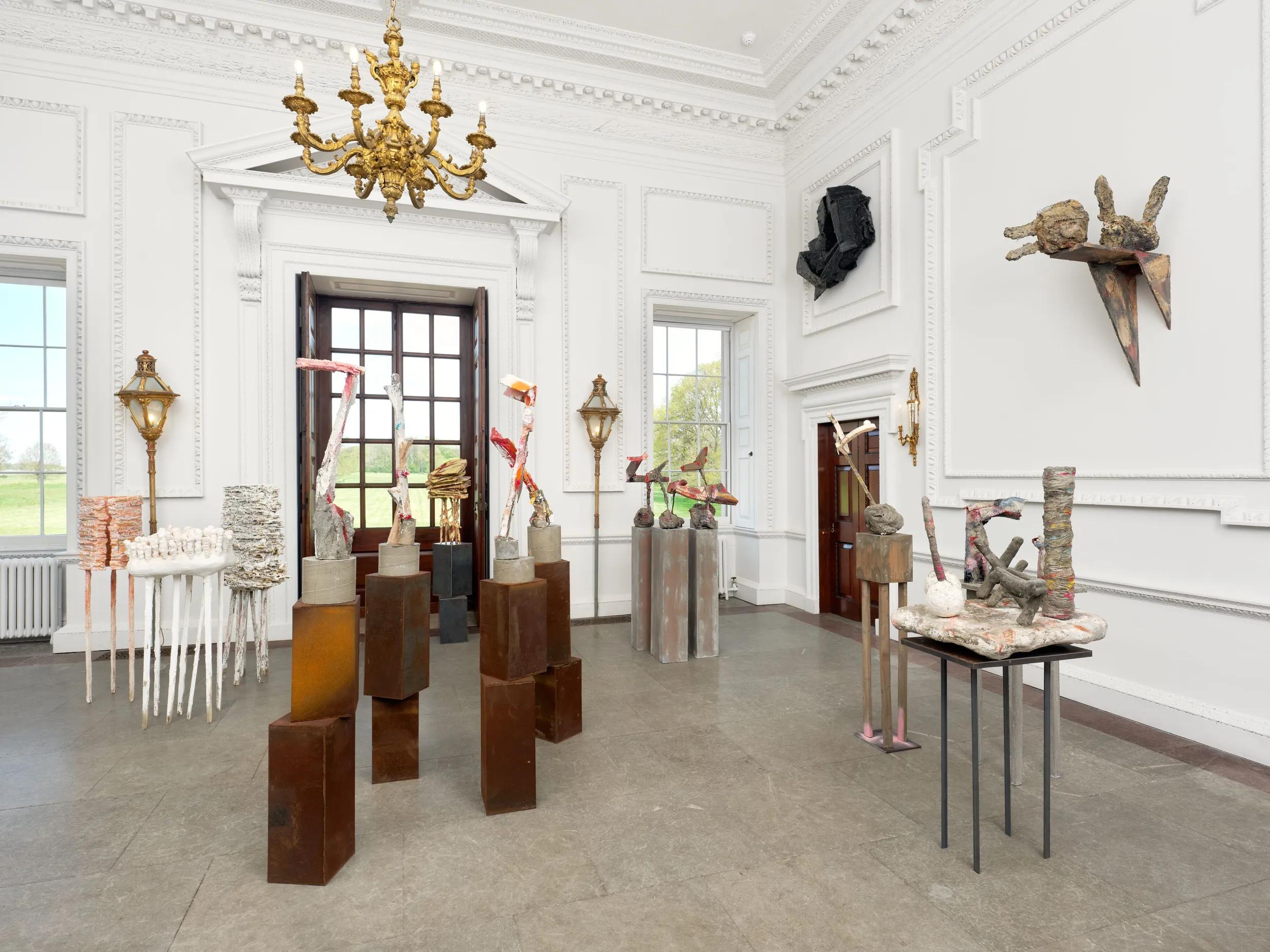
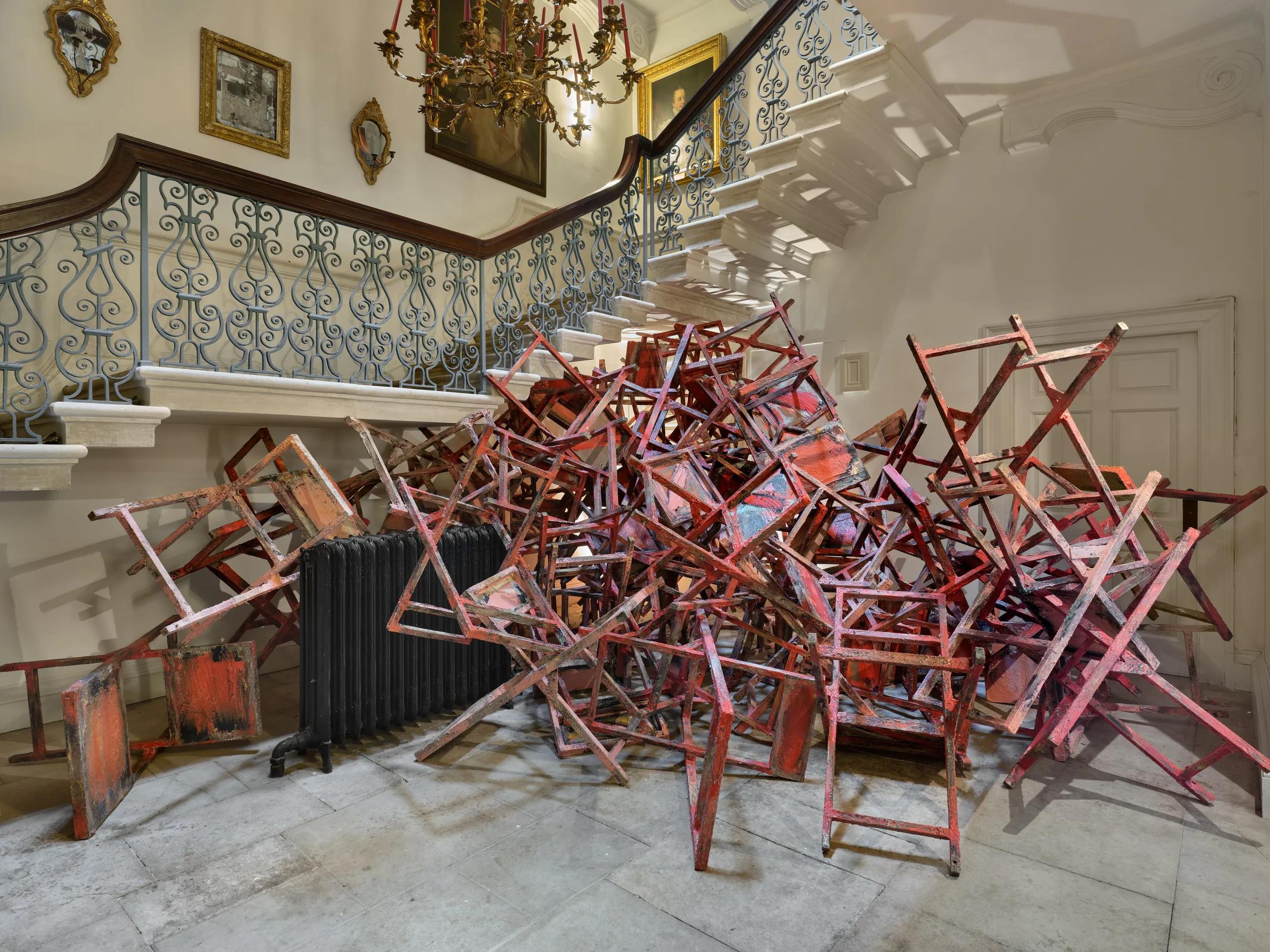
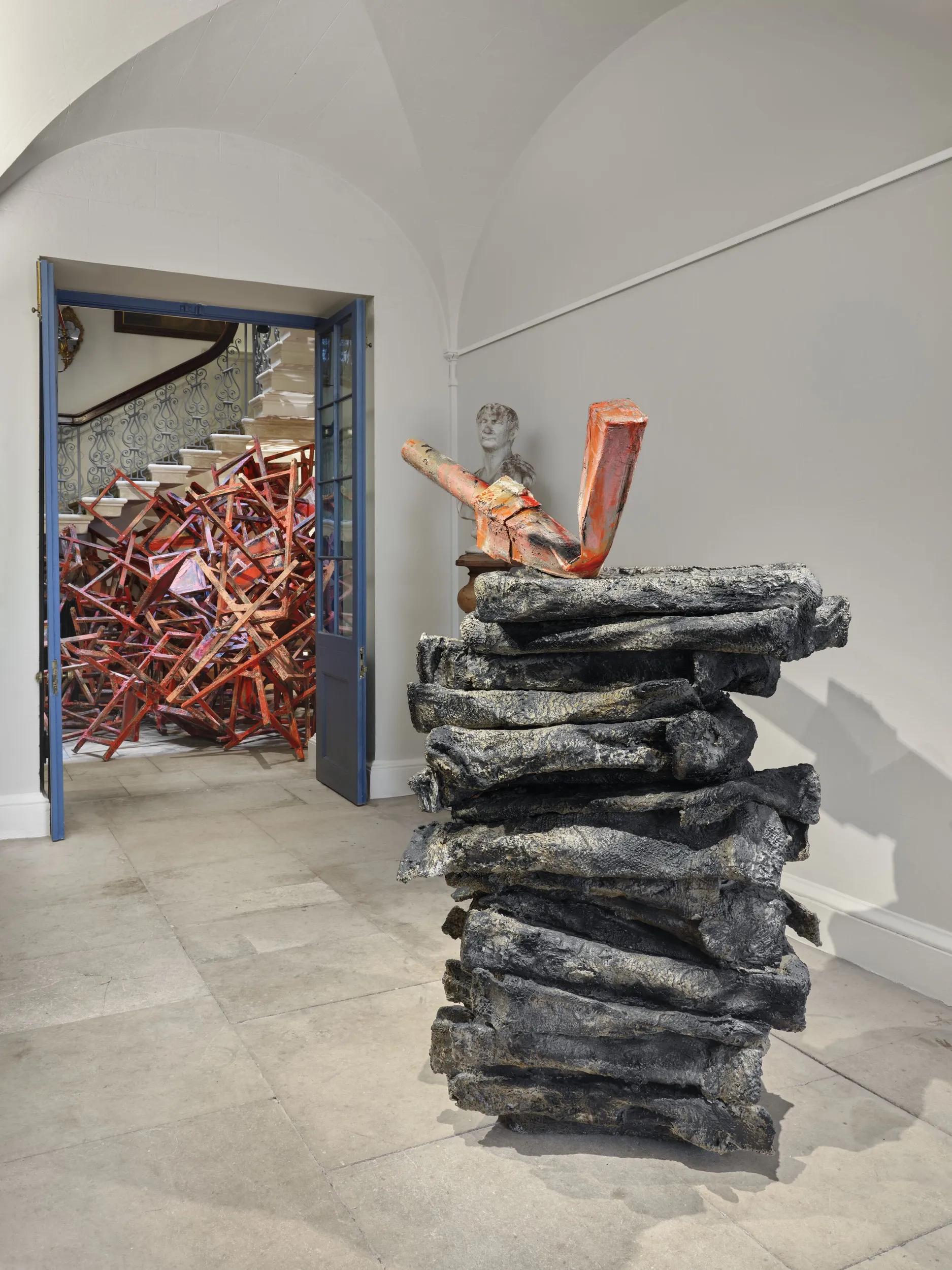
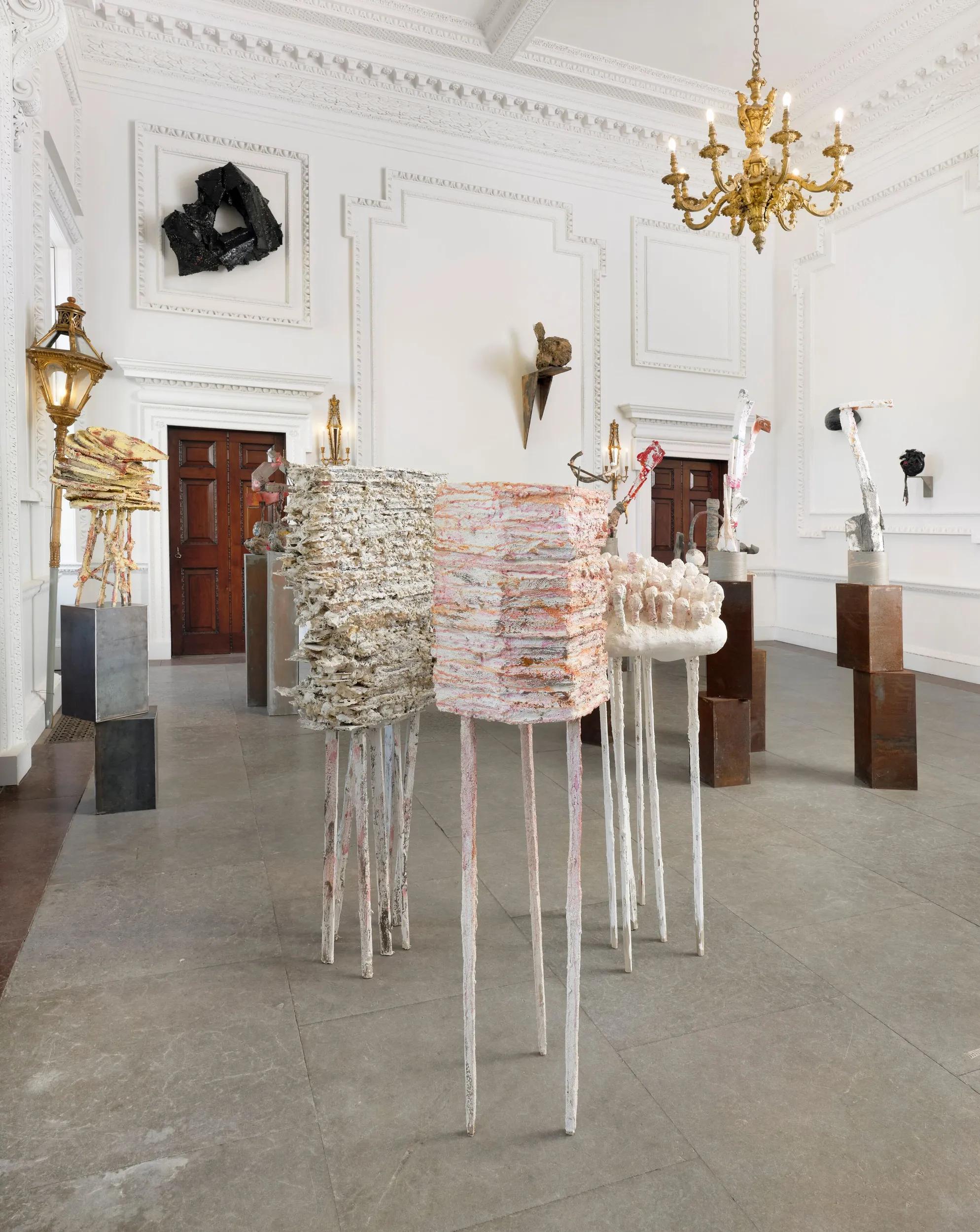
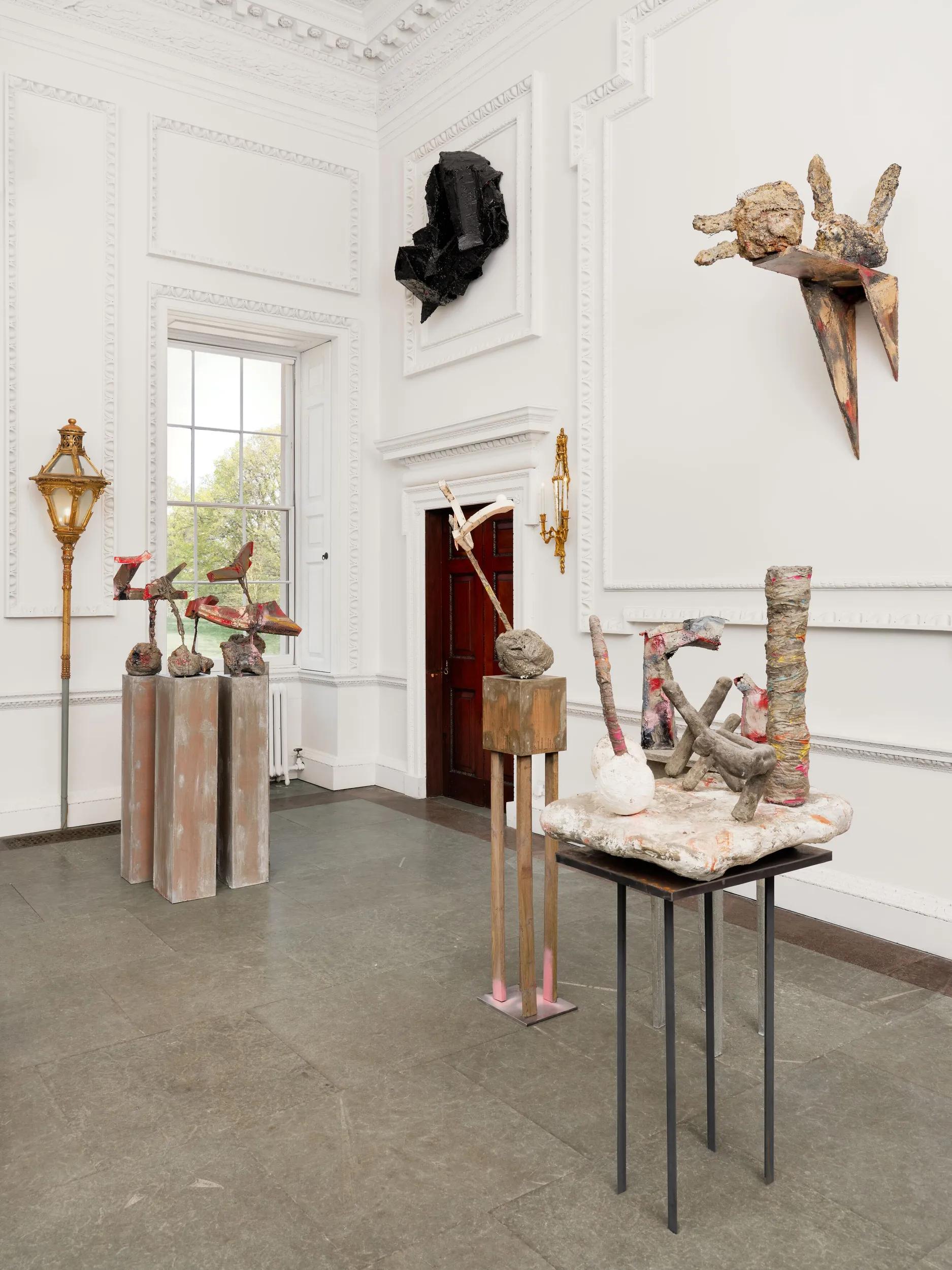
Installation views of “Phyllida Barlow: disruptor,” Wolterton, Norfolk, United Kingdom, 2026. Photos: Eva Herzog. Artworks © Phyllida Barlow Estate
At Wolterton, the sculpture of Phyllida Barlow seems perpetually on the verge of becoming something else: a tower, a body, a joke, a collapse. “I’ve become more and more interested in the breakdown of logic and the breakdown of meaning,” Barlow once said, likening the work of sculpture to “an archaeologist finding a fragment” whose place and purpose cannot be easily identified. Meaning, she suggested, might be liberated from explanation and become instead “evidence of a time, and an action, and a mental and physical process.”
This is a useful place to begin at Wolterton, a house conceived as an architecture of assurance. Rooted in the Palladian tradition, Wolterton performs authority through symmetry, procession and measured ornament. It is a building that knows how to stand, receive and endure, as it has since it was commissioned by Horatio Walpole in the mid-18th century.
Barlow’s sculpture enters this world as a late arrival: precarious, materially insistent, sometimes obstructive, always alert to gravity and risk. At Tate Britain, the Royal Academy of Arts and the British Pavilion at Venice, she treated buildings not as backdrops but as structures to be contradicted from within. At Wolterton, beneath the cantilevered staircase, untitled: stackedchairs (2014) makes the entrance stutter, but the exhibition’s center of gravity lies in the Marble Hall, where a forest of sculptures gathers and wall works perch, bulge and extrude from the plaster walls.
Among these are pieces gathered under the term “plinth works,” though this describes less a fixed category than a recurring condition in Barlow’s sculpture: the raised object, the compromised support, the tower that behaves like a plinth, the plinth that becomes a body. Earlier works in the room show how persistently she had worried at this condition. In untitled: catch (2016) and untitled: offcuts (2016), support is already unstable, overburdened or faintly theatrical; the plinth does not disappear but becomes a stage, a prop, a joke with serious consequences. It raises the work only to implicate itself in the act of raising.
The 2020 works extend this thinking into a more architectural and anthropomorphic register. The sculptures linteltower, lookouttower, cappedtower, stumptower and mantelstacked—all prefixed by “untitled”—are raised to eye level by precariously stacked steel boxes: the plinth-turned-sculpture-turned-plinth. References to Brancusi’s Endless Column and abstract steel sculptors of the 1960s and ’70s are inevitable—and a little cheeky.
They sit alongside untitled: townie (2020), lockdown 5b (2020) and a group of many-legged, white or pale-pink sculptures containing words such as fringe, hold and nibs (all 2021). Quite different from the tower works, they too are held aloft but now by metamorphosed table forms or insect-like legs. Even townie, with the most obvious table support, has legs that are far too inset for comfort, as if toppling may not be an accident but a possibility fully under consideration.
Created during and just after lockdown, these works belong to a private rhythm of making. They emerged not from the large studio spaces associated with Barlow’s monumental installations, but from a small, enclosed area of her studio. There, she immersed herself in something direct and physical: making by hand, at close range, without the machinery of scale. On entering Wolterton, her family saw some of these works for the first time, giving them a special emotional charge.
A pedestal is never neutral. It tells us that something has been authorized, valued and raised above ordinary ground. Modernism often sought to dismantle that authority, insisting instead on sculpture’s direct relationship to real ground and space. Barlow’s engagement with the plinth is therefore quietly subversive. She reinstates this discarded emblem of elevation and value only to make it unstable, exposing the hierarchy it was designed to uphold.
Her own words make the stakes plain: “As soon as something stands upright it starts to pretend it has power, and that’s when I want to undermine it.” The remark serves as a key to her presence at Wolterton. Uprightness is embedded everywhere in the house. Barlow’s plinth works enter but refuse its manners.
Their titles widen the field from architecture into character. A lintel carries weight over an opening; a lookout tower promises vigilance and command; a cap completes but also suppresses; a stump is what remains after cutting; a mantel suggests hearth, ledge, shelf, display. Works like townie, fringe, hold and nibs bring in something more bodily, social and oddly human: attitude, edge, protrusion, embrace, a fringe of matter. Even nibs carries a faint social echo—“his nibs”—as if self-importance is gently teased in this cluster of soft, insistent forms.
The wall works on ledges sharpen this sense of character. untitled: scowl (2021) and untitled: flash (2021) perch like compressed incidents or sudden moods. Their ledges act as miniature stages: scowl darkens into expression; flash seems to flare and signal. They extend the logic of the floor-based works sideways: Support is rudimentary, matter is animated and the room feels inhabited by a crowd of difficult, vulnerable, watchful things.
This “only just” quality is central to their power. The works stand before us as negotiations with gravity. If their supports seem too thin and leggy, their upper forms are burdened, bandaged, capped or clotted. Plaster and cement suggest weight, while polystyrene, scrim, fabric, foam and PVA introduce hollowness and fragility. They oscillate between object and body, load and collapse. Their jokiness is edged because it understands fragility.
“I want sculpture to be as awkward as possible, to feel unstable, as if it might fall apart,” Barlow once said. Awkwardness is not theatrical; it is ethical. Sculpture should not pretend to timelessness. It should register its conditions of making, its exposure to gravity. At Wolterton, Barlow’s awkwardness becomes a form of truth-telling, ungainly candor in a room that knows exactly how to behave.
Touch is crucial to this truth. Barlow recalled going into the studio late at night, turning off the lights and arriving at a pivotal shift: making “not through an image, but through touch.” Haptic encounter replaces image-certainty. The seams, fastenings, tape, makeshift joins and wrapped surfaces visible in her work are traces of decisions taken in real time. Her sculptures broadcast handling and do not conceal labor. They have elbows, scabs, shoulders, bad days. They are sometimes funny because they are so recognizably vulnerable, as people are.
This tactile logic clarifies why the plinth works refuse polished authority. Barlow said, “I want sculpture to feel physical, to register in your body before you think about it.” Palladian architecture addresses the body by disciplining it through proportion and expectation; Barlow addresses the body by interrupting it. Her works make one aware of looking up, bending down, stepping around, measuring one’s own balance.
Color intensifies the encounter. “Colors are bright and high visibility—they are expedient, and I use that word a lot in relationship to my aesthetic decisions,” Barlow observed. Color does not behave as finish; it acts as alert, structure, warning, repair. At Wolterton, these hues do not harmonize with the setting but make the historic interior feel momentarily under adjustment, mid-occupation. Whites are chalky and dusty; grays and blacks industrial, burned or tarred; pinks and fleshy passages hover between mischief and tenderness.
Barlow’s work at Wolterton offers contingency against permanence. Against symmetry, a lean. Against polish, a seam. Against the pedestal’s old command—look up, admire, keep distance—she proposes a more unstable relation: come close, move around, feel the weight, notice the doubt. Her works stand, cling, block, stack, cap, stump and erupt. They are upright, but only just. And in that tremor between assertion and failure, they are alive.
–
“Phyllida Barlow: disruptor” is on view at Wolterton until October 31, 2026.
Clare Lilley is a British curator, writer and cultural advisor working internationally with leading artists to realize ambitious, critically acclaimed projects that connect diverse audiences with contemporary art while generating economic, social and human impact. Formerly director of Yorkshire Sculpture Park, she curated Frieze Sculpture for a decade and projects for the Venice Biennale. Her practice is grounded in cross-cultural exchange and a conviction that art creates meaningful social, spatial and intellectual encounter.