
Conversations
Post-AI Painting
Avery Singer in conversation with Dieter Buchhart
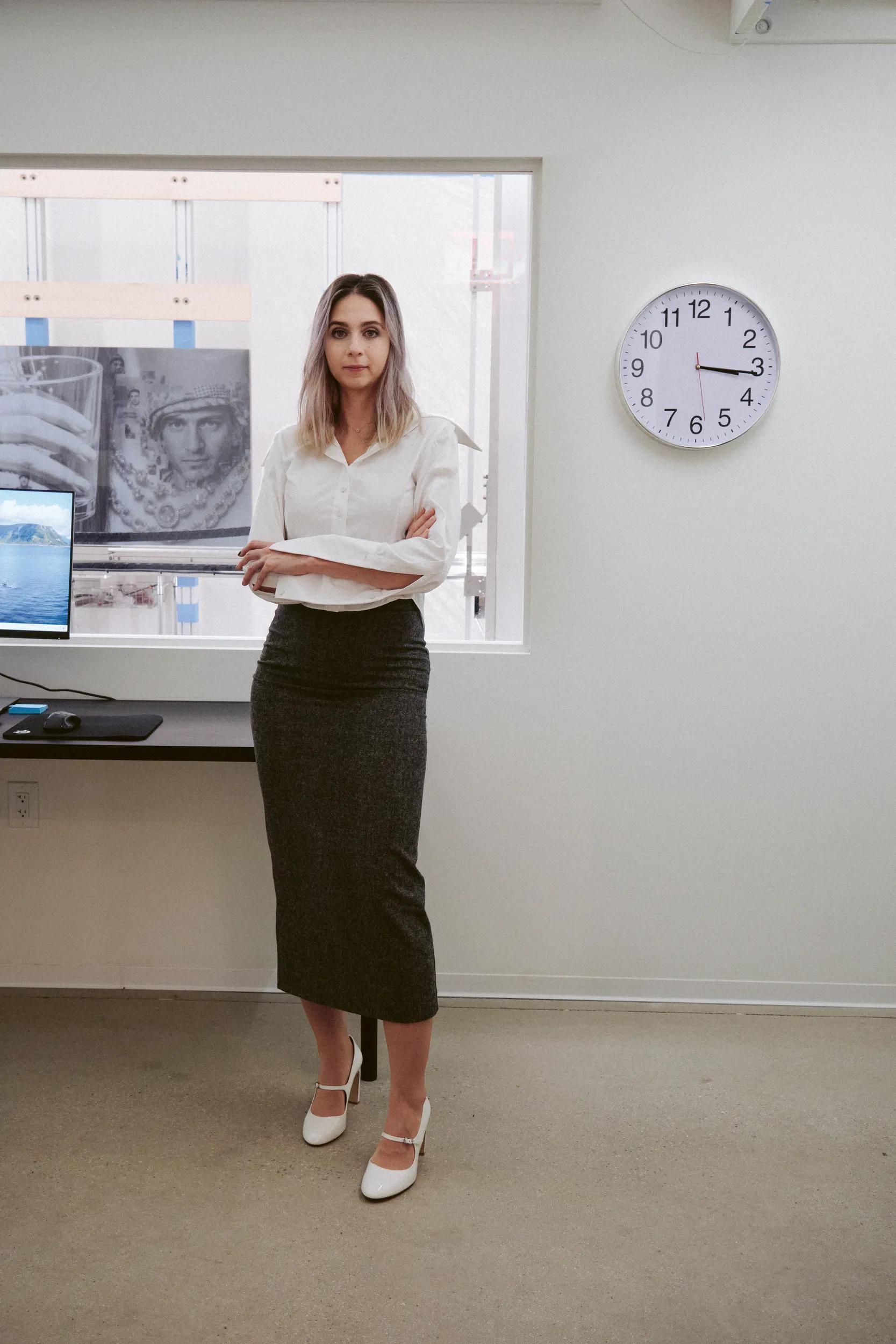
Avery Singer in her Brooklyn studio, 2026. Photo: Christian DeFonte
Avery Singer—whose work has been shaped by her interest in the relationship between painting and technology—has in recent years been creating increasingly complex, site-specific installations. For her new exhibition “War_overlays” at Hauser & Wirth Zurich, Limmatstrasse, Singer has transformed the gallery’s upper floor into a casino-like environment, overlaid with an atmosphere of surveillance and control. In new paintings, the figure of the poker player, a frequent protagonist in her recent work, emerges as a proxy for the artist: solitary, strategic and ever attuned to risk.
To make these new paintings, Singer worked with AI-based tools to generate source imagery, drawn in part from contemporary warfare and its related visual culture. Ahead of the exhibition, she sat down with art historian and curator Dieter Buchhart for a wide-ranging conversation about AI, the instability of contemporary imagery and what it means to be an artist in the 21st century.
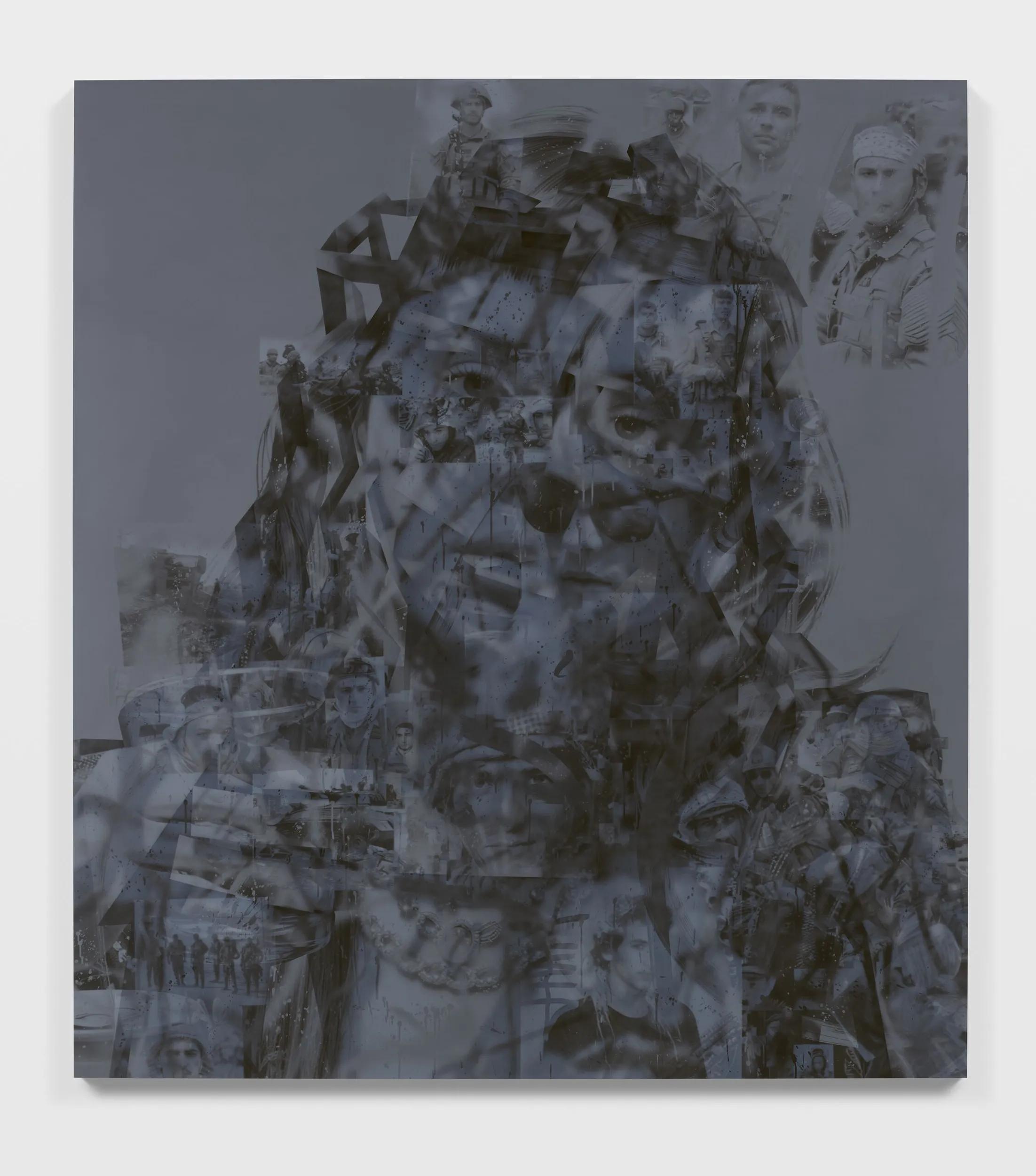
Avery Singer, Solver, 2026 © Avery Singer. Photo: Lance Brewer
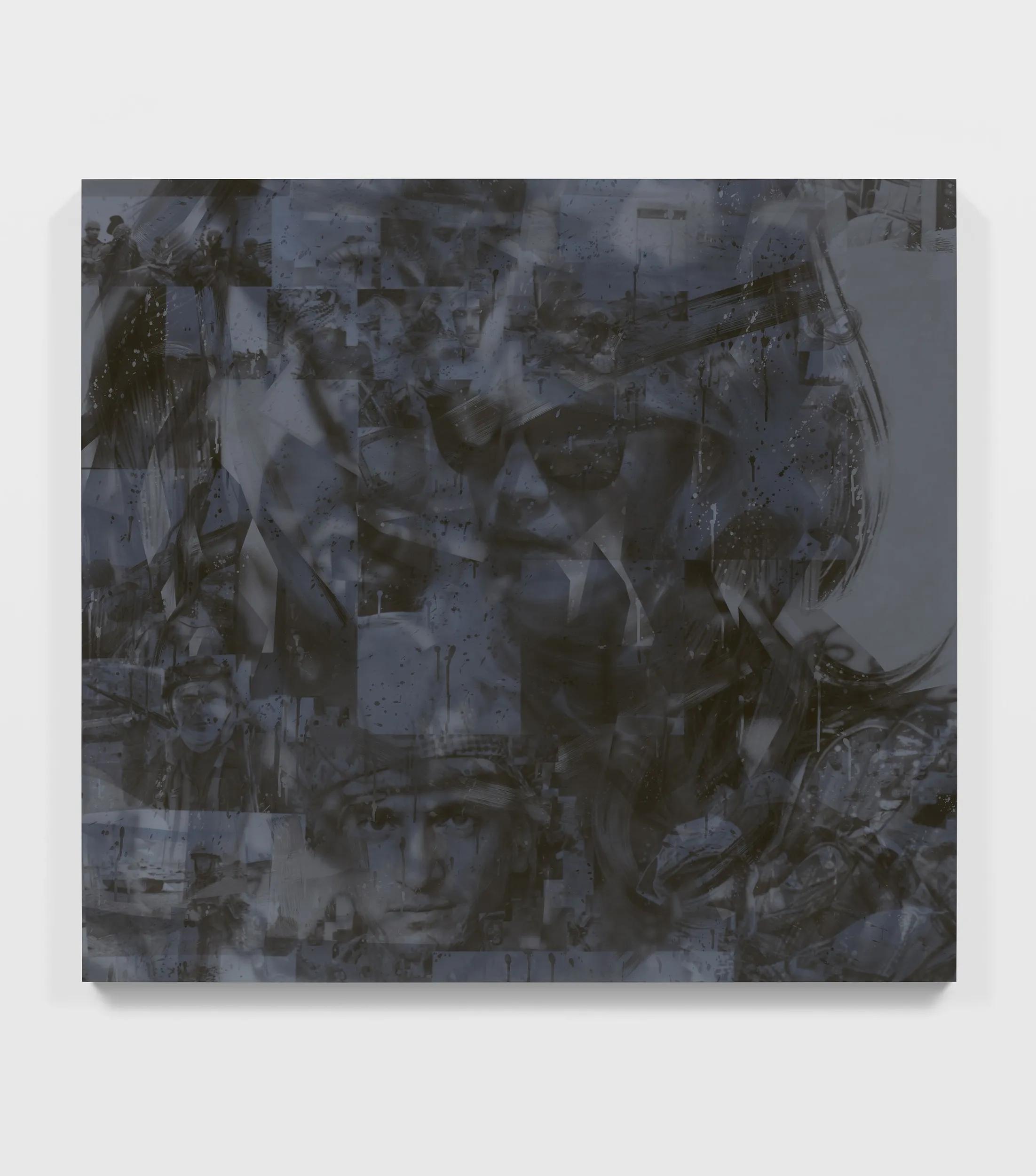
Avery Singer, Solver (v.1), 2026 © Avery Singer. Photo: Lance Brewer
Dieter Buchhart: You have started to address questions of AI in your recent work. But in some ways you were already working in a post-AI manner. What does this mean for you as an artist?
Avery Singer: I think what we’re going to enter is a post-AI art movement. Maybe we’re already there in a way. “Post” really means that something has sufficiently taken root in our culture to the point that it’s unavoidable. I think that younger artists will be working with AI a lot. But I think also artists of my generation, millennials, can get into it as well. I’m curious about it. And I have a lot of questions. If I use AI as a tool, how does it change my work? Is it going to make the work different? Is that change interesting? Is it relevant?
As AI becomes more intelligent, you’re also going to have a question of authorship. If it is truly becoming as intelligent as—or more intelligent than—me, and it’s able to think on its own and produce its own work, can I still put my signature on something and say, “I had all the ideas here”?
DB: Copyright is already a complicated question in art. But do you think AI will make it harder to define authorship in the future?
AS: People are concerned that their work can be replicated by AI because it can study photographs, digital imagery, text. But artists are already copied all the time. Once, I was walking down the street in my neighborhood, and I looked in a window and there was an exhibition by a guy who was clearly copying my work. Things like that happen, and there’s nothing we can do about it. When people worry about AI, I think, “But a human could do it to you, too.”
DB: In recent exhibitions, you’ve been working more in installation—creating total environments around your work. When did you begin to conceive of the exhibition space as a medium?
AS: After I did my show at Hauser & Wirth in New York in 2021, I started to think about how in these galleries—these pristine white cubes designed by prominent architects—the architecture can start to overwhelm the art. I thought it might be interesting to try to “downgrade” the architecture. I started thinking about waiting rooms and doctor’s offices, these basic spaces that everyone has been in. This type of architecture is not as rarefied as gallery architecture. I thought it would be interesting to see what happens to art when you put it in an environment like that, because it’s not where you would expect to see it.
DB: For your upcoming exhibition at Hauser & Wirth Zurich, you’ll install a casino-like space in the gallery. What drew you to the casino as a framework?
AS: I have a few friends who are painters and who supported themselves playing poker until they had art careers, or who just love gambling and love going to the casino. I started thinking about it—there’s got to be something about the painter’s brain and gambling. Painters tend to have very addictive personalities, and it’s always intrigued me. Then I went to the casino in Monte Carlo for the first time and thought that the architecture was incredible. But I was struck even more by the surveillance technology. Every pore of my skin was being recorded in there. We’re essentially always being recorded now, but I loved how exaggerated this was at the casino. I thought it would be an interesting thing to try to make people aware of in an exhibition.
Video: Christian DeFonte
DB: You could say that the casino is a metaphor for an algorithmic society—prediction, surveillance and risk.
AS: Yes. That’s a good way to sum it up.
DB: You’ve also made several portraits of poker players. What drew you to these figures as subjects?
AS: I started watching professional poker tournaments and learned about a poker player named Cate Hall. I paid attention to the techniques she used. She would study the pulse rate on the opponent’s neck to understand their emotional response to their hand. I don’t know if that’s a common technique, but it felt like being an artist. There are all these secret little things that we’re paying attention to on this global stage. I got really interested in thinking of the players as a kind of metaphor for artists. Poker is a solitary sport; you play for yourself alone. The players are exposed and scrutinized and surveilled. They are mediating risk and risk-taking behavior, which is what I think artists do, too. That’s the fun and also the freedom of being an artist. I don’t know, I just saw myself in them. Then I started to make paintings based on images I found online of women playing poker. I superimposed imagery on top of them to reflect the distracting thoughts and worries that inspire you when you work in the studio.
DB: Can you talk about the new paintings you’re going to show in Zurich?
AS: I worked with AI to generate visual material that I could incorporate into the paintings. These paintings layer AI imagery on top of hand-painted, digitally inspired material. In between each layer of paint is liquid rubber that I’ve applied very sloppily by hand, to signal that this is a painting—not a printout or a digitally produced object. I paint representationally, so I was searching for a subject that was a good metaphor, a metaphor I could identify with, and I found one in the poker players. I thought the paintings might give off an “uncanny valley” feeling—that eerie emotion generated when something looks almost human. I think that’s what I was going for with it. I thought it would be interesting if the viewers could look at the paintings and recognize an AI system that was malfunctioning. Maybe there’s poetry to be found in the breakdown of this highly developed technology.
DB: Can you describe the process of working with AI to generate these images?
AS: Let’s say I get twenty photos of you. I give the AI these photos and it gives me a digital likeness of you. Now I have the Dieter character, and I can do anything with your image. I can ask ChatGPT to make you into an American soldier, to make a female version of you. I could make a child version—whatever. For the new works, I did this and made a digital character for each poker player I was depicting. I also made one of Daniel Pearl, the American journalist who was kidnapped and murdered in Pakistan in 2002. His death is one of the enduring images from that time period, which I’ve been exploring in my work recently. But I forgot to pay attention to the gender when I was describing Pearl and I accidentally made a female version of him. I was looking at the image and thought the female Pearl looked like me when I was younger. So I had it give her my painting sweatshirt and my stained hands. Now I’m in the painting too.
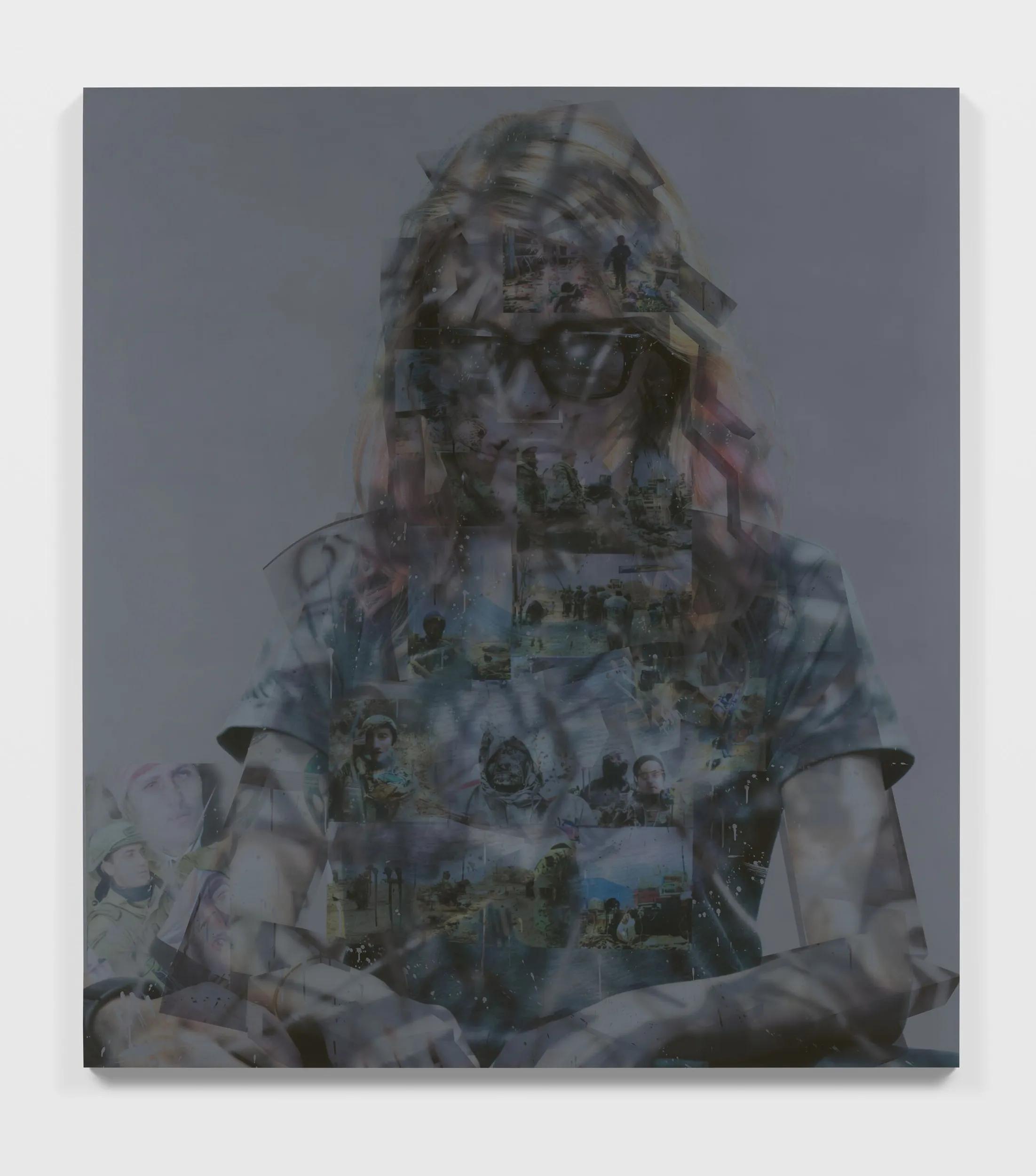
Avery Singer, Cate, 2026 © Avery Singer. Photo: Lance Brewer
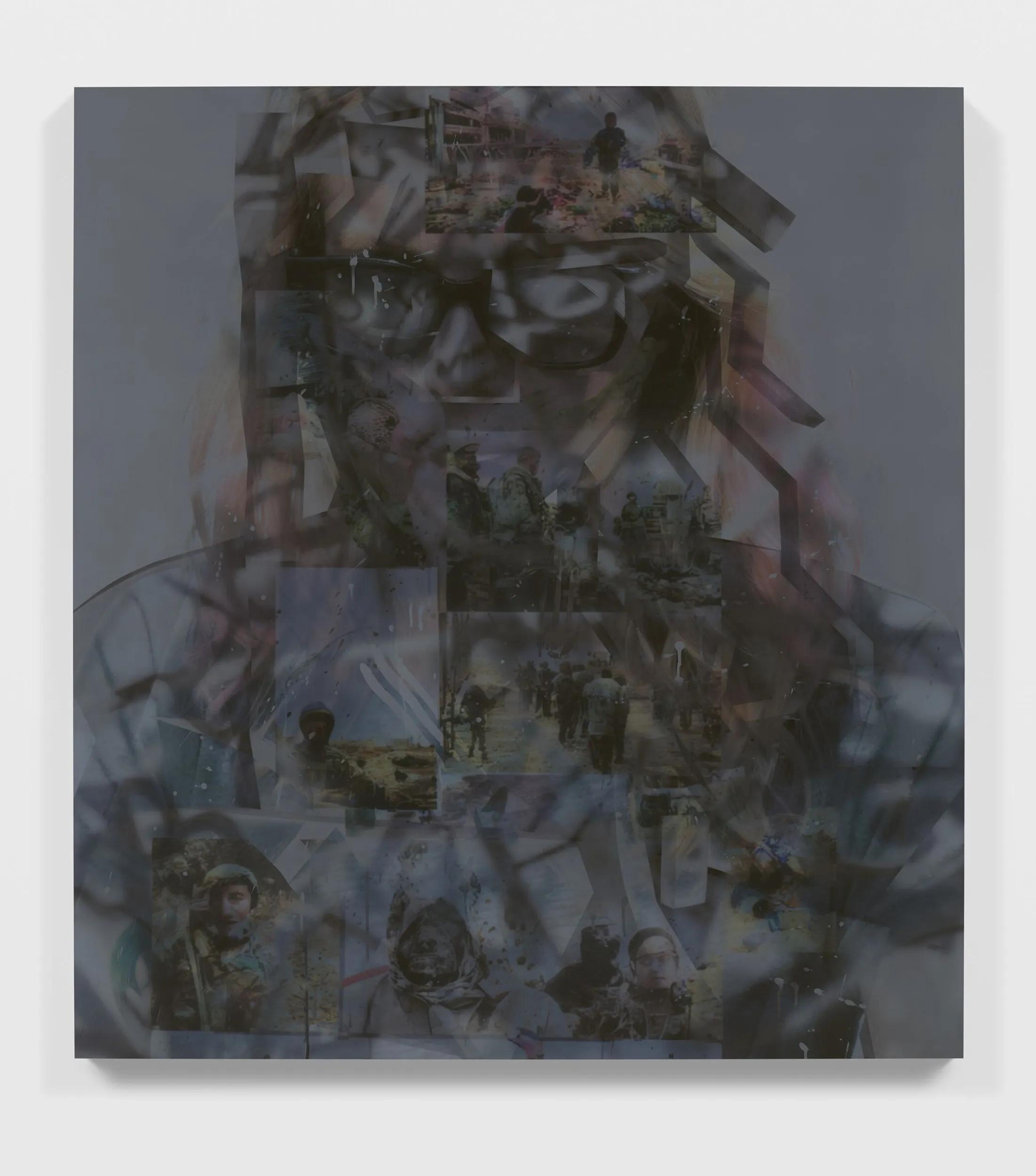
Avery Singer, Cate (v.1), 2026 © Avery Singer. Photo: Lance Brewer
DB: Essentially, you just gave a description of a very creative process in which you had a dialogue with another creator—AI—that inspired you.
AS: It’s cool. There was a workflow I made, and the AI was just hallucinating, and I had no idea why. Instead of doing what I had prompted it to do, it was just making granular blue and purple images. The breakdown that happens in AI is the most interesting thing to me. It’s not really optimization that I’m interested in. This felt like a digital brain having a breakdown.
DB: What do you think AI means for us as a society? What does it mean if you cannot believe any image or video you see?
AS: This is another reason that I’ve been interested in thinking about war imagery, like the Daniel Pearl images. If you think back to Baudrillard talking about the Persian Gulf War, he emphasized that it was a televised war. With a televised war the media can take short clips and frame them however they want to construct a narrative. You could end up disregarding ninety-nine percent of what actually happened in that war, right? If you have an image of the same missile launch playing repeatedly until the news cycle moves on to something else, then that’s how people experience and understand the war. Now we’re in a situation where people will not even experience the actual war at all because they will be given AI images and they will not be able to distinguish them from actual, recorded events.
DB: The New York Times recently had an article about AI war videos. There were clips included in the article, and it was so hard to tell whether or not they were real. Sometimes the videos looked a little too perfect, but that could just be the use of a filter or a good camera—it could just be reality. So I’m with you. I think we’re post-AI. We have entered a new epoch, even though I think many of us do not want to believe that we have.
AS: People already believe even the really obviously fake AI imagery. I think that as these videos become increasingly realistic, more and more people are going to believe them. Eventually, we’re going to have moments when the mainstream media will show us videos that were generated by AI, and millions of people will see and find credible something on TV because CNN or some editor thought it was real. I mean, not even AI can identify things made by AI all of the time.
Video: Christian DeFonte
DB: What do all these fake images mean for us and how do you deal with them as an artist?
AS: I think the internet brought about the collapse of traditional human knowledge. It’s just accelerating now. Eventually, everything is going to be refuted by so many different kinds of information that are gathered and spread online. We’re also at a point where our short-term memories are eroding. We’re facing a weird collapse of knowledge. Another thing is that it’s not just AI. It’s also bots and compute. Who has access to this and how is it controlled? Why do I get certain things promoted to me over and over again? If I do a Google search for a news article and I get the same station or the same website—and maybe it’s not even American—why are these sites being promoted to me? What does it mean? There are so many larger questions about power and control.
DB: It is certainly changing our brains. The human mind is always changing anyway, but now AI is trying to imitate the ways in which the human mind works.
AS: There’s so much work being done around biomorphic computing right now. I think the hope with this research is to make AI safer and more aligned with humans, instead of a threat. The real worry is that AI could end up being more destructive than productive. It’s more powerful as a destructive tool, especially with cyber warfare and military technology. It’s much easier to destroy than it is to create. How do we make it so that AI is not trying to run optimally in a way that ends up killing people in the process because it decides some people are just getting in the way of its optimization flow.
DB: The machine is completely neutral. It has no feelings—which can be both a good and a bad thing. But it’s great to hear your optimism that maybe AI will have a positive use in the future. As you describe it, it might actually open up new forms of creativity and create a new language.
AS: There are so many ways to work with it. ChatGPT is one of the coolest tools I’ve ever worked with, and I barely understand how to use it. It’s left me really optimistic and excited about how AI will influence art.
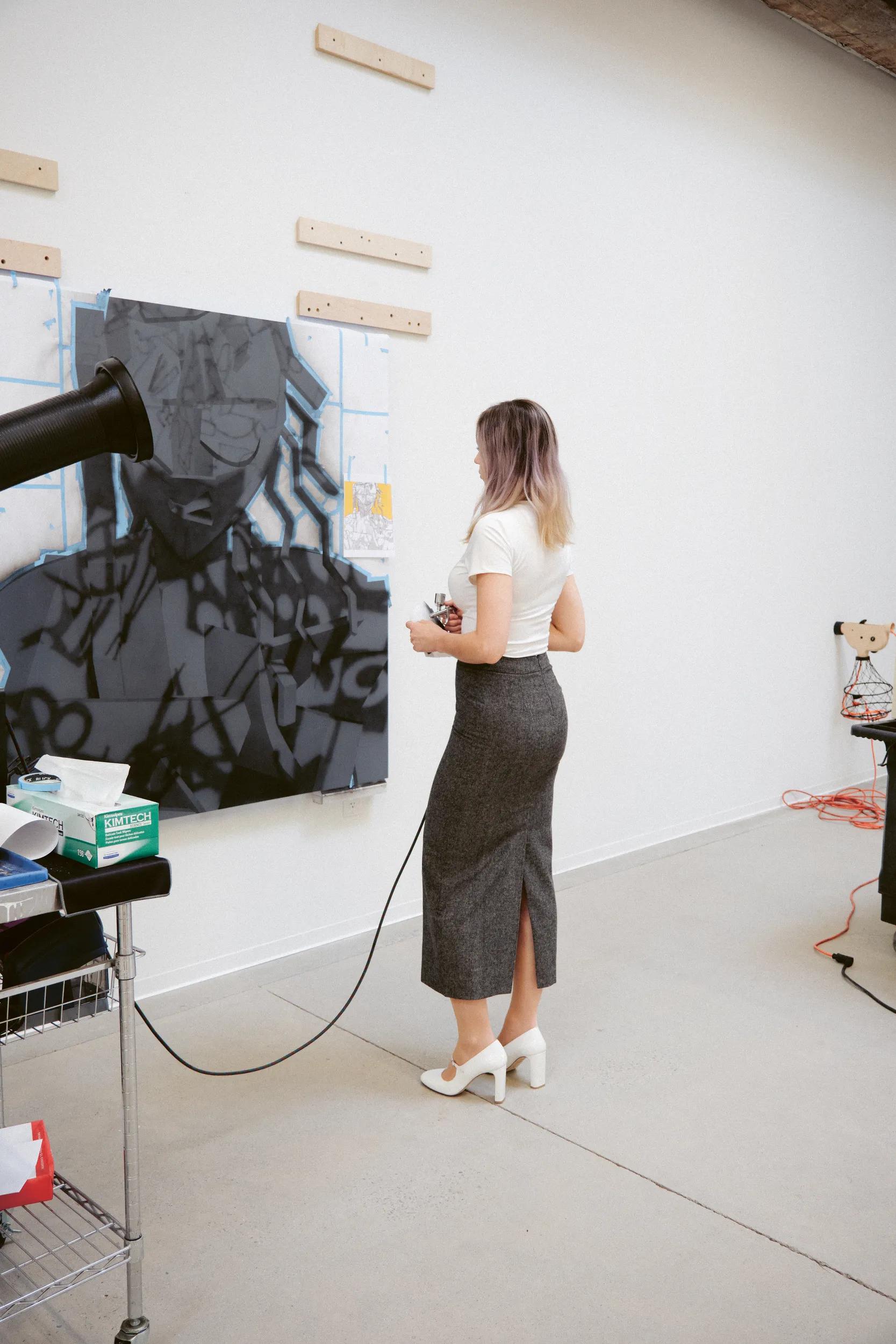
Photo: Christian DeFonte
–
“Avery Singer: War_overlays” opens June 12 at Hauser & Wirth Zurich Limmatstrasse.
–
Dieter Buchhart is a curator, art historian and theorist. He has curated exhibitions of the work of artists including Edvard Munch, Egon Schiele and Jean-Michel Basquiat, for museums including the Guggenheim Museum Bilbao and the Fondation Louis Vuitton, Paris, among others. He holds doctorates in art history and conservation and was previously director of the Kunsthalle Krems.
Avery Singer has emerged as a powerful contemporary voice whose work explores the possibilities in the convergence of painting and technology. Her highly distinctive oeuvre incorporates both autobiographical and fictional narratives, reflecting upon the art world today and the wider sweep of art history that she has inherited as a painter.