

Essays
Pierre Huyghe’s Polyphonic Soulscape at Fondation Beyeler
By Anne Stenne
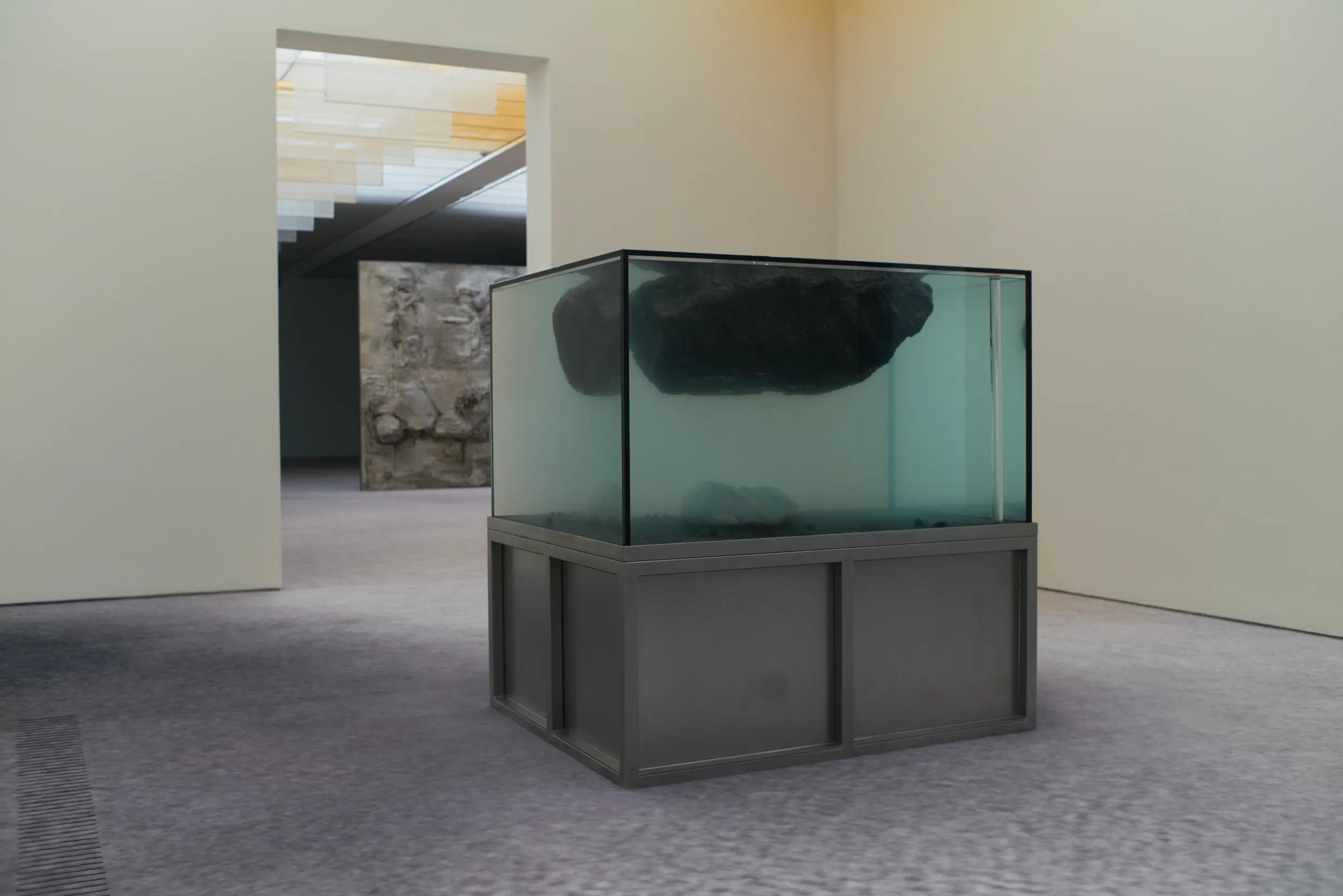
Installation views, “Pierre Huyghe,” Fondation Beyeler, Riehen, Switzerland, 2026 © Pierre Huyghe / ADAGP, 2026. Photo: Ola Rindal
For more than two decades, Pierre Huyghe has redefined the exhibition as a mutable situation shaped by time and unpredictability. Throughout his exhibitions, he has brought together living entities, machine-learning, material processes and fictional characters. His works operate as speculative fictions from which alternative modalities of existence may emerge, revealing continuities between biological, technological and inert forms of matter that learn, transform and evolve over time.
At Fondation Beyeler, he extends his metaphysical and fictional inquiry through what he describes as a “soulscape”—an inner world composed of multiple temporalities, voices and subjectivities, a polyphonic environment in which contradiction and uncertainty shape each experience. At once sensory and reflective, the exhibition functions as a field of resonance: composed of vibrations, sound, configurations of matter, image and language. Rather than presenting fixed objects, the works generate conditions that open onto possibilities, coexistences and superpositions. His interest lies not in representing the world but in enabling new forms of subjectivity and becoming.
The exhibition unfolds as a site-specific experience where multiple fictions intersect. Together, they form an interstitial and shifting space inhabited by hybrid, indeterminate entities. It becomes a liminal space made of ambiguous thresholds, where each work – and the intervals between them – operates as a transitional state rather than as a discrete entity, suspended between fiction and reality, human and non-human, living and artificial, presence and absence.
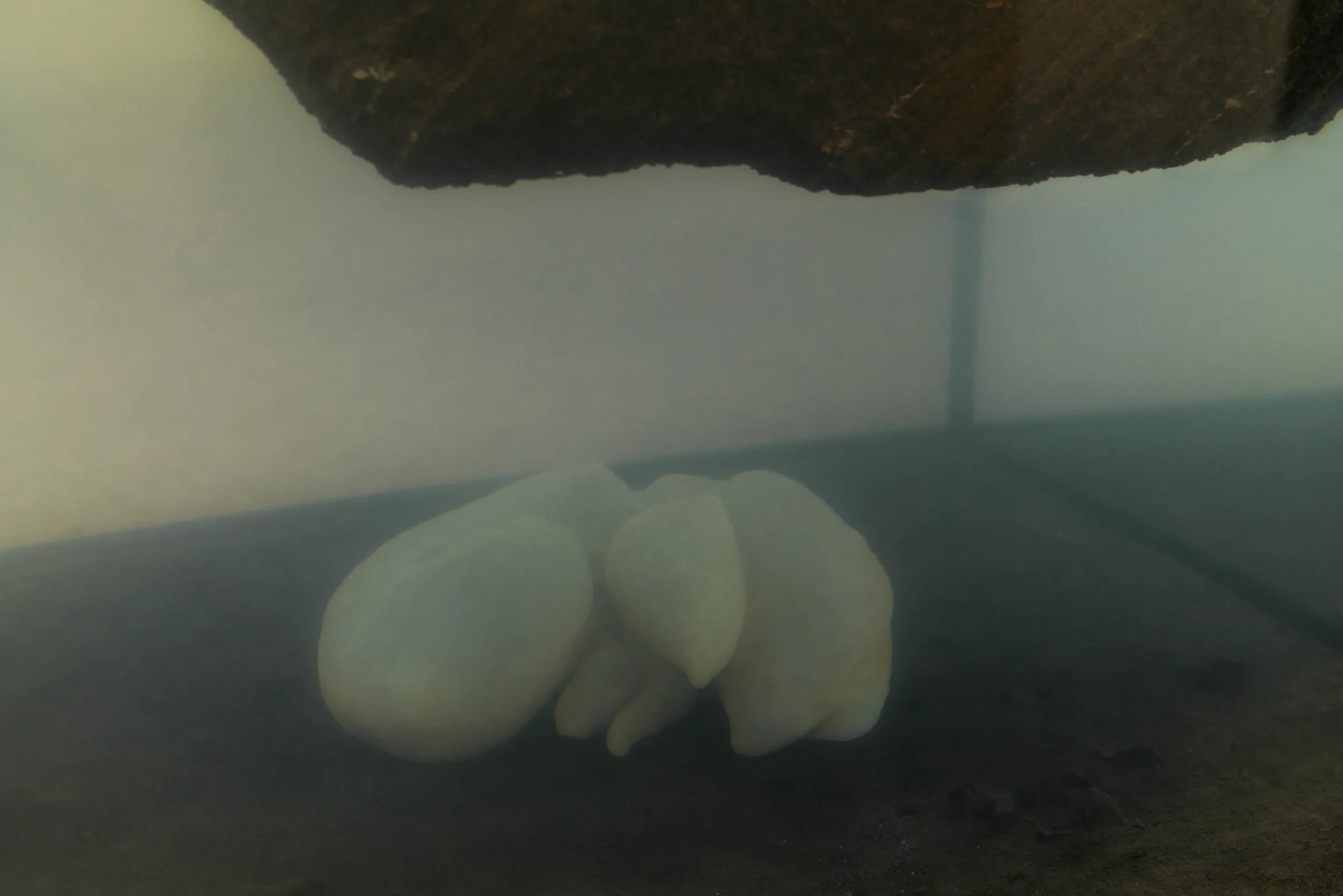
The galleries are transformed into a responsive environment through the introduction of dynamic presences. Breath, and its interruption through apnea, becomes a vector of instability and permeability, opening onto forms of empathy with non-human beings and altered modes of existence. In Apnea (2026), an artificial breathing organ, curled underwater, oscillates in irregular patterns inspired by disrupted respiration. The space adopts a subtle, living rhythm, as air and sound circulate through holes in the walls and the changing opacity of the breathing glass door’s liquid-crystals.
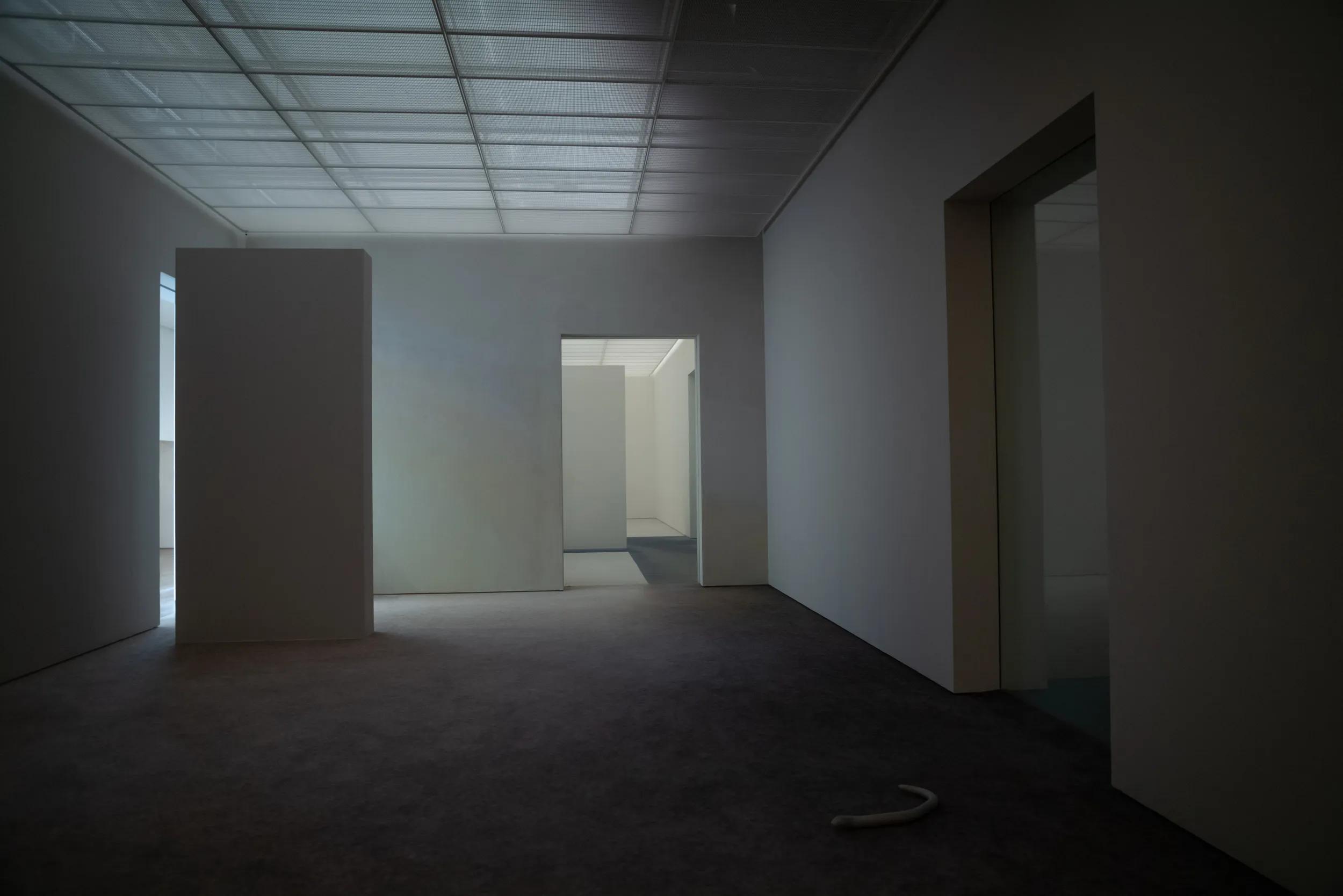
Breathing, the first human automatism, functions as a fundamental interface between interior and exterior, the individual and the surroundings. The exhibition becomes a shared respiratory field between human and non-human entities, emphasizing continuity among bodies, machines and their environments.
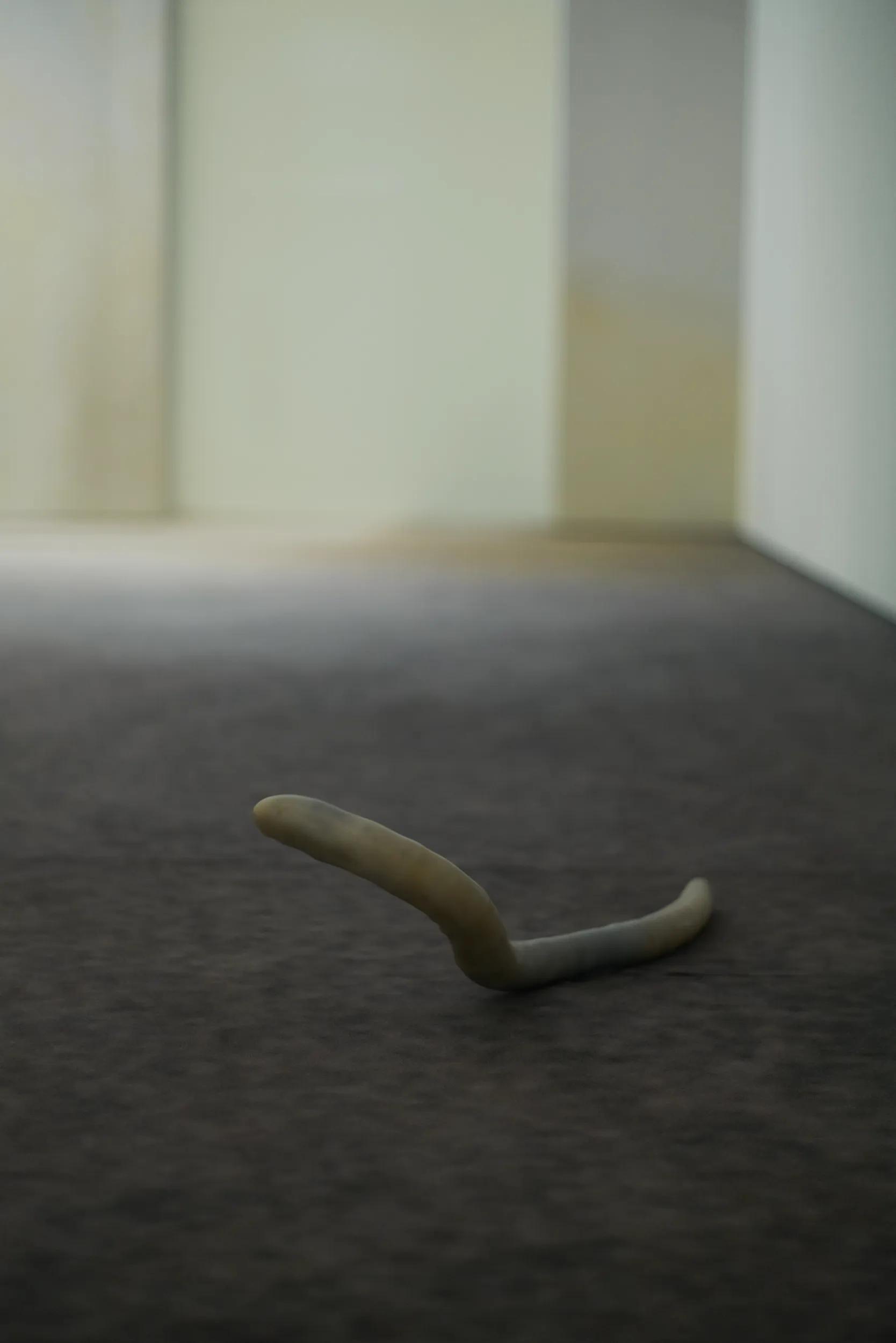
Respiration is a manifestation of a specific condition—a physical state between consciousness in wakefulness and unconsciousness in dreaming—extending into a broader narrative and environmental condition within the exhibition. Alchimia (2026) extends this idea with a worm-like form positioned at the threshold of a doorway, symbolizing a larval state of unconscious. Animated by breath, it emits faint sounds. When airflow is interrupted in the work Apnea, the worm convulses as if reacting to a new condition.
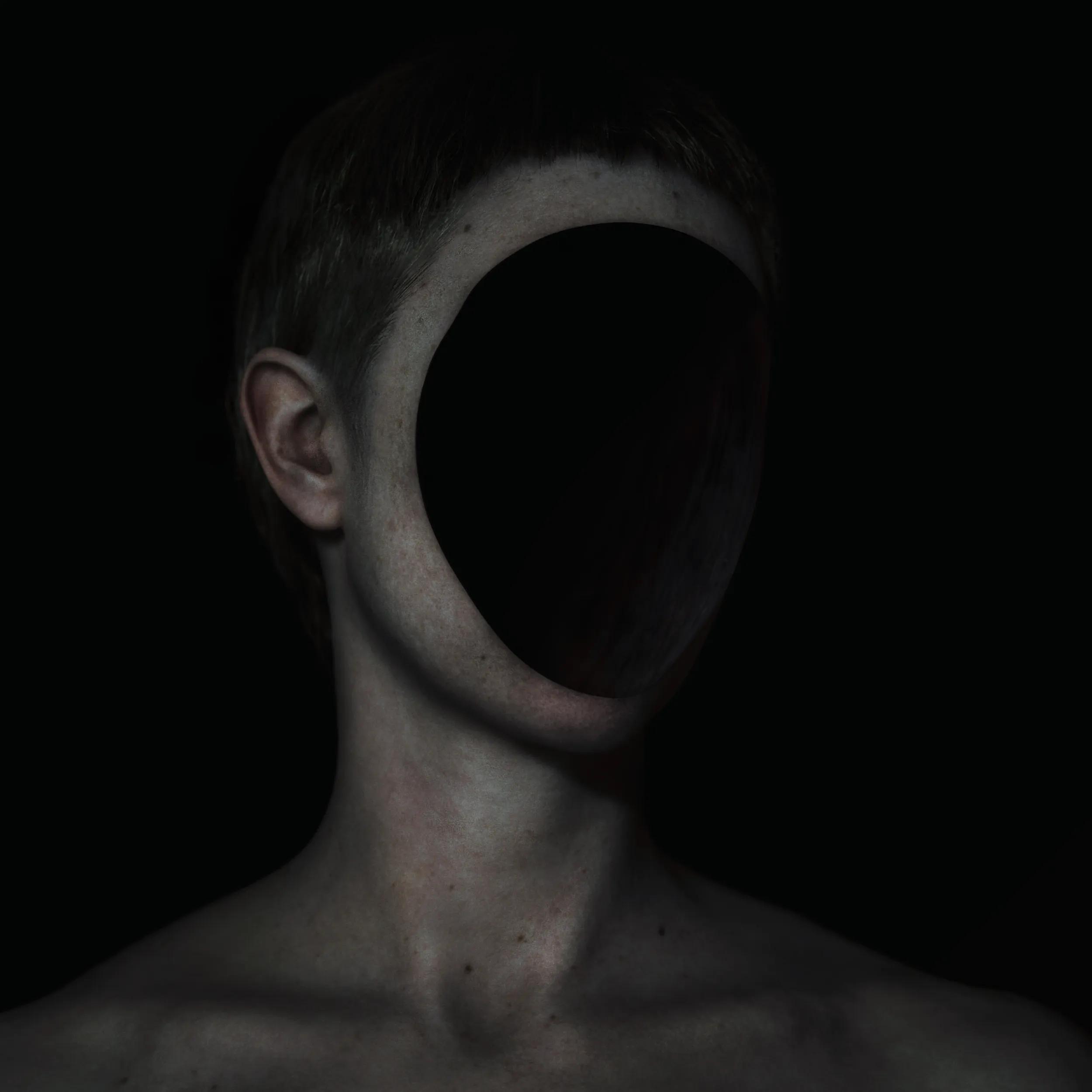
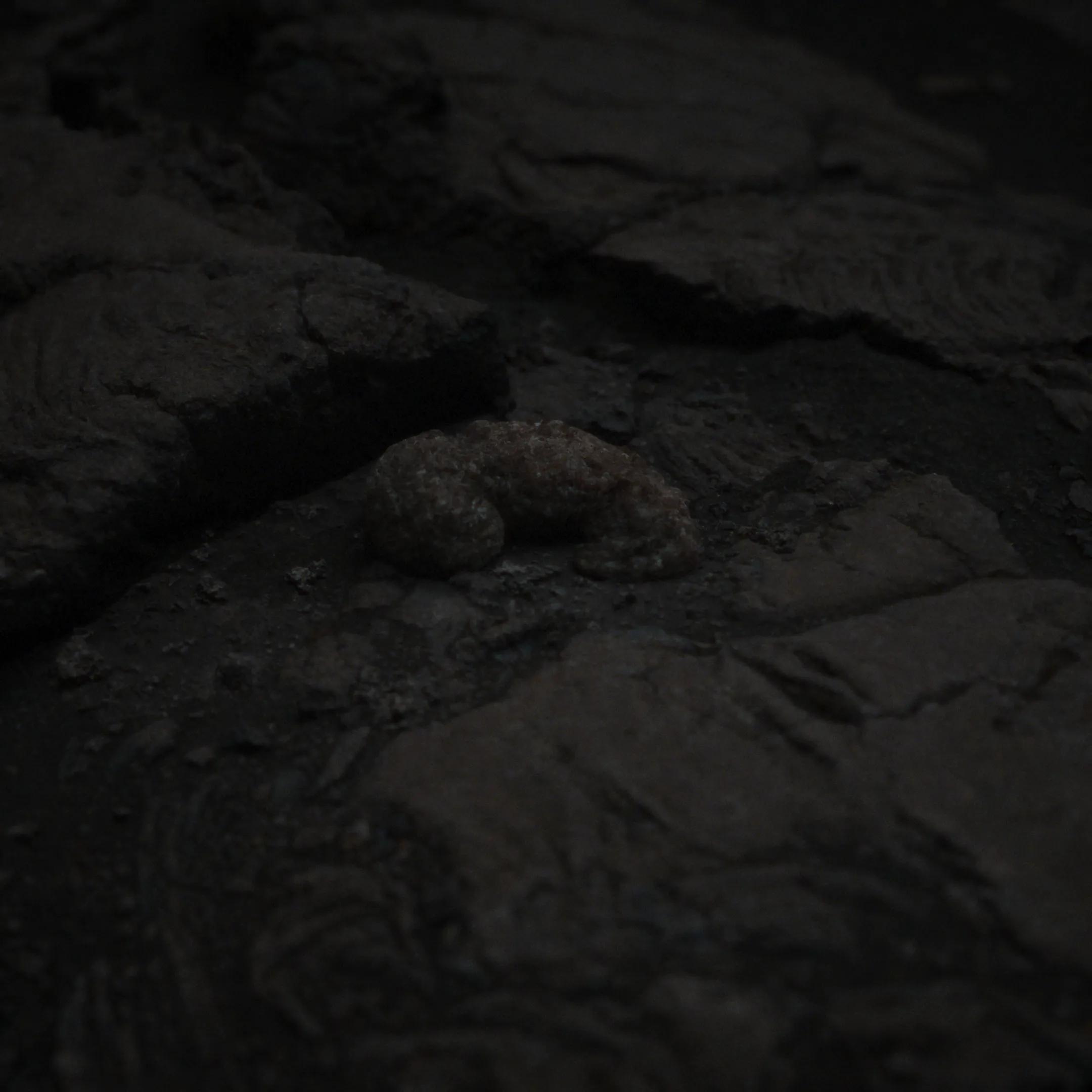
Film stills, Pierre Huyghe, Liminals, 2025. Courtesy the artist and Galerie Chantal Crousel, Marian Goodman Gallery, Hauser & Wirth, Esther Schipper, TARO NASU. Commissioned by LAS Art Foundation and Hartwig Art Foundation © Pierre Huyghe / ADAGP, 2026.
In Light Dust (2026), color appears to escape from the works, overflowing their boundaries and spreading across the floor. Combined with cast artificial light, it becomes an extension—almost a leakage. Colors merge, blur and gradually transform. A continuity emerges between the works: They are no longer separated but extend into one another, forming a continuous flow. The surface is both stable and unstable, like a landscape undergoing slow mutation, inviting heightened attention as you move through it.
Together, these works create a subtle, unsettling experience, felt as much as perceived, inviting encounters with the unknown, which is intensified by the presence of Liminals (2026). This film unfolds like a mythological narrative, following a faceless, hollow figure in a world outside of time and space, from which something unthought can emerge. Continually shaped by its surroundings, this solitary presence attempts to exist through successive transformations. Boundaries between body and environment, matter and void dissolve as inner and outer worlds merge. This liminal condition unfolds as an ongoing dance of matter, in which every moment remains unstable. The film asks how such a reality might be experienced and how multiple states might exist at once. In this sense, it reflects the exhibition itself, where works are interdependent formations, rather than isolated objects.
Liminals exists in a relation between something, nothing and everything. The figure embodies perpetual becoming, revealing a conception of the self in which existence is continuously transformed: “a projection of possibilities that makes it possible to navigate through chaos; it answers to a state of perpetual crisis.”1
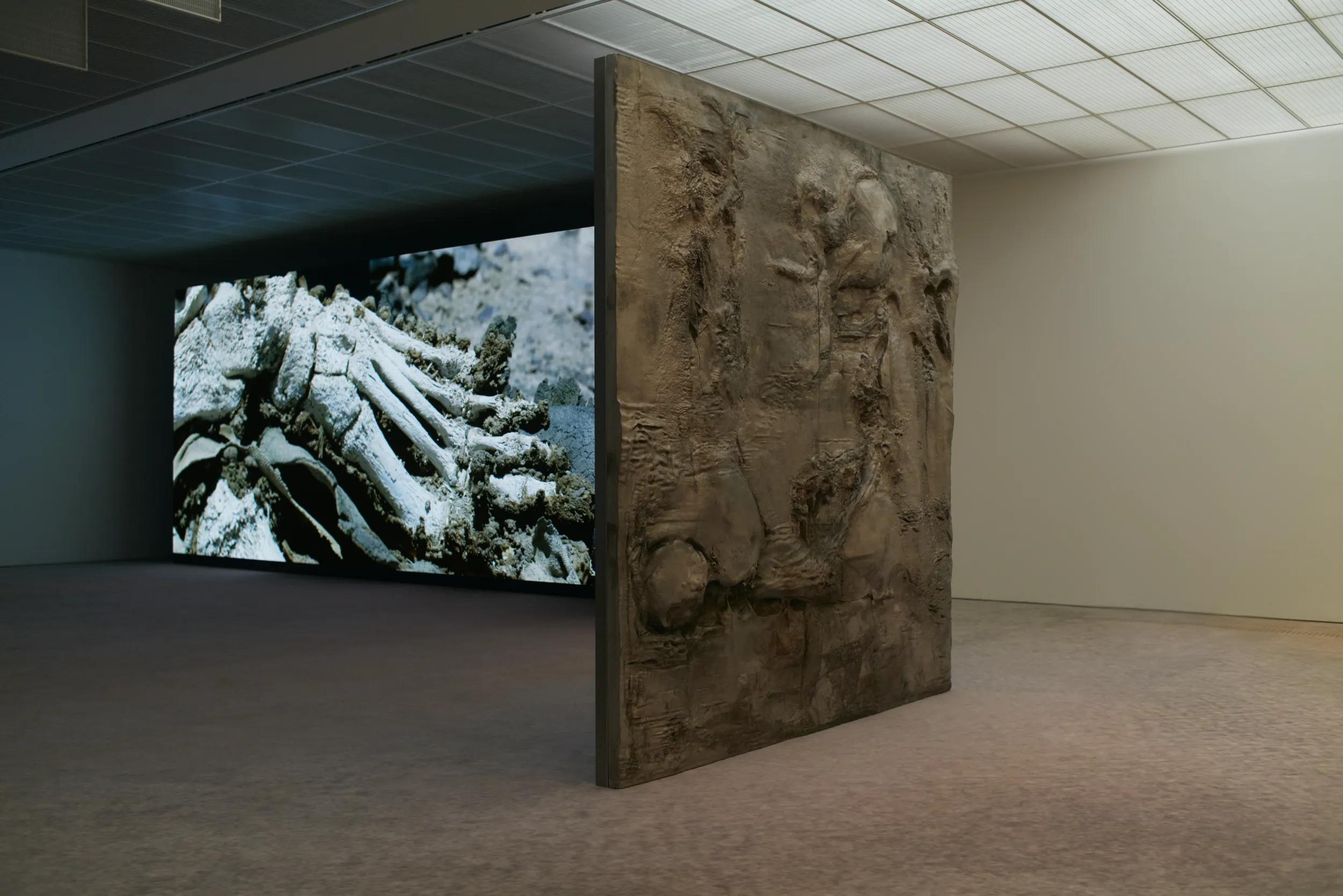
In the film Camata (2024), a set of machines appears to perform an unknown ritual on an unburied skeleton found in the lifeless Atacama Desert in Chile, at once an endless funeral rite, a learning process and the formation of a bodiless subjectivity. Without beginning or end, the film is continuously re-edited in real time through sensors embedded in the exhibition. It follows an uncertain passage between a human body and a disembodied presence.
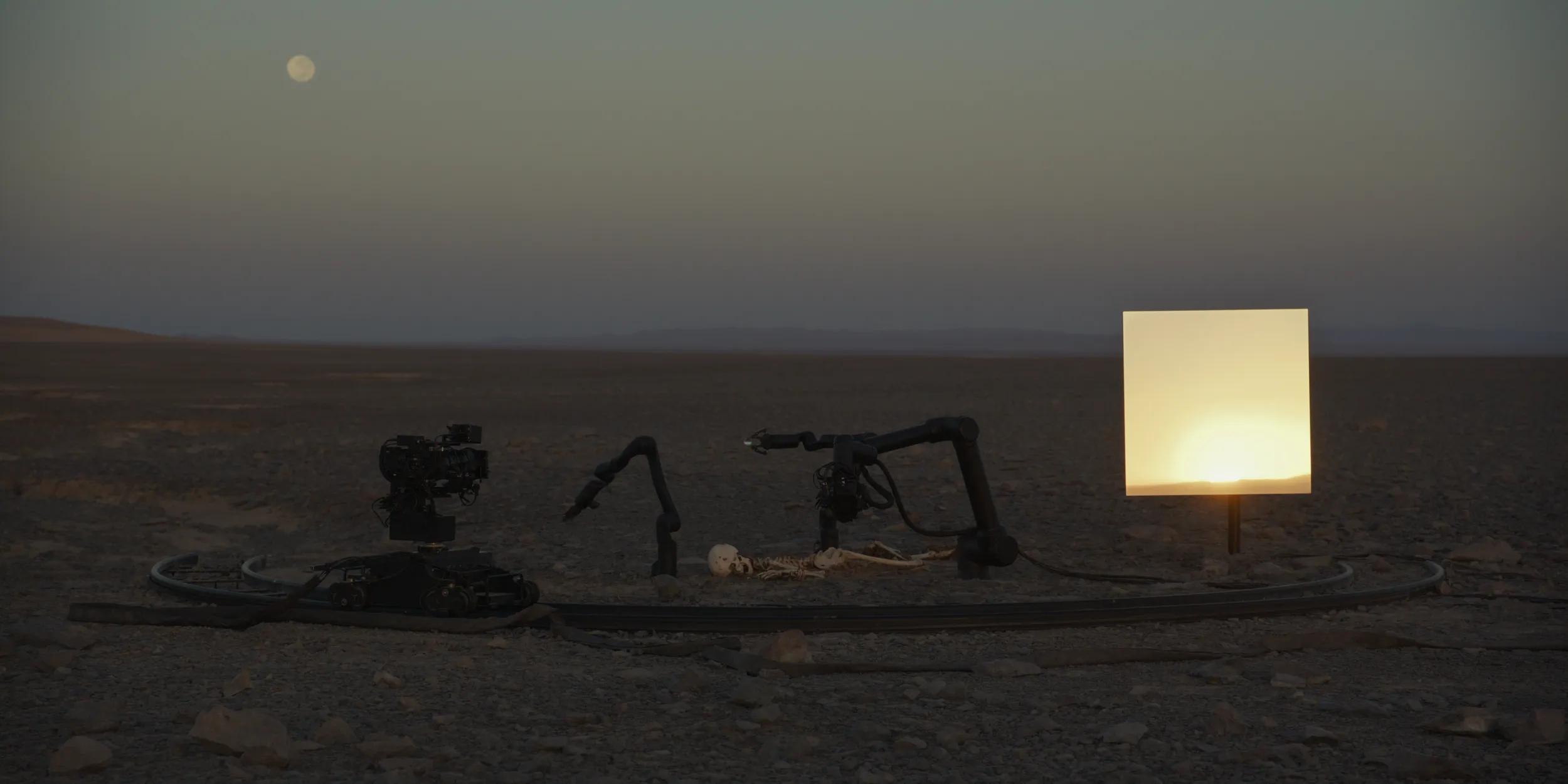
Pierre Huyghe, Camata, 2024 © Pierre Huyghe / ADAGP, 2026
Adversary (2026), another new work produced for the exhibition, is an imaginary gate, both image and threshold. Its bas relief surface originates from a mental image reconstruction process developed in relation to UUmwelt (2018). Working with researchers at Kyoto University, Huyghe invited a subject to imagine a series of images—including living organisms, prehistoric tools, machines and artworks—while the subject’s brain activity was recorded. Adversary materializes one of these “deep image reconstructions”: an image co-produced by a human cognition and a brain-computer interface. Emerging from a single mental image among millions of possibilities, the door suggests access to something beyond, while remaining closed and unresolved.
At the Fondation Beyeler, through newly created works alongside key pieces from recent years, the exhibition invites viewers to adopt a sensitive perspective that extends beyond human experience, as if stepping outside of themselves into alternative dimensions of existence. The exhibition proposes a poetic framework sustained by uncertainty, in which meaning emerges through passage, transformation and indeterminacy.
1 “Pierre Huyghe in conversation with Anne Stenne,” in Pierre Huyghe: Liminal, ed. Anne Stenne with Jacqueline Feldmann, exh. cat. Punta della Dogana, (Venice, 2024), pp. 3–22
–
“Pierre Huyghe” is on view at Fondation Beyeler through 13 September 2026.
The publication Pierre Huyghe is now available through Fondation Beyeler.
–
Pierre Huyghe lives and works in Santiago, Chile. He has had solo exhibitions at Punta della Dogana - Pinault Collection, Venice, Italy; LEUUM, Seoul, Korea; EMMA, Espoo, Finland; Kistefos Museum, Jevnaker, Norway; Luma Foundation, Arles; Serpentine Gallery, London; the Metropolitan Museum of Art, New York; Skulptur Projekte, Münster; and other major institutions throughout the world. In 2012, his work Untilled was one of the most critically acclaimed contributions to Documenta 13 in Kassel.
Anne Stenne is an independent curator. She has closely worked with Pierre Huyghe since 2014. Her recent curatorial projects with Huyghe have included exhibitions at LEUUM, Seoul, Korea; Punta della Dogana - Pinault Collection, Venice, Italy; EMMA, Espoo, Finland; and Kistefos Museum, Jevnaker, Norway.