

Inside Ursula Issue 17
By Randy Kennedy
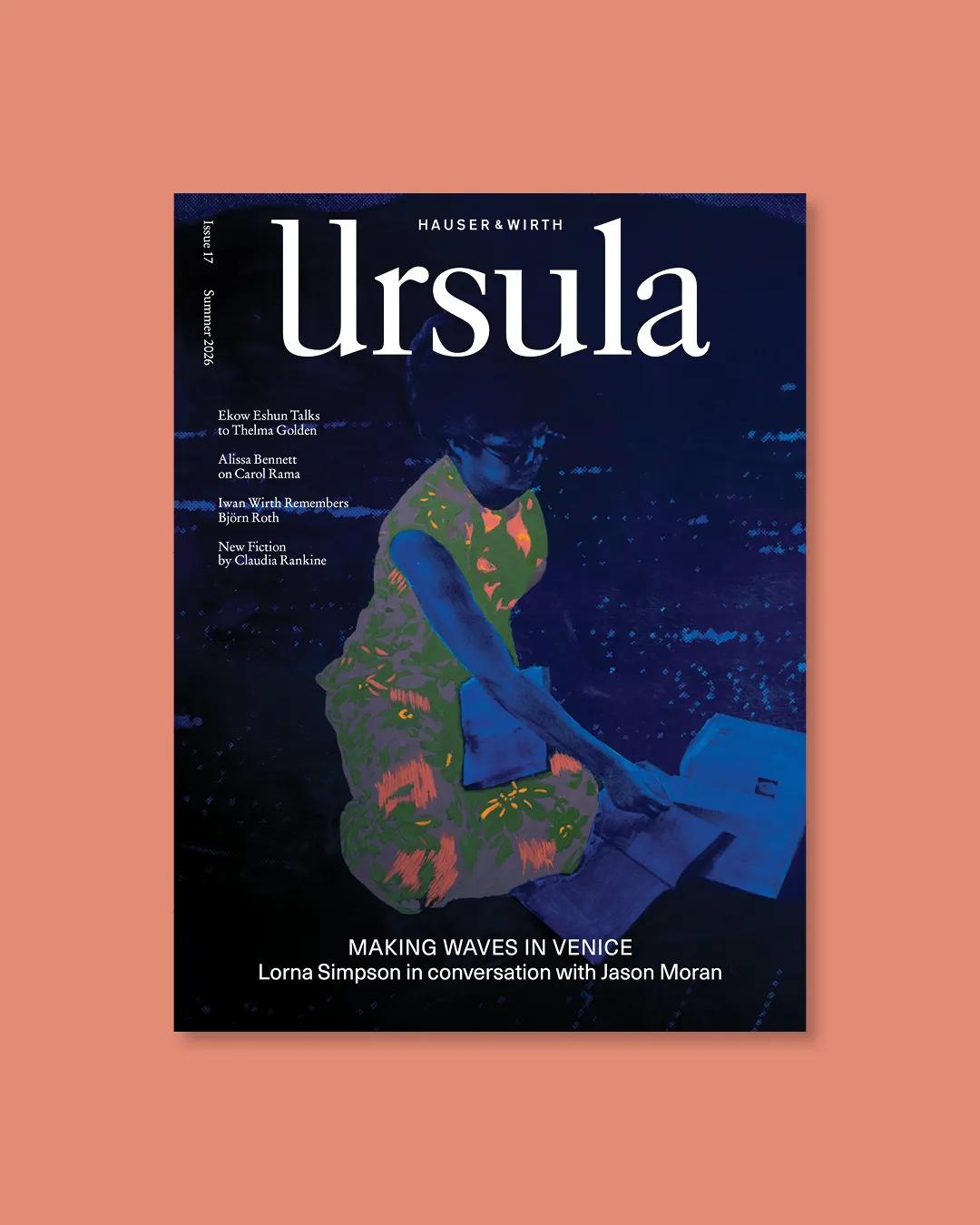
“Sing sweet, but put a little dirt in it.”
—Duke Ellington
When your eyes scan the magisterial expanse of The Wedding at Cana (1562–63), it’s no accident that you find its Venetian painter, Veronese, self-depicted among the biblical feast guests as a musician, bow in hand, playing a viola da braccio with fellow band members Titian, Tintoretto and Bassano gathered around him, peering down at sheet music on a table. The affinities that have drawn visual artists and musicians together for centuries run particularly deep in Venice, whose omnipresent lapping waters have inspired both painting and song. (“When I seek another word for ‘music,’ ” said Nietzsche, “I never find any other word than ‘Venice.’ ”)
Our cover story for this edition of Ursula celebrates both “Lorna Simpson. Third Person,” a sweeping exhibition of Simpson’s painting, sculpture and other work at the Pinault Collection’s Punta della Dogana in Venice, and her longtime collaborations with American musician and composer Jason Moran, who is at work on a new musical performance focused on Simpson sculptures made with singing bowls.
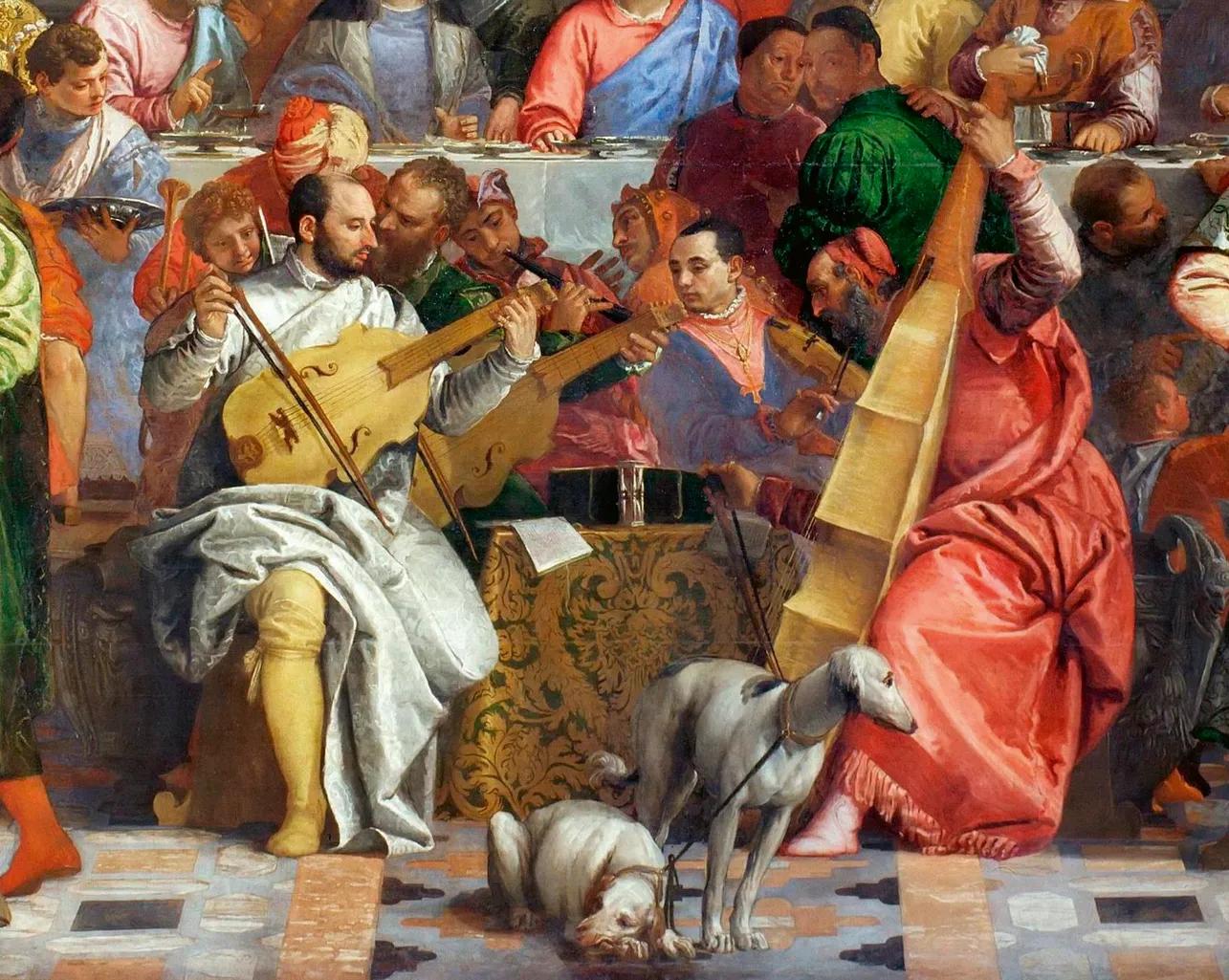
Veronese (Paolo Caliari), The Wedding at Cana, 1562–63 (detail)
In conversation with Moran for our cover story, Simpson stresses that making art often happens for her as it would for a musician—as a composition-and-performance call and response. “There’s something about the process of coming to ideas, and that formulation is the thing I hold onto the most, not so much the end product, the object,” she says. “As an object, it’s a thing that contains the experience of making it.”
Moran has worked as deeply within the art world as any musician in generations—collaborating with, besides Simpson, Glenn Ligon, Joan Jonas, Stan Douglas, Carrie Mae Weems and many others. He tells Simpson he believes music is “one of the most threatening vehicles we have right now as artists. So often you hear the rhetoric that it’s pointless, especially jazz. There’s the knock that it doesn’t earn any money. But Duke Ellington stands there as a person who says, ‘Nah. There’s something in here. Something actually dangerous and revolutionary.’”
Editor in chief, Randy Kennedy, introduces Ursula’s new issue
The idea of the culturally dangerous as a constructive political force thrums through the rest of the issue. The British artist Julianknxx, profiled by Harriet Lloyd-Smith, re-opens and dismantles histories of colonialism and subjugation, transforming them into visual poetry. The artist duo Cooking Sections, whose work is explored by Louisa Buck, create long-term projects that suggest new ways to live and think in the face of accelerating climate change. Carol Rama, Alissa Bennett writes, used her powerfully unsettling work to align herself “in perpetuity with the panic that blooms when we are confronted with evidence of our greatest vulnerabilities.” Thelma Golden, in conversation with Ekow Eshun, speaks about the dire necessity, in times of division, for more “conversations that allow us to hold complexity with each other in ways that are bound by respect and understanding.” And our regular film columnist Greg de Cuir Jr urges us to pay attention to the veteran Serbian filmmaker Želimir Žilnik, whose complex and compassionate work “stretches out a hand to those concerned with the humanity of others, to those who recognize that people are not products.”
Lorna Simpson has, for some four decades now, used the instability of language and images—especially the unfathomable calculus of their relation—to push us up against easy, facile assumptions. “I eliminate certain kinds of information,” she has said, and the result is “a question mark, rather than complete compliance.” The questions, as they do in the wake of all great art, reverberate, persist, sometimes agitate and instigate. Occasionally they lead to changed consciousness. “You think the sound has stopped,” she tells Moran about the mechanics of singing bowls. “But it hasn’t. It’s still vibrating, although you may not be able to hear it, which is incredible.”
—Randy Kennedy, editor in chief