

Conversations
Christopher Marlowe’s Dangerous Games
Stephen Greenblatt talks to Jonathan Cott
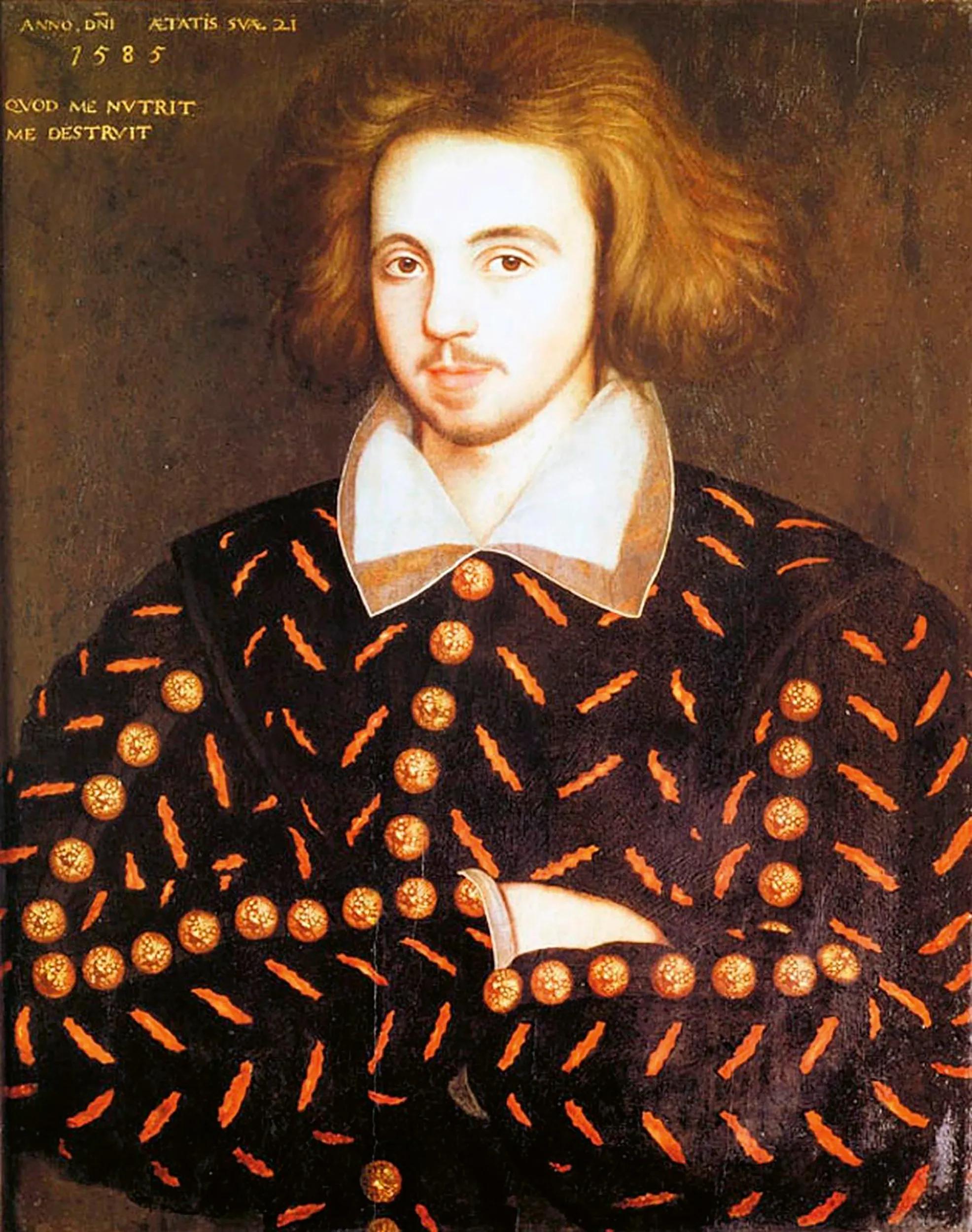
Portrait presumed to be Christopher Marlowe, 1585, artist unknown
“Friends hurt the most,” reads a fragment from the seventh-century B.C. Greek poet Archilochus. The sentiment has been applicable to interpersonal, social and political relations throughout history, but one sometimes overlooks the fact that betrayal on all these levels was egregiously pernicious during the Elizabethan era. It also played a part in an often invidious literary world, and no historian has more thoroughly explored the relations between literature and history than Stephen Greenblatt, who once stated that his deepest interests concern “the process through which certain remarkable works of art are at once embedded in a highly specific lifeworld and seem to pull free of that lifeworld.” He has pursued this idea in, among other books, his brilliant biography of Shakespeare, Will in the World, and in his riveting new portrait of Christopher Marlowe, Dark Renaissance: The Dangerous Times and Fatal Genius of Shakespeare’s Greatest Rival, published by Norton this past fall.
A Janus-faced genius, Marlowe was perhaps the most complex and controversial of his day’s constellation of writers. An atheist and gay, he was also a spy and worked in the secret service of Sir Francis Walsingham, Queen Elizabeth’s spymaster—through which he was involved directly or indirectly in betraying people who knew and trusted him.
I met recently with Greenblatt to talk about Marlowe’s sense of duplicity in both art and life.
Jonathan Cott: Many years ago when I was living in Northern California I read a fortune-cookie message that said, “When men are really friends, even the water tastes sweet.” Throughout your book about Marlowe, men, with few exceptions, seem to pretend to be friends; and although I’m exaggerating here, the world you’re describing, with its duplicities, double-dealings and backstabbing, not only makes the water taste rancid but also seems to depict a realm straight out of Dante’s ninth circle of hell, the domain of the most treacherous.
Stephen Greenblatt: I don’t know if you’re actually exaggerating that much if you’re describing the world Marlowe inhabited—although I don’t think it was the world that everyone inhabited. It’s true that he lived in very dangerous waters.
JC: It is a commonplace to recall that one of the ancient Greek principles of Socratic philosophy was “Knowledge is virtue.” But it certainly seems that Marlowe and his compatriots worked solely on the sixteenth-century statesman Francis Bacon’s principle of “Knowledge is power,” something that is clearly manifested in Marlowe’s depiction of Dr. Faustus, whom he portrays as one of the great avatars of knowledge/power.
SG: Absolutely, that is what Marlowe—and at least some of his contemporaries—took from Machiavelli and from looking about them and their world.
JC: Marlowe was known to have been gay, and his play Edward II unabashedly exhibited the king’s love for his companion Piers Gaveston, the First Earl of Cornwall. How do you think that might have affected his work as a spy and his relationships with his espionage co-frères?
SG: Hard to judge. The most notable other more or less “out” poet in the period was Richard Barnfield. But the two were not unique. What should we make of many of Shakespeare’s passionate poems to the young man? Does the fact that in one poem he said that the young man is “pricked out for woman’s pleasure” settle the issue? The concept of “gay” did not yet exist in this period, and I think the boundaries were less anxiously drawn than they are now.
JC: In your book you say, perhaps only part jokingly, that in certain respects “the world of Christopher Marlowe was closer to that of North Korea than North Carolina,” such that one can imagine Elizabeth I and Kim Jong Un playing the roles of Dear or Supreme Leaders. (Elizabeth was also known as the “Supreme Governor” of the Church of England.)
SG: Yes, you get the point. The flattery that was routinely used to win the approval of Elizabeth—flattery akin to downright deification—is far closer to what we witness in societies that have no space for open political discourse.
JC: Might it be fair to say—or not far from an exaggeration to say—that the conflict between the Protestants and Catholics (and perhaps the Calvinists and Puritans, included for good measure) could be seen in a certain sense as tribal warfare?
SG: Not really, since many families were split in two by these conflicts,. Or rather it depends what you mean by tribal warfare. Is the Thanksgiving dinner that is torn asunder by a political argument over Donald Trump “tribal warfare”?
JC: With regard to the sense of disloyalty that permeated this world, you write: “In order to be convincing, they had fully to inhabit the role they were playing; not merely to recite scripted lines, but entering the whole lifeworld of their intended victims.” In a way it seems that what you’re saying is that they had to be good actors.
SG: Yes. That is the case for anyone who is engaged in playing that particularly dangerous game that Marlowe is playing. And it is certainly the endless theme of spy fiction. My favorite is by the Spanish novelist Javier Marías. I think that he captures that very well, and in fact he refers to Marlowe multiple times in his books.
JC: The psychoanalyst Wilhelm Reich once said: “Words can lie. The mode of expression never lies.” But with these people, that seems not to be true. You’re saying that they not only recited their scripted lines but entered into the entire world of their intended victims. Their modes of expression must have insinuated their false motivations into their very expressions, don’t you think?
SG: Yes. And this playing of a part is also the gift of a playwright like Tom Stoppard, for example, and of course also to novelists as well. Because if the microworld of the character remains outside, how can you convincingly create the character?
JC: A few years ago there was a brilliant French television espionage thriller called Le Bureau [The Bureau]. . . .
SG: I loved it, and speaking of actors, the one who played the field agent Malotru [Guillaume Debailly] was particularly good.
JC: I agree. And to me one of the memorable things Malotru remarks is that in order to be able to lie to your husband, your wife, your children, your friends, you first have to be able to learn how to lie to yourself. Do you think that Marlowe was able to do that?
SG: I wish I had a very clear answer to that but I don’t. Marlowe’s most famous play, Doctor Faustus, has a theologically orthodox conclusion—the magician is dragged off to hell. And at the same time Marlowe presumably said at least some of the radical and outrageous things that are in the government’s reports about him. But the question that hovers over both the play and those reports is: Where was Marlowe in all of this? It’s very hard to know if Marlowe was performing for others as a provocateur or if he actually believed what he was saying. If you think about iconoclasm, Protestant iconoclasm against Catholicism, it seems to bear witness to an underlying acknowledgment: The people who smashed religious images in the 16th century were essentially the people who believed in their power.
JC: If Marlowe was an atheist, then in fact he was lying to himself about pretending to be Protestant.
SG: Yes, if he was a spy and an atheist and didn’t believe in any of it. But he pretended to be a Catholic in order to extract information from them, so you could say he wasn’t lying to himself—he was lying to his friends. But putting international politics to the side, he actually could have told himself that he was defending his country.
JC: But Marlowe seemed to enter into himself—for and by himself.
SG: It’s a question of whether you put it outside the special boundaries of fiction, the fiction of a playground in which you pretend to be something you’re not. Marlowe and Shakespeare were obviously good at it. There’s evidence, as you say, that this is the world that Marlowe entered outside the theater.
JC: I was recently haunted by something I read about a masked ball at the court of Louis XIV, where courtiers created wax masks of themselves that they wore beneath their conventional masks. At the moment when the masks were dropped, everyone thought that it was people’s real faces that became visible. But in reality it was the wax masks and the person beneath each one was someone completely different.
SG: That’s fabulous. My goodness, I love it.
JC: In your book you write that “to the extent that Marlowe was initiated into this enterprise he entered a world in which virtually everyone was in disguise and it was fantastically difficult to know whom to trust.”
SG: Yes. But what this makes me think of is not however Marlowe but a passage in Shakespeare. It’s Mercutio in Romeo and Juliet in Act 1, Scene 4. Romeo, Benvolio, and Mercutio are wearing masks and going to the Capulet’s masked ball. Mercutio says: “Give me a case to put my visage in. / A visor for a visor—what care I / What curious eye doth quote deformities?” He picks a mask with a scowling visage and says: “Here the beetle brows shall blush for me.”
JC: If there’s a mask behind a mask at the ball, and behind that mask is someone completely different, there’s a profound existential complexity and conundrum here. Were they blank slates?
SG: I don’t think so. But I am fascinated by the mask behind the mask. When betrayal and suspicion displace trust, one steps into a “wilderness of mirrors” and privileged espionage becomes impossible.
JC: In his book Anam Cara, the Irish writer John O’Donohue describes the Kalyana-mitra (the Noble Friend) as someone who “will gently but very firmly confront you with your own blindness. No one can see his life totally. As there is a blind spot in the retina of the human eye, there is also in the soul a blind side where you are not able to see. Therefore you must depend on the one you love to see for you what you cannot see for yourself.”
SG: I do think that’s exactly true. Sir Richard Dearlove, who was at one time the head of MI6 [the British Secret Intelligence Service] and whom I knew because he later became a master at Pembroke College at Cambridge, which I attended, proposed that a man named Thomas Watson was Marlowe’s case officer. Furthermore, the early death of Watson might have marked the start of Marlowe’s decline in his previously important role in the world of espionage world. All great spies lean heavily on their case officers to protect them from themselves. Spies by their nature are risk-takers and often fail to measure accurately the degree of the risk to which they are exposing themselves.
JC: I can’t get away without asking you the obvious question about the character of Iago in Othello, who says, “I am not what I am.”
SG: Right. It’s a version of “a visor for a visor”—he takes off a mask and there’s another mask underneath.
JC: To me, that statement echoes God’s “I am that I am” or “I am what I am” or “I am who I am.” Do you think Shakespeare was making reference to this?
SG: Probably yes. But I can’t remember how it was translated in the Geneva Bible because that’s the one that Shakespeare would have read. Exodus 3:14. [Greenblatt consults a Geneva Bible.] Aha! Look at that! “And God answered Moses, ‘I am that I am.’ ” So Shakespeare certainly knew that.
JC: To me, the most heartbreaking moment in the book is your description of the betrayal of the Catholic Anthony Babington by the Protestant Robert Poley, whose total trust in Poley—he considered him to be his best friend—led him to reveal to Poley the machinations of the 1586 assassination plot against Queen Elizabeth. Babington, like the other co-conspirators, was hanged, drawn, quartered and sliced into pieces for his efforts. I had tears in my eyes when I read Babington’s note to Poley that concludes: “Farewell, Sweet Robin, if as I take thee, true to me.” To me, those words hurt the most.
SG: Poley is the essence of the horrible world that Marlowe seems to have entered, and Poley was in some ways the most successful version of it. I totally agree.
JC: After studying and weighing the matter for a long while, how and why do you think Marlowe was murdered? Was it perhaps because of an argument and dispute over a lunch bill at some bar room (“a great reckoning in a little room”—I suppose they didn’t believe in going Dutch in those days!) or might it have something to do, as some suggest, with his blasphemy against religion and the church. He reportedly said that Jesus was gay and denied the truth of the incarnation and other tenets of Christianity. Or was he killed for being gay or for engaging in some malicious and disloyal dealings with regard to his espionage work?
SG: I do not think it likely that it was an argument over the bill. But I also doubt that it was about his sexuality, though that is what one contemporary implies. I think that he had ceased to be an asset for Walsingham and that his extreme provocations were no longer useful.
JC: The following may be an unanswerable question, and it certainly is a hypothetical one. The writer J. T. Fraser once asserted that Shakespeare was “an insider to all human feelings,” and the critic George Steiner was of the same mind, calling Shakespeare “the common house of our feelings.” Marlowe wrote seven plays that we know of, at least three of which are extraordinarily powerful, and is credited as a co-author with Shakespeare on the three Henry VI plays. Both men were born just months apart in 1564, and Marlowe died in 1593 at the age of twenty-nine, while Shakespeare, who died at the age of fifty-two, went on to write some thirty-nine additional plays. You’ve studied both playwrights in all their aspects for almost a lifetime, so I wonder if you think that Marlowe, although he lived such a short while, had the literary depth and all-encompassing vision of human nature that Shakespeare did. Has Marlowe been given short shrift by this comparison? Or does Shakespeare, as Cassius said of Caesar in his words to Brutus, “bestride the narrow world / Like a Colossus, and we petty men walk under his huge legs and peep about / To find ourselves dishonorable graves.”
SG: Well, though I am a Bardolater, I certainly do not think that Marlowe was walking beneath Shakespeare’s huge legs. Shakespeare himself evidently did not think so, since, as I try to show in my book, he carefully studied Marlowe’s every move and learned a great deal from him. Moreover, if I were asked to choose between Shakespeare’s “Venus and Adonis” and Marlowe’s “Hero and Leander,” I would at the least hesitate, and I do not think that the conception of the bookish magician Prospero is superior to Marlowe’s conception of the bookish magician Faustus. Having said that, of course Shakespeare is the greater artist of the two, but greater in the way that Mozart is greater than Haydn.
–
Jonathan Cott is the author and editor of more than forty books, including The Search for Omm Sety and Wandering Ghost: The Odyssey of Lafcadio Hearn. His most recent book is Let Me Take You Down: Penny Lane and Strawberry Fields Forever.
Stephen Greenblatt is an American literary critic, theorist, scholar and Pulitzer Prize-winning author. He is Cogan University Professor of the Humanities at Harvard University.