

Profiles
Between Salt and Stardust
On Julianknxx’s poetic histories
By Harriet Lloyd-Smith
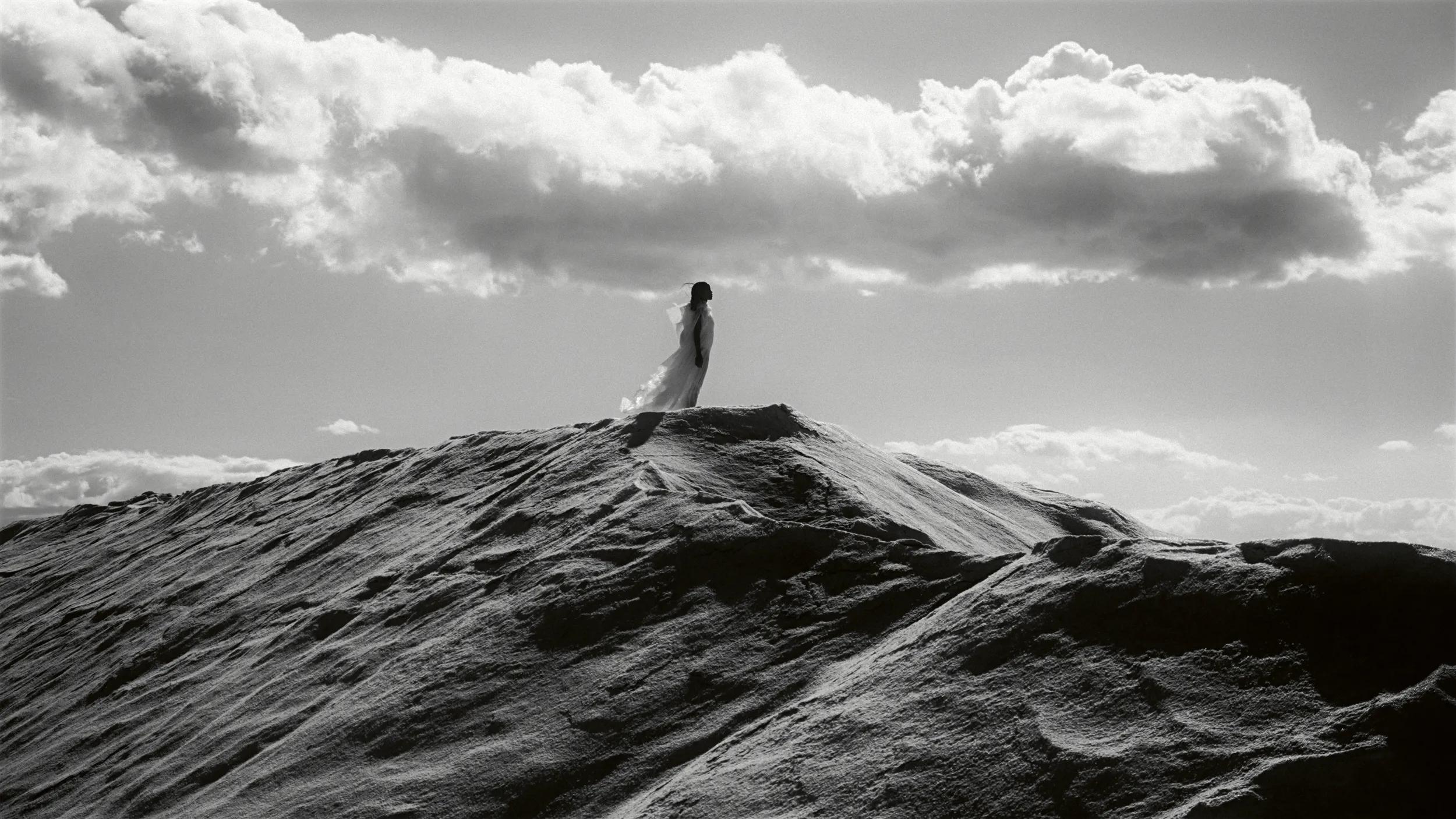
Julianknxx, Still from What Colours Can We Dream In This Night Filled With Salt?, 2025
“Trace the history of salt, and you trace human history,” says the London-based artist Julianknxx, who has spent the better part of a year preoccupied with the mineral. It’s unsurprising, given salt’s vast symbolic, historical and material reach. It’s expelled from our bodies in moments of emotional and physical extremes. It acts as a preservative, a healer and an enhancer of taste and plays a central role in ancient rituals. Salt water connects and divides continents and peoples. It can make our bodies float. It is entangled in histories of trade, movement, brutality and loss. For Julianknxx, salt is a witness, a messenger.
Julianknxx was born in 1987 in Freetown, Sierra Leone. When he was nine, he moved with his family to Gambia before settling in London in his teens. Across poetry, music, film, performance and installation, his work explores the transmission of histories—particularly those of Africa and its diasporas—and the ways in which stories migrate and evolve across generations and oceans.
In May, he opened “In Search of ... Incredible” at Luma Arles, his largest exhibition to date in France, a show that evolved from a three-month residency last summer at the arts center, which was founded by Swiss patron and collector Maja Hoffmann.
Although the exhibition developed in Arles, its roots lie in research that Julianknxx conducted forty-five miles south in Marseille, one of the cities that served as a focus for his 2023 Barbican Curve show “Chorus in Rememory of Flight.” For that project, he immersed himself in African diasporic communities across nine European port cities, gathering performances, songs, poems and oral histories. “I had all this research that was just sitting there—images I hadn’t used, songs I’d recorded, interviews,” he says. “It made sense to go deeper.” But he still needed a through line, which arose during a conversation with Vassilis Oikonomopoulos, Luma’s artistic director.
Oikonomopoulos, like many in the art world, first encountered Julianknxx’s work in the 2021 group exhibition “LUX” at 180 The Strand in London, where the artist showed a video installation titled Black Corporeal (Breathe). “What was immediately striking was that his practice did not sit inside any single category,” Oikonomopoulos says. “It moved between poetry, film, performance, music and sculpture with unusual precision.”
Some projects develop logically; others arise through near-surreal serendipity. For Arles, the alignment came when Julianknxx discovered the river city’s long history of salt production. Even cladding panels inside the Frank Gehry–designed Luma Tower, where he conducted much of his research during his residency, were made from salt crystallized in nearby Salin-de-Giraud, home to Europe’s largest salt marshes. These vast, bleached landscapes became the setting for one of the exhibition’s central works, What Colours Can We Dream in This Night Filled with Salt?, a short film that debuted at the 36th Bienal de São Paulo last September.
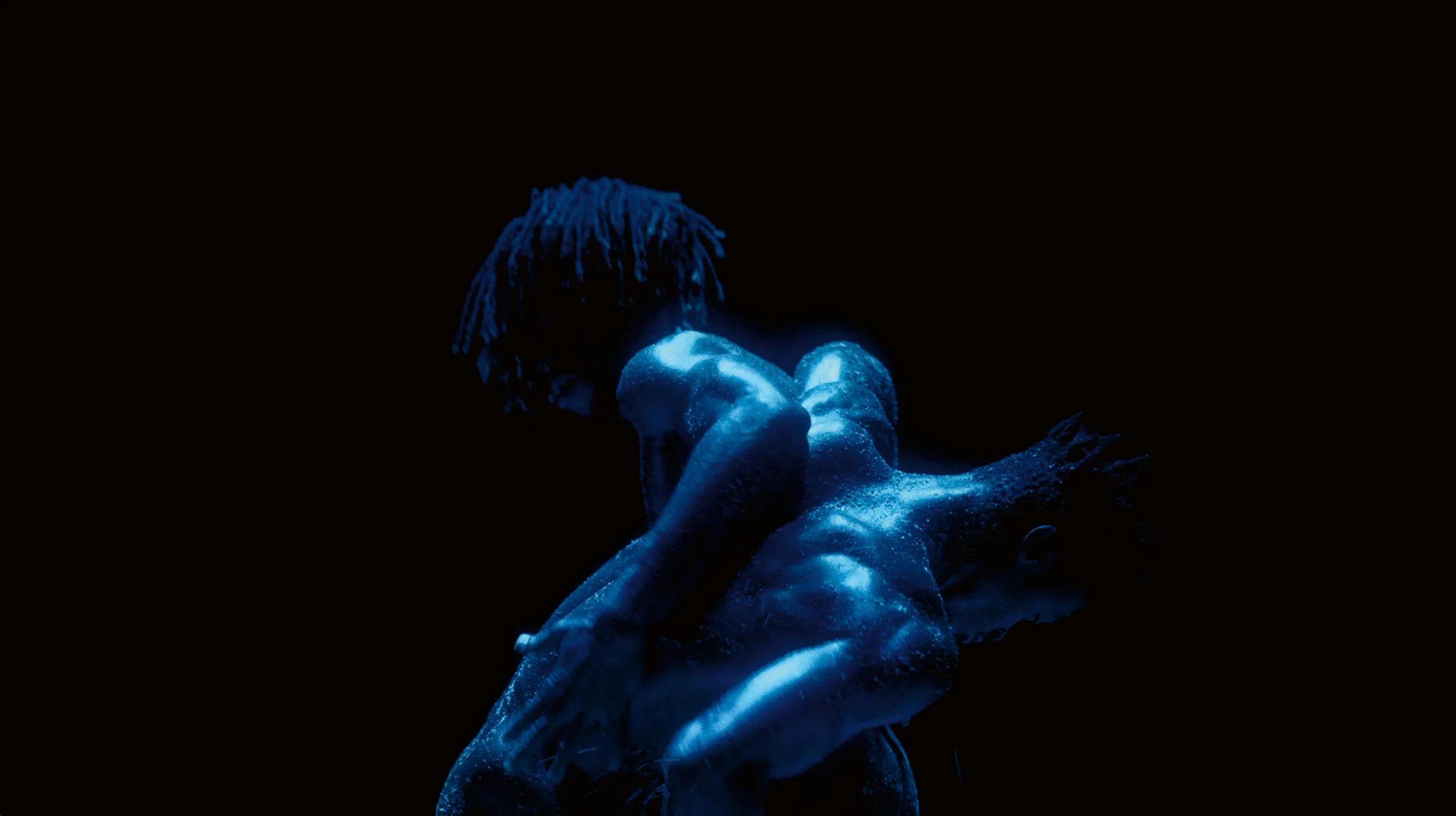
Julianknxx, Still from Untitled (ɔl bɔdi na sta), 2024
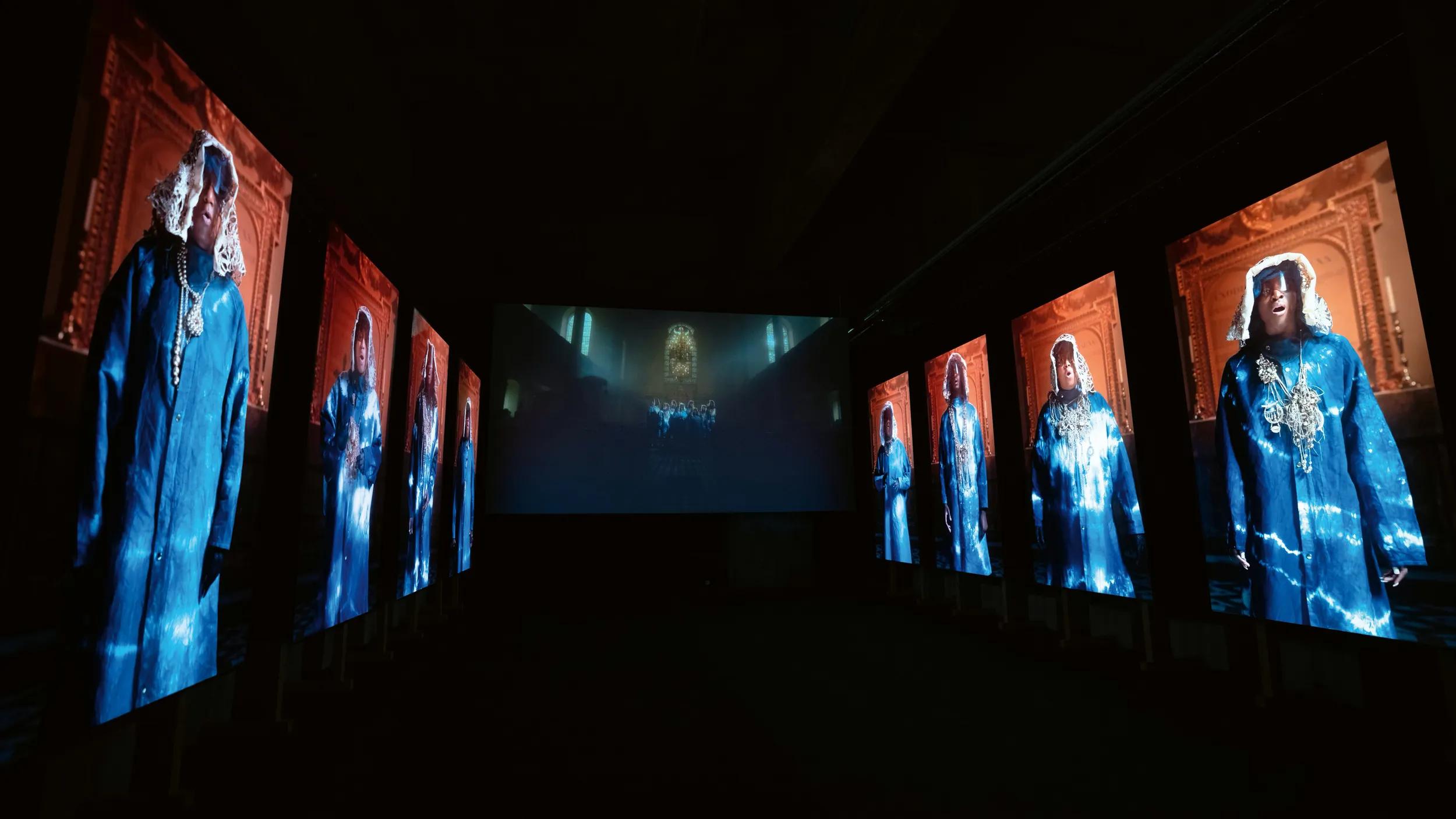
Julianknxx, Black Corporeal (Breathe), 2022. Installation view of “LUX: New Wave of Contemporary Art,” 180 The Strand, London, 2021–22
The film follows the Boras Choir, a Marseille-based vocal ensemble that preserves Comorian cultural traditions through song, as well as author, composer and slam poet M’Baé Tahamida Mohamed (“Soly”), who traveled to the Comoros Islands and brought back lullabies for his wife, Fatima Ahmed, founder of the choir.
A poem written by Julianknxx can be heard over a ghostly soundtrack, weaving the choir’s lullabies with the artist’s own. He composed the film’s score in collaboration with musicians Thabo, Aron Kyne and Paul Cousins, who also contributed to the Barbican show. “It was about listening, transforming and then presenting,” Julianknxx says.
The film also references an 18th-century legend surrounding an African witch named Gang Gang Sarah, whose story has been handed down in many versions. According to one, she flew across the Atlantic to free her enslaved family in Tobago, staying there to teach, heal and fall in love. When her husband died, she climbed a silk cotton tree to fly home to Africa but instead fell to her death. She had lost her powers, the story goes, after consuming salt.
Throughout the film, two girls in white dresses (played by Julianknxx’s own daughters, who inspire much of his poetry) wander across the Provençal salt marshes. Elsewhere, a woman whose character was inspired by Gang Gang Sarah dances spectrally, sometimes with apparent frustration, on the crest of the marsh. “It’s a story about the plight of women,” he says. “I wanted a character who felt caught, like she had landed on this salt plane and could no longer fly.”
The film’s landscape, he added, needed to feel “beautiful but ghostly,” as if it existed somewhere above the clouds. But the environment is not pure fantasy: Look closer and you’ll notice that the water is tinged red. “Beauty is not complete if there’s no blood,” he says.
Another of the film’s references is the story of the Igbo Landing, a tale that exists, like that of Gang Gang Sarah, somewhere between history and myth. In 1803, a group of enslaved Igbo people from modern-day Nigeria, transported via the Middle Passage and sold in the state of Georgia, revolted on St. Simons Island, just off the coast. Historical accounts record that, rather than follow their captors onto land, they turned back toward the water, choosing death over enslavement. Like many Black histories, the story has been carried as much through retelling as through record. In oral histories passed down across generations, the captives are said to have walked across the water, some returning to Africa, turning an act of resistance into something both historical and mythic. The revolt is often described as the first freedom march in American history.
For Julianknxx, What Colours Can We Dream is not about escape but about the present. “It’s not some distant, mystical thing,” he says. “You can apply Gang Gang Sarah’s story to now. Governments are still trying to stop women from accessing education. Institutions are being destroyed. People are being stopped.”
At the film’s end, the screen fades to white. “The longer you stare at salt, the more you realize you’re drawn to it because of the way it refracts light,” he says. “I was thinking about how light can be weaponized—if you’re not under it, you’re in darkness. But in the middle, in the gray areas, that’s where the contours emerge. That’s where things get interesting.”
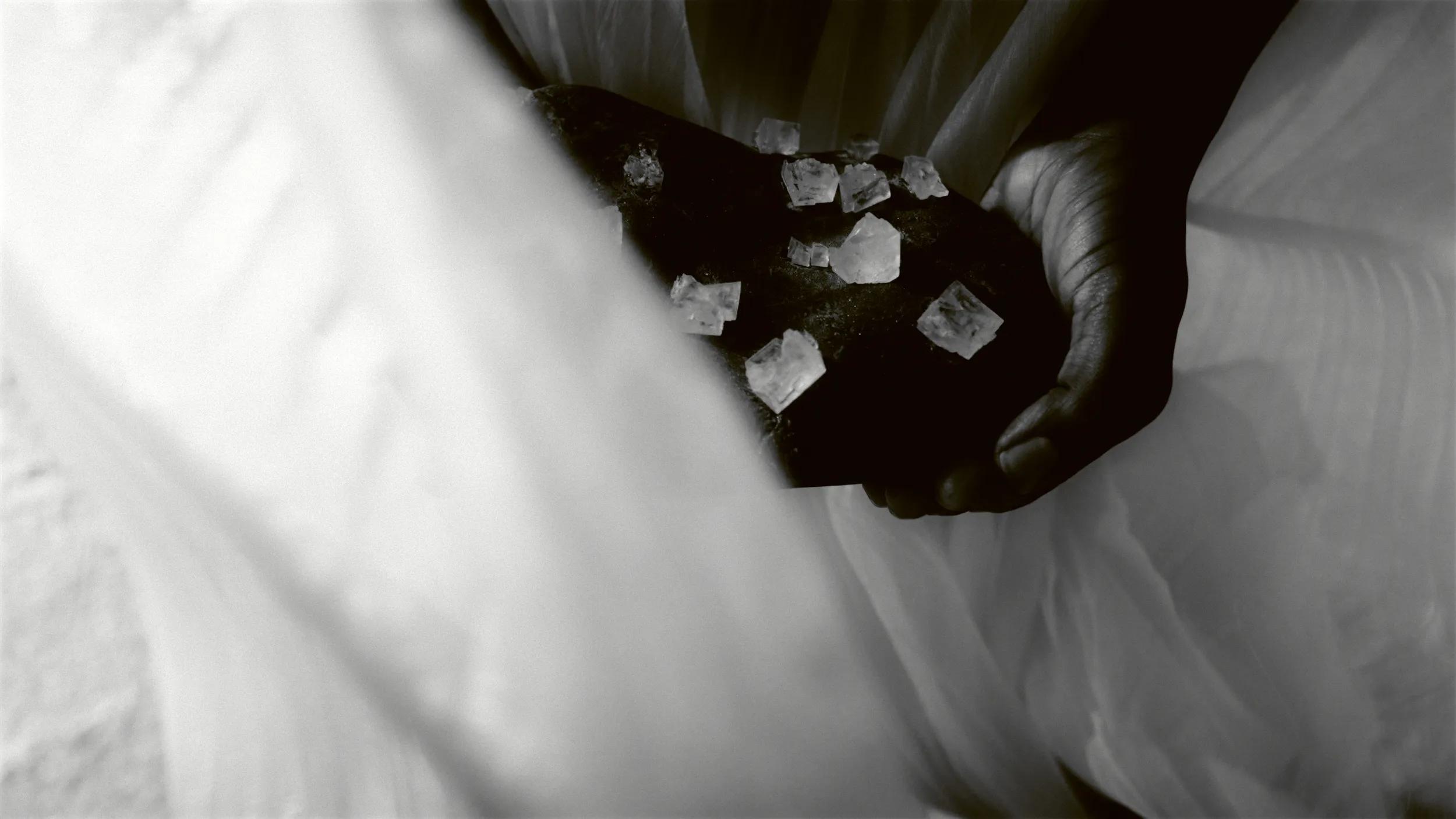
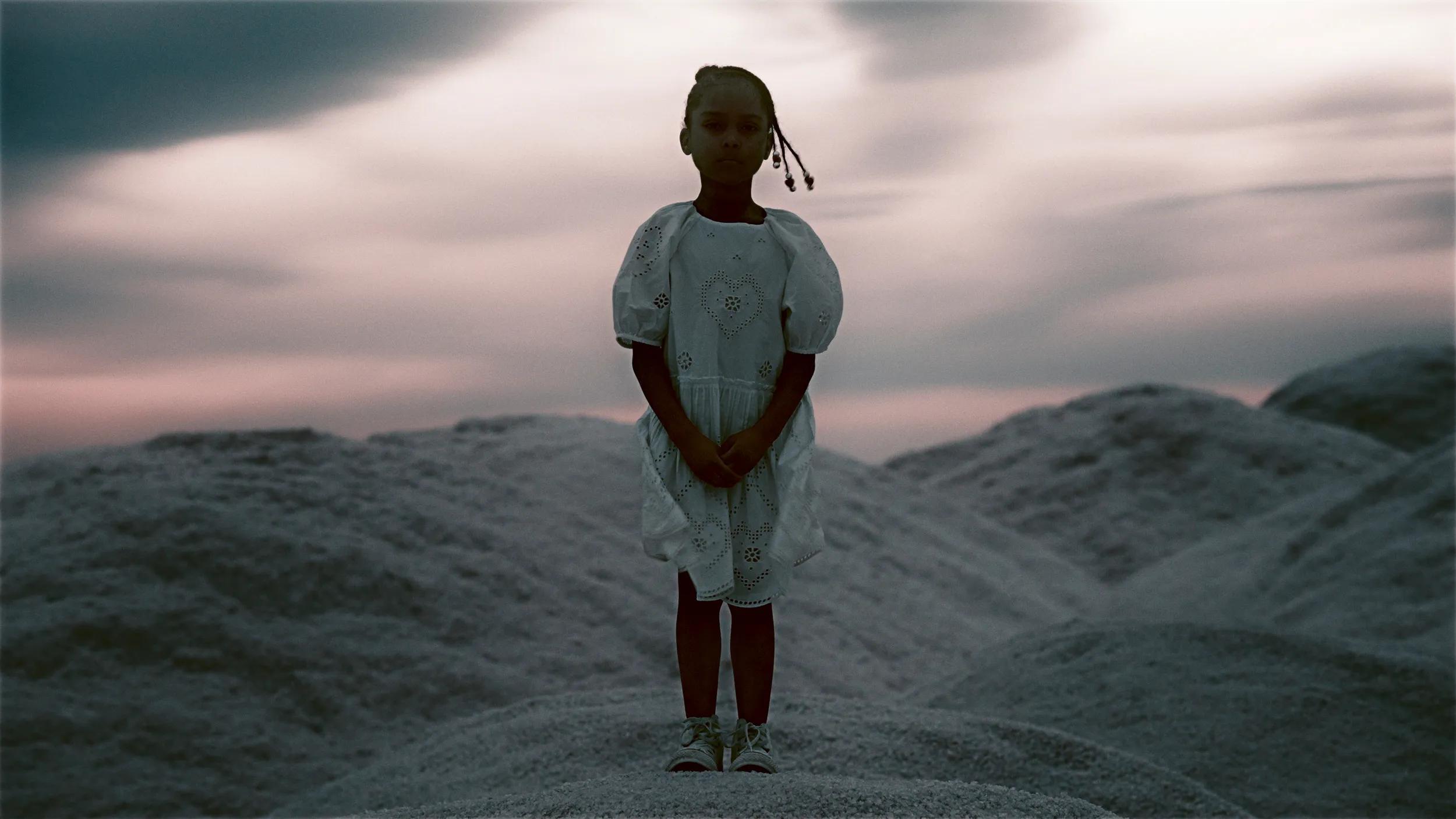
Julianknxx, Still from What Colours Can We Dream In This Night Filled With Salt?, 2025
Oikonomopoulos, who seems to position Julianknxx not simply as a maker of images but as an archivist, conservationist and interpreter of collective histories, says: “He approaches salt not as a single symbol, but as a dense and shifting medium; a material that is ecological, industrial, historical, sensorial and poetic, all at once. In Arles and the Camargue region, salt carries the weight of labor, extraction, climate, trade, transformation and territory. Julianknxx enters this field with extraordinary sensitivity, and he does not reduce the material to metaphor, history or utilitarian function only.”
Long before he started making films, Julianknxx engaged with drawing—sometimes to quiet an anxious mind. He shows me a few. They are mostly composed of single lines set against blocks of color, suggestive of figures, faces and masks. There is an automatic looseness to them, but also a quiet discipline, as if each line is feeling its way toward a form rather than describing it. Recently, he has been sending drawings to his mother, a retired teacher in Gambia, who takes them to a carpenter to be reimagined as small rosewood sculptures. She then sends the sculptures back to her son in London. “It’s about the passage, the idea of sending something home, something that’s not tangible, and then seeing what comes back, translated,” he says. “My mum is the main transmitter in that process; it’s preserving a dialogue with home, across the oceans. The thing that keeps coming up is searching for the ineffable, the thing you can’t put language to. I know that my mum gave—and gives—me life. So, if I send this thing to her, when it comes back it will have a life of its own.”
For a while, he didn’t know what to do with this now-extensive archive of wooden pieces that have, inscribed in themselves, their travels across wide physical and cultural geographies. In the Luma show, they will be displayed, preserved and transformed into various materials, including salt—a natural next step in their voyage. “It’s interesting when we understand salt as a substance that preserves, crystallizes, erodes and connects,” says Oikonomopoulos. “In a way, Julianknxx makes the territory legible again through its materiality.”
In 2023, when he was conducting research in Marseille for his Barbican project, Julianknxx met two young Congolese men who invited him to film their dance performance. “It was in a dark room with salt on the floor, and they were naked, using the salt to prepare them for this rite of passage; all you could hear was the salt on their skin,” he says, adding that he was deeply moved by the experience. “I’ve never seen two Black men be so intimate without being sexual. It was dope.” He said the performance brought to mind a line from Frantz Fanon’s 1952 book Black Skin, White Masks: “I am Black, not because of a curse, but because my skin has been able to capture all the cosmic effluvia.” He added that he also thought of his brothers, who had recently passed away.
He opens his laptop to show me another film for the Luma exhibition, Untitled (ɔl bɔdi na sta), developed from the dance recording in Marseille. Against an ethereal composition by the artist, the performers’ bodies appear to float in a black void. They dance with the salt, paint the floor with it, scatter it through the air.
Julianknxx uses poetry much like salt, as a preservative moving through time, water and bodies, carrying the stories of those who came before and those yet to come: Gang Gang Sarah’s flight across the ocean; the lullabies preserved by Soly and the Boras Choir; the drawings transformed into objects via his mother’s hands. “It’s a deeply, deeply personal show,” he says, reflecting once again on the encounter in Marseille, watching those two men perform: “I was looking at salt, but I was reminded of stardust.”
–
“Julianknxx: In Search of … Incredible” is on view at Luma Arles through January 10, 2027.
–
Harriet Lloyd-Smith is a London-based editor, journalist and artist. She is the former managing editor of Plaster and host of its podcast, Give Me a Break. She was previously arts editor at Wallpaper*. She regularly hosts panels, guest lectures at universities and sits on the board of the AWITA NXT GEN program.