
Over the course of her seven-decade career, Louise Bourgeois never privileged figuration over abstraction, any more than she favored one material over another, and yet her relationship to abstraction has been less well defined and understood, less easily situated within the main currents of postwar art.
‘Gathering Wool,’ curated by Philip Larratt-Smith, explores the artist’s complex relationship to abstraction through a series of late sculptures, reliefs and works on paper, many of which have never been exhibited before. These will be installed alongside a selection of earlier works to illuminate the consistency of Bourgeois’s themes and her development of a symbolic abstract language.
Twosome
The exhibition begins with the large installation ‘Twosome,’ (1991) in which a small tank on a track moves endlessly in and out of a larger tank. For Bourgeois, this mechanism represented the mother-child relationship. The same gallery also features a video clip from her 1978 performance ‘A Fashion Show of Body Parts,’ in which the actress Suzan Cooper belts out the song, ‘She Abandoned Me,’ which addresses the fear of separation from the mother. This juxtaposition of works manifests how the same psychologically charged emotions which gave rise to Bourgeois’s more figurative works also underpin the formal devices in her more abstract works.
Gathering Wool
The exhibition takes its title from an enigmatic work Bourgeois created in 1990. Gathering wool is an expression signifying rumination, daydreaming, letting the mind wander—a break from conscious, purposive thinking. This was the mental state in which Bourgeois worked as she experimented with forms and processes in her studio. She trusted the process by which these thought traces, fragments of dreams, idle speculations, hunches, fancies and intuitions coalesced into a form, but it remained mysterious even to her. The piece itself consists of seven wooden spheres arranged in a circle in front of a tall semicircular screen made up of four panels. ‘Gathering Wool’ (1990) is a precursor of her celebrated Cells in that it is both a sculpture and an environmental installation.
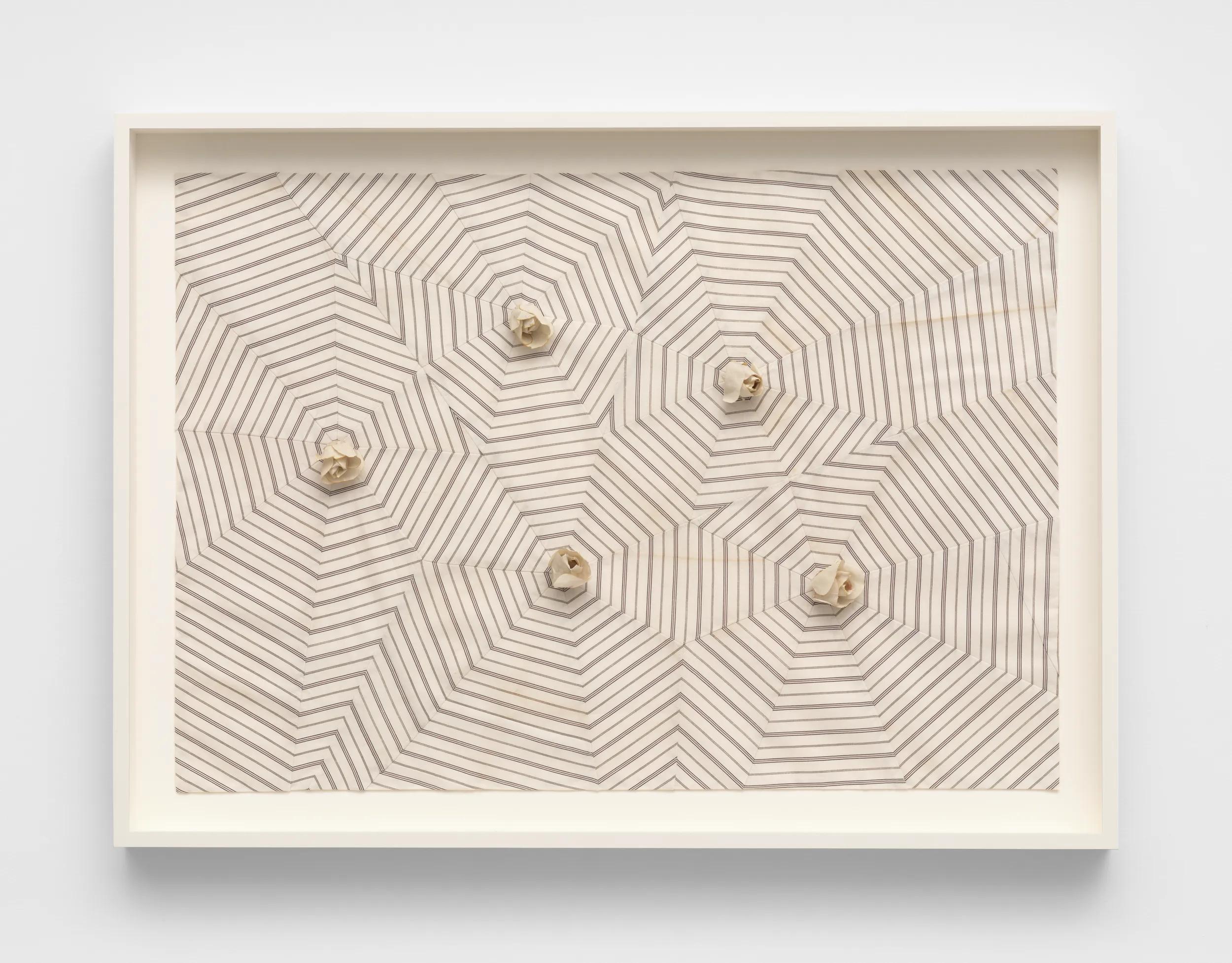
Untitled
2006
Mamelles
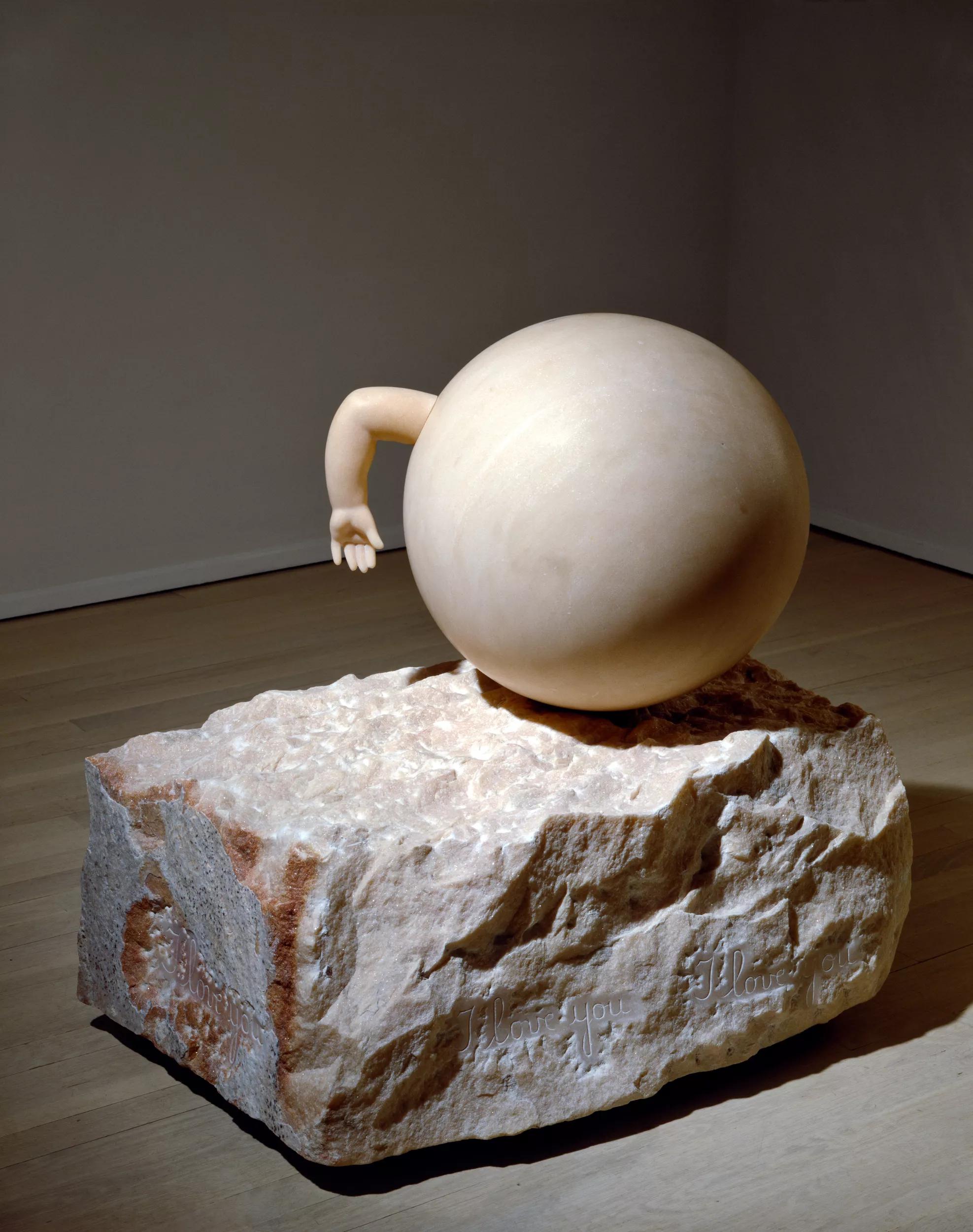
An iconography of things protruding out of other things prevails in many works on the ground floor. In ‘Untitled (With Hand)’ (1989) a child-like arm protrudes from a large sphere, in ‘Mamelles’ (1991) water spills from a long frieze of bronze breasts, in ‘Gathering Wool’ (1990) mushrooms grow out of the cracks and crevasses of the wooden spheres, and in ‘Le Défi II’ (1992) light emanates from glass elements meticulously arranged on the shelves of a metal cabinet. These works probe the boundary and the slippage between container and contained, past and present, the conscious realm with its rationality and order and the timelessness of the unconscious.
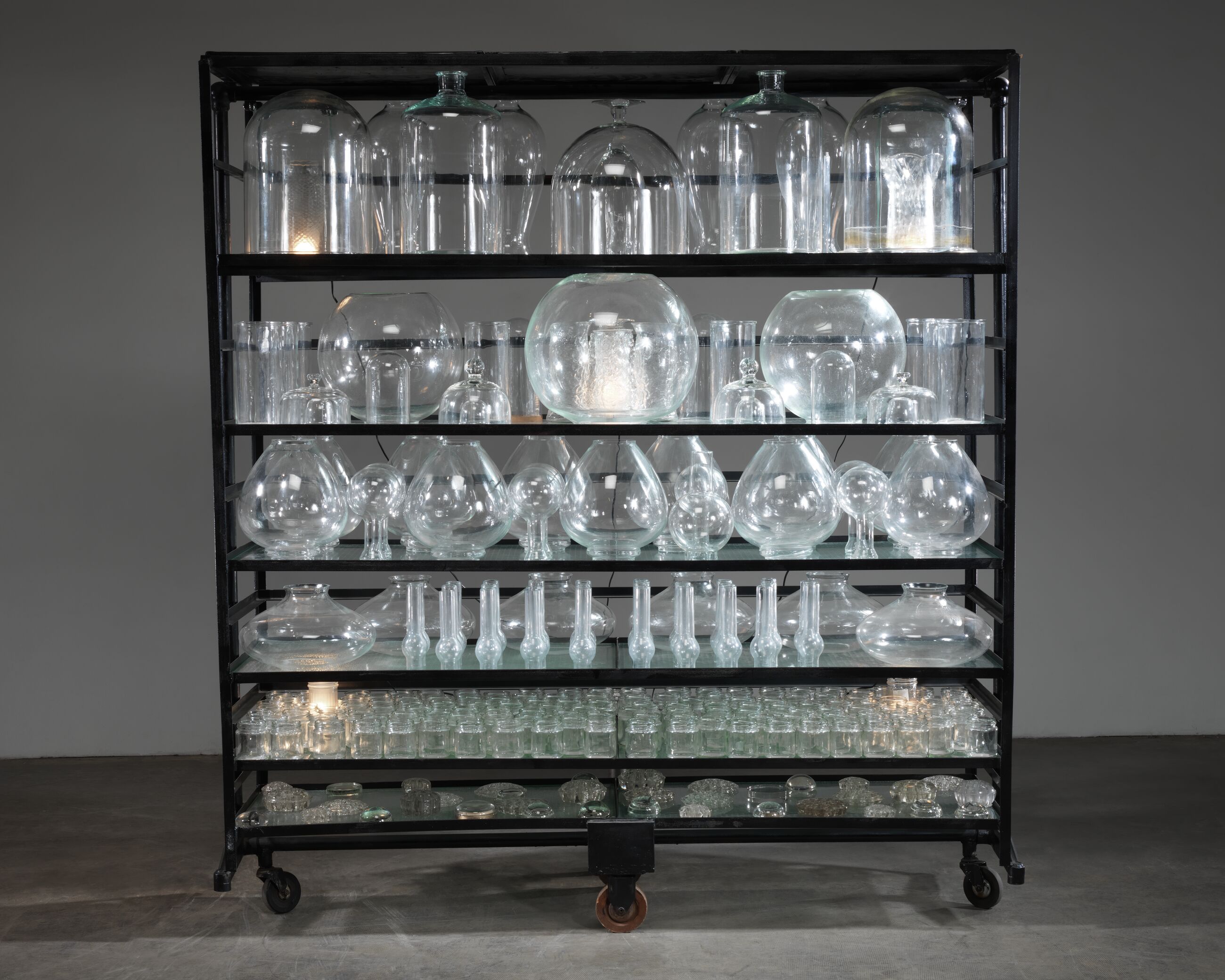
Le Défi II
1992
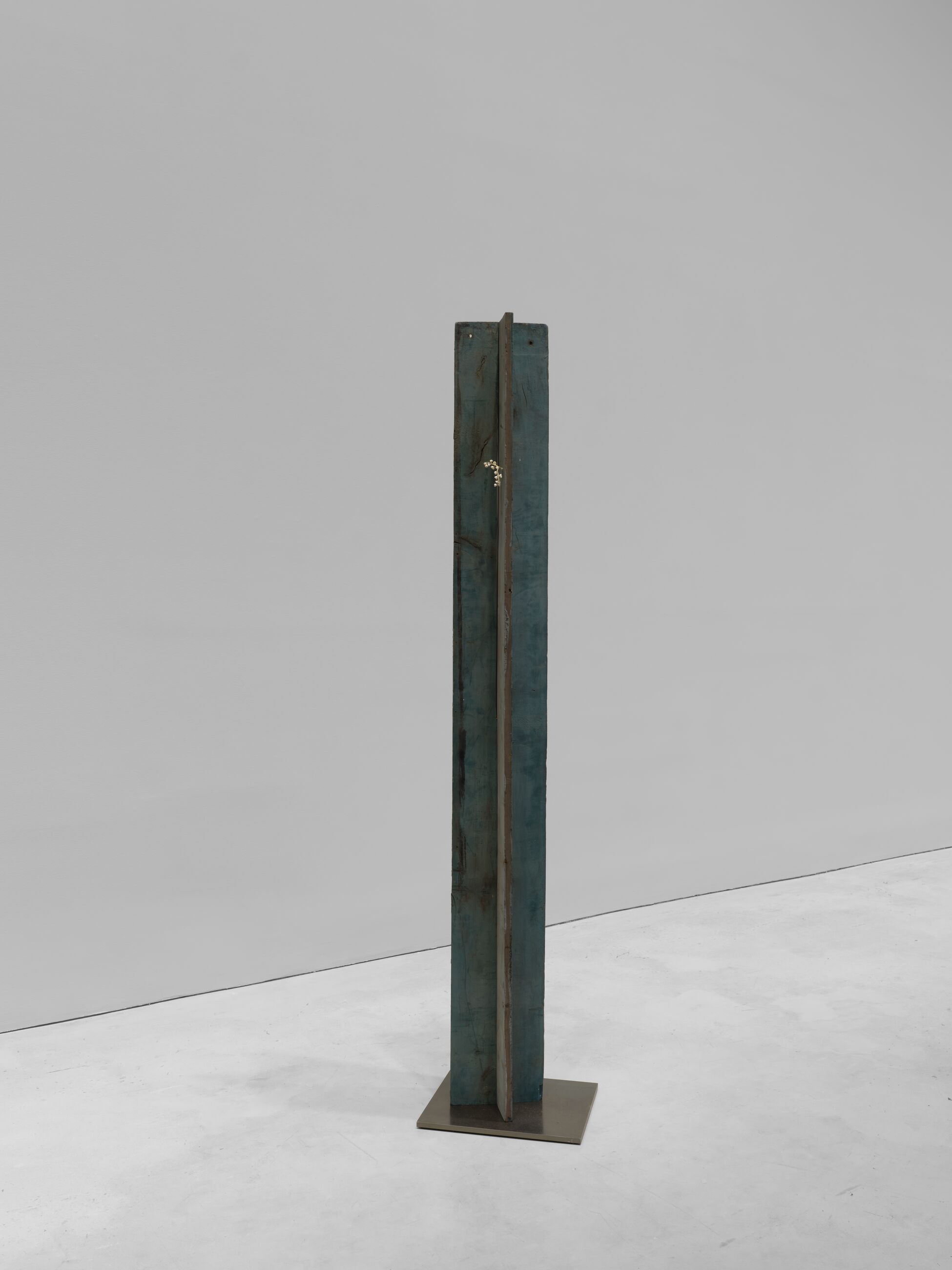
Subliminal II
1986, reworked 2004
Twosome, 1991. "Dislocations" curated by Robert Storr, Museum of Modern Art, New York, 16 October 1991 – 7 January 1992. Filmed by Paul Tschinkel.
Louise Bourgeois ‘Gathering Wool’ (1990) with a reading by Rene Ricard in the exhibition ‘Disturb Me’ at Massimo Audiello Gallery, New York, 17 March – 7 April 1990 © The Easton Foundation/VAGA at ARS, NY
Ursula
In the Court of Louise
In the spring of 1990, before a small audience in New York, the poet, painter and enfant terrible of the New York art world Rene Ricard read a selection of poems to Louise Bourgeois. The pair stood inside Gathering Wool, a Bourgeois installation of round wooden forms being exhibited for the first time in “Disturb Me,” a group show at the Massimo Audiello Gallery on Greene Street in SoHo, alongside works by Francesco Clemente, Robert Mapplethorpe, Bruce Nauman and Edward Ruscha.
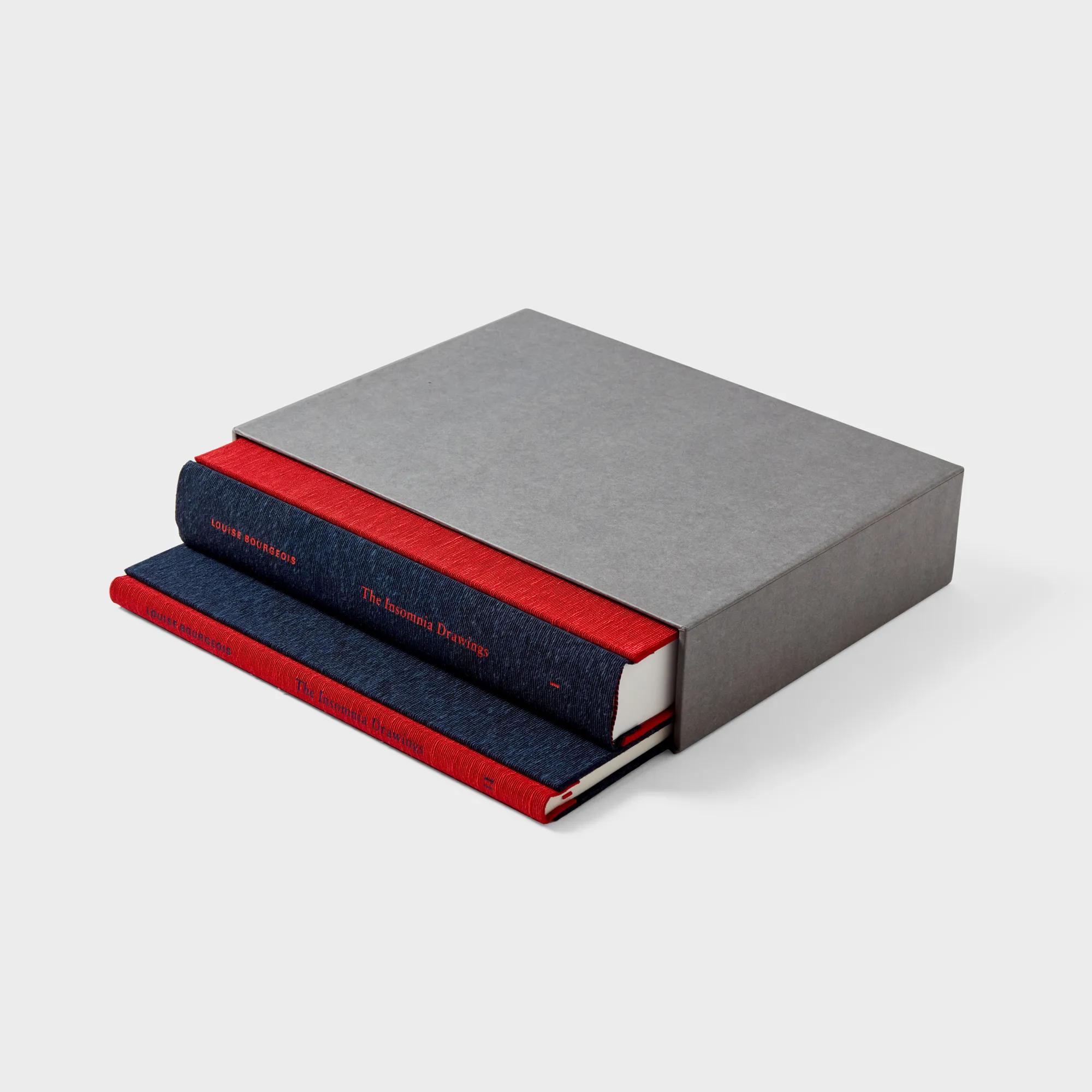
Louise Bourgeois: The Insomnia Drawings
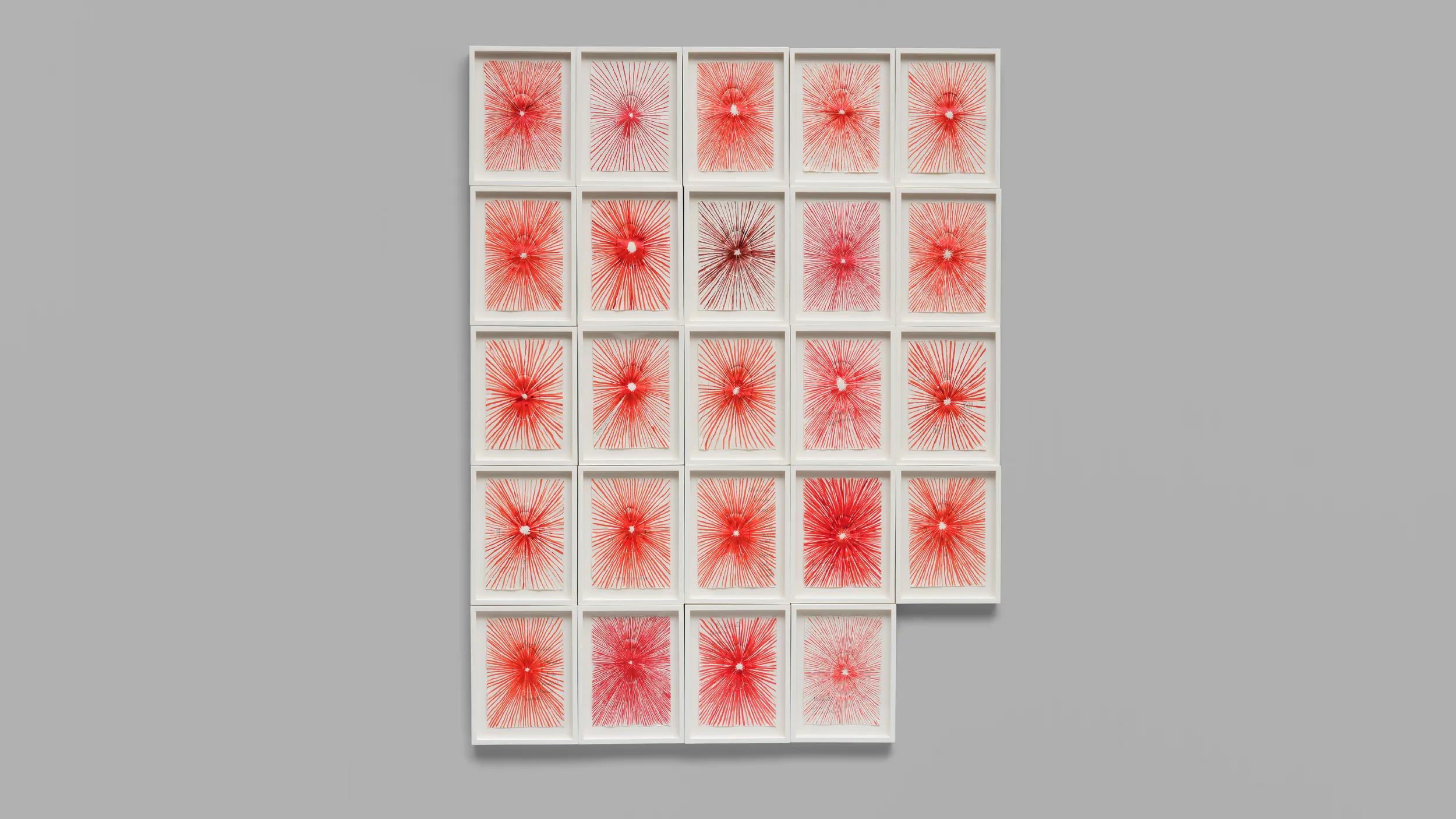
Insomnia was a lifelong companion of Louise Bourgeois’s nights. Between November 1994 and June 1995, she committed to paper the thoughts, memories, and images that surfaced during these sleepless hours. The resultant 220 drawings represent the quintessence of the impulses, sources, and motifs that inspired Bourgeois’s work. Originally published in 2001 by Daros and Scalo, the two-volume set of The Insomnia Drawings is newly available courtesy of The Easton Foundation and Hauser & Wirth Publishers.
Related Content
About the Artist
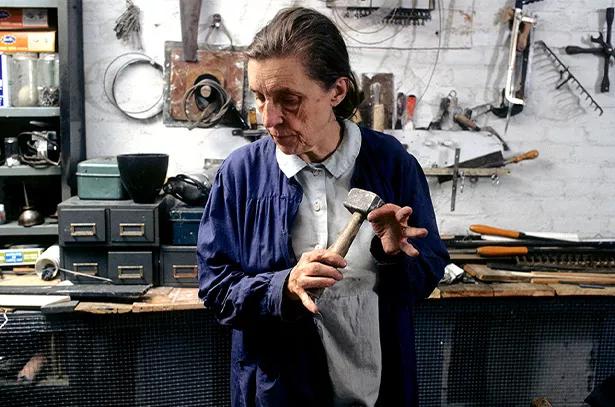
Louise Bourgeois
Born in France in 1911, and working in America from 1938 until her death in 2010, Louise Bourgeois is recognized as one of the most important and influential artists of our time. For over seven decades, Bourgeois’s creative process was fueled by an introspective reality, often rooted in cathartic re-visitations of early childhood trauma and frank examinations of female sexuality. Articulated by recurrent motifs (including body parts, houses and spiders), personal symbolism and psychological release, the conceptual and stylistic complexity of Bourgeois’s oeuvre—employing a variety of genres, media and materials—plays upon the powers of association, memory, fantasy, and fear.
Bourgeois’s work is inextricably entwined with her life and experiences: fathoming the depths of emotion and psychology across two- and three-dimensional planes of expression. ‘Art,’ as she once remarked in an interview, ‘is the experience, the re-experience of a trauma.’ Arising from distinct and highly individualized processes of conceptualization, Bourgeois's multiplicity of forms and materials enact a perpetual play: at once embedding and conjuring emotions, only to dispel and disperse their psychological grasp. Employing motifs, dramatic colors, dense skeins of thread, and vast variety of media, Bourgeois's distinctive symbolic code enmeshes the complexities of the human experience and individual introspection.
Rather than pursuing formalist concerns for their own sake, Bourgeois endeavored to find the most appropriate means of expressing her ideas and emotions, combining a wide range of materials—variously, fabric, plaster, latex, marble and bronze—with an endless repertoire of found objects. Although her oeuvre traverses the realms of painting, drawing, printmaking, and performance, Bourgeois remains best known for her work in sculpture.
Bourgeois’s early works include her distinct 'Personages' from the late 1940s and early 1950s; a series of free-standing sculptures which reference the human figure and various urban structures, including skyscrapers. The ‘Personages’ served as physical surrogates for the friends and family Bourgeois had left behind in France, while also highlighting an interest in architecture dating back to her childhood. Her installation of these sculptures as clustered ‘environments’ in 1949 and 1950 foreshadowed the immersive encounters of installation art twenty years before the genre’s rise to prominence.
Bourgeois’s work was included in the seminal exhibition ‘Eccentric Abstraction,’ curated by Lucy Lippard for New York's Fischbach Gallery in 1966. Major breakthroughs on the international scene followed with The Museum of Modern Art in New York's 1982 retrospective of her work; Bourgeois's participation in Documenta IX in 1992; and her representation of the United States at the 45th Venice Biennale in 1993.
In 2001, Bourgeois was the first artist commissioned to fill the Tate Modern’s cavernous Turbine Hall. The Tate Modern’s 2007 retrospective of her works, which subsequently traveled to the Centre Pompidou in Paris; The Guggenheim Museum in New York; The Museum of Contemporary Art in Los Angeles; and The Hirshhorn Museum & Sculpture Garden in Washington D.C., cemented her legacy as a foremost grande dame of late Modernism.
Header image: Louise Bourgeois, ARCHED FIGURE, 1993 © The Easton Foundation/VAGA, NY, Photo: Christopher Burke
Current Exhibitions


Glenn Ligon
Late at night, early in the morning, at noon
15 January – 11 April 2026
New York, 18th Street


1 / 12