
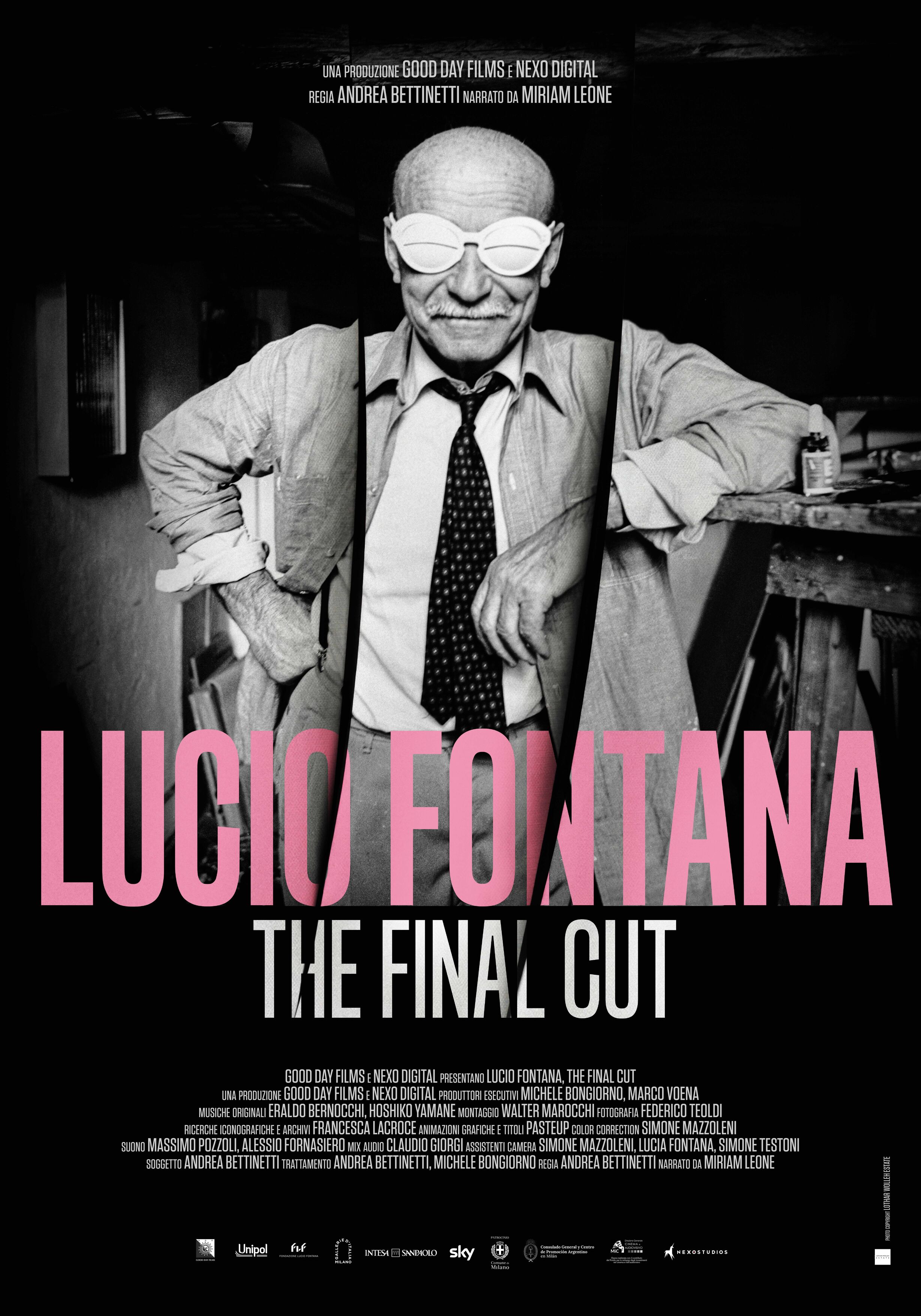
Poster of ‘Lucio Fontana. The Final Cut’. Courtesy Good Day Films and Nexo Studios
Join us for a screening of ‘Lucio Fontana. The Final Cut’ (2026) at M+ Cinema, in celebration of ‘Lucio Fontana. Spatialism. Pioneering the Contemporary’ at Hauser & Wirth Hong Kong.
A portrait of a 20th-century master who redefined space and matter, transforming the way we see art and creation itself. Directed by Andrea Bettinetti and produced by Good Day Films and Nexo Studios, this is the first documentary on Lucio Fontana, in collaboration with Fondazione Lucio Fontana, offering an unprecedented, multi-dimensional portrait of the revolutionary Italian-Argentine artist who tore through the canvas to redefine space, matter, and the very meaning of art.
The screening will take place at M+ Cinema, with seats being allocated on a first-come, first-served basis. Please note that the screening will start promptly at 6.30 pm.
Tickets are free, however, advance booking is essential.
Location: Cinema House 1, M+
Duration: 90 minutes
Language: In English and Italian (with English subtitles)
About Lucio Fontana
Lucio Fontana (Rosario de Santa Fé, Argentina, 1899 – Comabbio, Italy, 1968) was one of the most influential artists of the 20th-century international scene. Driven by an endless creative curiosity, he constantly explored new materials and languages to redefine artistic expression.
Fontana was born in Argentina to parents of Italian descent. After studying in Italy, he returned to Argentina in the 1920s where he pursued a career as a sculptor. In the 1930s, Fontana became a key figure in Italian abstract art. During the same period, he began his lifelong and groundbreaking research into ceramics, also through his friendship with Tullio d’Albisola, Futurist poet and ceramist, while working with leading Italian architects such as Figini and Pollini, BBPR, and Luciano Baldessari.
In 1946, he published his Manifiesto Blanco, which called for the integration of art, science, and technology, and laid the foundations for the emergence of the Spatialist movement the following year. Best known for his Concetti Spaziali and Tagli series of slashed canvases, Fontana redefined postwar art by dismantling traditional boundaries between painting and sculpture, violating the integrity of the canvas to open up the new and infinite dimension of the void.
Beyond his renowned Holes and Slashes, as well as his sculptures, Fontana developed numerous series throughout the 1950s and 1960s, including “Stones”, “Baroques”, “Impastos”, “Inks”, “Papers”, “Oils”, “Quanta”, “Natures”, “Metals”, “The End of God”, “Little Theatres”, “Ellipses”, and further Spatial Environments, which he continued to explore until the end of his life.


