

Essays
The Fisherman
Iwan Wirth remembers Björn Roth (1961–2026)
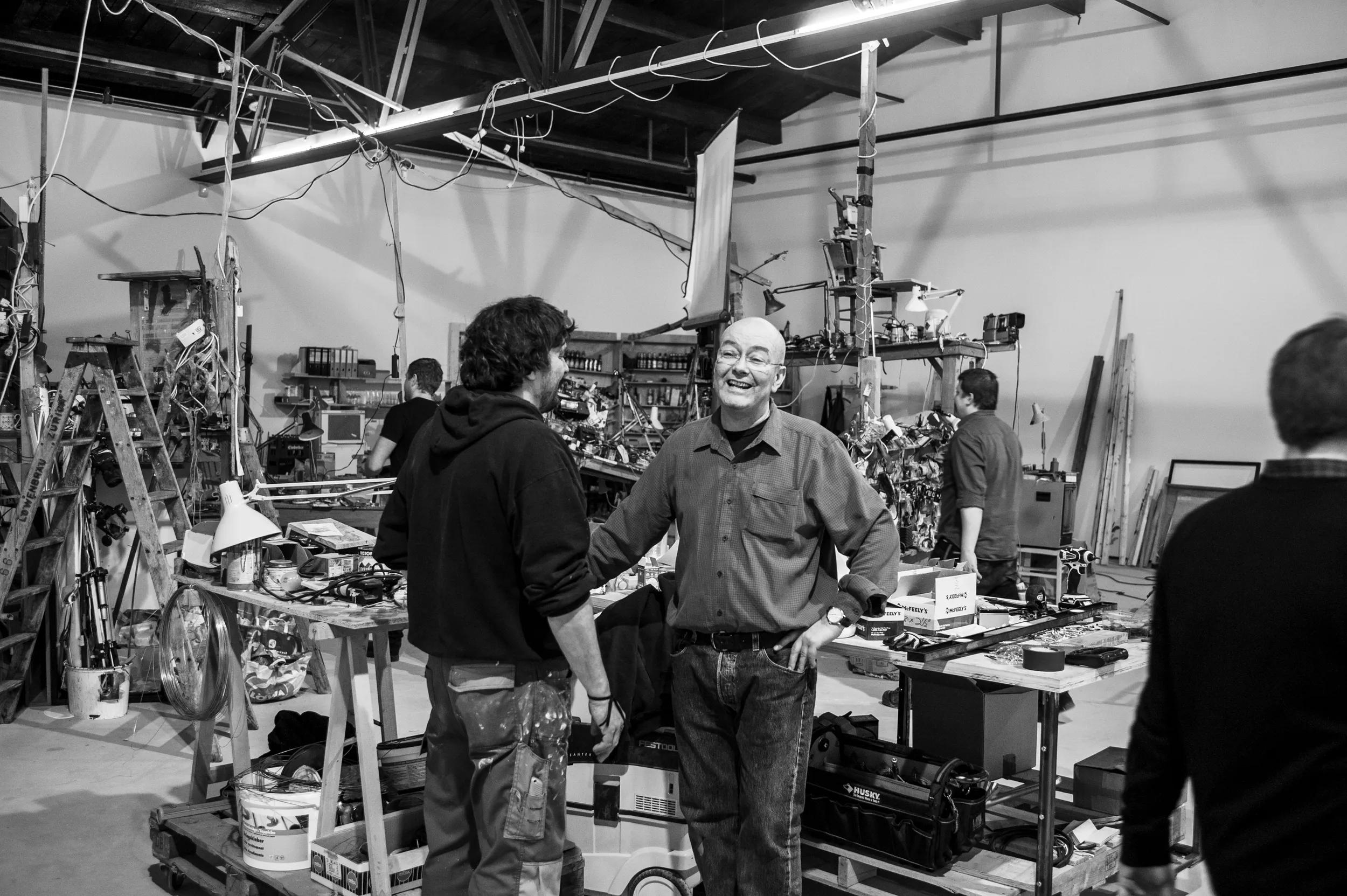
Björn Roth during the installation of the Roth Bar at Hauser & Wirth New York’s 18th Street location, 2013. Photo: Bjarni Grimsson
Björn Roth was one of the first people I came to know well in the serious art world, and his was my longest friendship there, one that started almost at the beginning of the gallery itself. He was part of that great first generation of artists that Manuela and I encountered, and our relationship had a profound effect on how I think about the art world and the world in general.
In the mid-1990s, obtaining an invitation to Dieter Roth’s studios in Basel was an almost impossible dream, especially for someone as young as I was. There were legendary stories about those studios. I had grown up with Dieter Roth’s work; I knew as much about him as I knew about Alberto Giacometti or Henry Moore or any of my heroes, and yet Dieter was still alive. I worked for many years to get to meet him, and it was never possible and then finally, unbelievably, it happened. Manuela and I were invited to go discuss a potential exhibition that we were planning for Zurich in 1997. I was twenty-seven years old. It was very much a meeting-your-hero moment.
We all sat down together in the version of the Roth Bar that was known as Bar 1 because it was set up in one of the studios in Basel and was essentially the first version of the bar as artwork. I could hear someone working in the back of the studio and Dieter told me, “That’s my son, Björn.” It was somehow very strange how Björn moved around the place that day. You could sense a tense atmosphere between them. They were having some serious issues with money at the time because Dieter was notoriously bad with finances.
Björn understood the dilemma that his father created for himself over and over again and was trying to fix it. Dieter said to us: “My son and I have had some arguments about money, but now he’s very excited because he thinks you might buy the new bridge we’re building.” And then pretty quickly we were asked to buy a work to make the exhibition possible. That was very old-school. Back then, galleries would often buy shows before they opened or parts of shows or forward some money in advance to the artist. Dieter was of that generation, and being in acute need of funds, he insisted we buy a work. We were building a house in Zurich at the time, our first house, where we still live, in Bäckerstrasse, and as we sat in the bar, I said: “What makes most sense for us to buy is this bar that we’re sitting in, because we’re building a house, and it would be incredible there.” Björn immediately jumped in and he said, “No, we cannot sell the bar. It’s too important. It’s part of every show and it’s the first thing we set up, and it’s a social sculpture.” Dieter felt the same way, but he said that he would agree to sell it as long as we would agree to run the bar for some period of time as a public bar, a functioning bar. Björn wasn’t happy with this, and so in a way we had a difficult start to our relationship. But it was really a defining moment for us and for the gallery, and we made the first show with Dieter and Björn in 1997.
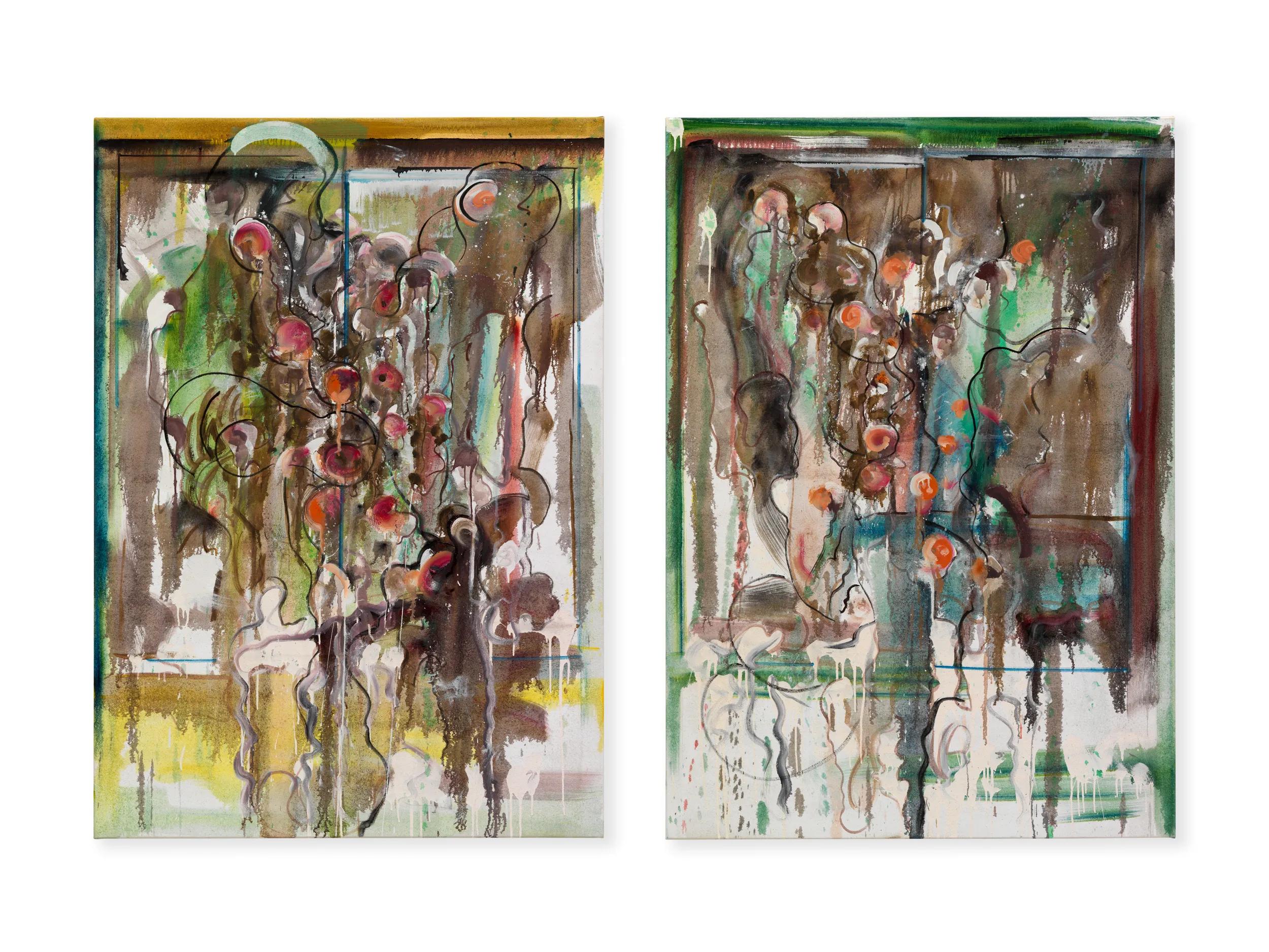
Björn Roth, Birdbook painting 5A, Birdbook painting 5B, 2005–2015. Photo: Stefan Altenburger Photography Zurich
At that point we had to find a location to run the bar, before the show even opened. Björn came with an entire Icelandic crew to help install it, and he quickly got thrown in jail because he had no work permit and, as I remember it, he was misbehaving in some way. He could be very wild, especially in those years. But we were able to get him out of jail and we spent a lot of time looking for a location and finally found a good place just around the corner from the gallery in Limmatstrasse, in what I think was a former musical instrument shop, which the owner allowed us to turn into a bar.
It was the beginning of a truly legendary moment in Zurich. We had a lot of local artists who helped us run the bar. It was a place to speak from your heart, a place to be ourselves. However there were strict rules about how it had to be run and one rule was that the barman had to document every guest with a Polaroid photo and include that in the guest book, to document “life” in such a way. It was a living sculpture. Dieter made the menu cards. Urs Fischer worked there part-time, as did many other artists. The bar became an extraordinary center of gravity for the 1990s art scene in Zurich.
We met Dieter and Björn again soon after in Marseille, where Dieter had a museum show. Jason Rhoades and Paul McCarthy, who were already with the gallery, told us about it and said it was absolutely crucial that we go see it. So we did, and we spent time with them again and acquired some further works. In fact, that was the basis of the invitation—no illusions there. It was very clear that we were becoming Dieter’s financial partners. He never liked dealers or gallerists, and that generation in general, from the 1960s and 1970s, had a very complicated relationship with the commercial side of things. So we understood that it was all a very one-way street, but we knew we were doing the right thing. And then, incredibly sadly, Dieter died soon thereafter, during the run of the Zurich show.
It was an intense time for Manuela and me because our first child had been born and the gallery was exploding as the art world began to flourish again after the slow years of the early 1990s. We had incredible things happening, and amid this we went to Iceland to meet the Roth family in a different way, post-Dieter, to start to discuss the estate and what it meant and to see all the studios in Iceland. And it was from those trips that Björn and I first began to go fishing together. It turned out that Dieter was once a very good and keen salmon fisherman, a fly fisherman. And that torch had been passed to Björn, who was obsessed with fly-fishing for a long time, as is his son Oddur to this day.
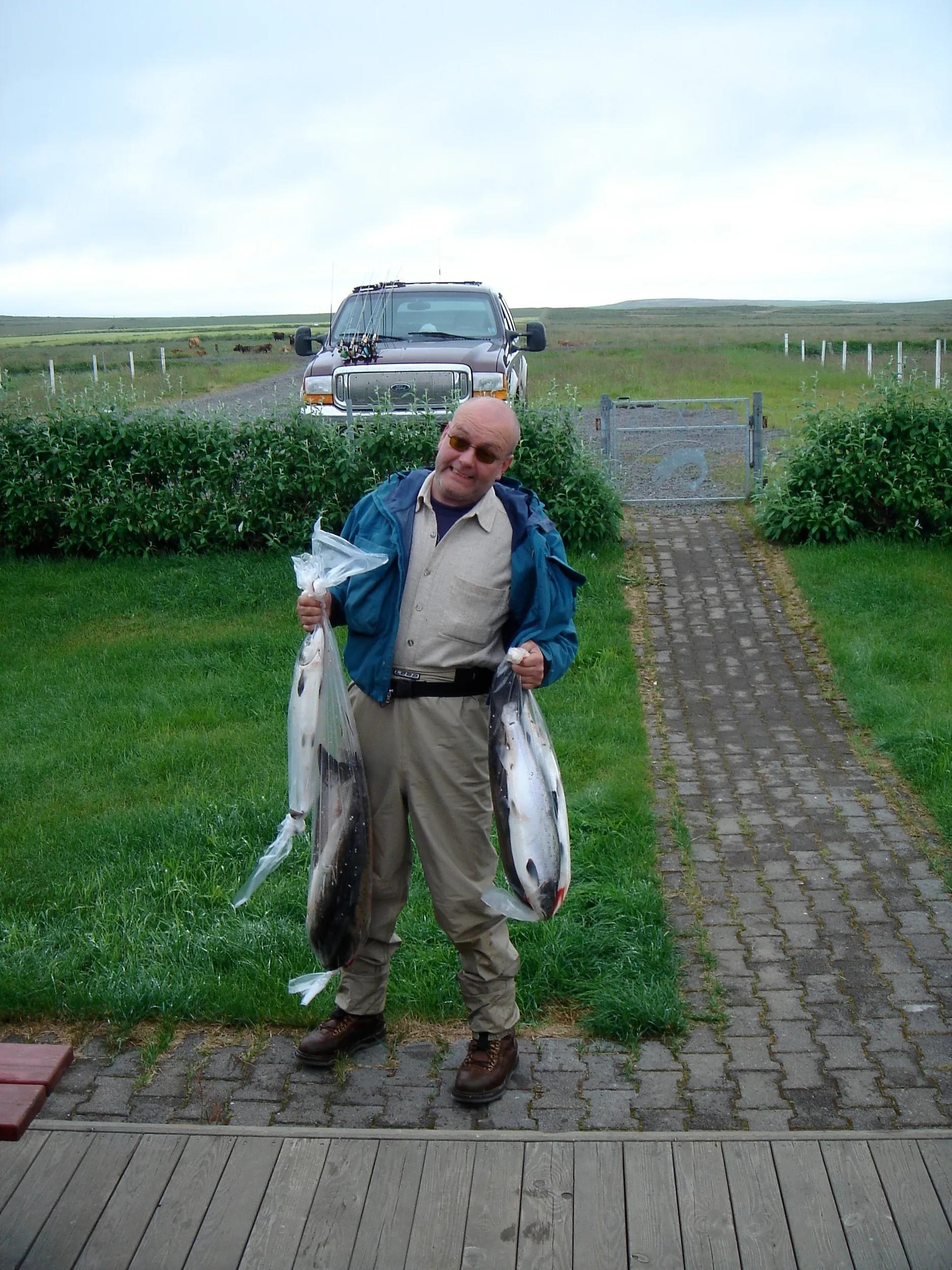
Björn Roth was, like his father Dieter, an avid fisherman. Photo: Iwan Wirth
Björn taught me how to cast, and taught my oldest childhood friend, Bruno Weber, and eventually he taught our children. And we ended up spending many, many weeks every summer, all over Iceland, fishing, camping in huts, trying to catch salmon. Björn knew the rivers, and he would introduce us to them and take us there. And of course when you fish you do everything else as well. You drink and you eat and you talk and tell jokes and laugh. It became an extraordinary exchange about fishing tales and art and life. Björn, who was a great chef, would cook. And he would drink and smoke and talk and cook some more. When you’re fishing, often the stories that you hear sound unbelievable and you’re sure that they have to be made up—like the story Björn told me about a horse veterinarian who would extract people’s teeth for them in the fishing hut when they had a toothache. Or when Björn once told me he was on a diet that consisted exclusively of fat. And yet it turned out that both of those stories, and many more he told me, were essentially true.
There was always a kind ritual whenever we arrived in Iceland. Björn would pick us up at the airport, and we would immediately go to buy cigarettes and groceries on the way to the river. We would go to many different places, but we always ended up at a fishing spot called Laxá in Ásum, which is a small place with the worst possible huts for sleeping but a legendary river, right by the sea, considered one of the best in Iceland. The rule of thumb with Icelandic salmon fishing is that the worse the huts, the better the fishing. And the huts there were largely primitive, especially considering the price of fishing, which is a very exclusive and expensive activity.
This was all in pre-iPhone times and car phones were all we had available to stay in touch with the world on these trips. Björn had an amazing car phone, so I would spend hours out in the car with this huge box, making calls, trying to make sales. The areas where you fish are called pools, and we had our own names for our favorite pools. There was one that was particularly ideal because it had both great fishing and somehow, unbelievably, a strong cell signal, so Björn nicknamed it the Office Pool because I was always there on the phone with clients and artists while also trying to catch fish.
Björn grew very busy in the years after his father’s death. Installations and shows needed constant attention, as did the managing of the estate and archival and scholarly requests. But then again, this would bring him to Switzerland and so we could spend more time together. Often when he visited us, he would bring a new work of his, a drawing, a gouache, other beautiful things. I have them all framed, and we still live with them. They’re fantastic.
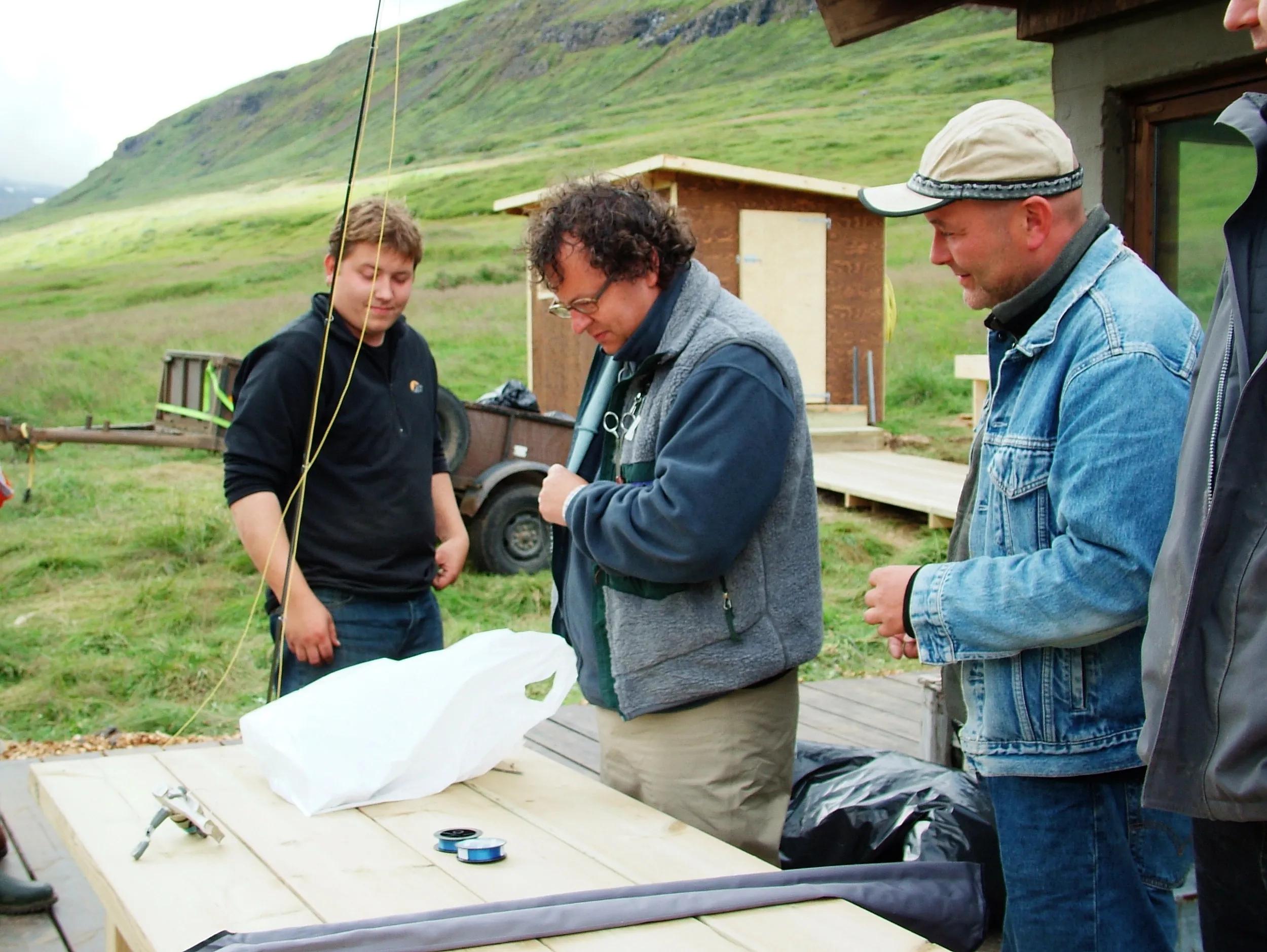
Oddur Roth, Iwan Wirth and Björn Roth during a fishing trip in Iceland, early 2000s. Photo: Iwan Wirth
Björn was clearly the product of a Swiss German father and an Icelandic woman, his mother, Sigrídur Björnsdóttir, a legendary teacher and art therapist. After Dieter left the family, when Björn was very young, they were extremely poor and Björn struggled with stuttering, probably because of the trauma of the family split.
I think his relationship with his father was extremely close and important but was also full of pain and anger. As an adult, he continued to speak slowly and he didn’t ever speak a lot. And he had the most extraordinarily contrarian views of things. You’d ask yourself: Was that humor? Or was it serious? With him, it was always a different kind of conversation on a different level. He was very wise and at the same time very naive. Of course, when he was drinking he started to loosen up a bit, and when he was seriously drunk, the conversations would change. But he was like a slow-moving American engine, impossible to break. He was, in his own way, never stressed. He always moved at the same speed. Even when we were hiking or hunting or fishing together, the same speed, uphill or down. With any challenges in his work, he’d approach it in the same way, with an absolute steadiness.
About most things, there was no way you’d be able to change his mind. There were people he liked and people he didn’t like. It was always a black-and-white situation. It all had to do with trust, because for Björn the question was always: Is something worth doing together? Are we going to be able to work together or not? He would assess people by whether it was going to be interesting and fun to work with them. He had an extraordinarily generous view about embracing opportunities, one that he shared with Dieter. It was about the idea that art and life are inseparable. The Roths lived that. They didn’t have another life, so their sense of authenticity and honesty went down to their core. They were the straightest shooters you can ever imagine. The people they kept around them and who worked with them were like a kind of band that goes on tour, a loyal band. These were people who had their own gigs but when an opportunity came up for a Roth show, Björn would say, “How much time do we have? Let me make some calls. Let me see who’s around.” And he would get the band back together. At every level of the process, there was no back or front of the house. Everybody was in it together. And like all great artists who follow their luck, Björn never turned down a good gig.
He and I spent considerable time together in the studio, but what really mattered was when we debriefed later or before over a meal. It was a very important part of the development of my own understanding about what an artist can be, how you can make art that reaches people and put it out into the world. It’s something that has never left me. Björn was extraordinary, and he was a member of an extraordinary family of geniuses and poets and drunks and writers and creators and fishermen who have left an indelible mark on the world.
—Iwan Wirth