
Diary
Architecture for Encounter
Es Devlin’s Library of Us
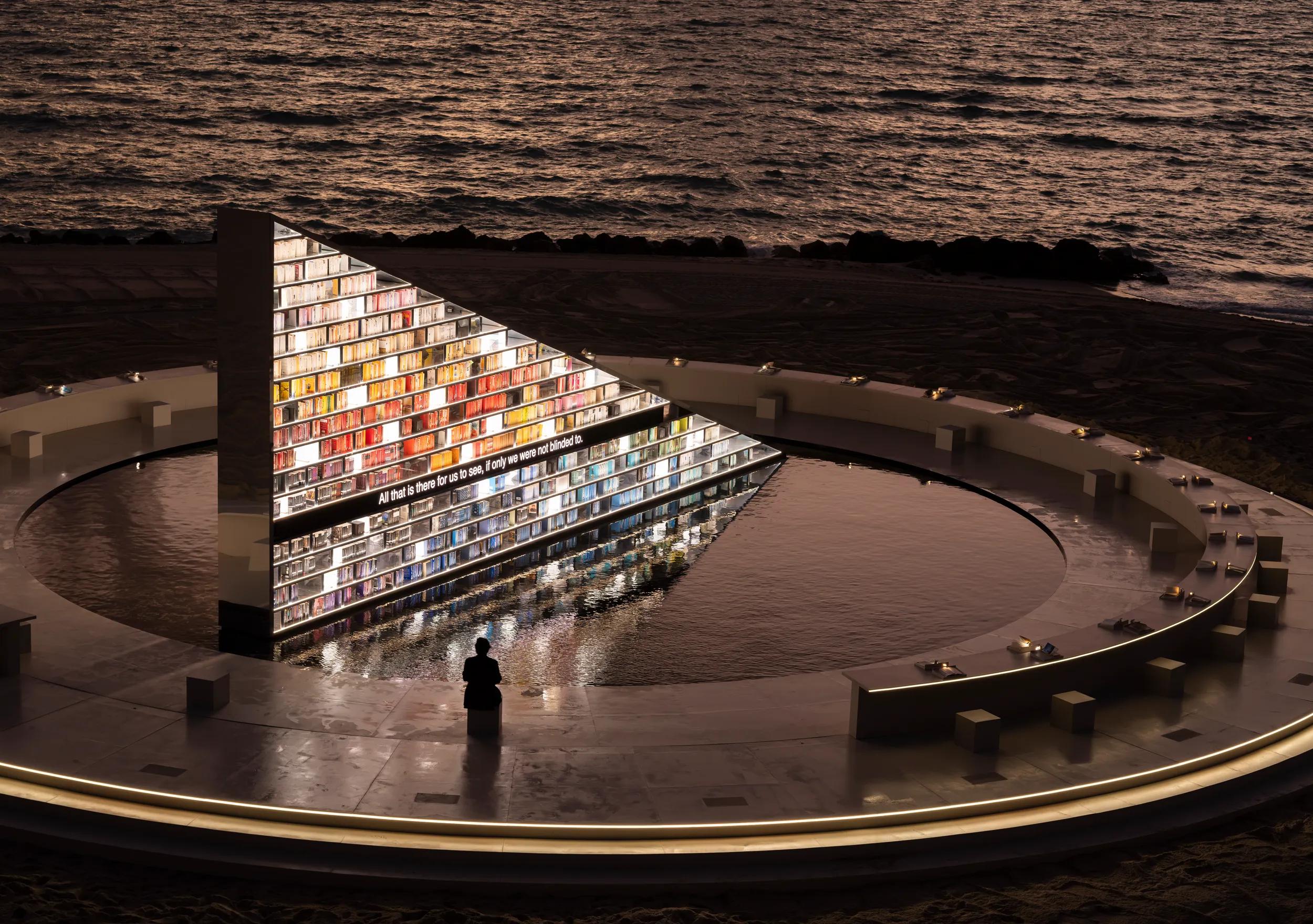
Es Devlin, Library of Us, 2025. Photos: Oriol Tarridas. Courtesy of the artist and Faena Art
Earlier this week, Es Devlin unveiled her latest project, Library of Us, on Faena Beach for Miami Art Week. The installation takes the form of a slowly rotating triangular bookshelf, nearly twenty feet tall and fifty feet long, set within a shallow reflecting pool and encircled by two concentric reading tables—one still, one in motion. Constructed from books, steel, mirrors and water, the work comprises 4,200 physical volumes drawn from 2,500 titles of personal significance to Devlin, many repeated to create its monumental, chromatic gradients. A soundscape of 250 recorded excerpts read by the artist plays across the site, along with a thirty-foot horizontal LED screen that scrolls brief text snippets drawn from the books on view.
The project builds on Devlin’s investigations into libraries as kinetic, communal sculptures—including Library of Light in Milan—and extends her evolving interest in reading as a shared, time-based experience. Throughout the week, the installation will be accompanied by a variety of programming including readings, performances and conversations that explore collective listening. On the occasion of its debut, Devlin sat down with Ursula in late November to discuss the making of Library of Us and the ideas that shaped it.
I have come to the conclusion that a library is a temporary society of books. I’ve read a lot about libraries written by Umberto Eco, who suggested that the books talk to each other when we’re not there. Whether or not that’s true, they are certainly charged with differing points of view that coexist on a single shelf. I didn’t think about this before I made the work, but a revolving structure of thousands of discrete containers of worldviews—all able to be together without contradicting each other or shouting—feels like a metaphor for how people might coexist in the world.
Earlier this year, at Salone del Mobile in Milan, I presented Library of Light. When I began making that piece, I was drawn to the Pinacoteca di Brera library in Milan. It’s an extraordinary library, but hidden and silent. I wanted to invert that—turn it inside out and bring it to life. To me, libraries are not silent; they vibrate with synaptic connections being made by readers. There’s a charge to that. So I made the piece kinetic, invited audiences into it and allowed it to speak: It’s a library that reads aloud to people. What surprised me in Milan was how content people were simply to sit and be read to. 200,000 people came to listen to a library reading to them.
Library of Us is really building on what I learned in Milan. It will be on Miami Beach. Instead of it being a cylindrical structure that holds the audience, it’s more like a compass dial. Eco said the library is a compass of the mind, pointing us in new directions. One side of the table will rotate and the other will not, so you will meet one another one by one, and you will each be faced with a different text in front of you. I hope you will meet each other through text—I hope it is an architecture for encounter.
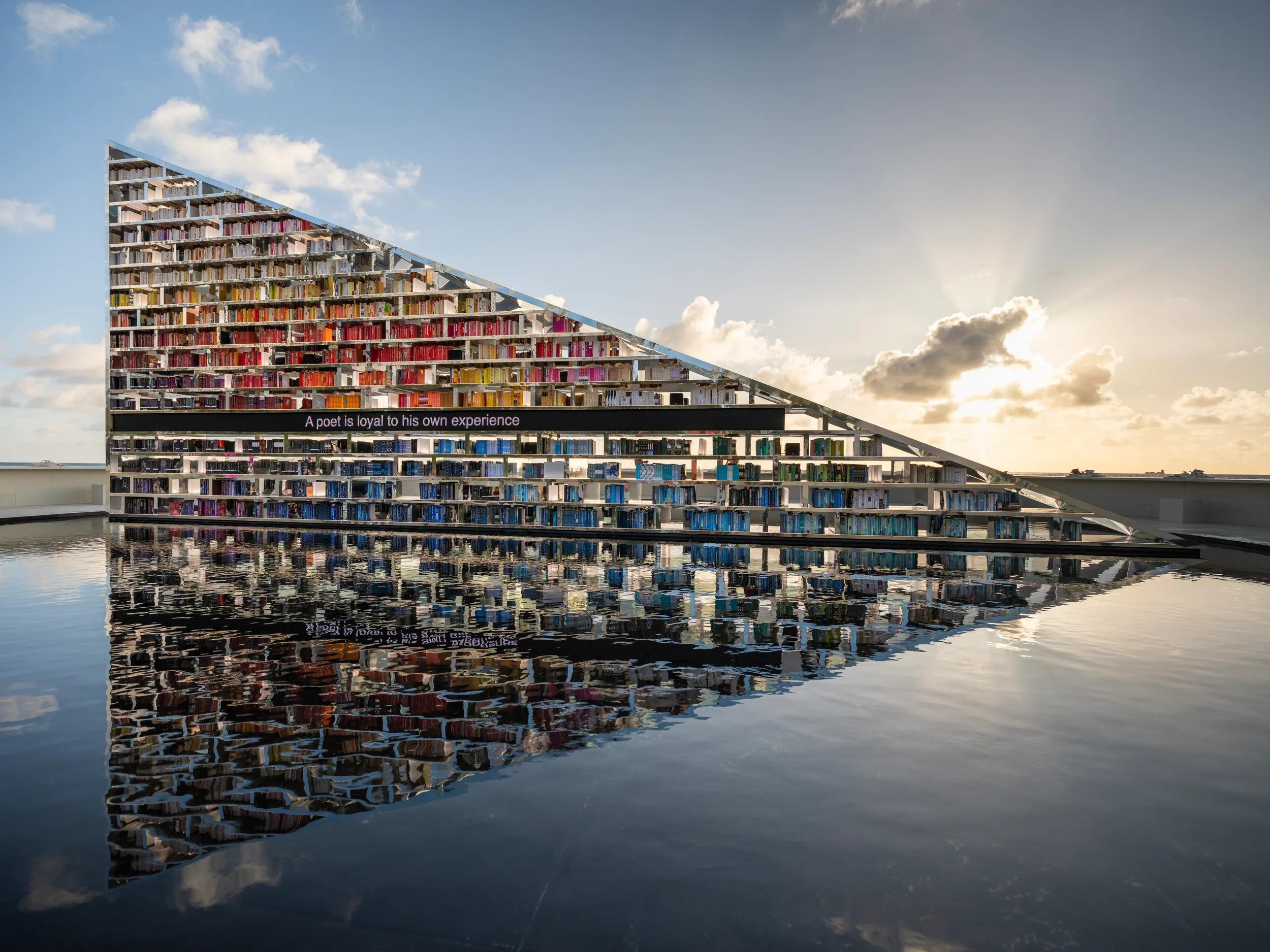
I get asked quite often, “Where do your ideas come from?” and this is sort of a way to answer that: they come from other people’s ideas and the different associations that I draw. When you are sitting on this revolving library, the view will constantly change—south to the Americas, north to the continent, east toward Europe and Asia. Miami is a gathering of those directions and languages, so each reading will always be inflected by the changing horizon. And unlike the Milan piece, which was held inside 18th-century architecture, this is completely exposed to wind, sun, sand and maybe rain, public and unprotected for a week.
This installation will end with all the books entering public circulation in Miami schools and libraries. The idea of a work having a gifting legacy began with Five Echoes, a site-specific project I made in 2021, also in Miami. I learned that the city has a low tree-canopy percentage compared to places like Tampa, and through the project we learned about what Miami needs to improve its canopy. For that installation, we brought in 4,000 plants and, at the end of the project, handed them on to Miami-Dade County Parks. They’re still growing now and thriving at Gwen Cherry Park, Camp Matecumbe Park and others. The books will continue that legacy. Some of them are banned books, including Toni Morrison and Margaret Atwood. They’re not banned on the beach—only in certain Florida schools and libraries. All the books will go where they’re allowed, where they can keep speaking.
—As told to Ursula
–
Library of Us by Es Devlin is on view on Faena Beach, Miami Beach, from December 1–7, 2025, as part of Faena Art Miami Art Week. The project is presented by Chase Sapphire Reserve and accompanied by a weeklong program of talks, readings and performances across the Faena District.
British artist and designer Es Devlin’s practice ranges from public sculptures and illuminated installations at the Victoria & Albert Museum, Serpentine Galleries, Imperial War Museum, Somerset House, outside the Tate Modern, Trafalgar Square and the Lincoln Center, to kinetic stage designs at the Royal Opera House, National Theatre and Metropolitan Opera, as well as Olympic Ceremonies, Super-Bowl half-time shows and monumental stage sculptures for large-scale stadium concerts. Devlin is a fellow of the Royal Academy of Music, a recipient of the Eugene McDermott Award for the Arts at Massachusetts Institute of Technology (MIT) and visiting professor at the University of Oxford.