
Inside Ursula Issue 16
By Randy Kennedy
The German art dealer and collector Konrad Fischer said one of my favorite things about the art world, or at least the one he hoped to inhabit. His job, he said, was not exactly to sell art, or to promote artists, but “to keep the family informed.” Of course, today the art world is far larger than it was when Fischer got his start, in the late 1960s. These days, the very idea of it being a family might sound quaint, if not naïve. But the notion of a federation of zealous devotees connected by grapevine has always struck me as a kind of beautiful ideal.
Even now, with the enormous growth of the commercial art world, the visual arts remain—by the standards of Hollywood, the music industry, even the theater—an esoteric field. If you walk out onto the streets of New York or London and ask passersby to name five contemporary artists, how many do you think would succeed? That kind of singularity, or stubbornly distinctive space, seems to me increasingly valuable as the digital rapidly homogenizes culture. At its best, art speaks to the human condition in ways no other genre can.
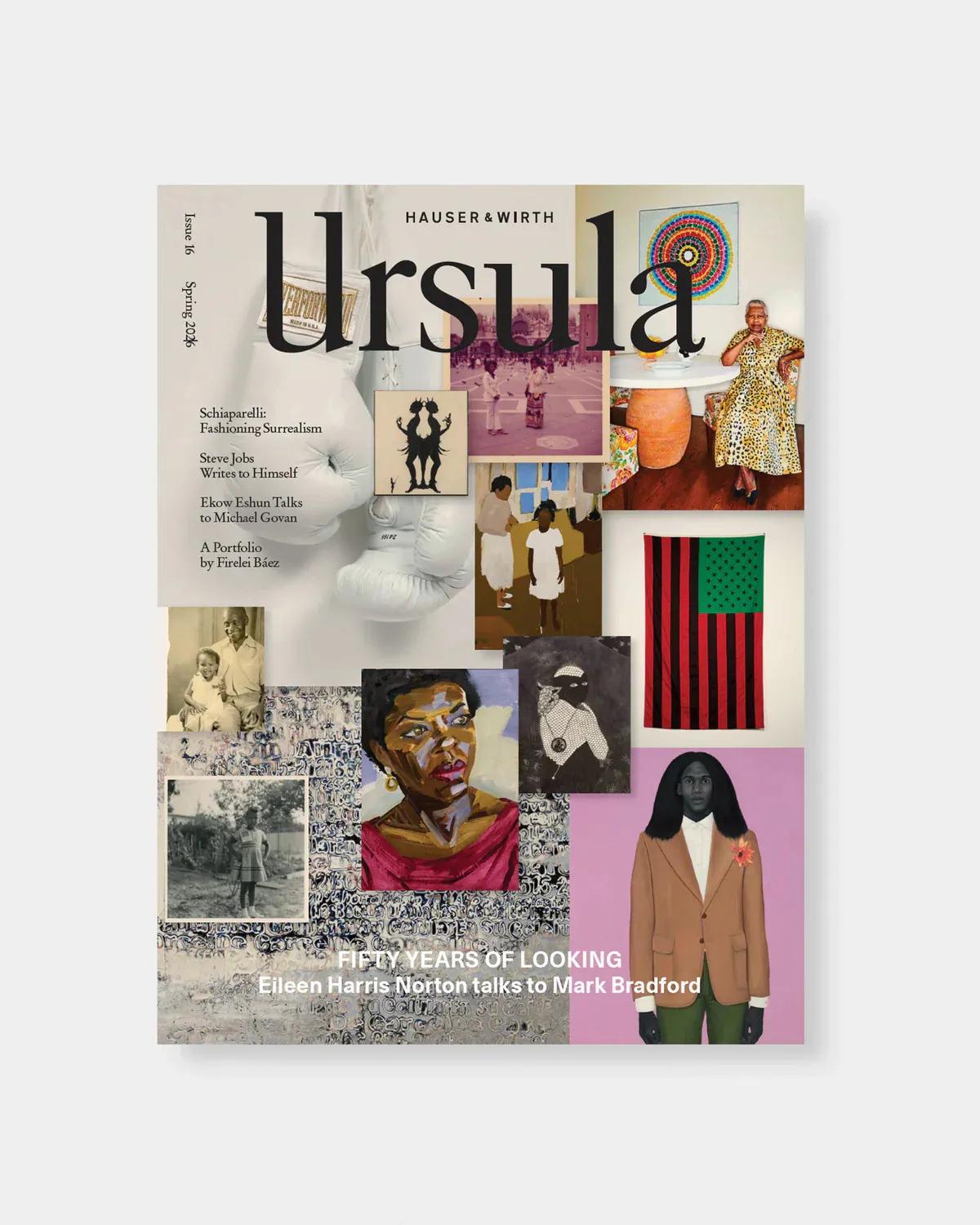
This issue of Ursula, our sixteenth, features the first cover story we’ve ever published about an art collector, the veteran Los Angeles patron Eileen Harris Norton. To say that Harris Norton embodies Fischer’s ethos of kinship would be a significant understatement. For half a century now, she has championed not only the artists of her city, many of them underappreciated and struggling when she met them, but also artists of color, with a special emphasis on work by women—to whom she gave a stage and support long before most of the institutional or commercial art world cared. Her life as a collector eventually broadened into a life as a community activist and patron—a role important to her as the daughter of a middle-class Los Angeles family, a woman who became a public-school teacher and was always acutely aware of the unmet needs in many of the city’s neighborhoods, especially those of young people.

Amy Sherald, When I let go of what I am, I become what I might be (Self-Imagined Atlas), 2018 © Amy Sherald. Photo: Joseph Hyde
In our cover conversation, Harris Norton tells Mark Bradford—with whom she founded the Leimert Park community organization Art + Practice in 2014—that her life in the art world, from her very first purchase of a Ruth Waddy print (sold by Waddy herself, at an exhibition on the third floor of a department store), has been as deeply rooted in human connection as in work.
“When I look around, I don’t just see objects; I think of the people, the presence of the artists themselves. . . . So many of the works here in the house are tied to stories.”
Many of the pieces in this issue carry the same thread of art-as-life, with no gap between—the designer Elsa Schiaparelli’s bonds with her Surrealist artist friends; our first regular columnist, Greg de Cuir Jr, on the films of Christopher Harris; Steven Watson’s incomparable oral histories of the downtown New York underground; Leah Singer’s deep-dive into Alice B. Toklas and her famous cookbook; Los Angeles County Museum of Art director Michael Govan’s belief in art as both a symbol of and a force for inclusion. (“Inclusion means I have the widest possible points of view to organize the future,” he says. “Who turns down opportunity?”)
Harris Norton expresses the philosophy behind this kind of art world and its value most simply and directly: “Art isn’t separate from the lives around it; it’s the relationship, the history, the memories.” To this day, she continues keeping the family informed.
—Randy Kennedy
–
Ursula Issue 16 (Spring 2026) is available to purchase now.