
Essays
Finding the In-Between
Phong H. Bui on Isaiah Berlin
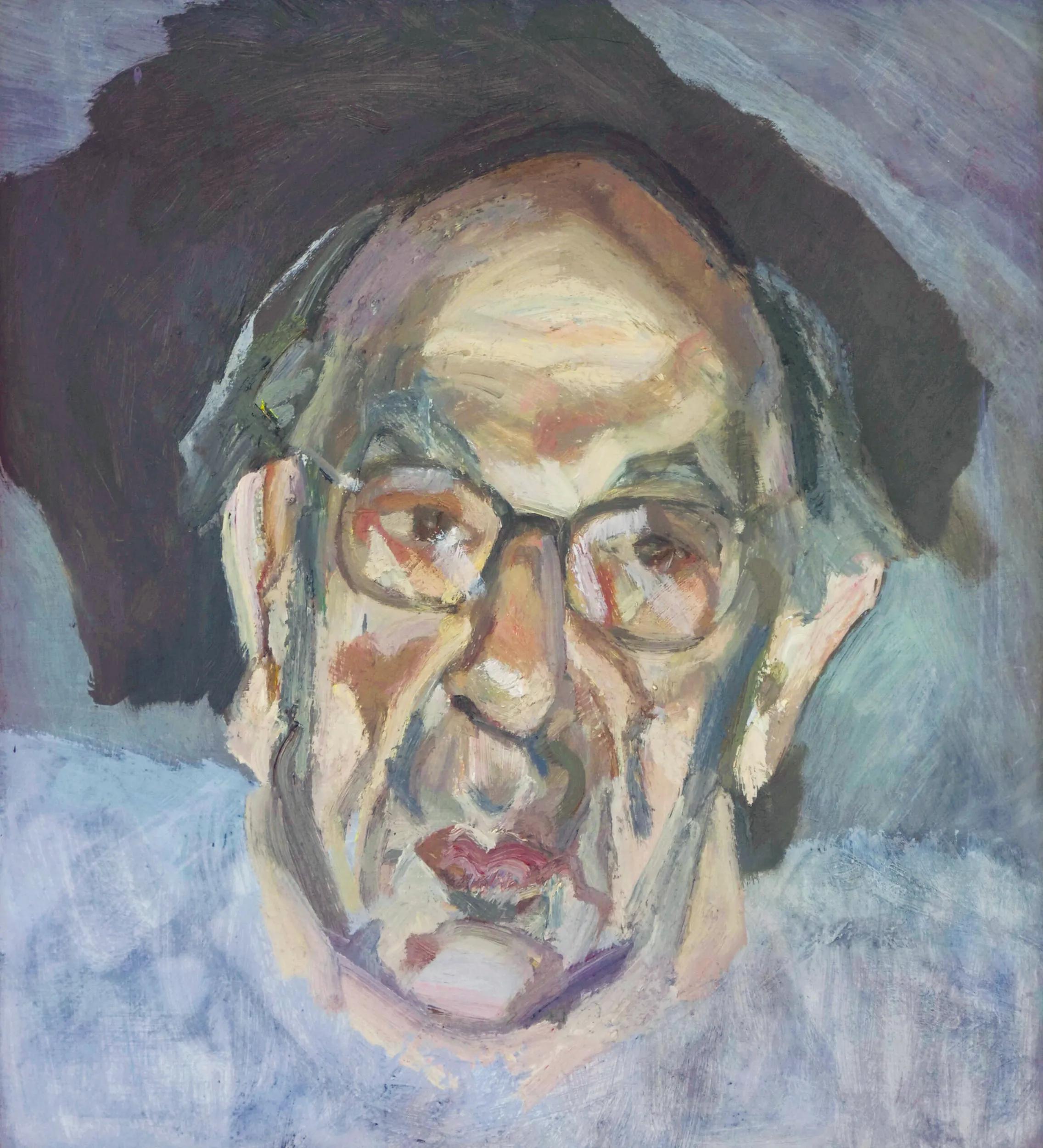
Lucian Freud, Isaiah Berlin , ca. 1996. Oil on canvas. Unfinished commission for the National Portrait Gallery, London © Lucian Freud Archive. Reproduced by permission of the Berlin Charitable Trust and Wolfson College, University of Oxford. With assistance from Bridgeman Art Library, New York
The steady rise of global nativism since 2016 has prompted a most essential question: What are the differences between knowledge and wisdom? While the former is universally taken as a tool for accumulating facts and information, the latter is a process that gives lived experiences a coherent unity and that can be used to deepen our inquiries into human nature.
In recent years, we’ve come to realize that too much information can have a deleterious effect. This is reflected in our profound miscalculations and misunderstandings about the internet, which was built initially for the free circulation of information unhindered by property rights or restrictive security and surveillance. But barely more than three decades into its existence, the internet has proven in its ubiquity to be an often-monstrous platform, optimized to “flood the zone,” channeling a constant flow of hideous noise that turns fact into fiction and information into misinformation. One could say that the increase of technological speed, from the invention of the printing press to radio, television and now the internet and social media, has rendered information both undependable and indigestible.
How are we to reconcile the intense friction between globalism, which depends on interconnectedness and global partnership, and nationalism, which values only narrow interests and ideas of identity? The in-between space where a balance has long been held between liberal principles and illiberal practices no longer seems viable. In recent years, the clash between concepts of a free, open society and a closed, secretive one has escalated, in part because of the arrogance and hypocrisy of U.S. foreign policy. And the assumption that the disintegration of the Soviet Union in 1991 ushered in the triumph of liberal democracy, presided over by the United States as the sole superpower, has now collapsed colossally, as is apparent in the mandate and priorities of the Trump administrations.
Amid this breakdown of the in-between space, the meditations of the great philosopher Isaiah Berlin (1909–1997) on the history of ideas, always valuable, have gained new urgency. Since the 18th and 19th centuries, contradictory political impulses have perpetually veered toward one extreme form or another—chiefly as a negation or affirmation of liberty. Berlin made a distinction between what he called “positive liberty”—a path of “freedom to” something, one that could easily be abused or manipulated by tyrannical authority—and “negative” liberty, or “freedom from” something, meaning the absence of external constraints or interference by other people or institutions. Berlin first articulated these arguments in 1958, in the context of the social and political philosophy following World War II, in his classic essay “Two Concepts of Liberty.” The ideas that formed his thesis emerged directly from his in-depth study of Kant’s notion of free will and of the nature of autonomy.
Berlin’s other equally famous essay, “The Hedgehog and the Fox” (1953), was intended to be read more narrowly, as a personal analysis of Russian culture. In considering the ideas it advances, one should keep in mind his birthplace, Riga (now the capital of Latvia), which was then part of the Russian Empire. There, and in Andreapol, Tver Oblast, the Berlin family could not escape antisemitism. They moved to Petrograd (now Saint Petersburg), where they lived through the upheavals of the February and October Revolutions before leaving Russia in 1920. The following year, they settled in London—first in a suburb, and later in the city—where Berlin would make his life and his name but where he never felt wholly at home. As he said once in an interview: “I am a Russian Jew from Riga, and all my years in England cannot change this. I love England, I have been well treated here, and I cherish many things about English life, but I am a Russian Jew; that is how I was born and that is who I will be to the end of my life.” We can imagine how all-encompassing this feeling was, forging his worldview and affirming his perpetual standing somewhere in the middle of cultures and power structures, not within them. As Berlin framed it in “The Hedgehog and the Fox”:
There exists a great chasm between those, on one side, who relate everything to a single central vision, one system, less or more coherent or articulate, in terms of which they understand, think and feel—a single, universal, organizing principle in terms of which alone all that they are and say has significance—and, on the other side, those who pursue many ends, often unrelated and even contradictory, connected, if at all, only in some de facto way, for some psychological or physiological cause, related to no moral or aesthetic principle.
In my own reading of Berlin over many years, I have come to identify deeply with his idea that humans are largely the creations of others, with whom we form coherent unities.
Following this logic, he placed among the single-minded hedgehog thinkers like Plato, Lucretius, Dante, Pascal, Hegel, Dostoevsky, Nietzsche, Ibsen and Proust. Among the pluralistic foxes he numbered Herodotus, Aristotle, Montaigne, Shakespeare, Erasmus, Molière, Goethe, Pushkin, Balzac and Joyce. The distinction furthered Berlin’s fundamental need to explore radically opposing intellectual and artistic temperaments as they mirrored human nature itself, and his thinking led him to a deeper consideration of Tolstoy, whose extraordinary struggle to place himself in one camp or the other defined his fiction.
Tolstoy published War and Peace between 1865 and 1869, during which time he was in his late thirties and early forties. Berlin greatly admired the novel’s sweeping panorama, its countless brilliantly realistic portrayals of characters living at a tumultuous moment in Russian history. Only a young fox in his prime, with powers of multiplicity and elasticity, could produce such a monumentally orchestrated depiction of the inner lives of so many characters and their mediations with their external surroundings. By contrast, in The Death of Ivan Ilyich, published in 1886, when Tolstoy was fifty-eight, we see him anxiously exploring mortality and alienation as social critique, especially within the Russian middle class, his meditations seeming to emerge from the worldview of the hedgehog, the principles of a unified system. In my reading, it is precisely this dichotomy, which Berlin referred to as a “crack,” that ultimately led Tolstoy to realize that while he may have been naturally endowed with a fox-like temperament, his true desire was to become a hedgehog.
Tellingly, Berlin begins “The Hedgehog and the Fox” in antiquity: “There is a line among the fragments of the Greek poet Archilochus which says, ‘The fox knows many things, but the hedgehog knows one big thing.’ ” One of Nietzsche’s most trenchant observations—“Only something which has no history is capable of being defined”—helps us fully appreciate how usefully open Berlin’s far-reaching interpretations of history were and how consistent his lifelong philosophical mission, demonstrated by the numerous subjects of his interest, among them Marx, Locke, Voltaire, Berkeley, Hume and Johann Georg Hamann.
His entire body of work, in my view, was fluidly synthesized in his magisterial 1965 Mellon lectures, The Roots of Romanticism, delivered at the National Gallery of Art in Washington and broadcast in the same year by the BBC (now compiled as a book and available in a video playlist on YouTube). By tracing the genesis of the counter-Enlightenment while distilling its substance through various manifestations, Berlin brought to light the ways in which appeals to certain impulses during the rise of Romanticism were violent reactions against rationalist dogmas, especially when the bureaucratic forms of those dogmas grew complacently static. His arguments show how the aspirations and attitudes of thinkers like Kant, Rousseau, Diderot, Goethe, Fichte and Blake, among many others, led to multifaceted and wildly unexpected outcomes in the twentieth century: nationalism, existentialism, democracy, totalitarianism, and ideas at the fore in the present, about passionate individualism, self-fulfillment and exaltation in political and cultural life.
In the lectures, Berlin fondly quotes Kant: “Out of the crooked timber of humanity no straight thing was ever made.” As he was keenly aware of human imperfection, from which everything that lies within the in-between space is to be perceived as a profoundly personal refutation, Berlin was also aware that human ideas are open to widely varying interpretation, vulnerable to distortions that can lead to endless unexpected and perverse consequences. These beliefs were formed by Berlin’s upbringing and migration, his life as the product of two worlds, his mind equipped with immense curiosity but always sensitive to the push and pull, Sturm und Drang, between ideas and their applications. Holding his ground in such a space meant committing personally to self-introspection and to a view of human behavior as understood through adaptable theory rather than insular analysis.
As the world becomes more unpredictable in its complexity, so have nationalism and racism, for neither had ever died. Whether or not we are convinced by Berlin’s assertion of the treacherous and insidious effects Romanticism had on modern thought, we find at least his highly personal frames of reference timely, instructive and useful. It was the Romantics who proclaimed artists to be the creators of the original, those to whom value was not given by their predecessors but rather made from nothing each time. Two thinkers in particular focused Berlin’s lifelong thinking: Giambattista Vico, who held that one can know the truth only in what one makes, and Johann Gottfried Herder, who believed Volksgeist (the “spirit of the people” or “people’s culture”) to be among the most elemental and powerful human forces, a shared pride in what we create and a sense of belonging with the communities where we feel most at home. Herder believed in the value of cultural self-possession and viewed Volksgeist as a nonaggressive ideology. But of course we’ve seen what happens when a culture’s self-belief is undermined, offended or suppressed by external powers. It naturally lashes back, often with great fury and velocity, like a severely bent twig upon release.
Throughout the course of his professional life and in the afterlife of his writings, Berlin has been the subject of great misreadings, misunderstandings and criticism. He was a philosopher whose belief system was often seen as too labile. But in my own reading of Berlin over many years, I have come to identify deeply with his idea that humans are largely the creations of others, with whom we form coherent unities. Individuals are formed by education and by language. Language is made collectively by past and present members of communities of peoples who have resisited and remain able to resist political or aesthetic dogma.
Berlin’s intellectual contributions are pertinent to our current crisis insofar as they shed light on how we understand that present hostilities, just like those in the past, are direct results of prolonged oppression and humiliation inflicted by oppressors upon the oppressed. In the United States, as a recent example, we have seen the dignity of labor and of vocational skill, the lives of working-class Americans, become woefully impugned, undervalued and ignored, as those in power, on both right and left, battle on largely meaningless turf—supposed losses of national glory, grievances over excesses of globalization, amplifications of difference for the sake of power. The emergence of China as a superpower and Russia’s aggression to reclaim what it considers its providential rights, along with the rise of other authoritarian states, pose real problems. Given these, I believe Berlin was prescient in elevating the uncompromising spirit of artists, who by their very nature, unlike political and financial power brokers, embrace failure as an essential part of growth. This is, again, the in-between space, where Berlin, along with confederates like Hannah Arendt and Meyer Schapiro, shared a profound admiration for the artist’s “inner freedom” as a forever pre-condition.
–
Phong H. Bui is an artist, writer and independent curator and a co-founder and the publisher and artistic director of The Brooklyn Rail, Rail Editions, River Rail and Rail Curatorial Projects.