

Essays
The City Breathes
Greg de Cuir Jr on Christopher Harris
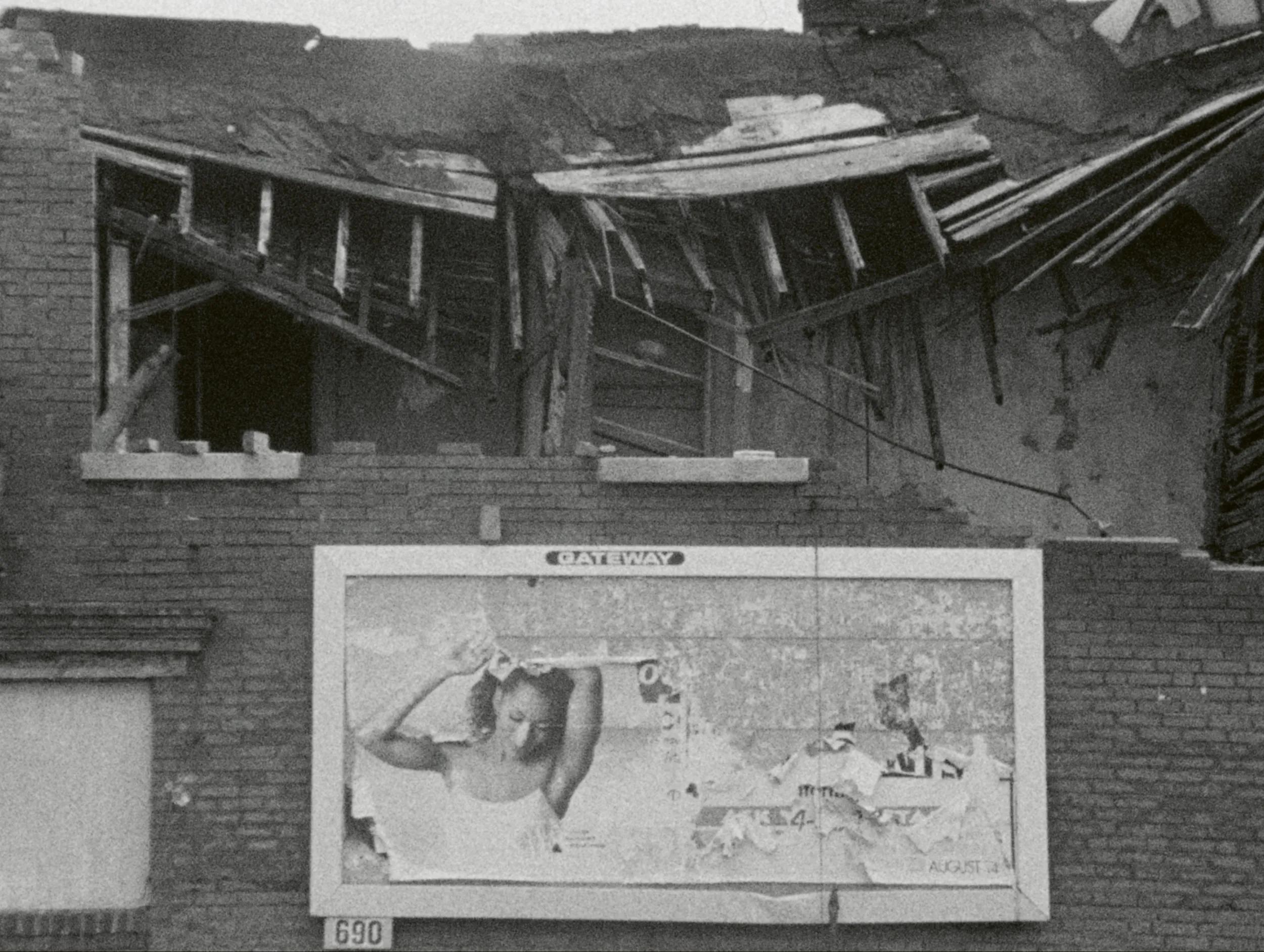
Still from Christopher Harris, still/here, 2001. Courtesy Christopher Harris
For the debut of Film Perfect, a new Ursula column, Greg de Cuir Jr—our magazine’s first columnist—considers the work of Christopher Harris, an experimental filmmaker who works with documentary materials.
“A lot of film is perfect left alone.”
—Ken Jacobs (1933–2025)
We begin by paying homage to a maestro. In 1986, Ken Jacobs demonstrated the postulate above with Perfect Film, a readymade requiem for Malcolm X. It was Jean-Luc Godard who, with his 1969 film Weekend, romanticized the ideal of a film found on a trash heap. But it takes a special artist to believe fully in the potential of the trash heap, to find a film on it, to leave that film alone and to celebrate it as unconscious form. One has to truly love film, to have deep faith in it, in order to present it in its found state of sublime disrepair. Perhaps Jacobs’s masterpiece Perfect Film is not perfect – but his devotion to it is, and the approach is immaculate.
I have always loved Perfect Film because it has a perfect title, at once wildly arrogant while at the same time being an exercise in austere humility. It is also a material fact, pushed to its logical extent as a subversive play on words. All film is perforated therefore all film is perf film. The number of perforations per frame dictates image size and aspect ratio, as well as image quality and resolution, which is to say aesthetics, not to mention cost and related existential matters. Film is born perfect, and loses its innocence only at the moment it is exposed to the world. The qualities of that fall can be considered a coefficient of art. Perfect film has an Edenic quality. Jacobs called it a wilderness haven salvaged from capital-E Entertainment. In assuming the title, this new column will endeavor to renew that project.
••
Christopher Harris is the slow chef of contemporary film art. He has been making work since 2001, though his total filmography consists of only ten pieces and one multichannel installation. For many years, in the early stages of his career, he worked in relative obscurity, isolated from his filmmaking peers while teaching at the University of Central Florida. He is now a professor of visual arts at Princeton, and his work is firmly positioned in the centers of attention in both the film world and the art world.
Only two films into his early career, he’d already made two masterworks. The second was a 16-mm collage film titled Reckless Eyeballing (2004), in which he plays the optical printer like a piano, interpolating clips featuring Pam Grier in her Blaxploitation phase with D. W. Griffith’s notorious Birth of a Nation (1915). His first film, still/here (2001), is something of a missing link in the history of Black film. This debut served as Harris’s thesis at the School of the Art Institute of Chicago, and one of the most striking things about it is the understated yet confident tone produced by an artist who was still so young; it feels like the work of a seasoned veteran. Generally, there are two types of film students: those who derive a majority of their life experiences from films and those who derive a majority of their life experiences from life. Harris belongs to the latter camp.
The film is a 16-mm portrait of St. Louis, where Harris was born and raised. In particular, it details the city’s North Side, a predominantly Black neighborhood, which fell into total disrepair in the late 20th century due to criminal mismanagement by city officials. When Harris returned to St. Louis after a long absence, he was shocked to encounter a city that looked as if a bomb had fallen on it—instead, the people in power had dropped policy ordinance on it, and the result was exactly the same.
If Harris is a slow chef, still/here is a slow meal. The film is primarily composed of languorous shots that train patient and contemplative views on desolate cityscapes. These takes are punctuated by the experimental double-bass motifs of the musician Tatsu Aoki, who is also a professor and teaches handmade cinema and other film courses at the School of the Art Institute of Chicago. Aoki is himself an accomplished experimental filmmaker who got his start in the 1970s in the experimental art and music scene in Tokyo, though he is primarily known today as an in-demand bassist and tours internationally with legends of jazz. Another significant figure makes up the third part of the artistic triumvirate that structures still/here. Harris inserts audio excerpts from a lecture delivered by the great photographer Roy DeCarava in which DeCarava speaks at length about bricks made by hand as a high expression of craft and also about the transformative power of human touch and the ways in which it alters surfaces with physical and spiritual traces.
Cities sleep, awaken and also expire. Do they dream? Film is close to music as an art form but closest to dreams as a kinesthetic experience.
Though still/here is characterized by long shots, the opening of the film triangulates Aoki’s bass and DeCarava’s speech with a rapid free-form montage that functions like a creative manifesto in brief. This preamble assembles a high-level overview of the city skyline. Harris plays with still frames and single frames, switches lenses mid-shot and practically animates the city by stacking celluloid bricks to “rebuild” it from the ground up. A Constructivist aesthetic makes itself apparent in this opening passage, perhaps inspired by Dziga Vertov. This improvisational passage brings the film closer to jazz, and indeed Harris has been influenced by modern jazz music. He calls himself a failed musician, but film is in many ways close to the musical arts and to notions of tempo, rhythm and verse. The majority of still/here proceeds with no dialogue, only a sharply defined and virtuosic design of sound effects—footsteps, doorbells, phones ringing, rainstorms, water dripping. The soundtrack could be described as musique concrète, and it shows Harris to be a director just as interested in sound—and just as accomplished in it—as he is in images.
This can be considered an essay film, and it relies on many generic codes of nonfiction. Harris documents his hometown, but he really documents his feelings toward his hometown. The film is an elegy. It contains elements of postwar rubble films and certainly channels Roberto Rossellini as much as Jean-Luc Godard. In addition to being an urban study and a study of feelings, it’s also a receptacle for Harris’s dreams. The closing sequence re-introduces the spoken word, this time a female voice that narrates Harris’s experience of returning to his broken hometown. She narrates a dream the filmmaker had about his childhood; in it, he’s in the dark, listening to his father’s rhythmic snoring. The voice tells us that cities also have a breathing sound, if one listens closely enough. Cities sleep, awaken and also expire. Do they dream? Film is close to music as an art form but closest to dreams as a kinesthetic experience.
After still/here was made, it went into a hibernation of sorts and was shown only occasionally in small settings. Little to nothing was written about it. But a slow meal takes time to be savored, and in the past few years, awareness of and critical engagement with the film have reached a critical mass. It was restored (previously only Harris’s lone, personal 16-mm answer print had circulated). The restored version premiered at the Whitney Biennial in September 2024, and this was immediately followed by a career retrospective at Anthology Film Archives in New York. In the summer of 2025, the restoration print and the retrospective went on tour in Europe, with stops at the Barbican and Tate Modern in London, Cinema Spoutnik in Geneva, Videoex in Zurich and the Austrian Filmmuseum in Vienna.
After twenty-five years of working exclusively in short-length formats, Harris is now returning to a feature-length mode and also to explicitly personal and intimate subjects, which he has not done since his brilliant debut. All this is to say that a master chef is in the kitchen. Film might not be close to the culinary arts, and some might say it is not an essential need. But as the ancient saying goes, man does not live on bread alone.
••
This column will devote its attention to at least three different film worlds. These worlds do not always intersect, and in some cases they are fairly hostile to each other. The first and oldest can be thought of as the traditional film world, most regularly encountered in the movie theater and eternally burdened with that sublime conundrum of Kipling: “It’s pretty, but is it art?” The second world is an alternative to the first, distinguished by experiments (very often in 16-mm and 8-mm) that do not aspire to a longform representation of narrative reality and do not adhere to commercial demands. Participants in this world generally consider film to be an art form and its practitioners artists. Though often looked upon distastefully by the other film worlds, this experimental sphere has been very influential throughout its history.
The third world is not a film world at all, but rather the art world, which is at times hospitable terrain for experimental film, despite the fact that many film artists have been just as suspicious of it as they are of the traditional film world. Films in this world are sometimes not films at all but rather video or installations or moving- image and time-based art. Many people who are native to this world still believe that film is not a form of art. But which film, and which art?
This column will assume a polemical stance, manifesting a foundational belief that film is not only a form of art but also the most exciting, fluent, relevant and consequential artistic form of our time. I will alternately explore and celebrate all of the worlds mentioned here, mapping their intersections and divergences, and I’ll keep an eye out for forms yet to emerge. After more than 100 years, we still might not know what film is. This is not necessarily a bad thing. As the great Annette Michelson once asked: “When is a film not a film? And when is a film a movie? And, as they say, ‘What is cinema?’”
–
Greg de Cuir Jr is a writer, translator and curator. His work has been published in journals including Cineaste and Millennium Film Journal, and he has written essays for many international institutions, including the Centre Pompidou. His book Yugoslav Black Wave was published by Amsterdam University Press in 2025.