

Essay
In the Garden of the Surreal
The rediscovery of Elsa Schiaparelli’s fashion as art
By Rachel Garrahan
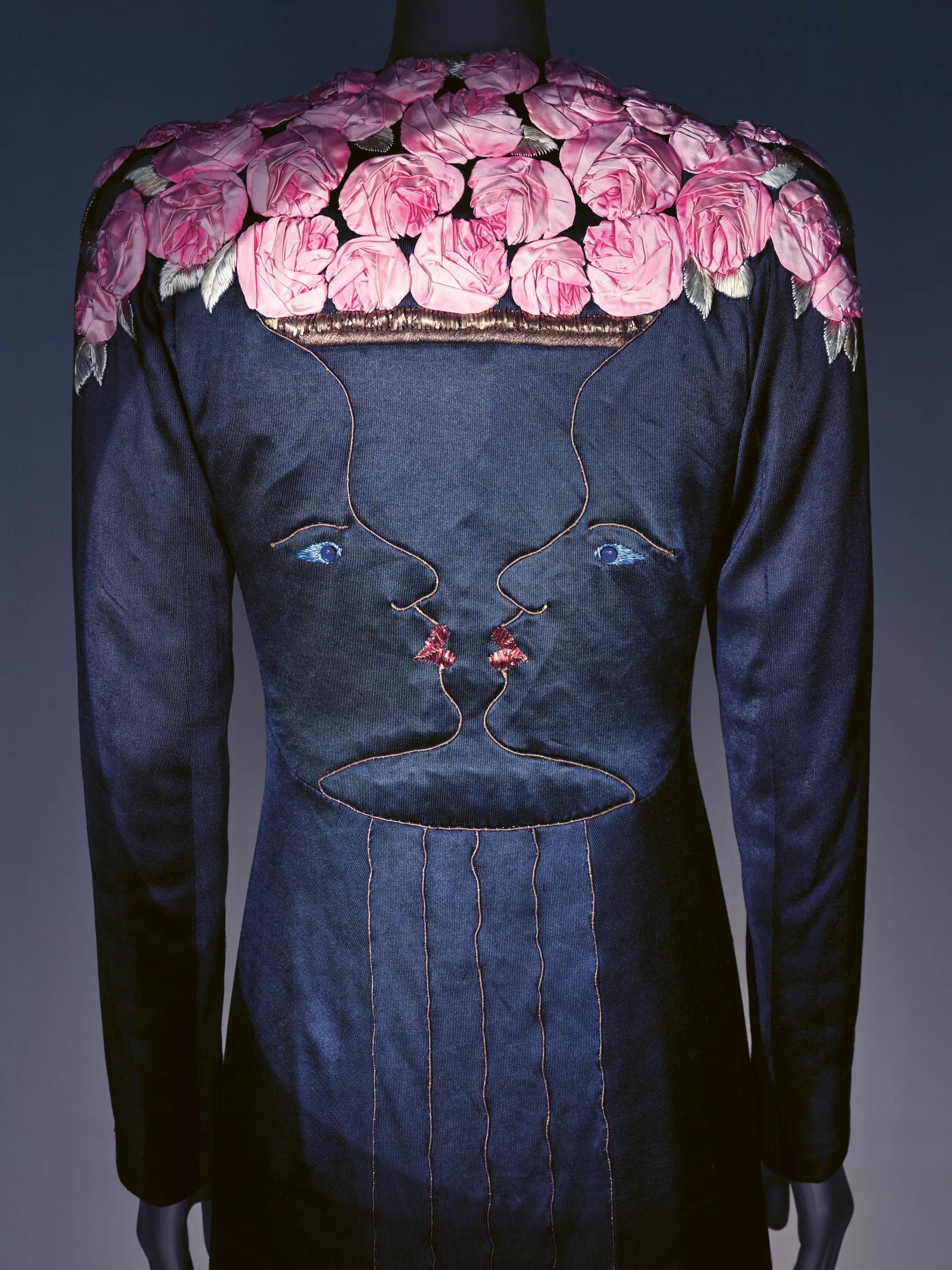
Evening coat designed by Elsa Schiaparelli and Jean Cocteau, 1937 © Jean Cocteau ARS / Comité Cocteau, Paris / ADAGP, Paris 2026. Photo: Emil Larsson
In her memoir Shocking Life, published in 1954, the Italian fashion designer Elsa Schiaparelli recalled a childhood marred by her mother’s damning judgment that she was “as ugly as her sister was beautiful.” Schiaparelli began having vivid dreams of her face “covered with flowers like a heavenly garden,” which in turn led her to pilfer seeds from the family gardener and jam them into her mouth, throat and ears in the hope of making her dream a reality. Alas, “no flowers grew to turn her into a beauty,” she later wrote, referring to herself in the third person, and the doctor had to be called to deal with the seeds.
Thirty or so years later, in 1937, when Schiaparelli had grown up to become one of the most dazzlingly inventive designers of the 20th century, that head of flowers appeared on the bottle of Shocking, her most famous fragrance. Surrealist artist Leonor Fini, her friend and client, designed the bottle, modeling its torso shape after Mae West, the couturier’s most curvaceous customer. In June 1939, the cover of American Vogue featured an illustration by Salvador Dalí, another close collaborator, of a flower-headed female figure in the foreground of one of his barren dreamscapes.
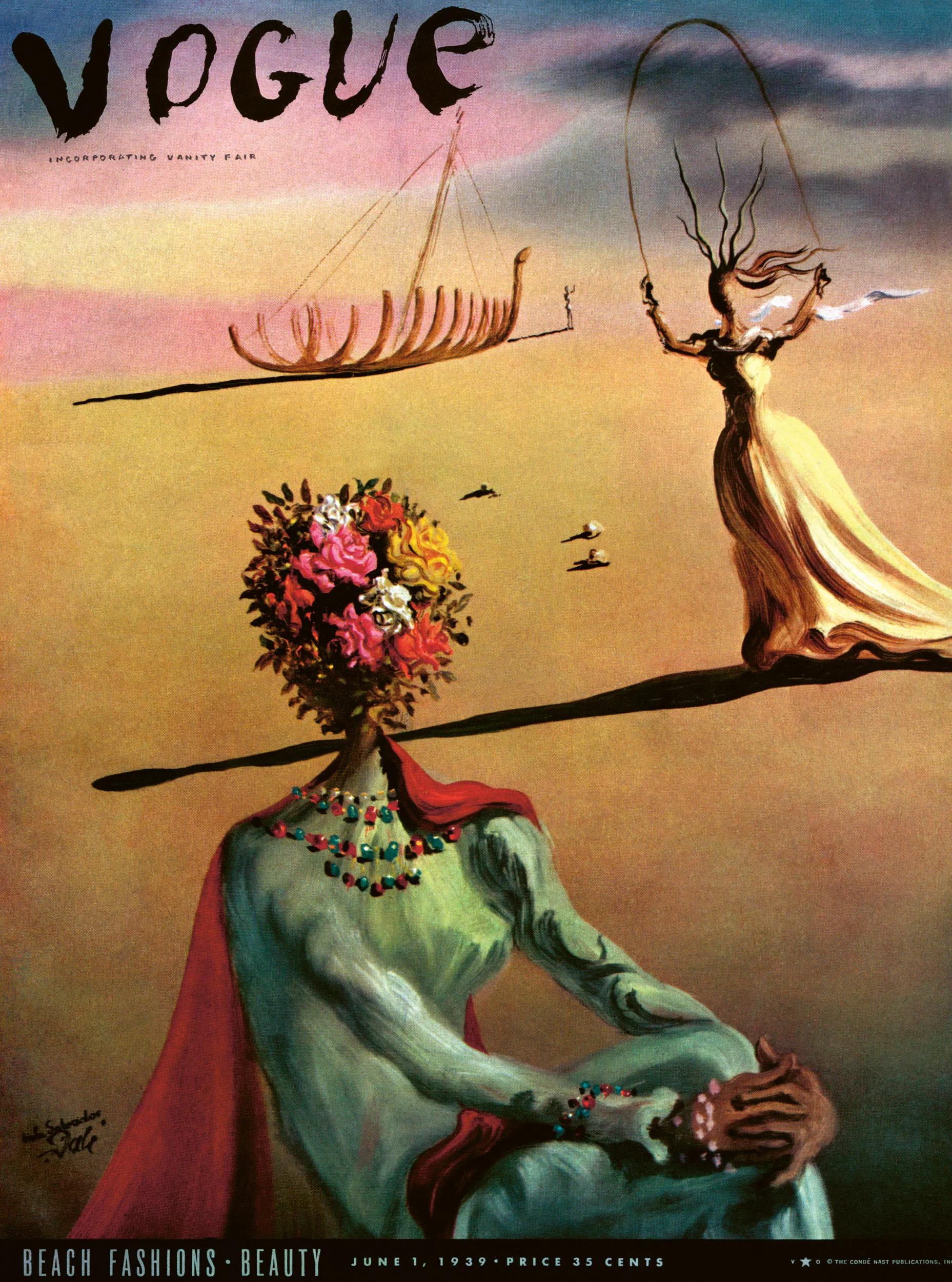
American Vogue June 1939. Cover artwork by Salvador Dalí © Condé Nast
Many of Schiaparelli’s creations, including her Shoe Hat and her Skeleton and Tears dresses that were produced in collaboration with Dalí, look as startling and contemporary today as they did in the 1930s.
These are just a few among countless examples of the dynamic flow of ideas that coursed between Schiaparelli (1890–1973) and those in her artistic circle throughout her career. Taken together, the collaborations form the heart of “Schiaparelli: Fashion Becomes Art,” an exhibition opening at London’s Victoria and Albert Museum in late March. Dalí, who collaborated with the designer on many occasions, described her salon on Paris’s Place Vendôme in the 1930s as the beating heart of the capital’s Surrealist art movement. “Here,” he wrote in his 1942 autobiography, “new morphological phenomena occurred; here the essence of things was to become transubstantiated.”
Like Dalí, Schiaparelli possessed a talent for self-promotion and, as her memoir makes clear, a penchant for exaggeration and omission. It is no coincidence, say the exhibition’s curators, that the artists she mentioned in her book were those most widely known when she wrote it, in 1954. Along with Dalí, they included luminaries whose stars still shone brightly long after Schiaparelli’s pre–Second World War heyday, such as poet, artist and director Jean Cocteau and photographer Cecil Beaton.
The exhibition places Schiaparelli’s version of her life against the backdrop of a plethora of historical sources, revealing that her artistic collaborations in fact went deeper and wider than even she proclaimed, stretching from Paris to London to New York and including figures who are only now receiving the attention they deserve, such as Fini and Meret Oppenheim. Her work was a touchstone for Man Ray, Alberto Giacometti and Andy Warhol, and for photographers and jewelers who went on to become successful in their own right, like Tiffany & Co.’s Jean Schlumberger, one of the 20th century’s most influential jewelry designers.
One extraordinary collaboration was a fur-covered bracelet made in 1935 by Oppenheim for sale in Schiaparelli’s salon. A year later, Oppenheim wore the bracelet to a cafe with Dora Maar and Picasso and was inspired to create one of Surrealism’s most important works, her fur teacup and saucer simply titled Object (1936). The uncanny juxtaposition of fur and quotidian objects was also reflected in Magritte’s 1935 painting Love Disarmed, in which blonde tresses spill from dress shoes. This in turn inspired Schiaparelli to create monkey-fur boots for her 1938 Circus collection.
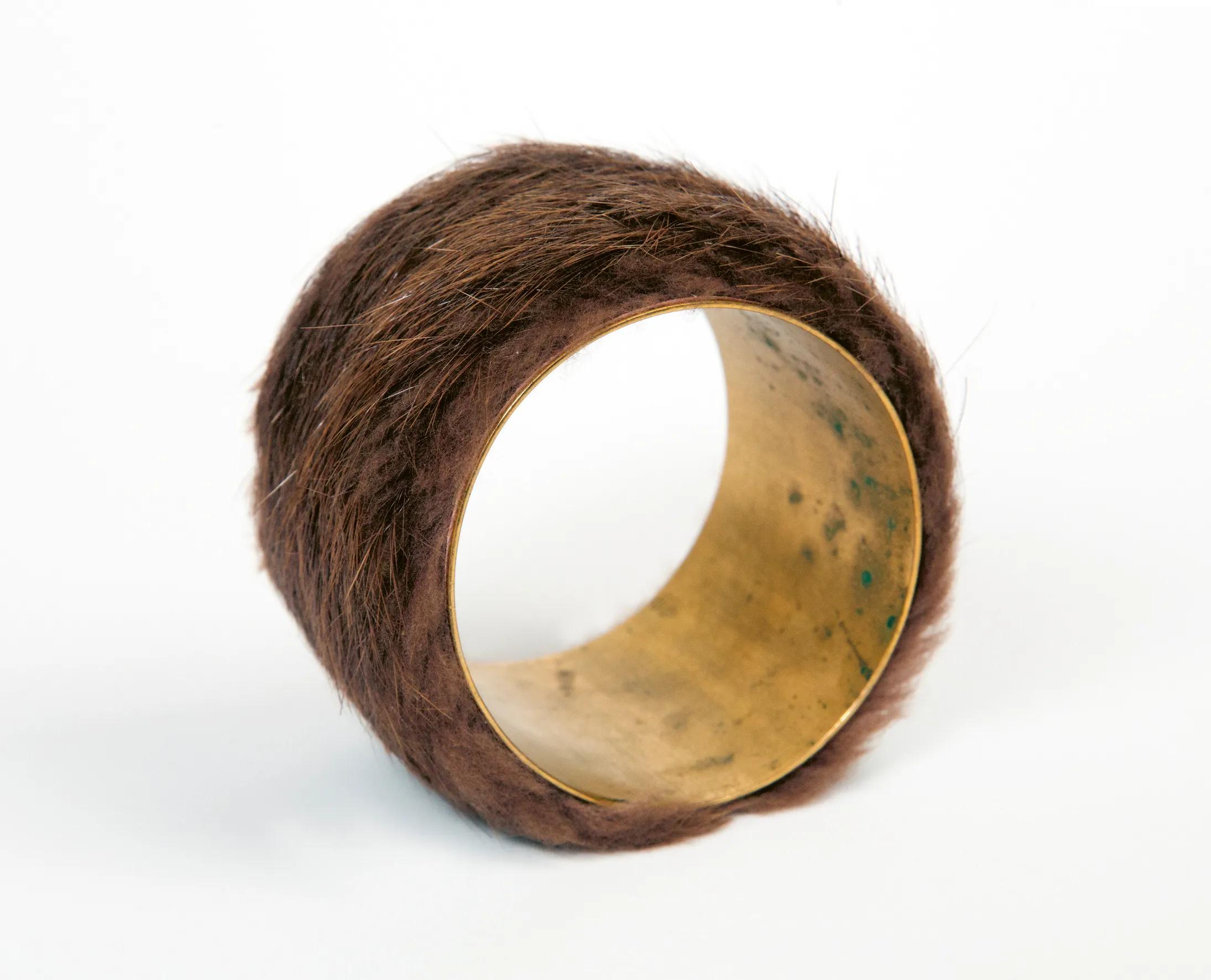
Fur bracelet designed by Meret Oppenheim, 1936 © Meret Oppenheim, 2026 Artists Rights Society (ARS), New York / ProLitteris, Zurich. Photo courtesy Patrimoine Schiaparelli, Paris
“She had a real sixth sense for who she wanted to work with,” says Sonnet Stanfill, senior fashion curator at the V&A and one of the show’s curators along with Lydia Caston, project curator at the museum, and Rosalind McKever, the V&A’s curator of paintings and drawings. “It wasn’t about well-established names, it was about those she felt a kinship with, a shared creative spark.”
For those involved—including Schiaparelli herself—such exchanges were a natural consequence of their friendships, as well as of a shared desire to challenge artistic and social conventions and subvert notions of beauty. “In the first half of the 20th century, there is this idea of collective creative activity that’s really widespread and which crosses disciplines,” says McKever.
Schiaparelli, the show’s curators argue, was fundamentally an artist whose medium happened to be fashion. Like her Dadaist and Surrealist friends, she challenged perceptions and, through her boldly inventive and witty creations, pushed the world to look at itself with new eyes. Many of Schiaparelli’s pieces, including her Shoe Hat and her Skeleton and Tears dresses that were produced in collaboration with Dalí, look as startling and contemporary today as they did in the 1930s.
While art history might prefer to exclude the “dressmaker,” as Schiaparelli described herself, from the serious business of art, that was not how she and her friends saw themselves. “It was fluid,” says McKever. Indeed, Schiaparelli wrote that dress design “is to me not a profession but an art,” one that is most “difficult and satisfying” because “as soon as a dress is born it has already become a thing of the past.”
Listen to Rachel Garrahan discuss Schiaparelli’s daring attitude to design
Despite her own harsh judgment of her chosen medium, and the relatively short peak of a career that spanned little more than a decade between the wars, Schiaparelli’s influence still reverberates today, and not only within the walls of the atelier where creative director Daniel Roseberry now furthers the legacy. For Dancers in the Dark, the house’s Spring 2026 collection, Roseberry re-interpreted Oppenheim’s fur bracelet as giant hoop earrings that he paired with a fur-embellished leather jacket.
In her time, Schiaparelli pioneered a new “hard chic” silhouette that molded a woman’s body into modern, strong-shouldered shapes, a look she combined with adornment in the form of fantastical jewels, buttons and glittering embroidery. She had a seemingly inexhaustible taste for newfangled materials made from substances as unlikely as tree bark and straw, as well as latex and metal. Her experiments were not always successful: A garment made from Rhodophane, an early, shimmering plastic, was said to have disintegrated once it was taken to the dry cleaner.
It could well have been used in another synthetic creation, in the form of a Surrealist tree worn by Schiaparelli herself, that burst into flames when Coco Chanel steered her “with purposeful innocence” into a candlelit chandelier at a late-1930s costume ball. Fellow guests had to put out the fire with soda water. Chanel dismissed her rival as “that Italian artist who’s making clothes.”
Schiaparelli balanced her love of experimentation with a then-revolutionary recognition of the need for versatile clothing to suit the lives of modern women. “What’s so wonderful about reading her press releases of the time is that every season there is some practical solution,” says Stanfill. “One year it was a ski suit that you could unzip or unbutton, and underneath would be a bikini top so you could get the sun while you were skiing. I mean, who wouldn’t want that now?”
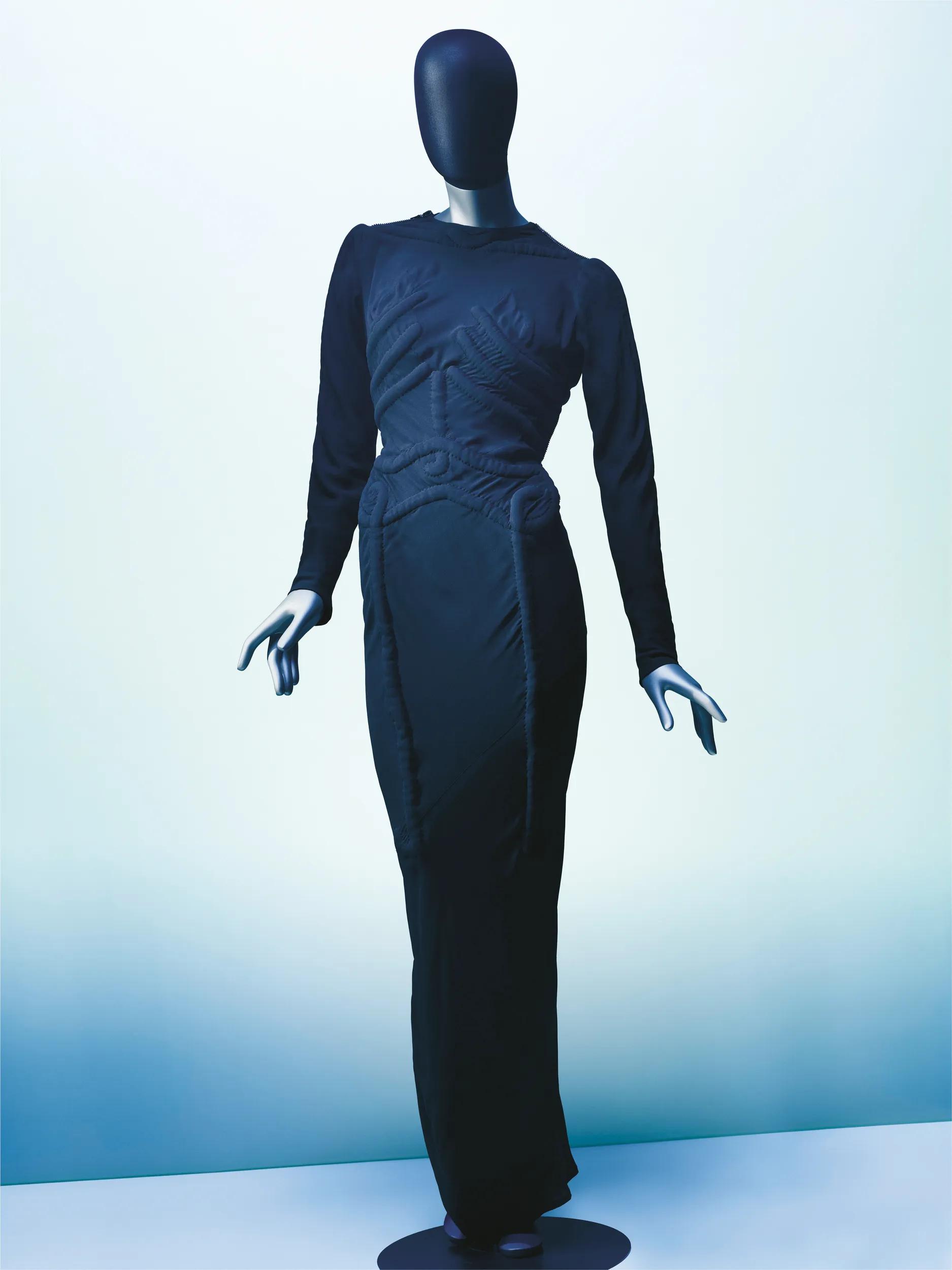
Skeleton Dress by Elsa Schiaparelli and Salvador Dalí, 1938 © 2026 Salvador Dalí, Fundació Gala-Salvador Dalí, Artists Rights Society. Photo: Emil Larsson
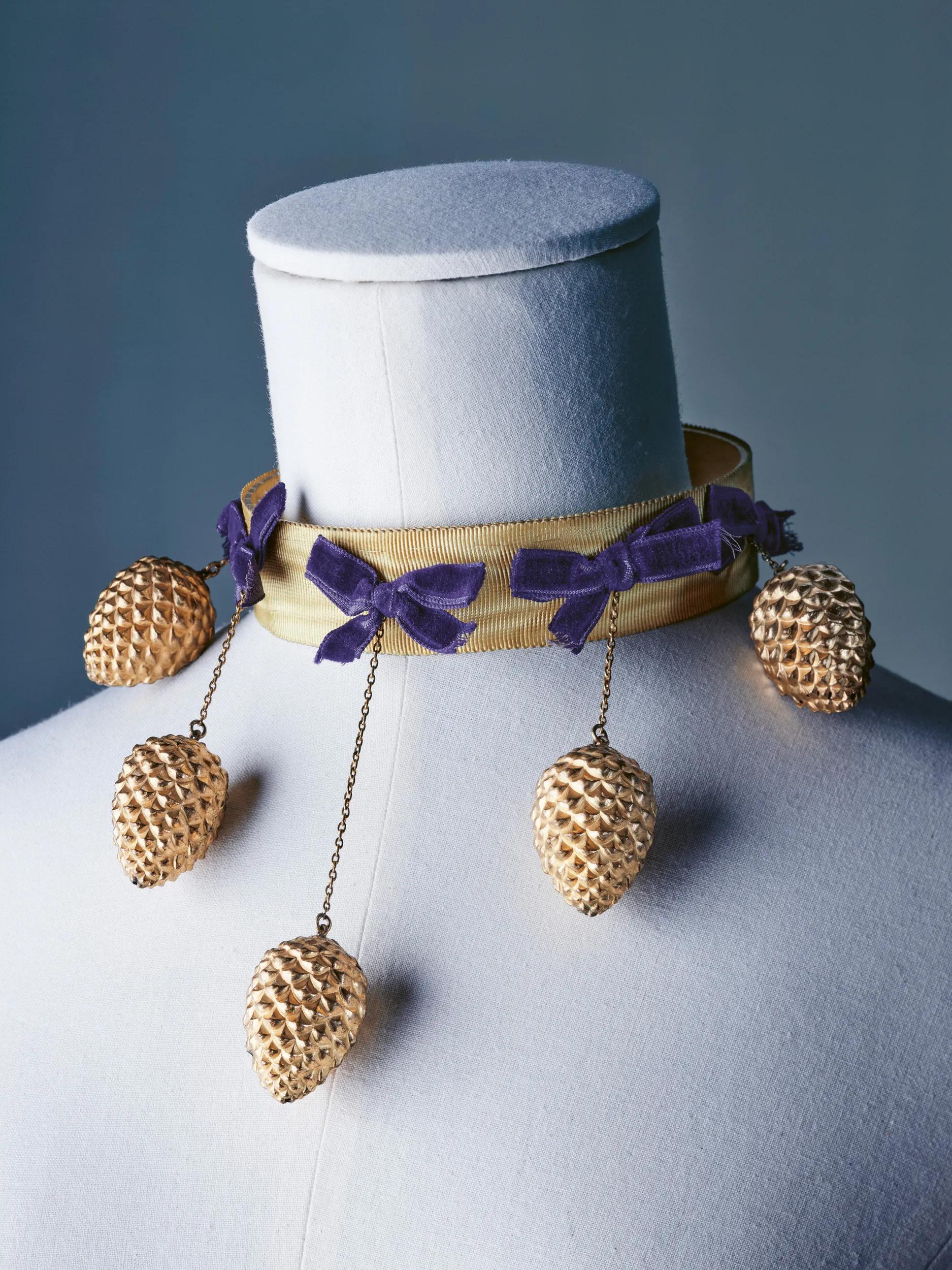
Choker by Schiaparelli, Pagan collection, 1938. Photo: Emil Larsson
Her extraordinary evening jackets were like jewel boxes, heavily adorned by Maison Lesage, the French couture embroiderer, with glass mosaics and beads. But Schiaparelli would pair them with a plain skirt so the wearer could be comfortable sitting at a dinner table. “All the drama was up top and could be seen from across the room or across the table,” says Stanfill.
The wrap dress, whose ease of wear is widely thought of today as the 1970s invention of Diane von Fürstenberg, was believed to have first been created by Schiaparelli in 1930. “Why don’t you zip yourself into your evening dresses?” asked Diana Vreeland in the first of her famous Why Don’t You…? columns for Harper’s Bazaar in 1936, reacting to Schiaparelli’s subversive introduction of such a hitherto resolutely utilitarian item into haute couture.
Roseberry’s contemporary work, including dramatic tailoring and anatomical accessories such as chest-spanning necklaces depicting life-size lungs or sunglasses covered with eyes, has roots in Schiaparelli’s creations. He expands on her corporeal themes, uncannily transposing the inner body onto the exterior, and his creations have been worn by contemporary style icons like Tilda Swinton and Lady Gaga, just as Schiaparelli’s were by Marlene Dietrich and Katharine Hepburn.
Schiaparelli knew her own mind from an early age. She admits in the memoir that she “was definitely difficult” as a child and remained so as an adult. Growing up in an academic and conservative wealthy family in Rome, she was familiar with Futurism, the Italian art and literature movement that sprang up in the years before the First World War, and she illicitly attended a lecture by its founder, F. T. Marinetti, in her youth. She scandalized her parents when, at fifteen, she wrote Arethusa, a book of philosophical love poetry (published later in 1911), prompting them to pack her off to a Swiss boarding school for the remainder of her education.
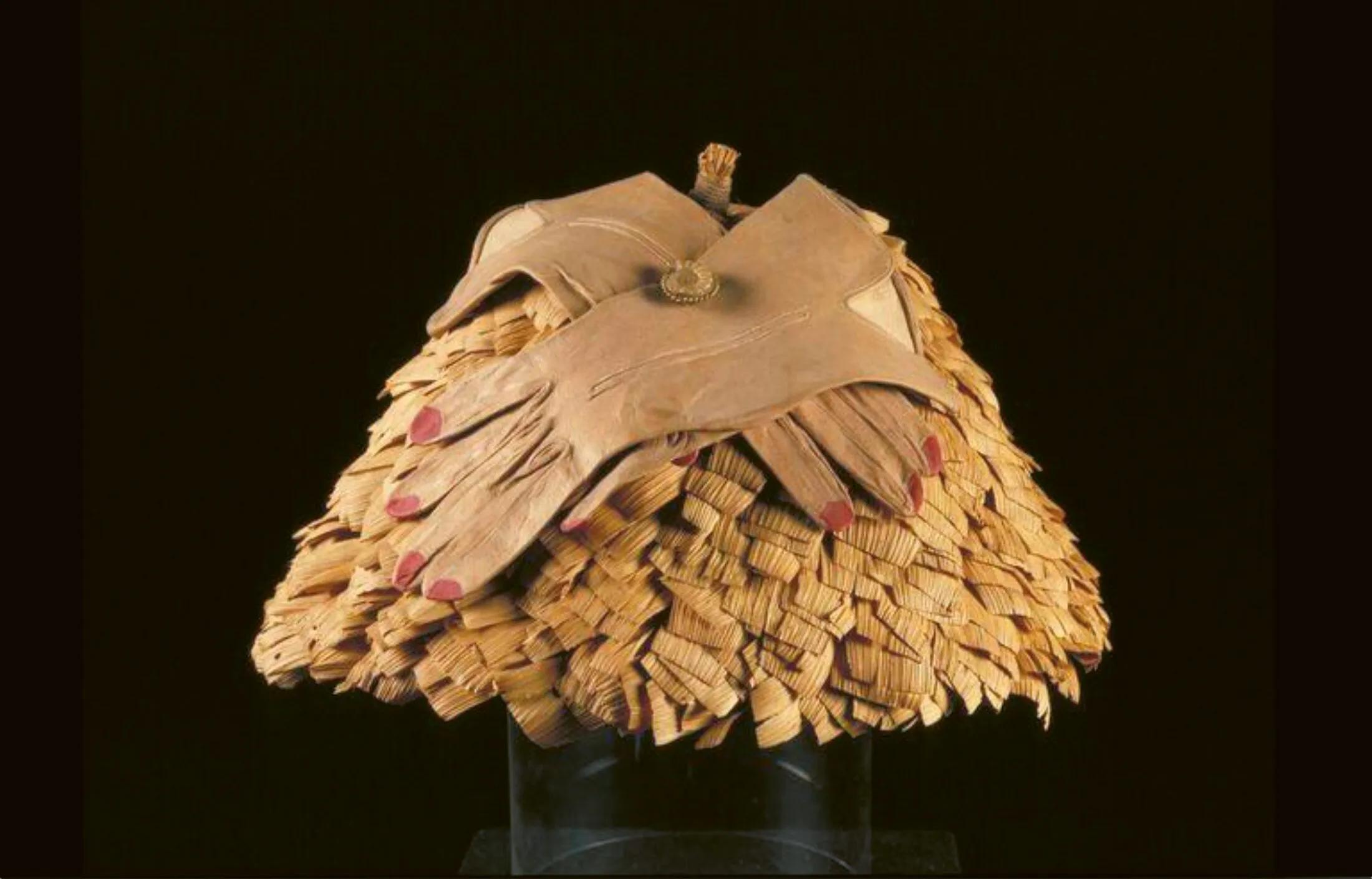
Glove Hat, designed by Eileen Agar, trimmed with a pair of fingernail gloves by Elsa Schiaparelli, 1936–38. Given to the V&A by Mrs. Jenny Fraser © Victoria and Albert Museum, London
In 1913, at twenty-three, she escaped an arranged marriage to an “ugly” Russian and distanced herself further from her parents’ ever-watchful eyes by moving to London. It was there that she met the charismatic theosophist Wilhelm Frederick Wendt de Kerlor, and a year later she married him against her family’s wishes. The union was ill-fated; De Kerlor turned out to be little more than a charlatan. But their time together proved fortuitous in some ways. They moved to New York in 1916, and their Atlantic crossing was pivotal: It was on board that Schiaparelli made her first direct friendships in the art world.
Her earliest connection was Gabrielle Buffet-Picabia, a musician and art critic and the wife of Francis Picabia. Buffet-Picabia was impressed with her new friend’s knowledge of Futurism and Cubism, and once in Manhattan, she introduced Schiaparelli to friends such as Man Ray, Marcel Duchamp and Edward Steichen. “The friendships she made in New York set her up for later life,” says Caston. Blanche Hays, another artist Schiaparelli met on the journey, subsequently helped her move to Paris. Schiaparelli had been abandoned by her husband in New York and discovered that her young daughter, Maria Luisa (nicknamed Gogo), had polio. In Paris, she filed for divorce and sought medical treatment for her child.
Inspired by the modernity of architecture and life that she had experienced in New York, Schiaparelli began designing clothes. Her first success, in 1927, was a trompe l’oeil black-and-white sweater that created the surrealistic illusion of a pussy bow at the neck. “I wore it at a smart lunch and created a furore. . . . Soon the restaurant of the Paris Ritz was filled with women from all over the world in black-and-white sweaters,” she later recalled. From there, she enjoyed what The New Yorker’s Janet Flanner described in a 1932 profile as a “comet-like rise” to the summit of fashion. By 1935 her business had grown so large that she moved her salon and workshops into a ninety-eight-room mansion on the Place Vendôme. Jean-Michel Frank, the pioneering French interior designer of the period, created the interiors and a young Giacometti the columnar lighting and the ashtrays.
Over the years, Giacometti also created buttons and jewelry for her, in her preferred figurative style, including mythological creatures and female figures. Other talented collaborators included writer and jewelry designer Elsa Triolet, whose “aspirin necklace” featured white porcelain beads designed to look like tablets. Long before Schlumberger was creating high jewelry for the likes of Bunny Mellon and Jacqueline Kennedy at Tiffany, he was making costume jewelry for Schiaparelli, including imaginative pieces like a ribbon choker of golden pine cones for her 1938 Pagan collection and a whimsical gilded bear brooch for her Circus collection. Picasso painted the model Nusch Éluard, Schiaparelli’s friend, in 1937 wearing the designer’s horseshoe hat with a pair of Schlumberger-designed angel brooches.
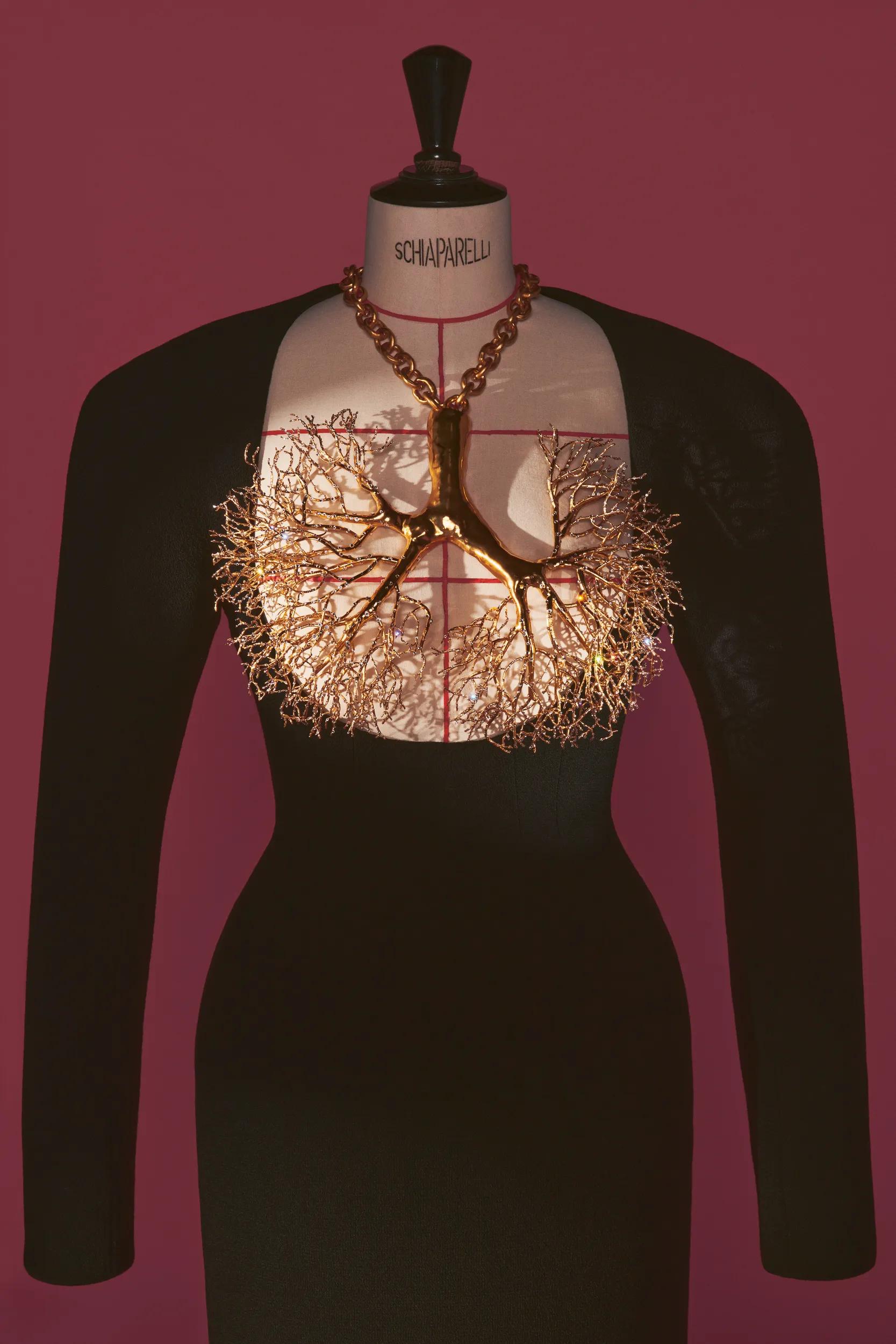
Schiaparelli by Daniel Roseberry. Long sheath gown, wool crepe. Matador Couture collection. Gilded brass necklace adorned with rhinestones in the shape of lungs. Haute couture fall-winter 2021–22. Patrimoine Schiaparelli, Paris. Photo courtesy the Victoria & Albert Museum
“King Button,” as Schiaparelli joked, “reigned without fear at Schiap’s,” in the form of giant, colorful butterflies, golden padlocks and all manner of animals. These whimsical items, says Stanfill, “rendered even the simplest garment immediately recognizable as her own.” At the V&A, a selection will be appropriately displayed as a garden of buttons, each one a flower head atop a wavy stem.
Perhaps Schiaparelli’s greatest artistic collaborations were with Cocteau and Dalí. Cocteau described her as having “the air of a young demon,” and he provided the line drawings in 1937 for several whimsical pieces that were artfully embroidered by Maison Lesage. One captures a woman’s golden tresses spilling down the sleeve of a pale gray jacket, her disembodied hand holding a handkerchief around her waist. Another is an evening coat decorated on the back with the profiles of mirrored, kissing faces that form a vase of pink roses atop a fluted column of golden threads.
Dalí was penniless when he first met Schiaparelli. For their first collaboration, in 1935, for her Place Vendôme salon opening, he created a powder compact in the form of a rotary telephone dial. It will be displayed at the V&A alongside Schiaparelli’s 1937 Lobster Dress, which was painted by Dalí and worn by one of the era’s most stylish women, Wallis Simpson, in a series of famous Beaton photographs for Vogue on the eve of her wedding to the Duke of Windsor. They will be joined by Dalí’s famed Lobster Telephone, created in 1938.
In 1939, Dalí’s wife, Gala, was pictured alongside Jane Clark, wife of British art historian and museum director Kenneth Clark, the two women both wearing Schiaparelli to the opening of the new home of the Museum of Modern Art in New York. The designer’s clothes were also worn by art dealers Peggy Guggenheim and Ileana Sonnabend. For a time, Schiaparelli was the go-to designer for women in the art world, says McKever. “These were people who wanted art for modern life and clothes for modern life.”
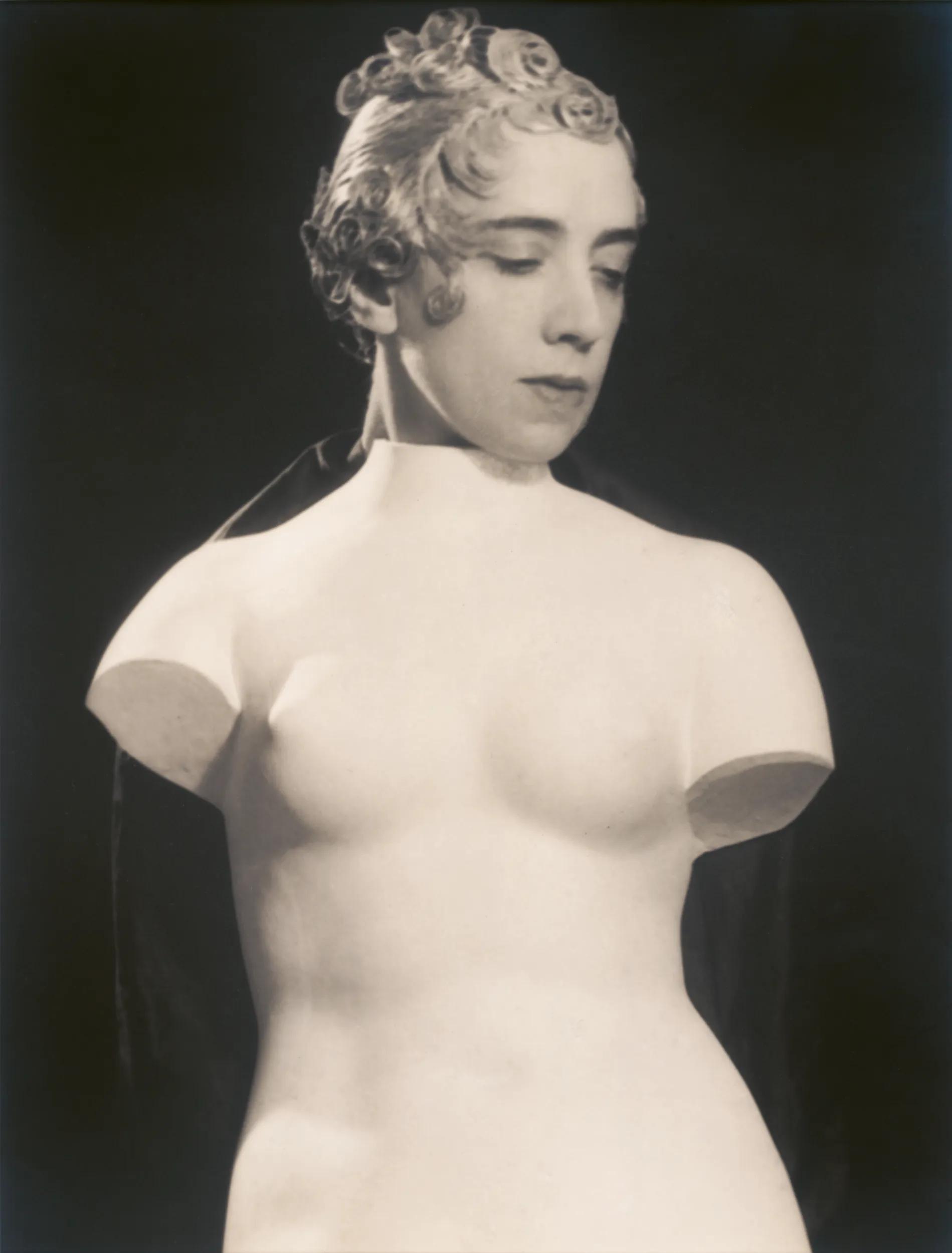
Portrait of Elsa Schiaparelli by Man Ray, 1933 © Man Ray 2015 Trust / Artists Rights Society (ARS), NY / ADAGP, Paris 2026
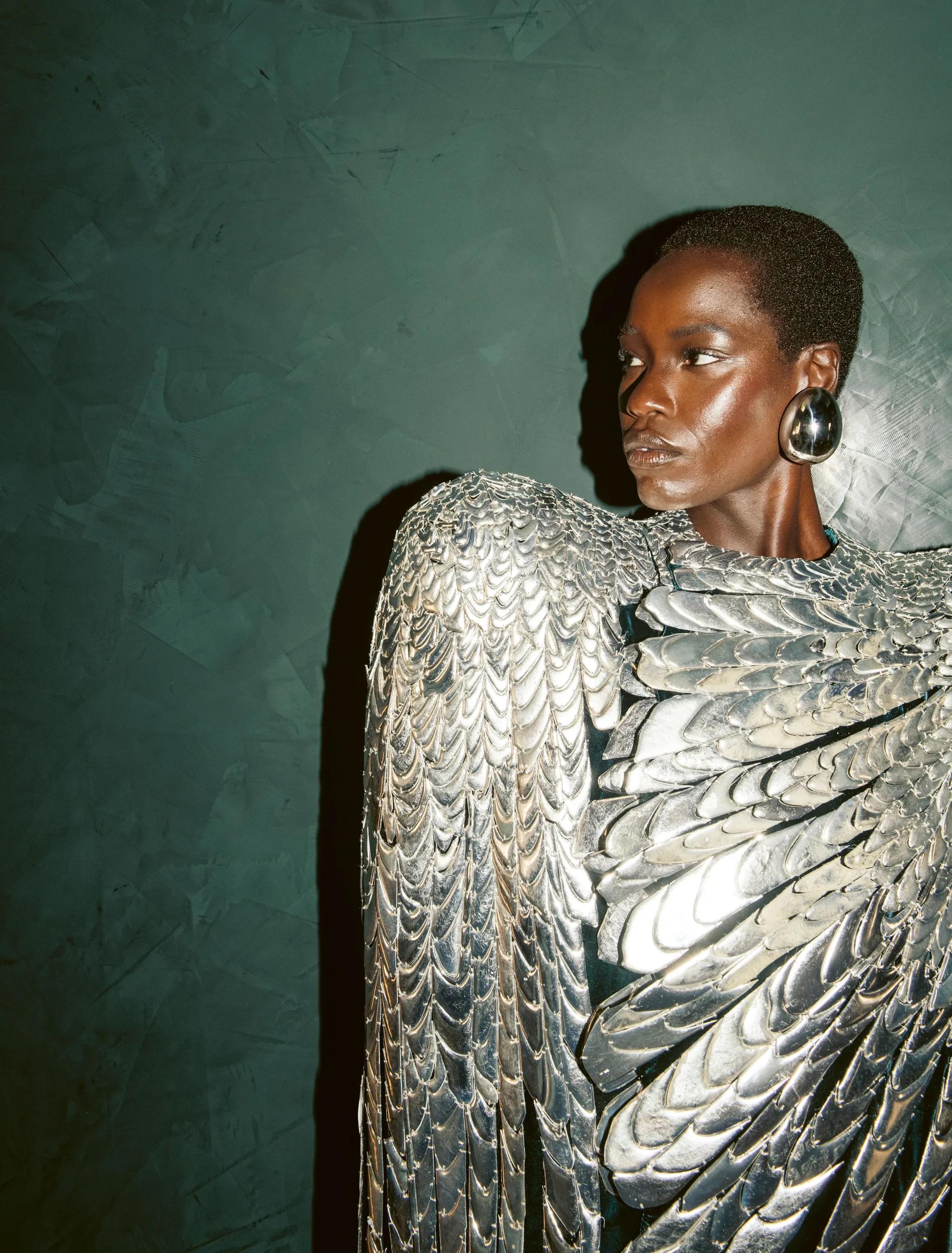
Schiaparelli by Daniel Roseberry. Haute couture fall-winter 2024–25. Photo courtesy Patrimoine Schiaparelli, Paris
Schiaparelli’s support of Surrealist artists extended beyond Paris. She opened a London branch in 1933, as Surrealism was gathering momentum in the city. Three years later, the New Burlington Galleries hosted the seminal “London International Surrealist Exhibition,” organized by Roland Penrose, David Gascoyne and Herbert Read. That exhibition attracted headlines for its controversial opening stunts, which included Dalí delivering a lecture inside a diving suit with an airtight helmet; the suit ran out of oxygen and he almost suffocated.
Schiaparelli capitalized on the exhibition by writing “Surrealism Gets Into Our Clothes,” which advertised that her Mayfair salon would display her collaborations with Dalí alongside his artwork. In 1938, the press reported that British-Argentinian artist Eileen Agar had worn white leather gloves decorated with red fingernails to the opening of a Magritte exhibition at the London Gallery. The gloves were later attached to a hat, which now resides in the V&A’s collection. Until this exhibition, the gloves had been assumed to be the creation of Schiaparelli (whose first fingernail gloves dated back to 1928), but new research has revealed that the gloves and hat were made by Agar, another example of the designer inspiring an artist.
During the war, Schiaparelli returned to New York, where she worked for the Coordinating Council of French Relief Societies. There, in 1942, she instigated a fundraising exhibit called “First Papers of Surrealism,” enlisting the help of André Breton. She brought Duchamp out of retirement for it, and he made headlines when he filled the gallery with a giant ball of string. “It was one of the city’s first Surrealist exhibitions and it was her idea,” says McKever.
Sadly, in the end, the horror of the war put paid to the appetite for both Surrealism and Schiaparelli’s avant-garde fashions. When it ended, the designer returned to Paris, where she carried on creating amid the furor caused by Dior’s ultra-feminine and conventionally romantic New Look. By 1954, Schiaparelli’s business was bankrupt.
Fortunately, over time, her genius for combining the worlds of art and fashion, as well as the avant-garde with the fiercely practical, has been recognized, along with her prolific and meaningful relationships with her artist friends. Schiaparelli’s granddaughter, the actor and former model Marisa Berenson, perhaps sums up her career the best: “Fashion was her medium, but her soul spoke the language of Surrealism.”
–
Rachel Garrahan is an award-winning editor, writer and curator. She co-curated the Victoria and Albert Museum’s major Cartier exhibition in 2025 and co-edited the accompanying publication. Previously at British Vogue, she is now the jewelry and watch director of the media platform EE72. She has contributed to publications including The New York Times and The Financial Times.