

Film
Fragments of Elsewhere
On the films and feminist preservation work of Vivian Ostrovsky
By Patrícia Mourão de Andrade
Translated from the Portuguese by Christopher Mack
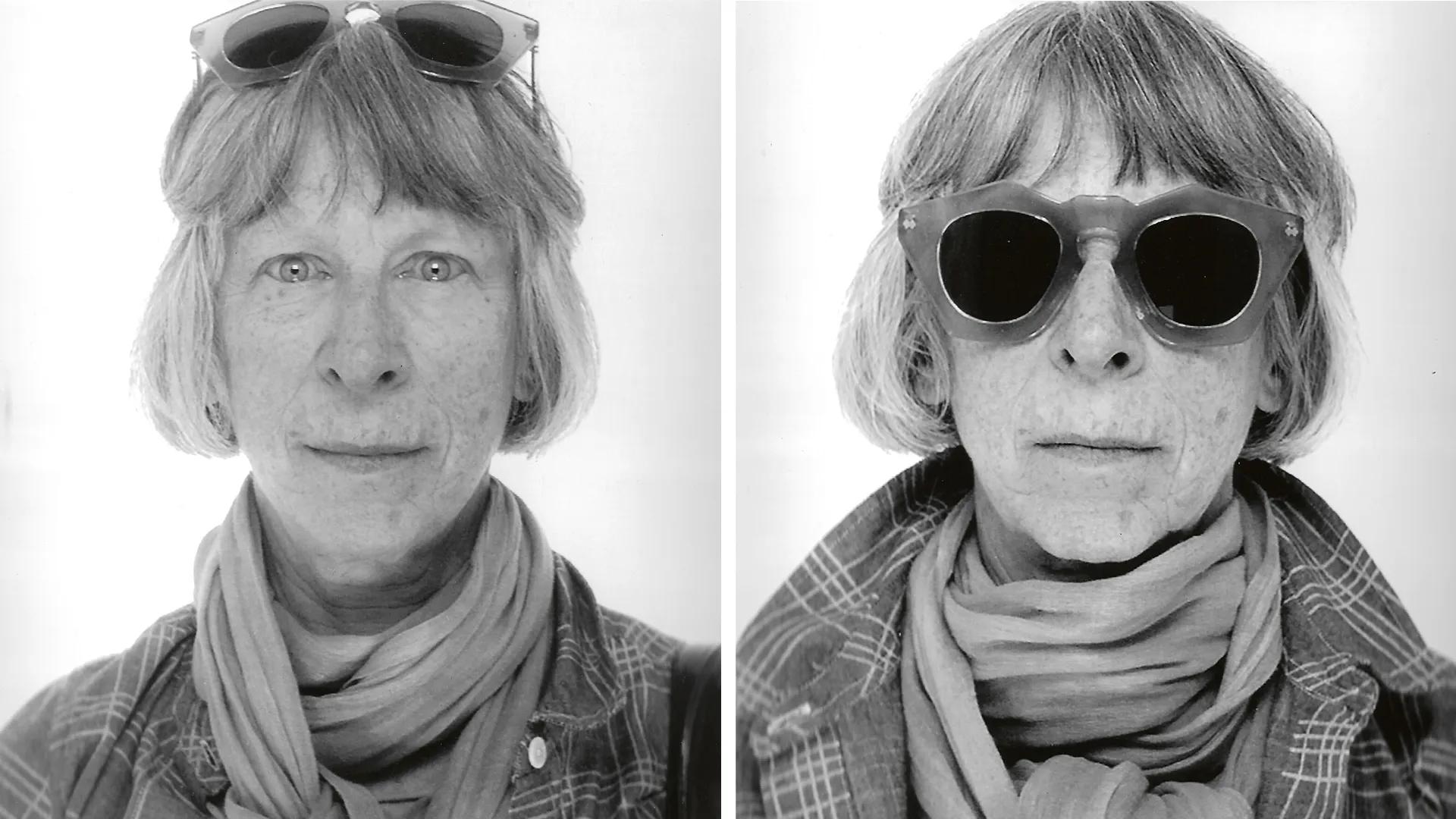
Ostrovsky, 2011, portraits from JR’s Inside Out Project, Centre Pompidou, France
When Vivian Ostrovsky arrived in Brazil in the winter of 1946 at just six months old, her parents, descendants of Russians and Ukrainians, had already been living in Rio de Janeiro for six years, having fled persecution in Europe. Vivian, their second daughter, was born in New York City when her mother, eight months pregnant, was paying an emergency visit to see her ailing father, Vivian’s grandfather. Vivian would be the only member of this family of the Jewish diaspora to hold an American passport.
Her early life coincided with what came to be known as Brazil’s “Fourth Republic,” a period of democracy that lasted from 1946 to 1964. This was a time of rapid industrialization, growing cosmopolitanism and optimism in politics, the economy and culture. The new capital, Brasília, was being built, modern art museums were opening and the Bienal de Sāo Paulo was created; it was the age of Bossa Nova, Concrete art and Neo-Concretism. Brazil, then still a young republic, was “the land of the future,” as Stefan Zweig declared in his 1941 book of the same name, and there was a promise of happiness in the air.
But this future was brought to a crushing halt by the military coup in April 1964, which established a dictatorship that would last for the next twenty-one years. A few months after the coup, at the age of eighteen, Ostrovsky moved to Paris.

Vivian Ostrovsky, Copacabana Beach (film still), 1983. 16mm film, 10 min © On the Fly Productions
While repression tightened its grip on Brazil, she was surrounded in France by social movements—May 1968 and the rise of the second wave of feminism chief among them—that ushered in their own sense of hope. After abandoning studies in psychology at the Sorbonne and taking courses at the Cinémathèque Française, Ostrovsky threw herself into creating a scene for feminist cinema, programming some of the first film festivals in France dedicated to work made by women. In 1975—declared the “Year of the Woman” by the United Nations—she and Esta Marshall organized an international congress to debate the role of women in cinema; Mai Zetterling, Susan Sontag, Chantal Akerman and Agnès Varda were among its participants. Ostrovsky also helped set up two pioneering associations for distributing films made by women in Europe, the first with Marshall and another with Rosine Grange, organized around informal networks of acquaintances.
Ostrovsky began making her own films in the early 1980s. By then, a culture of feminist cinema was well-established in France, thanks in part to her own efforts. Her intimacy with the camera preceded this moment. As a teenager, she had been given an 8mm camera; she eventually swapped it for a Super 8 that she used to record trips and everyday life.
Think Eadweard Muybridge working alongside Jacques Tati, informed by a feminist perspective, and you’ll have a sense of what’s going on in Ostrovsky’s cinema.
Such diarist leanings have continued throughout almost all of her work. Her short films emerge from images that she captures without any preconceived idea or specific project in mind. Unlike what one might expect from a diary, however, Ostrovsky’s films are discreet and almost impersonal, more comical than lyrical. Where one might encounter small moments of intimacy or glimpses of beauty in the films of the tradition’s founding father, Jonas Mekas, Ostrovsky is instead drawn to moments of extravagance in everyday life: bodies exercising, people eating, people at play, animals and beaches—lots of beaches.
She warps the speed of the images during editing, adding improbable sounds and soundtracks and marrying distinct space-times to build a world that isn’t quite like this one. Humans become mechanical or animalesque. They cluck like chickens, trot like horses, march like penguins or move like machines.
Watching her films, I waver between thinking of them as arising from the gaze of a child, enchanted by life’s pulse, or from a highly analytical mind that takes movement apart in order to understand its logic and subvert it. Quite probably both. Think Eadweard Muybridge working alongside Jacques Tati, informed by a feminist perspective, and you’ll have a sense of what’s going on in Ostrovsky’s cinema.

Vivian Ostrovsky, Anne Claire Poirier, Mira Hamermesh and Marie-Pierre Herzog at the UNESCO Women in Cinema conference, Saint-Vincent, Italy, 1975. Courtesy UNESCO/Dominique Roger. Collection of UNESCO Archives
Some critics see irony in her work. But ironic humor presupposes a critical distance from the object of the laughter. Ostrovsky’s laughter, by contrast, is underpinned by humility; she neither demeans nor shies away from her subjects. Her work arises from a sense of unfamiliarity, as if she is viewing the world through awestruck, attentive foreign eyes that haven’t quite mastered the strange new codes of her host country and thus perceive what locals no longer notice. We might say that the world of the ironic is one of disbelief. Ostrovsky’s world is deliciously nonsensical.
Nomadic and cosmopolitan are other terms used to describe her work. She wouldn’t disagree—after all, one of her production companies is named Jet Lag. It also wouldn’t be a mistake to place her work within peripatetic traditions shared by cosmopolitan Jews of the prewar era. Though she made work during her travels, her films can hardly be understood as travelogues or portraits of places. She is a well-humored demiurge of the editing room who exercises zero obedience to the laws of geography or geopolitics: A ball thrown on a beach in Rio de Janeiro settles on Israeli sand in Public Domain (1996); a funeral procession in Moscow is tailed by American Boy Scouts in a film whose title represents the formation of new geopolitical spaces, U.S.S.A. (1986).
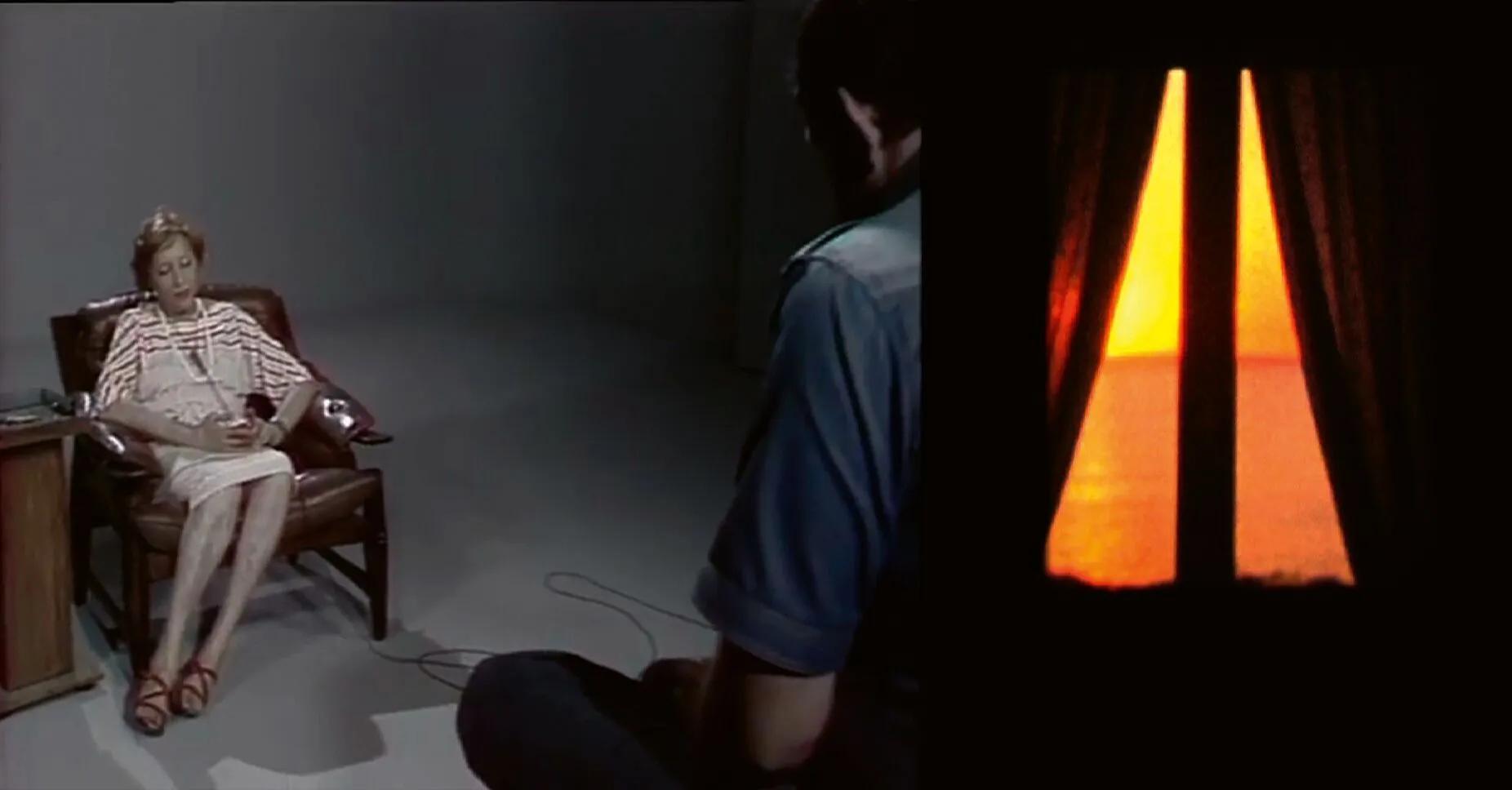
Still from Ostrovsky’s film Hiatus (2018), about the reclusive, introspective Ukrainian Brazilian writer Clarice Lispector (left) © On the Fly Productions
The films of the women Ostrovsky admires present a brutal awareness of their otherness, their foreignness, in the eyes of European and American viewers. . . . They maintain a crystal-clear view of the place that is set aside for them, on the fringes—and they denounce it.
Copacabana Beach (1983), one of her first films, firmly rooted in place, is an exception. Ostrovsky grew up in an apartment overlooking the beach, and this short features images filmed on a return visit to Brazil following a fifteen-year absence. In the decades that followed, she returned to Brazil repeatedly to work on cinematic portraits of artists she admired: sculptor Ione Saldanha; Paulo Werneck, a pioneer of mosaic murals in the country; writer Clarice Lispector; Elizabeth Bishop, the American poet, who lived in the country for almost twenty years. Although Ostrovsky has made films about artists from other parts of the world, no other place receives as much of her attention as Brazil—which leads me to believe that the country has always represented something of a calling for her.
Ostrovsky’s commitment to art produced in Brazil deepened and took on a greater sense of commitment in 2015 when she initiated the Brazilian Film & Video Preservation Project, which restores work made by women in the country during the 1960s and 1970s. The effort began after Ostrovsky realized how difficult it was to see films by Brazilian artists from the period. She had spearheaded a movement to foster and distribute feminist cinema in Europe but returned to Brazil to find a landscape of artists whose work was largely unknown to her and which remained inaccessible, a distressing discovery.
These artists—among them Anna Bella Geiger, Letícia Parente, Iole de Freitas, Regina Vater, Sonia Andrade and Anna Maria Maiolino—began producing their work during the dictatorship, and their oeuvres, in film or other formats, responded to and dealt with the trauma and suffocation of those years of repression. For both those who stayed and those who chose exile, Brazil continued to hold a possessive sway over their work.

Anna Maria Maiolino, In-Out (Antropofagia), 1973–74. Color Super 8 film, transferred to video in 2000, 8 min. 14 seconds. Courtesy the artist
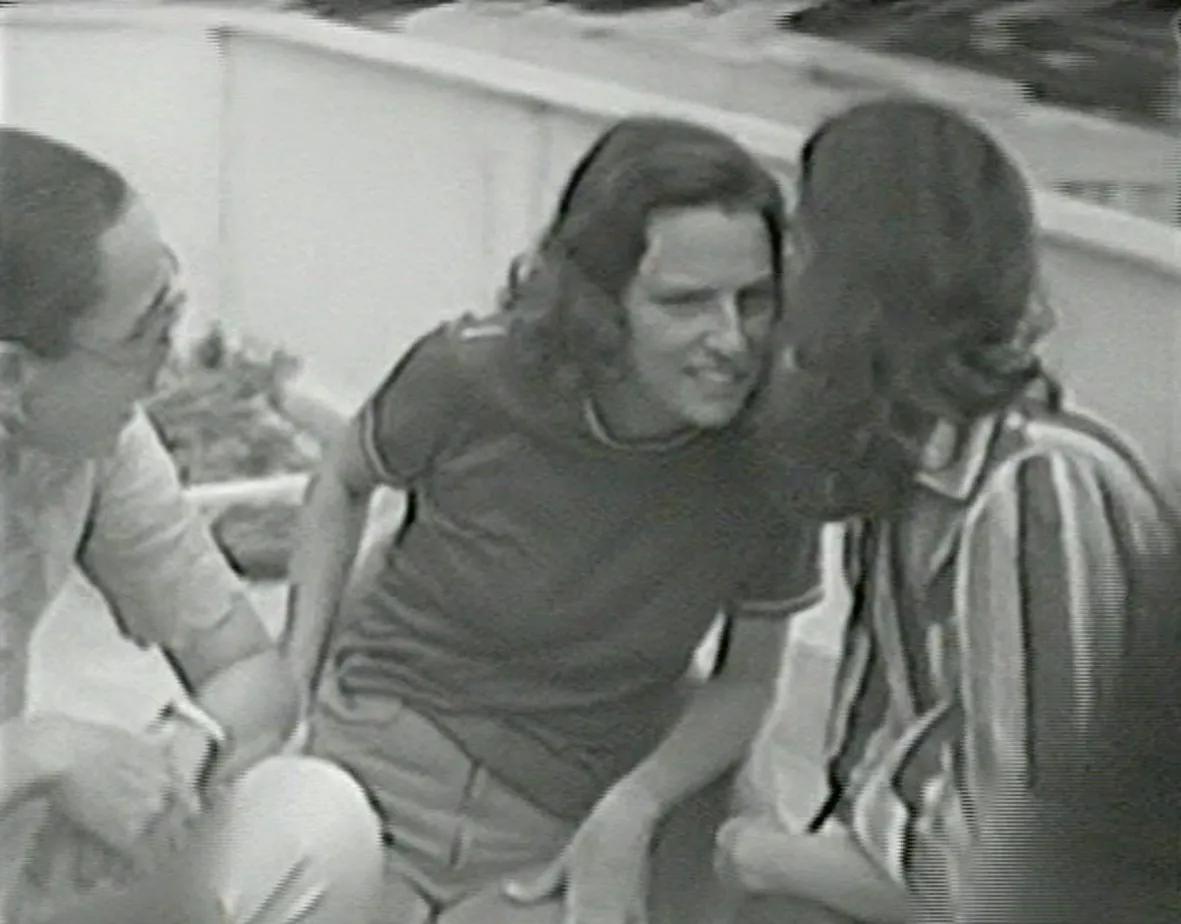
Ana Vitoria Mussi, Anna Bella Geiger, Fernando F. Cocchiarale, Ivens Machado, Leticia T.S Parente, Miriam Danowski, Paulo E.Herkenhoff and Sonia Andrade, Telephone sem fio (film still), 1976. Digital video, 13 min. 36 seconds. Courtesy the artists
The nation’s version of Modernism had sought to establish a specific identity and language for the country’s art. One proposal for this philosophy was put forth in the 1928 Manifesto Antropófago (Cannibal Manifesto), written by the poet Oswald de Andrade, which argued for the concept of cannibalism as a cultural strategy—as a way to create a new language based on the ingestion, digestion and transformation of other cultures. The end of the 1960s saw a return to these questions around Brazilian identity—both cultural and artistic—albeit in a more unruly, aggressive form.
The films of the women Ostrovsky admires present a brutal awareness of their otherness, their foreignness, in the eyes of European and American viewers. In the delicate balance between cosmopolitan life and the geopolitics of the arts, they maintain a crystal-clear view of the place that is set aside for them, on the fringes—and they denounce it.
I can’t imagine works that convey moods more starkly distinct than those of Ostrovsky and these women: on the one hand, her radiant “bossa nova” wit; on the other, their dark, corrosive humor, which surfaces as they explore relationships with their origins and with foreignness.

Vivian Ostrovsky, Elizabeth Bishop: From Brazil with Love (film still), 2025. Digital video, 68 min.
Thinking about these differences, I find myself imagining what might have become of Ostrovsky’s work if she had never left Brazil, or what would have happened to the work of these Brazilian artists if their country hadn’t developed such an appetite for the surreal. I like to create my own cinematic fantasy and imagine Ostrovsky alongside Andrade, Geiger, Parente and other pioneers of Brazilian video, playing a game of telephone on the roof of an apartment building in the 1976 video Telefone sem fio—though Ostrovsky didn’t know these artists and wasn’t in Brazil when they made this seminal work. I find myself thinking that this game of transmission, in which words are transformed from ear to ear, from mouth to mouth, until they become something else entirely, represents cannibalism par excellence. I also consider this dynamic of abstraction, in which something loses its meaning until it becomes a delightfully nonsensical babbling, to be a particular feature of Ostrovsky’s cinema—and perhaps there is a hint of the cannibal in there, too.
I’ll go even further with the metaphor. The logic-illogic of the game of telephone may well encapsulate the very essence of Brazilian preservation—letting the shards of a fading story circulate while never losing sight of a sense of humor.
–
Patrícia Mourão de Andrade is a visiting scholar at the CUNY Graduate Center and a postdoctoral fellow at the University of Campinas. She holds a Ph.D. from the University of São Paulo. She is the author of the forthcoming O erro como aventura: Lygia Pape e o cinema and Criança velha.