

Essays
Alice Lives Here
Revisiting The Alice B. Toklas Cookbook
By Leah Singer
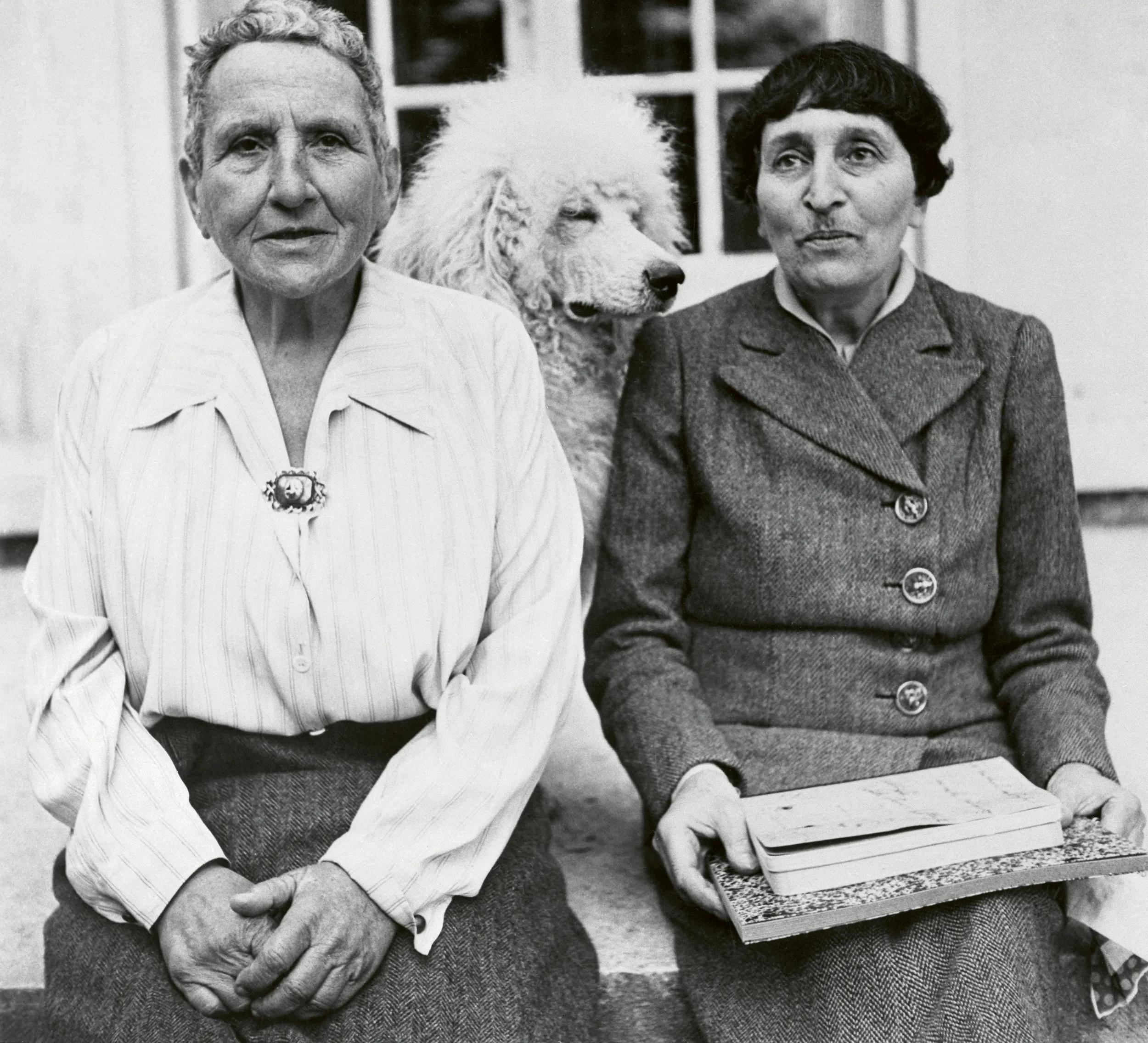
Gertrude Stein and Alice B. Toklas with their dog Basket in front of their home in southern France, ca. 1940s. Photo: Bettmann / Getty Images
I
When The Alice B. Toklas Cookbook was published in 1954, its author was seventy-seven years old and sick with hepatitis, living alone and destitute in the Paris apartment she once shared with her partner Gertrude Stein. Prevented from selling the valuable paintings that made up Stein’s famous art collection, Toklas was unable even to afford heat.
Some have speculated that Toklas, in her fragile state, produced the cookbook out of sheer financial desperation, but there were other reasons. Years had passed since Stein’s death in 1946 from stomach cancer, and Toklas seemed ready to tell her own story. More than a decade earlier, in 1933, Stein had usurped that privilege when she published The Autobiography of Alice B. Toklas, a veiled memoir told in her beloved’s voice. Its success finally established Stein as the superstar she knew she was but had failed to become with her idiosyncratic avant-garde writings.
Like Stein, Toklas subverted conventional autobiography by writing what Janet Malcolm called “a work of literary modernism,” something much more than a cookbook and more than a memoir. The Alice B. Toklas Cookbook is a psychiatrist’s couch, a propagandist’s tool, a 20th-century set piece, a gossip column, a bourgeois dinner party, a love letter and a war story, all in one.
In the introduction to the 2021 Harper Perennial Modern Classics edition, the food writer Ruth Reichl recalls the book sitting unwrapped on the bookcase in her parents’ living room, her mother unwilling to transfer it to the kitchen and tackle its fussy recipes. Reichl, though, was smitten: “This was a cookbook that made me hungry for life.”
In the preface, Toklas explains that the book “was written as an escape from the narrow diet and monotony of illness . . . nostalgia for the old days and old ways.” The stories within entertain, featuring boldface names like Picasso and F. Scott Fitzgerald, and the recipes intrigue, with extravagances like four cups of truffles for an otherwise simple turkey dish. But the cookbook also reports, recounting Toklas’s and Stein’s war efforts for the American Fund for the French Wounded, a relief organization founded during World War I, and it includes an entire chapter on their cooks in Paris.
It also lays bare Toklas’s grief at the loss of her partner. “Now she is gone and there can never be happiness again,” she wrote to an editor friend at the time of Stein’s passing. As it did for Irma S. Rombauer, who authored The Joy of Cooking a year after her husband’s suicide, the act of writing about food can help fill the gaps of loss.
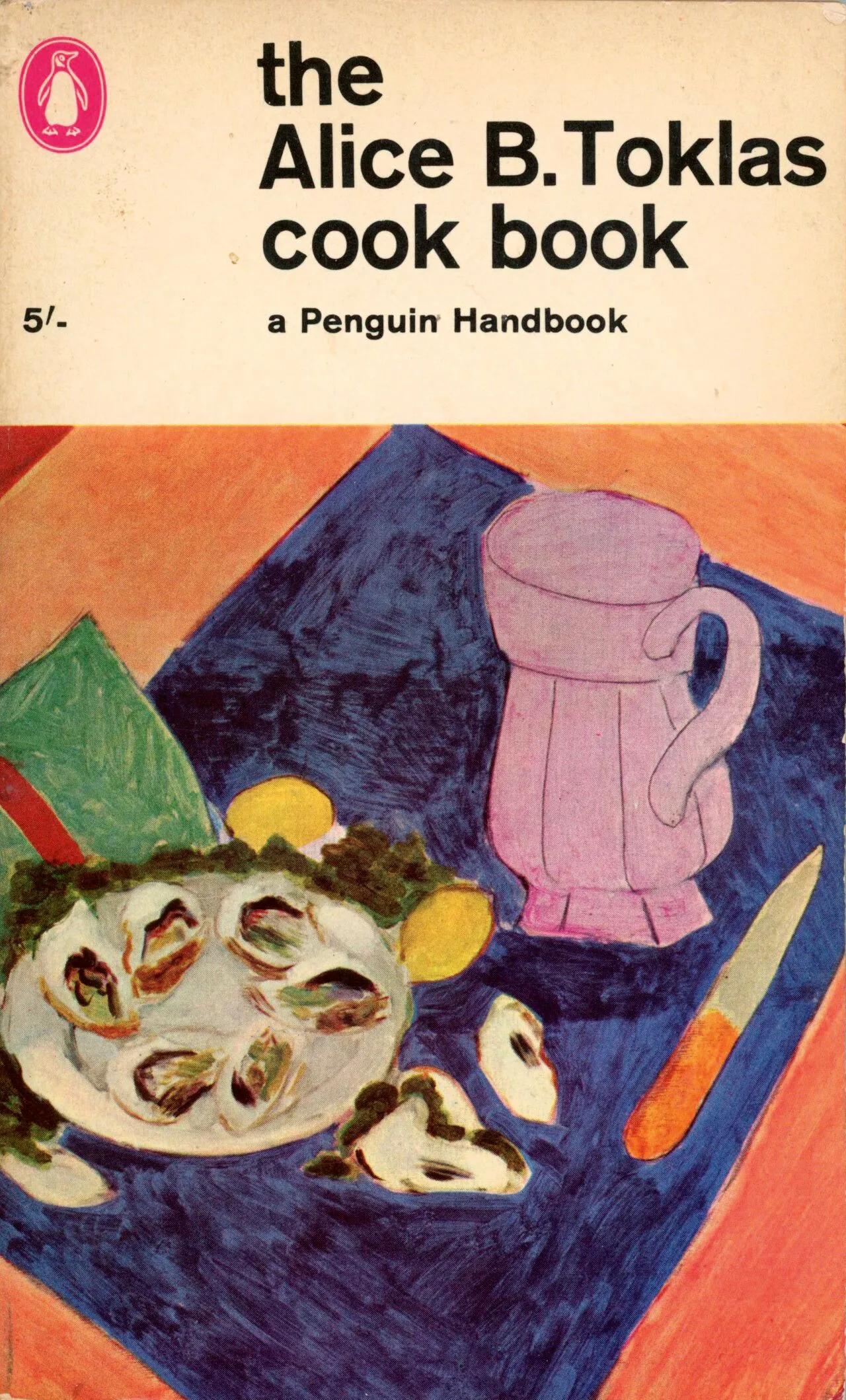
Cover of the 1961 edition of The Alice B. Toklas Cookbook
The Alice B. Toklas Cookbook is a psychiatrist’s couch, a propagandist tool, a 20th-century set piece, a gossip column, a bourgeois dinner party, a love letter and a war story, all in one.
II
Toklas was born in San Francisco in 1877 and spent most of her childhood in Seattle before the family eventually moved back. She grew up with cooks and servants—Toklas called it “a necessary luxury.” When she was twelve years old her mother died after a long illness, causing the family’s circumstances to change. Toklas was now tasked with taking care of the household. She took solace in reading her mother’s many cookbooks. Later, Stein began a tradition of giving Toklas a cookbook each year at Christmas and the reliable coping mechanism continued, sometimes with great effort. She had the nearly 1,500-page Belle Epoque tome Le Grand Livre de Cuisine by Montagné and Salles smuggled across enemy lines during World War II solely for its potential to console Toklas. “The recipes for food that there was no possibility of realizing held me fascinated—forgetful of restrictions, even occasionally of the Occupation, of the black cloud over and about one, of a possible danger one refused to face,” Toklas wrote.
The danger was the Gestapo. As Jews, lesbians and modern art collectors, they were especially at risk. If it were not for an old friend turned Vichy accomplice named Bernard Faÿ, the couple most definitely would have suffered and likely would have perished. Under Faÿ’s protection, they were given special treatment by the Nazi Vichy regime—ration coupons for food staples, including a special one for pedigreed dogs, which they used for their white poodle, Basket, as well as the security of knowing their art collection in Paris was safe.
When the Nazis searched the apartment in 1944, they took only a petit-point footstool—which Toklas had embroidered from a Picasso design—a pair of Louis XV silver candlesticks and, to Toklas’s chagrin, a corn-stick baking dish given to her by an American friend. The paintings were left untouched.
In “The Winner Loses,” an article Stein wrote for The Atlantic Monthly in 1940, she attempts to explain why the couple decided to stay in war-torn Europe when the American consulate was ready to prepare documents to get them out. Stein writes that moving back to America from France “would be awfully uncomfortable, and I am fussy about my food.” As callous and pretentious as that may sound, Stein often used food as the determinant for her decision making. Before accepting an invitation to go on an American book tour to support the publication of the autobiography, she had to be reassured that all the hotels along the route had good restaurants.
III
As Malcolm suggests in her 2007 biography Two Lives: Gertrude and Alice, the couple were always concerned with keeping up appearances. Analyzing a 1922 Man Ray portrait of Toklas and Stein in their rue de Fleurus apartment, posed in parlor chairs too small for their frames, Malcolm rightly detects that the formal setup exudes a sense of normalcy, of “things not being said.”
Toklas and Stein did not hide their close friendship with Faÿ. In fact, they left it right out in the open, as if being friends with the enemy was perfectly normal behavior. We know from the autobiography that when Faÿ first befriended Stein, he offered to translate an excerpt from her novel The Making of Americans. He later asked her to translate the political speeches of Marshal Philippe Pétain, the head of the Vichy regime, establishing a transactional exchange that would serve them for many years.
Not mentioned in the cookbook is that after the war Faÿ was tried as a Nazi collaborator and sentenced to life with hard labor. In 1951, Toklas helped fund his prison break, enabling him to escape to Switzerland. It was around this time that she quietly sold two works by Picasso, a gouache and a drawing.
IV
The success of the cookbook—it is now one of the best-selling cookbooks of all time—far surpassed Toklas’s expectations. Certainly, the recipe contributed by the experimental artist Brion Gysin, titled “Haschich Fudge (which anyone could whip up on a rainy day),” played a role, turning Toklas into something of a counterculture icon. She added the chapter “Recipes from Friends,” in which the fudge recipe appears, at the last minute. It’s likely that she knew its inclusion would titillate, but its impact went much farther than that. Gysin later claimed he thought the recipe would help with sales.
Her publisher, Harper & Brothers, expunged the recipe from the first American edition, calling it “dangerous,” but Michael Joseph, her British publisher, had no qualms about printing it. After outlining Gysin’s recipe—and warning that eating two pieces is sufficient—Toklas goes on to give advice for growing cannabis in one’s own window box. The recipe was finally published in the American paperback edition in 1960, just in time for its Age of Aquarius reception.
The book’s cultural impact remade Toklas into a harbinger of cool. This eventually led to the 1968 film I Love You, Alice B. Toklas, a story about the allure of hippie life, starring Peter Sellers. A reference to Toklas in an episode of Bewitched, the 1960s American television sitcom, is thrown out casually by the actress Agnes Moorehead as if everyone watching at home knew precisely who she was.
Most of the recipes in the cookbook were borrowed or were given to Toklas by friends or professional cooks. She had a formidable array to choose from—the teenage poet Mary Oliver contributed sophisticated recipes like fondue de bâle and filet de sole à la Ritz; the artist Dora Maar’s entry was a bare-bones laurel-leaf soup, made with a laurel leaf, hot water and an egg.
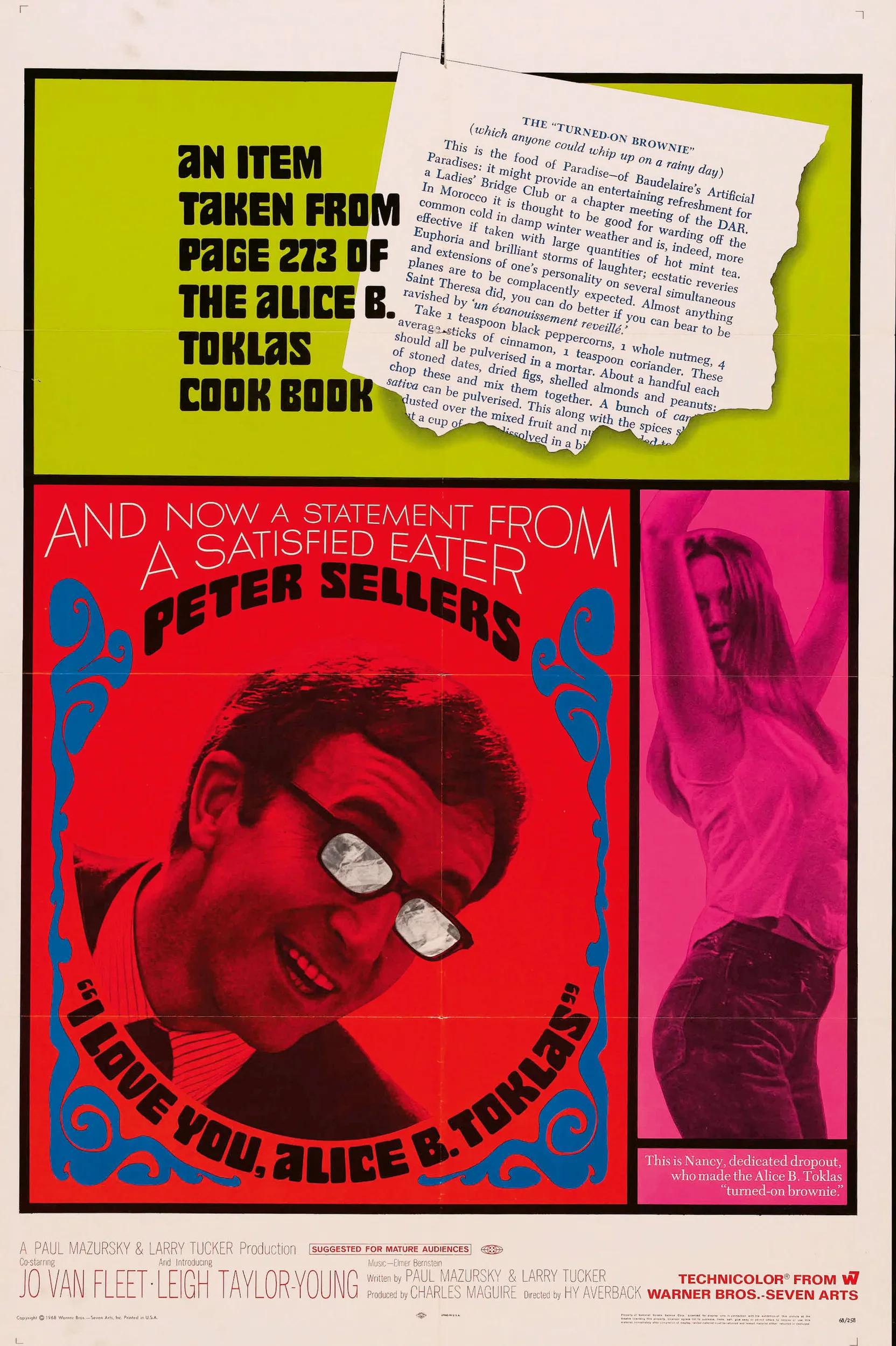
Movie poster for I Love You, Alice B. Toklas (1968). Photo: PictureLux / The Hollywood Archive / Alamy
IV
The success of the cookbook—it is now one of the best-selling cookbooks of all time—far surpassed Toklas’s expectations. Certainly, the recipe contributed by the experimental artist Brion Gysin, titled “Haschich Fudge (which anyone could whip up on a rainy day),” played a role, turning Toklas into something of a counterculture icon. She added the chapter “Recipes from Friends,” in which the fudge recipe appears, at the last minute. It’s likely that she knew its inclusion would titillate, but its impact went much farther than that. Gysin later claimed he thought the recipe would help with sales.
Her publisher, Harper & Brothers, expunged the recipe from the first American edition, calling it “dangerous,” but Michael Joseph, her British publisher, had no qualms about printing it. After outlining Gysin’s recipe—and warning that eating two pieces is sufficient—Toklas goes on to give advice for growing cannabis in one’s own window box. The recipe was finally published in the American paperback edition in 1960, just in time for its Age of Aquarius reception.
The book’s cultural impact remade Toklas into a harbinger of cool. This eventually led to the 1968 film I Love You, Alice B. Toklas, a story about the allure of hippie life, starring Peter Sellers. A reference to Toklas in an episode of Bewitched, the 1960s American television sitcom, is thrown out casually by the actress Agnes Moorehead as if everyone watching at home knew precisely who she was.
Most of the recipes in the cookbook were borrowed or were given to Toklas by friends or professional cooks. She had a formidable array to choose from—the teenage poet Mary Oliver contributed sophisticated recipes like fondue de bâle and filet de sole à la Ritz; the artist Dora Maar’s entry was a bare-bones laurel-leaf soup, made with a laurel leaf, hot water and an egg.
V
During the writing of the cookbook, a doctoral candidate from Columbia University named Leon Katz paid Toklas a visit. He had just discovered a stockpile of unread Stein notebooks at the Yale University Library from the time of the couple’s blossoming courtship. When Katz asked Toklas if he could interview her about the contents she jumped at the chance. “Nothing but really nothing could have stopped me,” she later reflected.
During four exhausting months, working eight hours a day, four days a week, Katz drilled Toklas about her life with Stein. The experience drained her as much as it filled her. Some of the notebook entries were unflattering, but after reading them Toklas felt a sense of relief: “At least she didn’t accuse me of disloyalty.”
Toklas admits that she was initially interested in food but not in cooking it. Stein suggested that she prepare American dishes on Sundays, their cook’s day off. At first, her attempts were humble, simple dishes, like fricasseed chicken and cornbread. But from these Toklas learned to experiment with French ingredients and methods.
Some in their inner circle remained unconvinced of Toklas’s skills and were much happier eating at 58, rue Madame, where Stein’s older brother Michael and his wife, Sarah, famed collectors of Matisse, purportedly served better dishes.
Toklas did excel at baking cakes and enjoyed fooling Stein into believing that they were store-bought. She longed to prepare a “liberation fruit cake” for the end of the war and squirreled away dried fruit for the fateful day.
At the beginning of World War II, the couple fled to the South of France, leaving Toklas no choice but to cook. “It suddenly and unexpectedly became a disagreeable necessity to have to do it when war and Occupation followed,” she wrote.
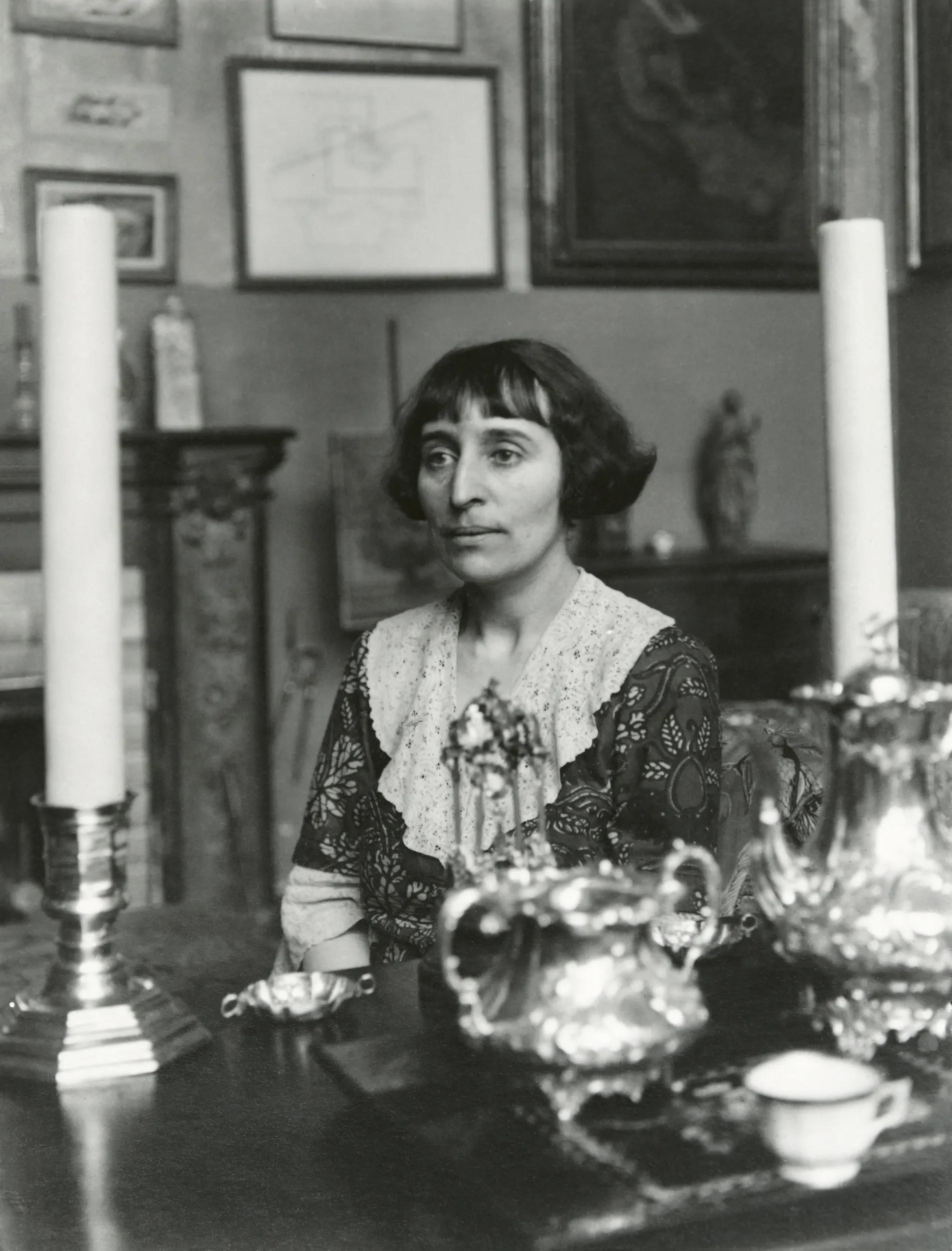
Toklas at her and Stein’s Paris apartment, 1922. Photography by Man Ray © Man Ray 2015 Trust / Artists Rights Society (ARS), NY / ADAGP, Paris 2026
VI
It seems somehow inconceivable that Toklas, often described in unflattering physical terms—James Beard called her “nicely ugly”—would become such a cultural figurehead, especially since for most of her adult life she catered ceaselessly to the needs of Stein, neglecting her own. The food writer M. F. K. Fisher referred to Toklas as a “willing shadow.”
In a 1945 photo session with Cecil Beaton, Toklas looks as if she is taking refuge behind the furniture, forever the wallflower to Stein’s social butterfly. Even if Beaton suggested the positions—he often placed lesser-known subjects in the background—it was an accurate depiction.
For all the photographs taken of the couple, staged or otherwise, few show Toklas in the kitchen or at a meal. This part of her life was left mostly undocumented, as if it was not relevant.
Even Stein, who spoke flatteringly of Toklas’s skill in managing the household and in transcription and editing, did not include cooking among her chief talents. It didn’t seem to matter to Toklas, who evinced little concern over others’ opinion of her cooking: “It neither beguiled nor flattered me into liking or wanting to do it.”
VII
In the mid-1920s Toklas and Stein discovered southeastern France and began spending their summers there. Before long they leased a manor in Bilignin, where Toklas diligently rehabilitated a garden overrun with weeds and snakes. They moved in more permanently when the war broke out. Toklas wrote about the garden’s many pleasures. “There is nothing that is comparable to it, as satisfactory or as thrilling, as gathering the vegetables one has grown.”
Evidence of a previously planned cookbook exists on the inside cover of Stein’s copy of James Fenimore Cooper’s novel The Pilot. A list of seven chapters, including one titled “Eating and not eating, an occupation,” are written out along with a note indicating that the recipes would be interspersed with their own recollections. Given the names of the chapter headings, it appears that this was a full-fledged concept invented by both women in the 1940s.
Even earlier, in the 1930s, the thought of writing a cookbook was on their minds. Yale University’s Beinecke Rare Book and Manuscript Library has an incomplete manuscript among their papers called, “We Eat: A Cookbook by Alice B. Toklas and Gertrude Stein.”
It appears that Toklas did not publicly discuss their shared idea for a cookbook, preferring instead to take on the task when the timing seemed right, in this case after Stein had died and she could assume the role of sole writer. In her letters, Stein chided Toklas about the book she would one day write.
On the last page of the cookbook, Toklas recalls that she was in the upper gardens at Bilignin when she told two friends, one of whom was the writer Thornton Wilder, about her intention to write a cookbook someday. Wilder, like Stein, was quick to doubt her.
“But Alice, have you ever tried to write?”
“As if a cookbook had anything to do with writing.”
As if a cookbook was not the ideal place for sorrow and joy.
–
Leah Singer is a journalist and visual artist. She is an editor and writer at Apartamento and an oral historian for the Smithsonian’s Archives of American Art. Her film work, presented live in performance with musician Lee Ranaldo, was recently presented at Berlin Atonal.