
Allison Katz
Outta the Bag
30 April – 24 July 2026
New York, Wooster Street
‘Allison Katz. Outta the Bag’ is the Montreal-born, London-based artist’s first solo exhibition with Hauser & Wirth in New York—the city she moved to 20 years ago to obtain her MFA at Columbia University, and where she then lived and worked for seven formative years.
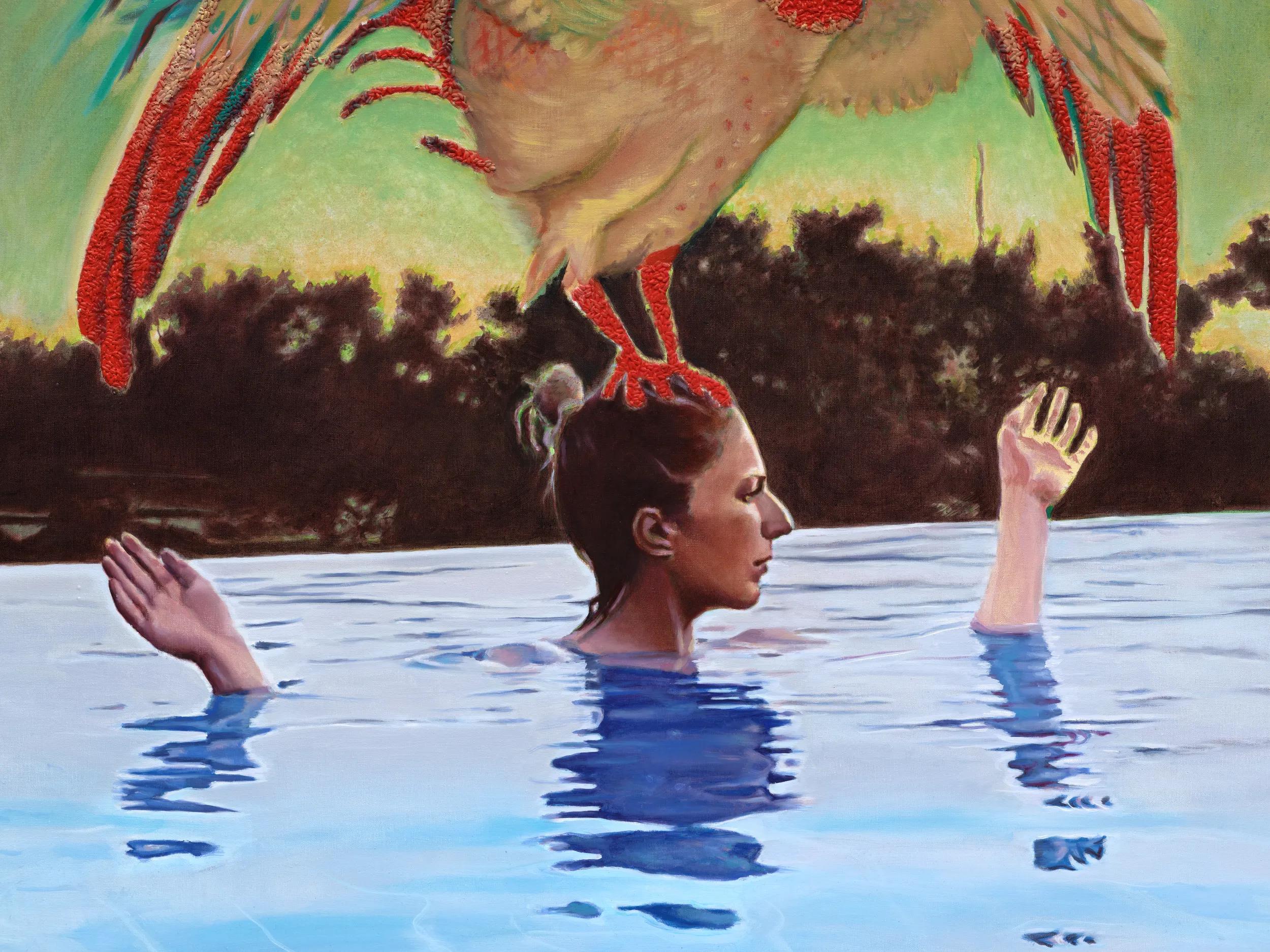
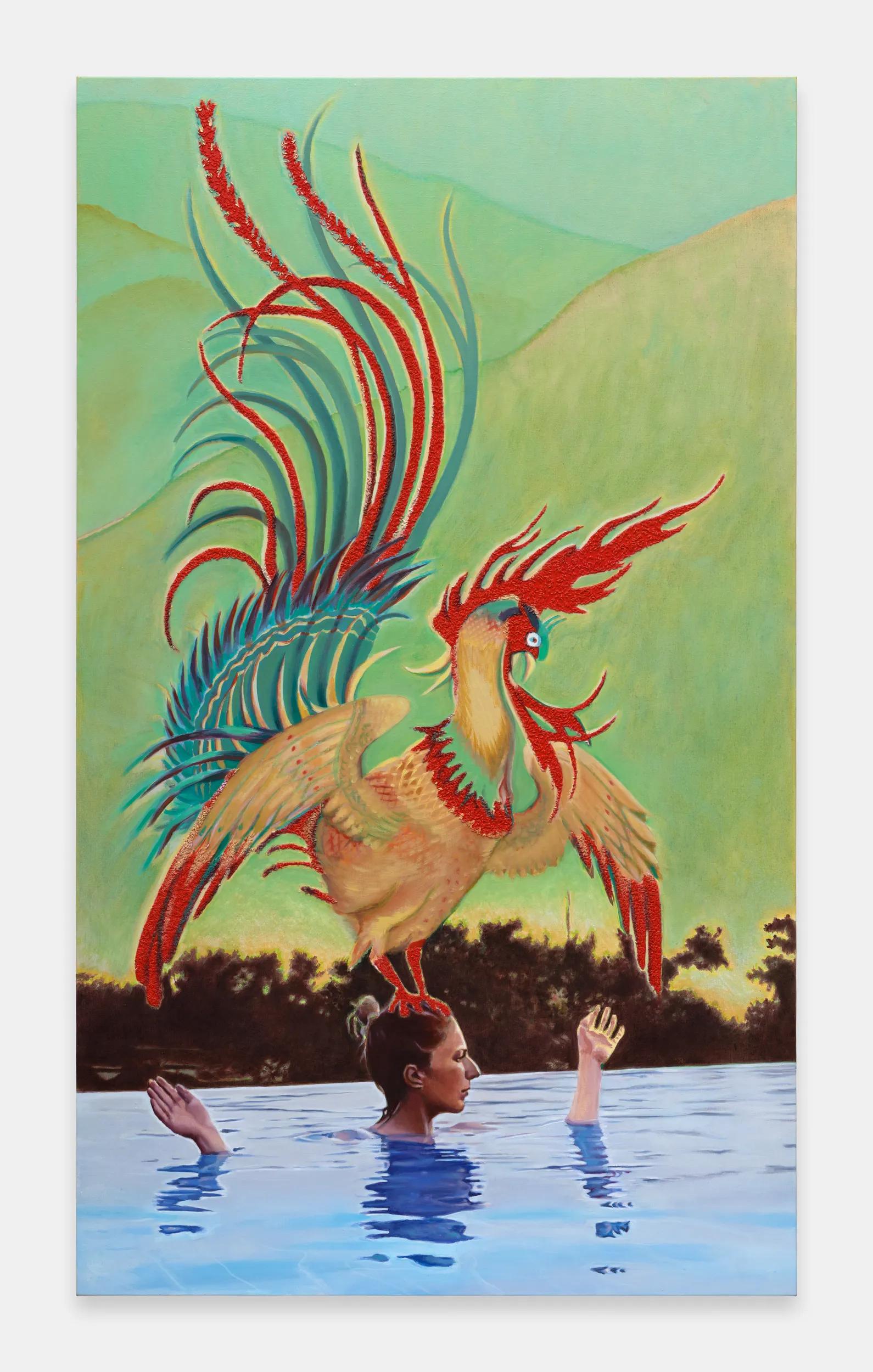
Across the exhibition, Katz extends her inquiry into the capaciousness of painting—what it can record, absorb and transmit. Wit and lived experience ripple through art-historical citations, modes of self-portraiture and allusions to the precarity of an image-saturated world. Language, too, operates as a structuring device. Through wordplay, expressions and elliptical titles—beginning with the exhibition’s, which reminds us that showing one’s work is a bit like revealing a secret—Katz creates verbal frames elastic enough to hold both the playful and the erudite, allowing meaning to slip, collide and subtly steer the viewer’s path through the work.
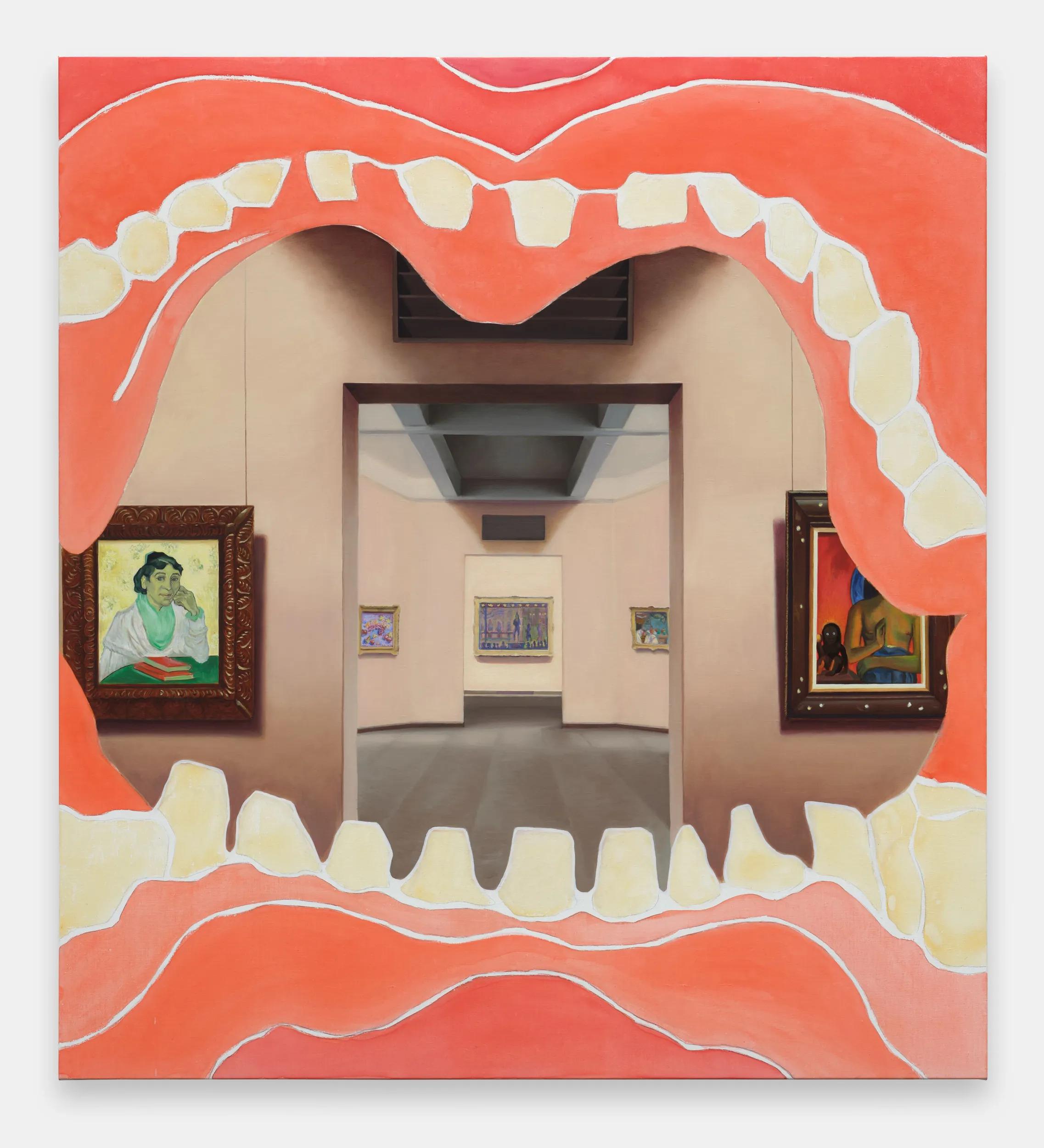
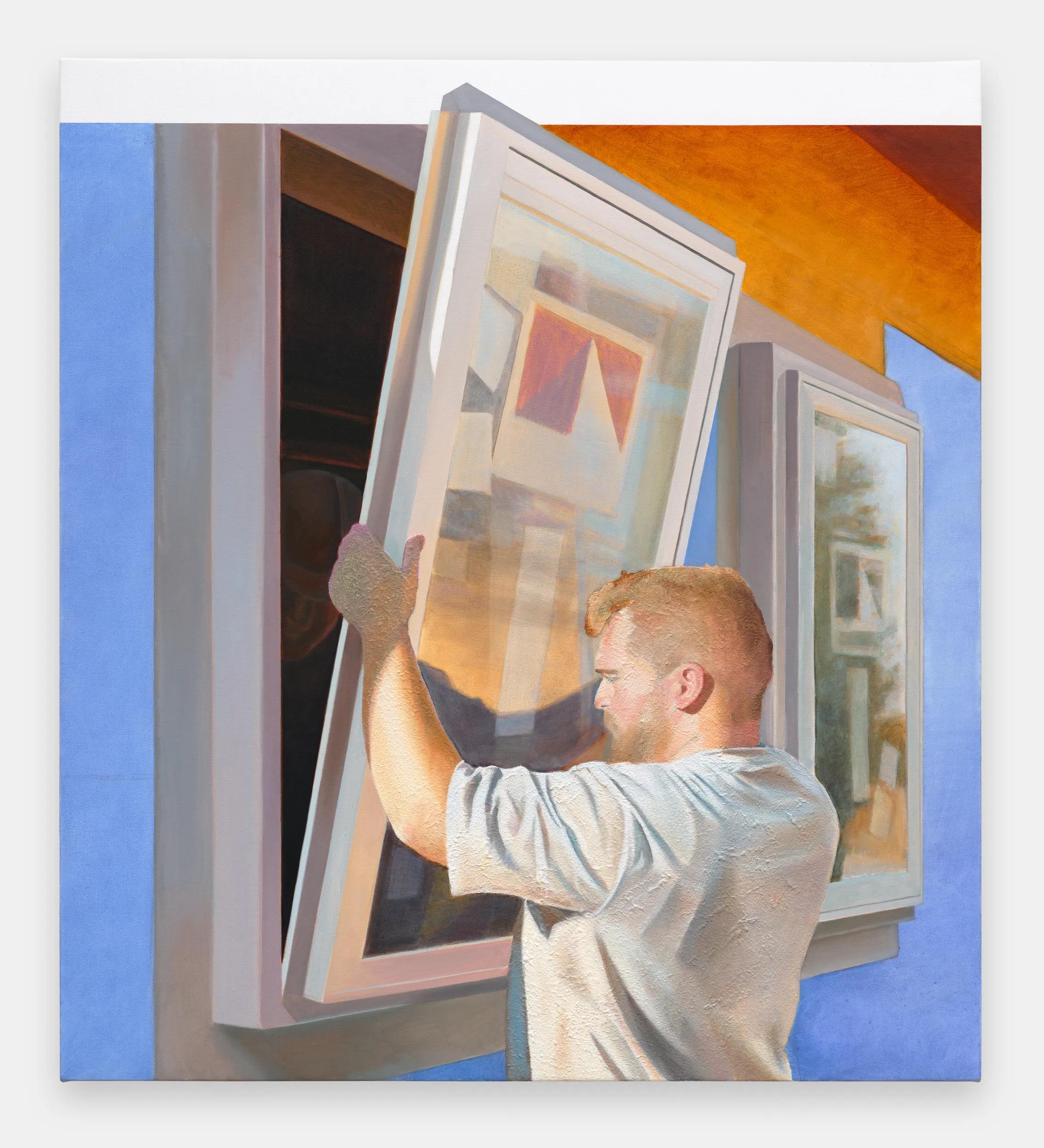
In ‘Outta the Bag,’ framing devices operate both as a motif and conceptual structure: architectural apertures, bodily thresholds and pictorial conventions call attention to the conditions under which images are experienced. In ‘Jaws’ (2026), Katz has framed an interior view of The Museum of Modern Art’s inaugural 1929 exhibition within a wide-open mouth—a recurring motif in her oeuvre. Invoking hunger and consumption as metaphors for looking, the composition holds two systems in tension: the one-point perspective organizes the museum interior as a kind of mechanistic intervention—a cleaning-up of the visual field—set against the biomorphic, ungovernable mouth that contains it. If the museum, like the digestive tract, is a space through which things are taken in, processed and transformed, then perspective here is not neutral but ideological: a formal order that disciplines the restless, embodied nature of perception.
Burden
2026
Jaws
2026
Reflection
2026
Related Content
About the Artist
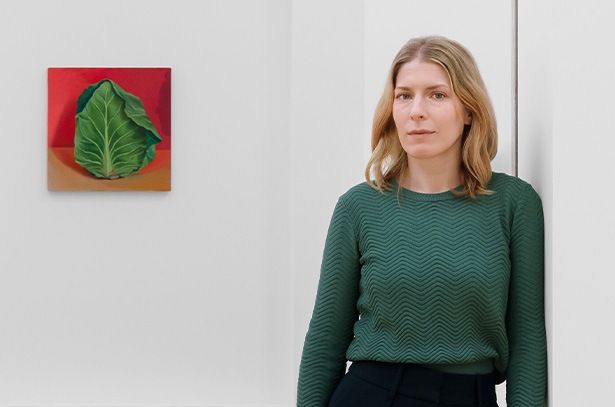
Allison Katz
For over a decade, Katz has investigated the ways in which aesthetic practices link and absorb autobiography, commodity culture, information systems and art history. Her diverse imagery, including cocks, cabbages, mouths, fairies, elevators, noses, waterways, and variations on her own name, appear as recurring symbols and icons which build an unending constellation of ideas and references. Images transmute across the media of painting, posters, ceramics and installations. It is through this act of returning to, copying, transforming and reshaping motifs that the artist creates a lineage and continuity from one work to another, informing and connecting the totality with each new appearance. ‘I paint like I write, that is, I build around quotes, which is a conversation, in effect,’ says Katz. Her subjects are united by a curiosity for how an image passes through embodied experience, while its elasticity of meaning is shaped by impersonal, cultural conditions through time. In this way her work addresses the ambiguity of subjectivity and its presentation.
Katz’s work is an examination of painting’s plane as a flat space where depth can appear, in both a literal and metaphorical way. Beyond the picture plane, her practice has a complex arrangement with the tactile world, engaging with the idea of the viewer as both subject and participant. Katz’s use of texture complicates the painting’s window-like view into another world, grounding the physicality of images in our own sense of touch by mixing sand or rice into the pigment.
Further breaking the autonomy of the illustrative tableau, her staging of exhibitions is inextricably linked to the paintings but also separate to them, and often an artwork in and of itself. The walls that she designs are built around the idea of a viewer’s encounter. This may involve the creation of contrasting perspectives, rooms within rooms or one-to-one painted copies of pre-existing architectural features, such as an elevator. Her relationship to site specificity is fluid, and motivated by constraints and a willingness to undermine the premise itself: paintings made to measure for one location find new meaning through a completely alternative set-up elsewhere. The autonomy of painting as a discrete object is both complicated and energized by the contingency of its reception and by the exhibition as form.
Katz’s interest in framing as both motif and subtext is a formal technique that investigates subjective assumptions; the frame becomes a portal for making sense of the world. The windows and mouths that frequently appear in her paintings address a duality between the sensual and intellectual consumption of information, and synthesize different kinds of sensory experience, such as taste and sight. Exhibition posters frame the event with actual dates and times, but also skew and extend it, by existing as independent artworks that are displayed after the fact.
Katz’s use of wordplay, double entendre or riddle, in both her choice of titles and the generation of the image itself, extends to the use of her signature as a visual element, and speaks to a self-referential thread running throughout her work. The AKgraph paintings—whose titles play on the origins of the words autos ‘self’ + graphos ‘written’—mine the territory between everyday signatures and formal drawing, inscribing identity to leave a trace. Creating a likeness of her own face through the elements that make up her name, Katz pits cartoonish forms against ideas assumed to be stable and hierarchical. This playful and inquiring touch refuses the conventional notion of an artist’s ‘signature style’ in favor of a broader engagement with how a painting can be made today.
Current Exhibitions


Glenn Ligon
Late at night, early in the morning, at noon
15 January – 11 April 2026
New York, 18th Street


1 / 12