
Conversations
Turning to Look Back
William Kentridge and Colm Tóibín in conversation about Orpheus, family, tragedy and art
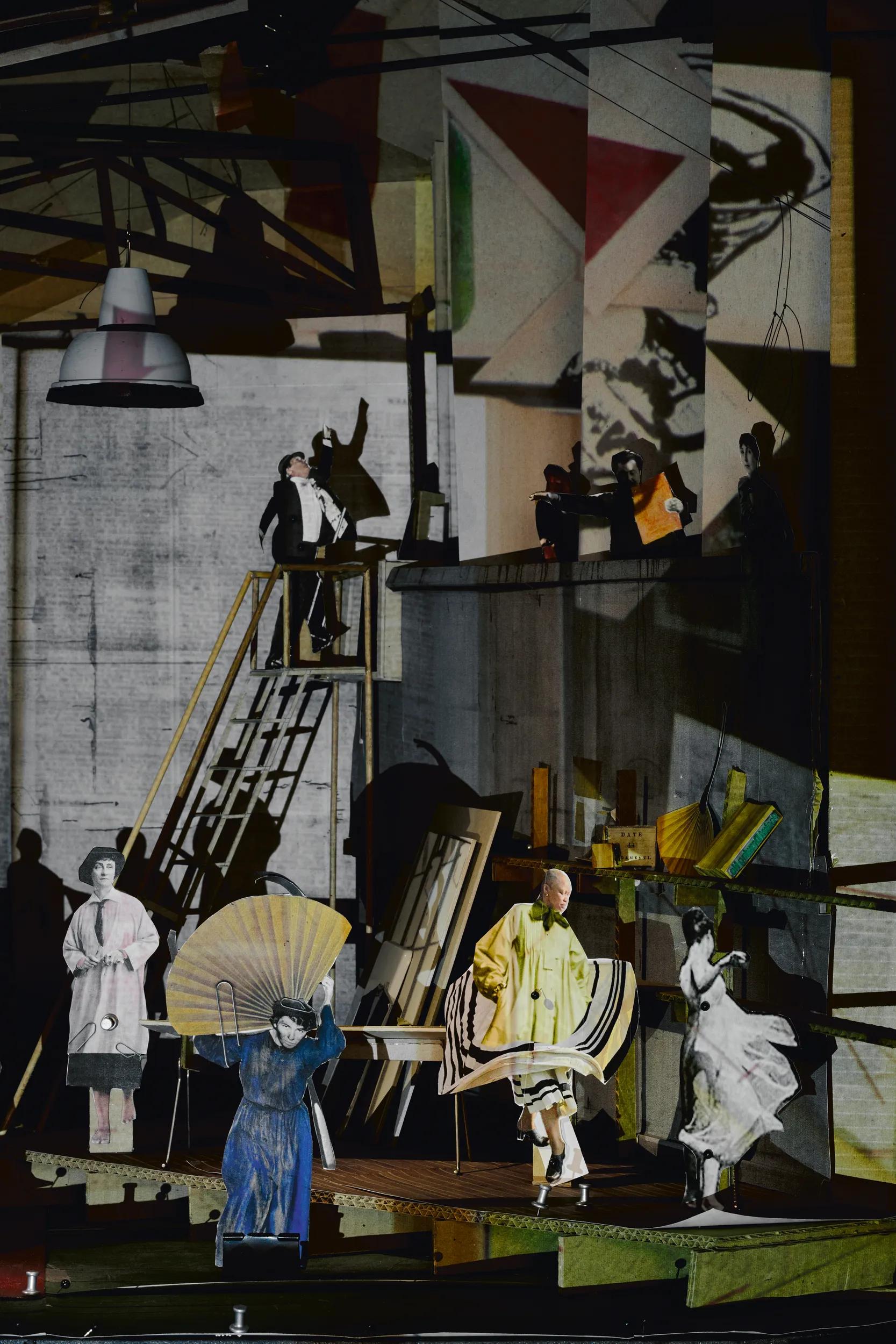
William Kentridge, model for L’Orfeo, Johannesburg, 2026 © William Kentridge. Photo: Stella Olivier
Artist William Kentridge and novelist Colm Tóibín were born the same year, 1955—Kentridge in Johannesburg and Tóibín in Enniscorthy, Ireland. Throughout their celebrated careers, the two have shared a multitude of interests, as considered from the vantage points of their respective fields—19th-century literature, opera, the burdens of national history, the provisional nature of truth and the consequences of exile. But until now, Kentridge and Tóibín have never been in conversation. For Ursula, they recently spent an afternoon together for a wide-ranging talk as Kentridge finalized preparations for a new production of Monteverdi’s L’Orfeo at Glyndebourne opera house in England and worked toward a major exhibition and multidisciplinary collaboration at Bozar, the Centre for Fine Arts, in Brussels.
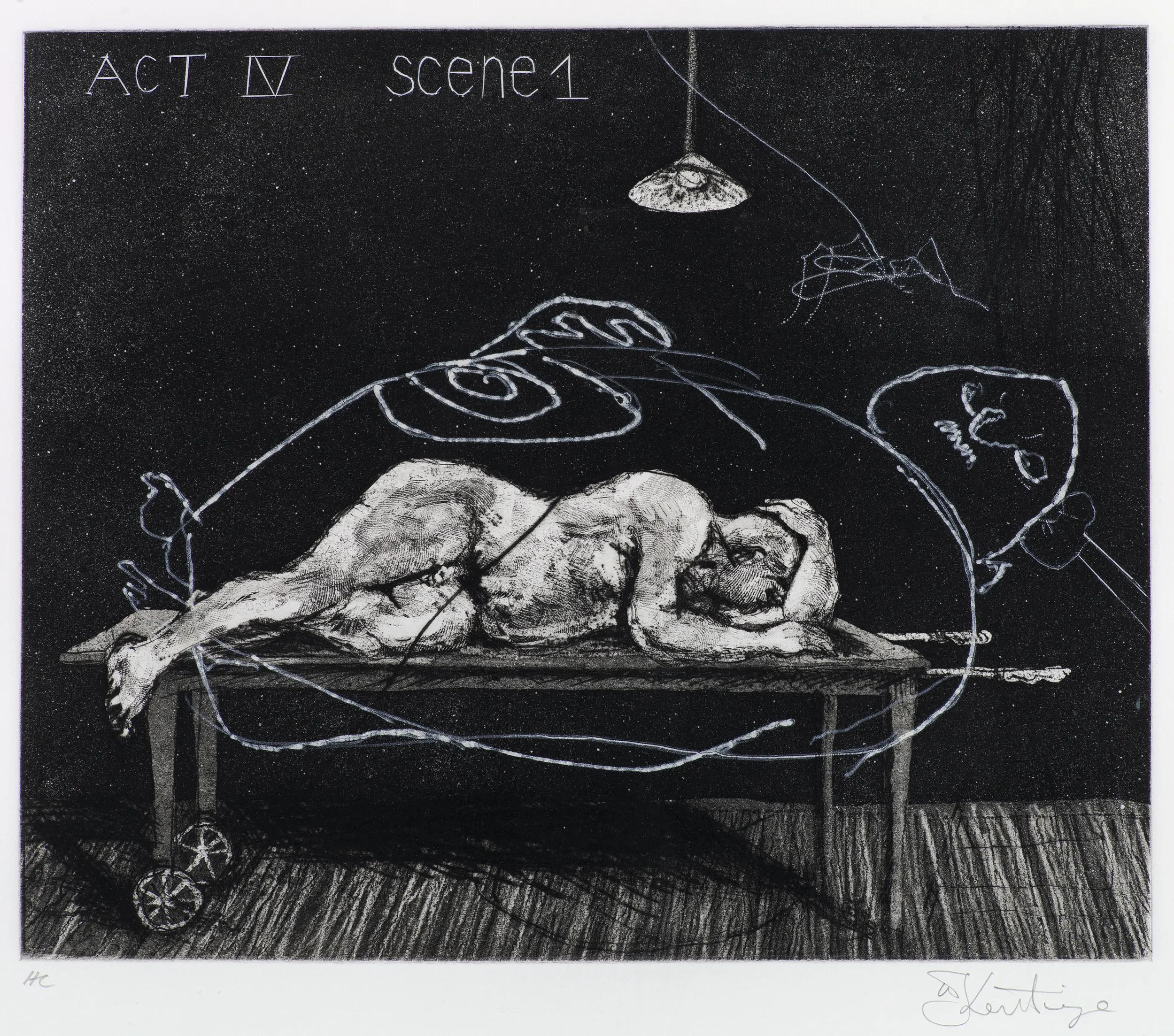
William Kentridge, Ubu Tells the Truth: Act IV Scene I, 1996. Etching, softground, drypoint and aquatint on Fabriano Rosaspina, Bianco 220, paper dimensions: 36 x 50 cm. Edition of 50 plus 1 artist’s proof © William Kentridge
Colm Tóibín: William, would it be all right if we started right off by talking about Orpheus?
William Kentridge: Yes.
CT: I wonder if Orpheus, more than any of the other myths, is the one that governs us. The idea that, as artists, we try to lead somebody out of the underworld and fail, and that we—or our characters—do foolish things like looking behind when we shouldn’t.
WK: I think it is. I do come at it from a slightly different angle. The fundamental lesson of Orpheus, I suppose, is that death is death is death. That you think you’re going to trick it, but in the end, it will always catch you. That was the one thing I fixed on. But I’m interested in all the different Ovid stories, and I think I really got interested in Orpheus primarily through the Rilke poem about Eurydice.
CT:“Nothing else was red.”
WK: Yes! I mean, the fantastic section of it where Orpheus is coming to rescue Eurydice, but for Eurydice, as Rilke writes, her death was “still so new that it hadn’t been fathomed.” She is so filled with it, it’s like a pregnancy. When the messenger touches her and says, “I’m sorry, he has turned around,” all she can say is, “Who?”
CT: “Who?” Right.
WK: She’s forgotten who Orpheus even is. I think it’s that “who?” that prompted me to want to do the production of Monteverdi’s opera L’Orfeo. And then, of course, there is the fabulous mirror in Jean Cocteau’s film Orpheus, through which Orpheus disappears—which we use in our production in a slightly different way. But I suppose the idea of Orpheus as the rescuer of the world, a figure whose music is strong enough to move stones and rocks and trees, is a powerful one. In our case, we transpose that a bit and it becomes the power not just of music but of art as a whole. The music is visualized by the character of La Musica in the opera, being the artist who constructs the production in front of our eyes. How exactly do you see Orpheus?
CT: I suppose there’s a great sadness at the root of it, that he really thinks it’s possible to bring her back from the underworld. And sometimes when you’re writing something, you think, “This is almost real. If I could just make this real, if I could push it farther … if I could write a novel about my mother after she’s dead, if I could rebuild her, if I could just get that scene back, if I could go back into that room, if I could even invent things that didn’t happen, that might have happened.” The whole business is not about bringing back the dead. That would be too large an ambition. But there’s some intimation that you could remake it or you could re-dream it. And then you end up standing from the table and you look behind yourself.
WK: I made a film about my father, who’s not physically dead, but he’s very far disappeared from the world in terms of sight and memory and awareness of where he is. I hadn’t thought of that film as being connected to Orpheus, but it’s certainly connected to disappearance and the memory of things. I suppose that’s a premonition of myself, a reminder that things seem so clear now, but we know they are going to disappear and get fainter and fainter. And looking back to try to track them doesn’t necessarily make them come back any more clearly. You have to wait for them to come to your side, I think.
CT: If I saw a photograph of my parents on a beach with myself as a baby, I’d be reasonably interested. But if I saw a photograph of my grandparents on a beach with my father or mother as a baby, I would sit up. Somehow or another that more distant past I can almost inhabit at certain moments. I can dream it up—what it was like in 1930-something, 1920-something, on that very beach that I would go to if only my grandparents could be there. I’m wondering if you could take me through that photograph of yours, that famous photograph of your grandparents.
WK: Yes, of course. It was a photograph of them around 1930. My father must have been about eight. My grandfather in his Homburg hat and a three-piece striped suit, sitting in a deck chair on the beach with his socks and shoes still on. And my father, with his primary-school cap on, is sitting in the sand next to him, my grandmother there next to them. It’s an image that’s come through many different works of mine, first as a linocut because there’s something about the line that a linocut tool makes and the stripes, both of the striped deck chair and, with the finer blade, the lines of the pinstripes of the suit, that sort of meets the image halfway. And then later, much later, I made a film in which there’s a character who’s been in all my films, Soho Eckstein, sitting on the deck chair looking like my grandfather, and Soho remembering his younger self as a boy throwing a stone on a beach. The boy in fact was based on a drawing of my son.
CT: So four generations.
WK: As my brother pointed out, the only way you can tell that it’s not actually a picture of either me as my younger self or my father or my grandfather is that the boy I drew, my son, is left-handed and the rest of us are right-handed. That’s the forensic giveaway. I suppose the pull of ancient parents, of our ancestors toward us, is always very strong. I sometimes use a photo as a starting point, as a first reference that kicks things off. When you’re writing, I suppose it’s a different kind of invention, because your nib is the same. You can’t suddenly use a fatter pen and new words come out.
CT: I’m trying to write at the moment. Trying to work out how to start a novel in which there is a central image, not a photograph but a mental image that for me is really important. At a certain moment, on a certain morning in July of 1967, I went to the window, the front window of our house, and I saw a woman, a neighbor. She was with another woman, another neighbor, and the two women were talking, whispering for a while. I could see them. Then they both looked up at our house and I realized, from the way they were talking, that it could only mean that my father was dead. Obviously, soon, somebody told me. But that was the thing that I saw that caused me to know.
WK: Your father had been ill?
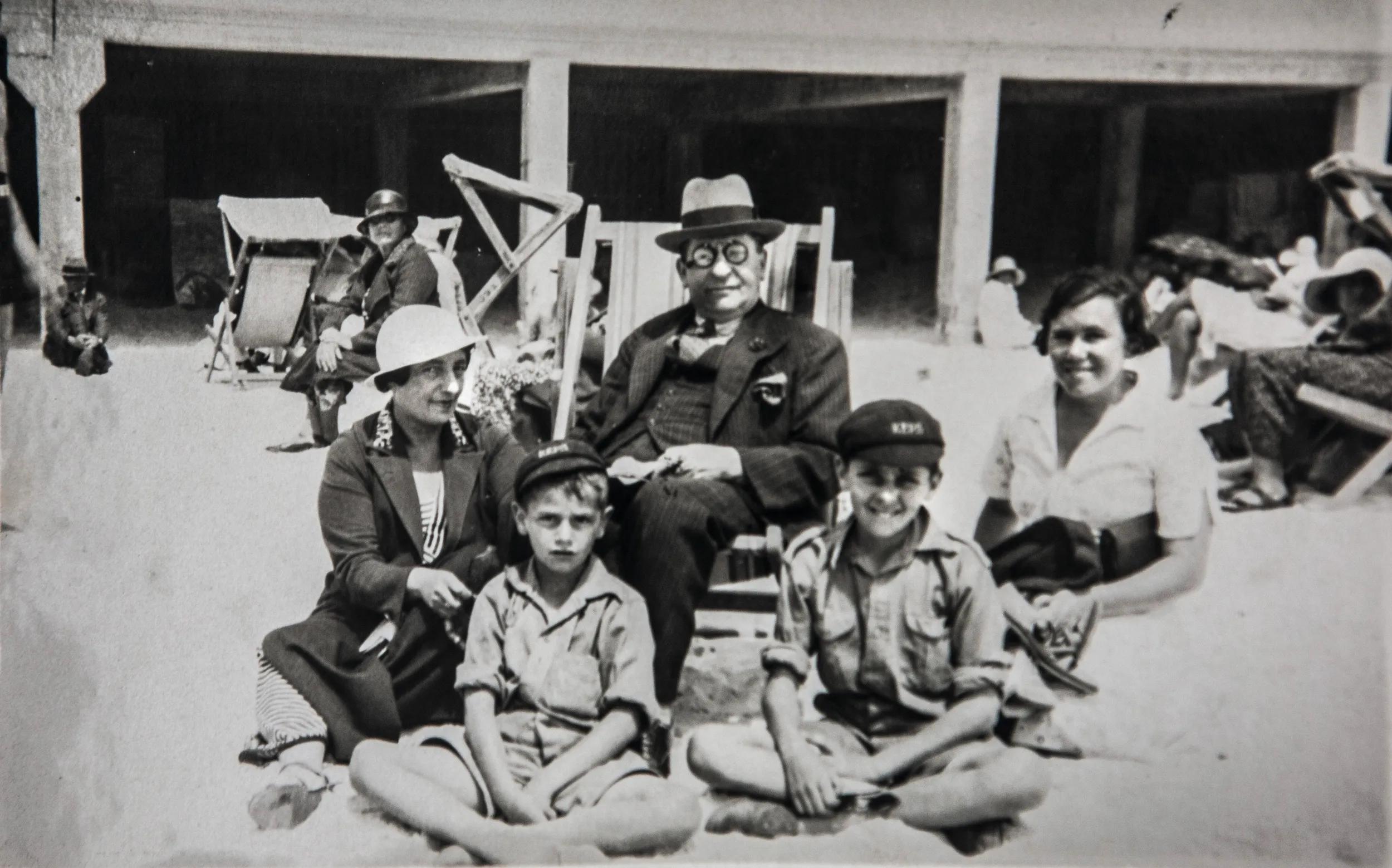
Kentridge’s grandparents and father on Muizenberg beach, Cape Town, ca. 1930. Courtesy William Kentridge
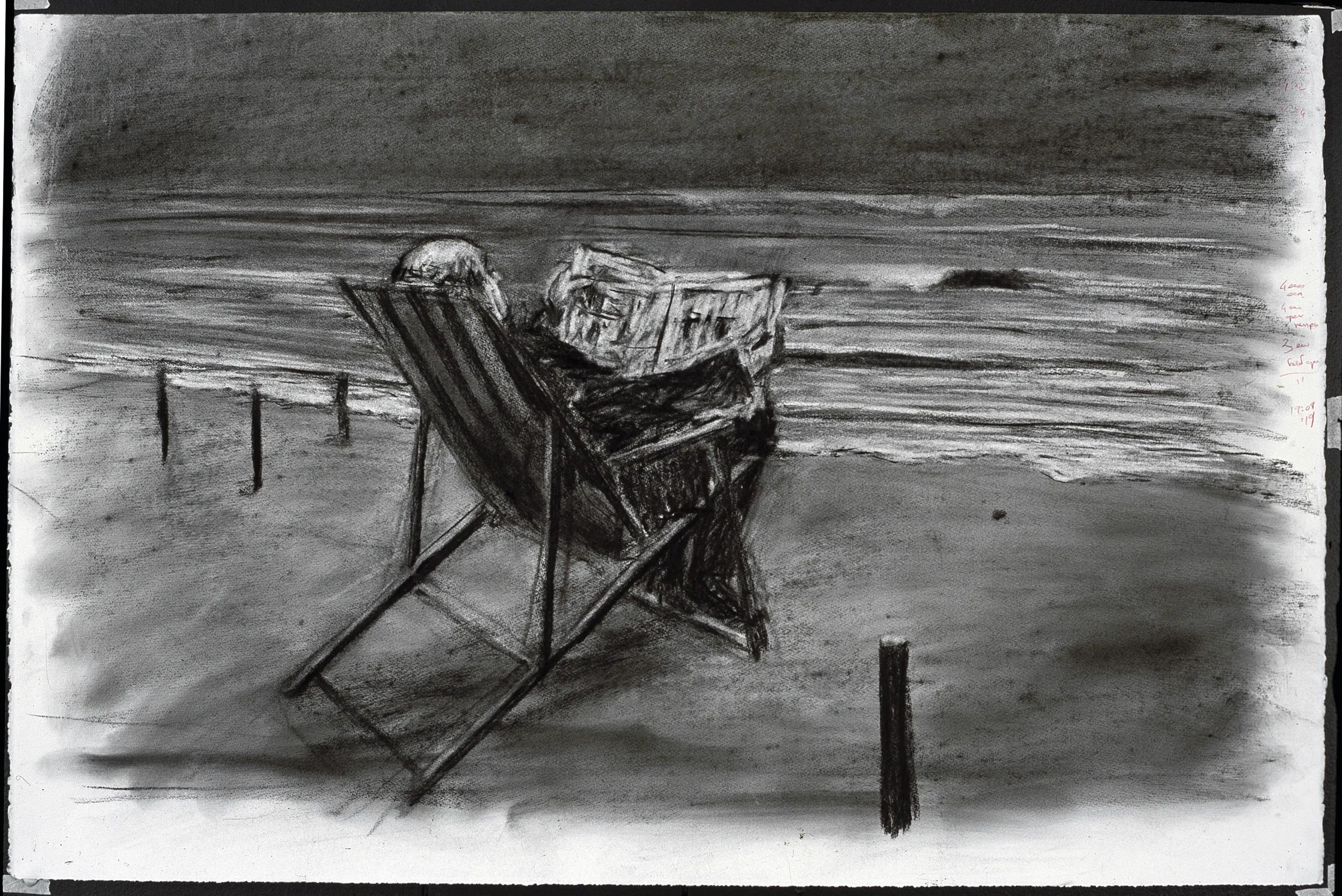
William Kentridge, Drawing for Tide Table (Soho with Newspaper I), 2003. Charcoal and colored pencil on paper, paper dimensions: 80 x 120 cm © William Kentridge
“Sometimes when you’re writing something, you think, ‘This is almost real. If I could just make this real, if I could push it farther … if I could write a novel about my mother after she’s dead, if I could rebuild her, if I could just get that scene back.’”—Colm Tóibín
CT: He had, yes.
WK: You were how old then?
CT: I was twelve. And then that takes me back four years earlier to a moment that had really changed everything. I came into a room after my father had had brain surgery to find that his entire head had been sort of stitched back together. This was totally unexpected. No warning. I’m eight. Wasn’t there a certain moment in your life when you opened a box that could have been a box of chocolates but what was really inside, what you saw, made an enormous difference to the rest of your life?
WK: Yes, this was in 1960, when my father was working as a lawyer for the families of the people massacred by the police in Sharpeville. So I would have been five or six. And instead of being chocolates in this yellow box, it was Kodak 8-by-10 glossy black-and-white photos of the people who’d been shot. There was the guilt of looking inside the box, of wanting to steal a chocolate when I shouldn’t have been stealing a chocolate, and then the punishment was being shown this kind of image of hell, which was completely traumatic. Quickly putting the photos away in the box was both a stepping-back, as if there’d been a trap inside to catch my hands for trying to take the chocolate, and also a kind of guilt. I hadn’t made those photos, but in looking at them I was complicit suddenly in that world.
CT: It was clear to you at the time that this was South Africa, clear to you what you were seeing?
WK: I doubt it. I mean, I knew the word “Sharpeville” because it was in the house the whole time around then. I must have had some sense of what had happened. But I didn’t know the difference between an entry wound, which is just a tiny, dark stain on someone’s jacket, and what I see in the next photo, an exit wound, a back that has been blown to smithereens by the bullet, with all of the viscera coming out. I think it’s stayed with me in part for this reason. It’s like an object lesson in trying to resist feeling flat in the face of archival evidence and images. There’s something true about a child’s immediate emotional response and a feeling that you should continue to register that shock later in life, years later, after you’ve seen so many similar images. One tries to recapture the outrage of youth in a much more jaded time.
CT: In 1985 in Buenos Aires, I attended the trial of the generals who had caused the disappearances during the dictatorship and caused the Malvinas War, and I took notes and wrote a long piece about the trial and the evidence. The problem was that I never planned to write a novel about it. A novel, or certainly one that I might work on, would have to include irony, ambiguity, uncertainty, general complexity. And therefore to go starkly into one of the detention “Damon, who owns this?” And then it struck me later, as I was thinking about the distance between charcoal and color in your drawings, that it’s almost the distance between me as the tourist and someone who grew up in the land. I was delighted. The sun, the blue sky, the glinting rock, the redness in the rock and the sense, I suppose also, of a contested history that might be coming to some conclusion. Basically, I was in a state of rubbish, and everything I said was rubbish, and I was delighted with my rubbish.
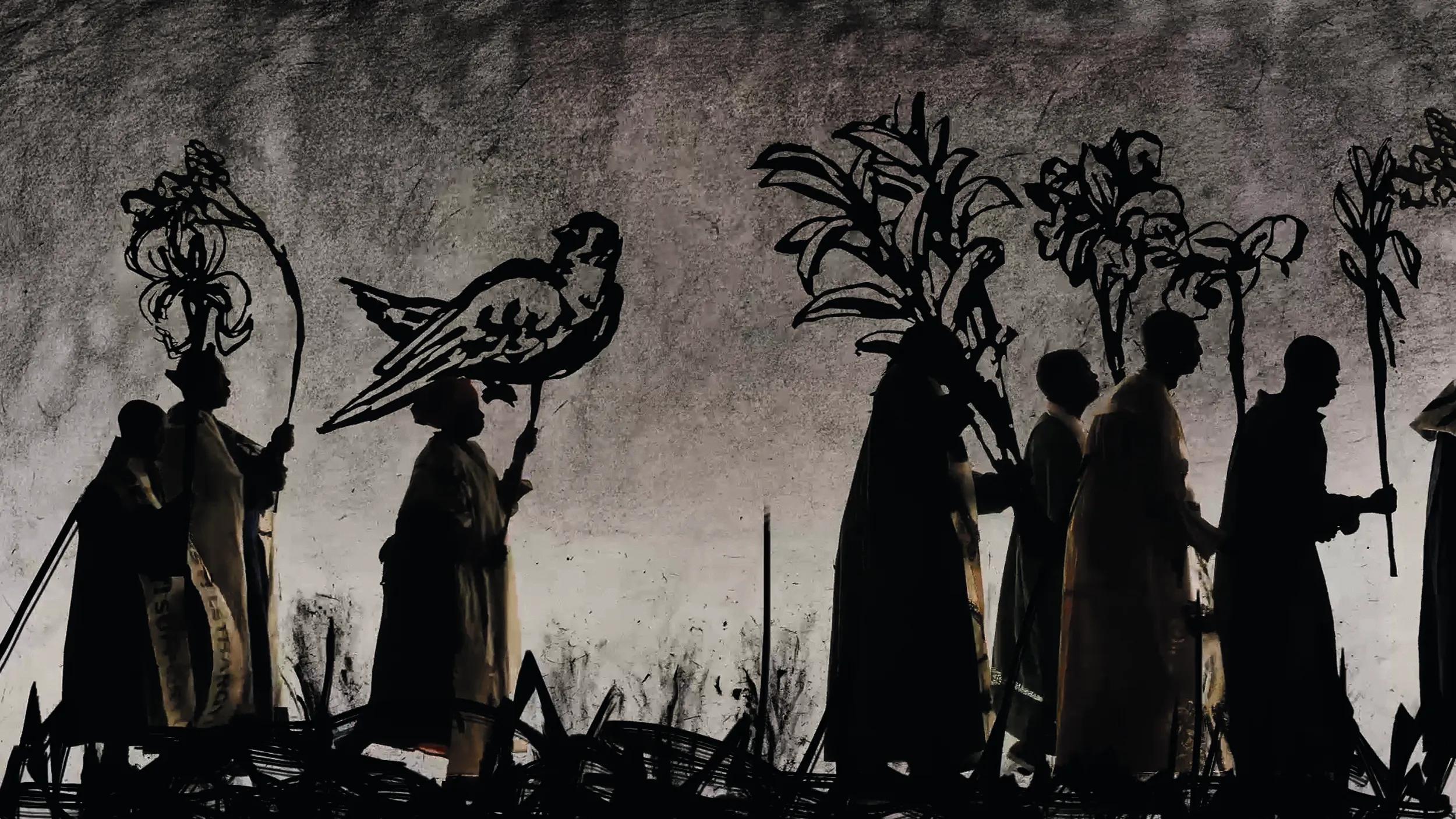
View of “William Kentridge, More Sweetly Play the Dance,” at EYE Filmmuseum, Amsterdam, 2015. Eight-channel video installation © William Kentridge
“After years in the studio making drawings, I finally say to myself, ‘Oh, in fact, I’m drawn to the absurd. I’m drawn to the Dadaist. I’m drawn to things that hover at the edge of meaning.’ Not to things that have no sense, but to riddles you can’t quite find an answer to, or language you can almost understand.”—William Kentridge
WK: In drawing, I’m much closer to the Karoo in the sense of the monochromatic and of the bright, harsh light and of the hard shadows than of the soft grays and greens of Ireland, for example. When I drive through the Karoo, part of me thinks, “Thank God I don’t live here. Thank God I’m not stuck here. Thank goodness I’m just passing through. I’ll be somewhere else soon where there’ll be shade, where there’ll be moisture.” I wonder if that’s a learned response. In my case, I think, “Is this because of a strange love of English vistas from children’s books, from images of the vicarage and the forest and the meadow and the stream?” Or is there something deeply in us that craves shadow, dappled light, not the harsh sun? You’re a kind of counterexample, I guess.
CT: Thinking about that landscape makes me want to ask you about the charcoal stick. Talk to me about having it in your hand and what it can do.
WK: One can work with a piece of charcoal the way one works with a pencil to write and have fairly good control of where the tip is. Or one can work with a piece of charcoal that’s more or less the size of this fountain pen box, too fat to really see what the end is doing, not square or pointed but a blunt stub. And one has to trust something between your arm and your fingers about the marks the stub makes. You can’t predict them completely, but nonetheless the charcoal will push an image into being that makes sense at the end. The real thing about charcoal is its changeability. More than any other medium I know, it’s possible to wipe and redraw and erase and draw again. If you’re working even with colored pastel, it’s a much more cumbersome process to completely change an image. You can make a charcoal drawing darker, starting with a mid-gray drawing and pushing it toward darkness, but you can also use an eraser or a cloth to pull out a lightness. I suppose my love of charcoal also has to do with my experience with color. It’s the same as—if you ask me to sing a tune, I’ll sing it, but it’ll be so out of tune you’ll struggle to recognize what it is. But if someone else is singing, I can hear very clearly when they are out of tune. In the same way, if I have to arrange colors on a palette myself and put them down, they’re all out of tune. They’re kind of just wrong. Yet I’m completely sensitive to watching other people’s colors and seeing them. So it was a big relief when I found a part of art-making in which it was legitimate to work monochromatically. And that started off through the history of printmaking, in which the foundational element of making a print is that it’s a black-and-white image. That follows of course into other essentially black-and-white mediums like photography, no longer now but certainly when I started out.
CT: In an interview once, you said there’s no doubt that the extraordinary political situation of South Africa gave you an early insight into instability, contradiction and paradox as a norm rather than an aberration at the edge of the world. How does that transpire in the studio?
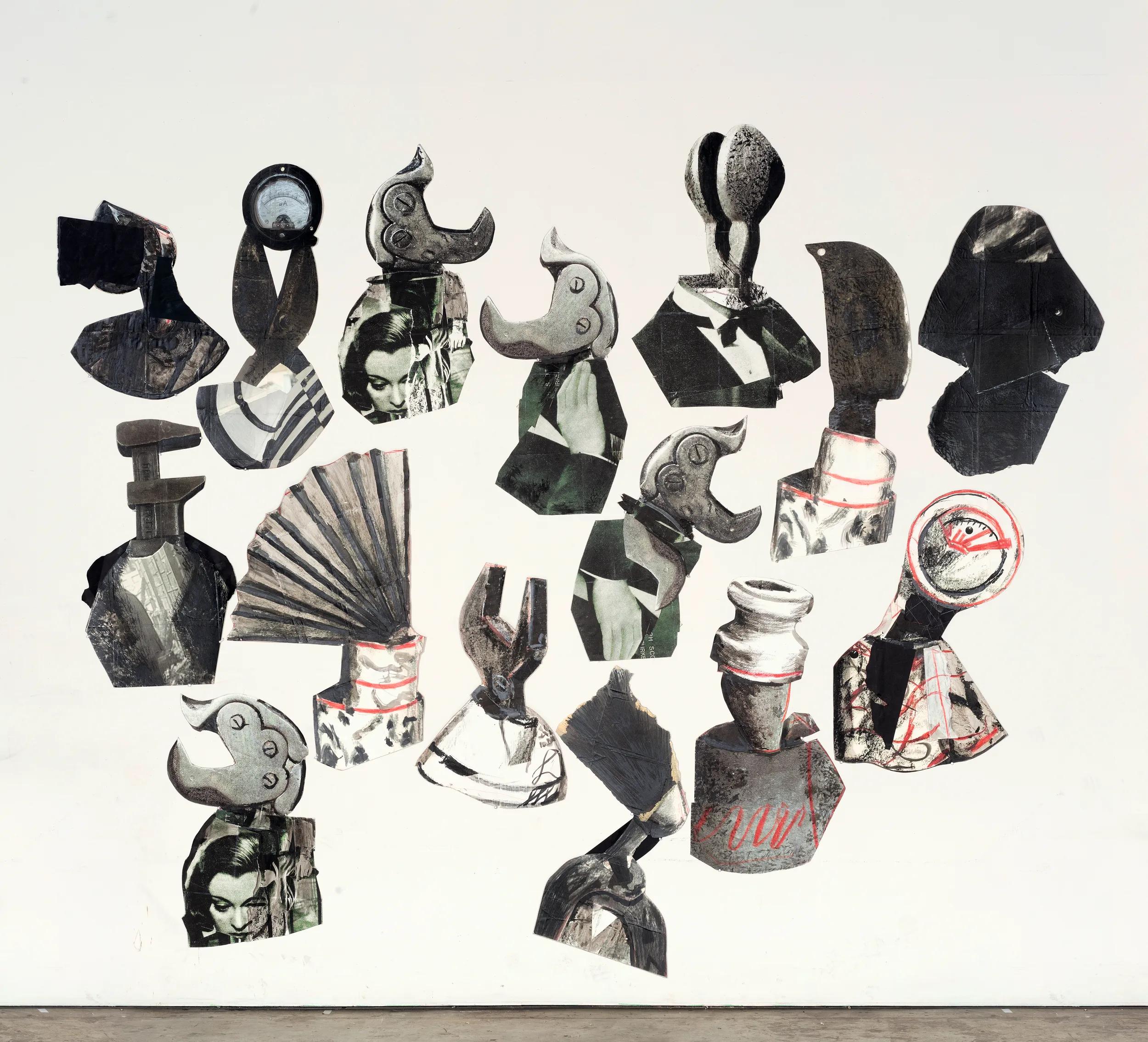
William Kentridge, masks for L’Orfeo, 2026. Digital print, Indian ink and collage on cardboard © William Kentridge
“The fundamental lesson of Orpheus, I suppose, is that death is death is death. That you think you’re going to trick it, but in the end, it will always catch you.”—Kentridge
WK: Well, it’s a bit of a backward thinking. After years in the studio making drawings, I finally say to myself, “Oh, in fact, I’m drawn to the absurd. I’m drawn to the Dadaist. I’m drawn to things that hover at the edge of meaning.” Not to things that have no sense, but to riddles you can’t quite find an answer to, or language you can almost understand. Through that I become very active in trying to complete a picture or an image or a phrase or an understanding. And from that, reflecting on that after the fact, saying to myself, “Oh, that does have an affinity with the circumstances of South Africa.” There are many things which you could describe as either the absurd or the paradoxical in the South African situation, in the clashes between different traditional ways of thinking and claims to modernity that people want to have. There’s a desire for the protection of a constitution and laws, but also a desire for the right to traditional views on witchcraft. If you’re accusing someone of witchcraft, are they held guilty under traditional beliefs or can they claim the protection of a constitution and legal system? There are circumstances in which there is no good solution, in which these different things occur at the same moment. It’s all based on a central absurdity. But absurdity doesn’t mean a joke. It means a logic that’s gone awry and that can be pursued with great assiduity and great cruelty, a logic of deciding who people should be based on their skin color or whether their hair is curly or not. In South Africa, your racial classification could be decided based on whether you could keep a pencil in your hair or not. It destroys people’s lives and erases people’s lives in different moments. In that sense, the category of the paradoxical feels essential. It feels like a kind of naturalism.
CT: I came across a wonderful quote from John Lennon where he said, “I am a cross between a monk and a performing flea.” I love the idea that there is in some of your drawings a sort of gravity, a sort of seriousness. And then looking at the projections, at those great processions of yours, you realize that you’re also a comedian and that absurdity or paradox interests you more than the flat business of the single mark with a single meaning. You interview yourself. You are a figure in the studio who’s alone and then doubled, talking to yourself, as well as a figure who’s elsewhere, collaborating in opera. So you play. There’s a very playful idea afoot.
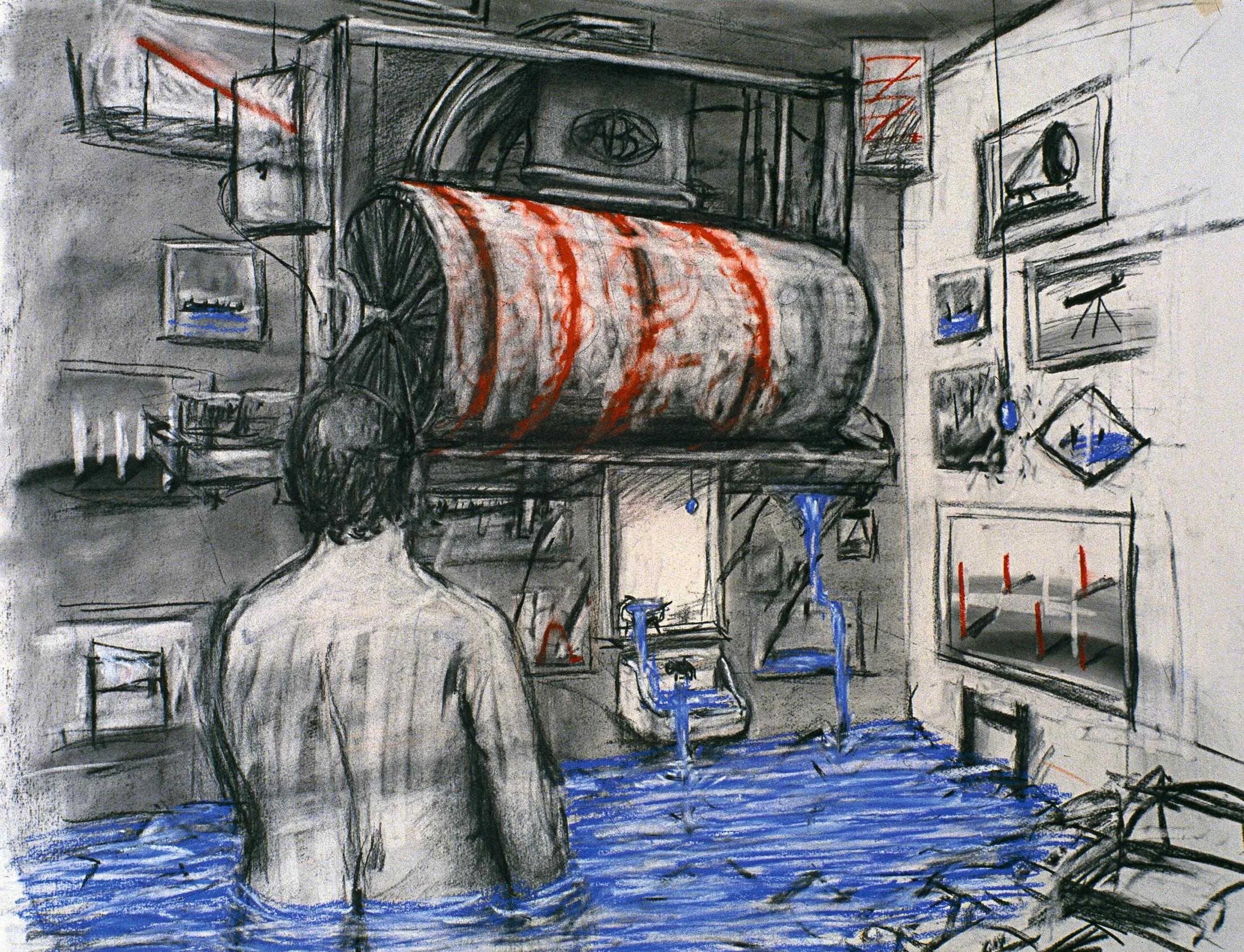
William Kentridge, drawing for Felix in Exile (Felix with Seismograph), 1994. Charcoal and pastel on paper, paper size: 80 × 121 cm © William Kentridge
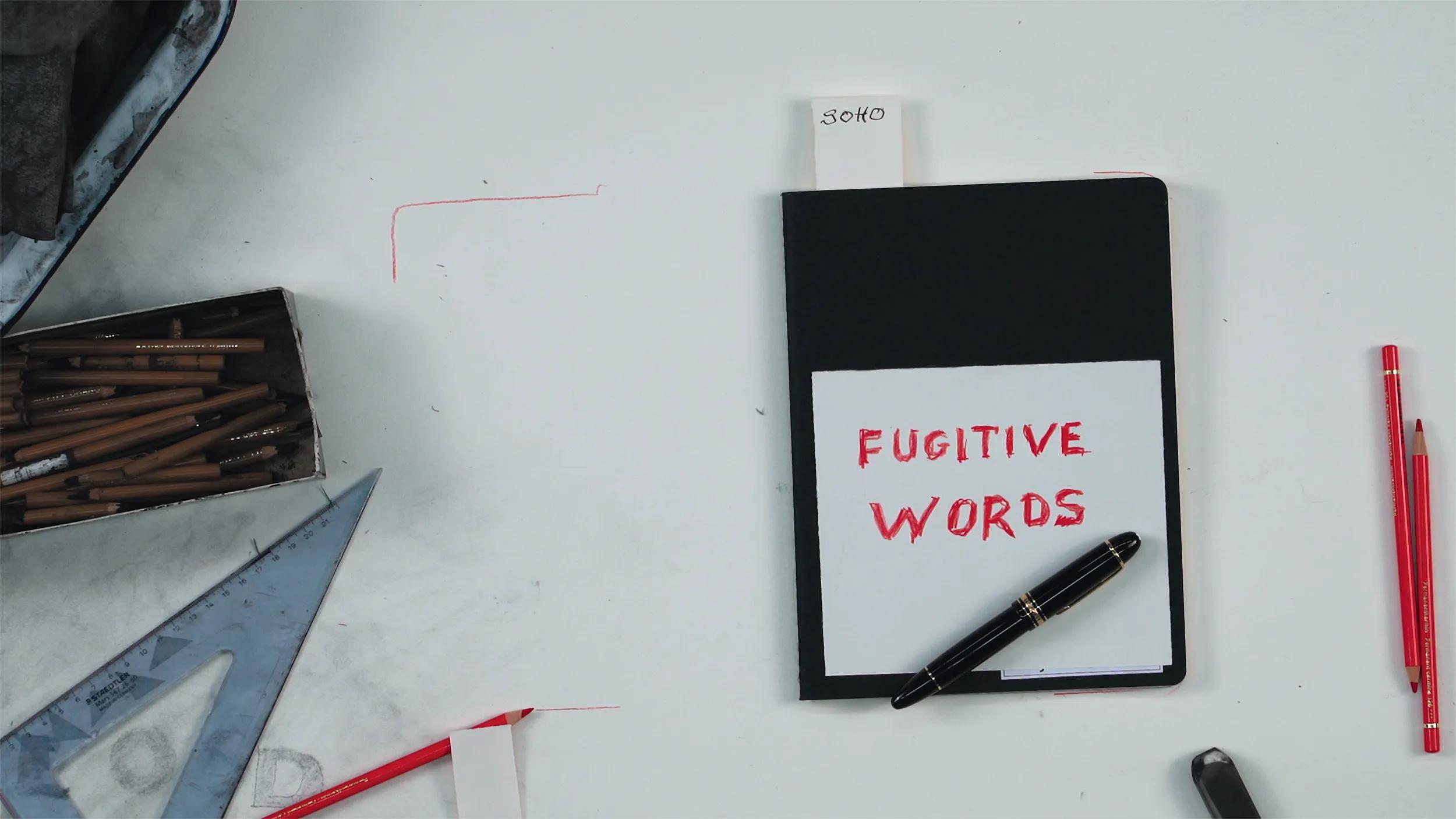
Still from William Kentridge, Fugitive Words, 2024 © William Kentridge
“I’m interested in that idea of aftermath, of not working directly with the atrocity or the history but with the strange, shadowy time that comes after, how this matters to people.”—Tóibín
WK: To give you a good idea of the paradoxical in how things work, we once needed some portraits of Stalin, who I wanted as a central image for The Nose, the Shostakovich opera. But I’m really bad at portraiture, really ham-handed at that. I did about three or four different quick ink drawings of someone who should be easily recognizable as the familiar face of Joseph Stalin and they were all generally wrong. Then what I did is I tore the drawings all up into four and started to rearrange them, taking the eye of one that seemed like the best left eye and another the best right eye, the mustache of one, a bit of another, and constructed a portrait that in the end looked much more like him than any of the individual drawings did. Sometimes it’s a blessing when something goes badly wrong, because then you’re not precious about it. You can take much more liberty with tearing it, with erasing whole sections. It’s trusting the image to show you something, rather than you knowing what you’re doing at the beginning.
CT: One of the things that I found in working in the theater or in opera is the simple matter that you get up in the morning and enter the workforce. You have to be somewhere at a particular time because others are going to be there, and if you’re late, you’re going to keep them waiting. At that moment when you’re tearing up drawings, are there other people in the room?
WK: If it’s a drawing, generally not. It doesn’t really help to have other people around if I’m drawing. As soon as anything else happens, as soon as music’s involved or I’m editing or making a sculpture, then I need everybody to come running. With drawing, as soon as an actual mark starts being made, even if it’s going at a right angle, there’s something in the physical action that prods something in the mind to start working. I wonder how it is when you’re writing. Do you need to have a first sentence in your head before you start writing in the morning? Do you need to have a phrase?
CT: There’s a really big difference between starting a book, where you have to wait and wait and try things that don’t work and just leave them and eventually something might come, and later, when you’re in it, in a story, and you can work.
WK I’m interested in the first part, in the prelude.
CT: You might sometimes be foolish enough to actually force it. If it’s going to come, it will come on its own, like breath. You’ve got to wait for it.
WK: But before you start a novel or story, are your characters already generally in place?
CT: Oh, yes. That’s all there.
WK: So you’ve been walking around and in a sense there’s been an image of the whole novel already shaping itself in you?
CT: Yes. And what you’re waiting for is rhythm. What you’re waiting for is the sound the thing makes.
WK: And you say to yourself, “I know how this person talks?”
CT: Yes. And it can be unexpected.
WK: The unexpected is so important. Let’s say I’m going to start an animated film and I have this image in my mind of a man walking in an empty city. He’s walking down a particular street. And I know the street and I spend time and I draw him and I animate him and you see the street. But then the street sets up other ideas of a building destroyed and an explosion and then that explosion starts going underground and what emerges is a memory of this man as his younger self, underground. And then, when the film is being edited, you say to yourself that there’s just one thing that feels superfluous. And the thing that’s superfluous may well be that very first image you started with.
CT: Oh, wow.
WK: It’s a bit like an umbilical cord rather than a heart. You need it for the whole thing to begin. But once the film is there, you don’t need it like you need the heart. I’m sure in writing you do that also?
CT: Yes. Often for me it’s an ending. You’re planning a conclusion and you realize it’s far too predetermined and has to be let loose. You never know until you know. It reminds me of some of the lines from your series Self-Portrait as a Coffee-Pot (2024). You’re talking about the studio as a cavern, a cave. “A space of transformation. A sound becomes a line. A line becomes a drawing. A drawing becomes a shadow. A shadow gains the heft of a paperweight. A movement becomes a word. A word becomes a color.” There is not a logic, but there’s a kind of logic of the studio, the romantic idea of the studio. I love the idea that the studio is a safe place for stupidity.
WK: There are so many things that are done inside the studio that if anybody were to get a glance inside they’d say, “Well, this is clearly a person who should be in some kind of institution! But I suppose we’ll humor him and let him go on.”
–
William Kentridge is internationally acclaimed for his artworks, theater and opera productions. He combines drawing and erasing, tearing, gestural painting, collage, weaving, casting, writing, film, performance, music, theater and collaborative practices to create works of art that are grounded in politics, science, literature and history.
Colm Tóibín is the author of eleven novels, including The Master, Brooklyn and its sequel Long Island, and three collections of stories. He has been three times shortlisted for the Booker Prize. In 2021, he was awarded the David Cohen Prize for Literature. Tóibín was appointed the Laureate for Irish Fiction 2022–2024.