
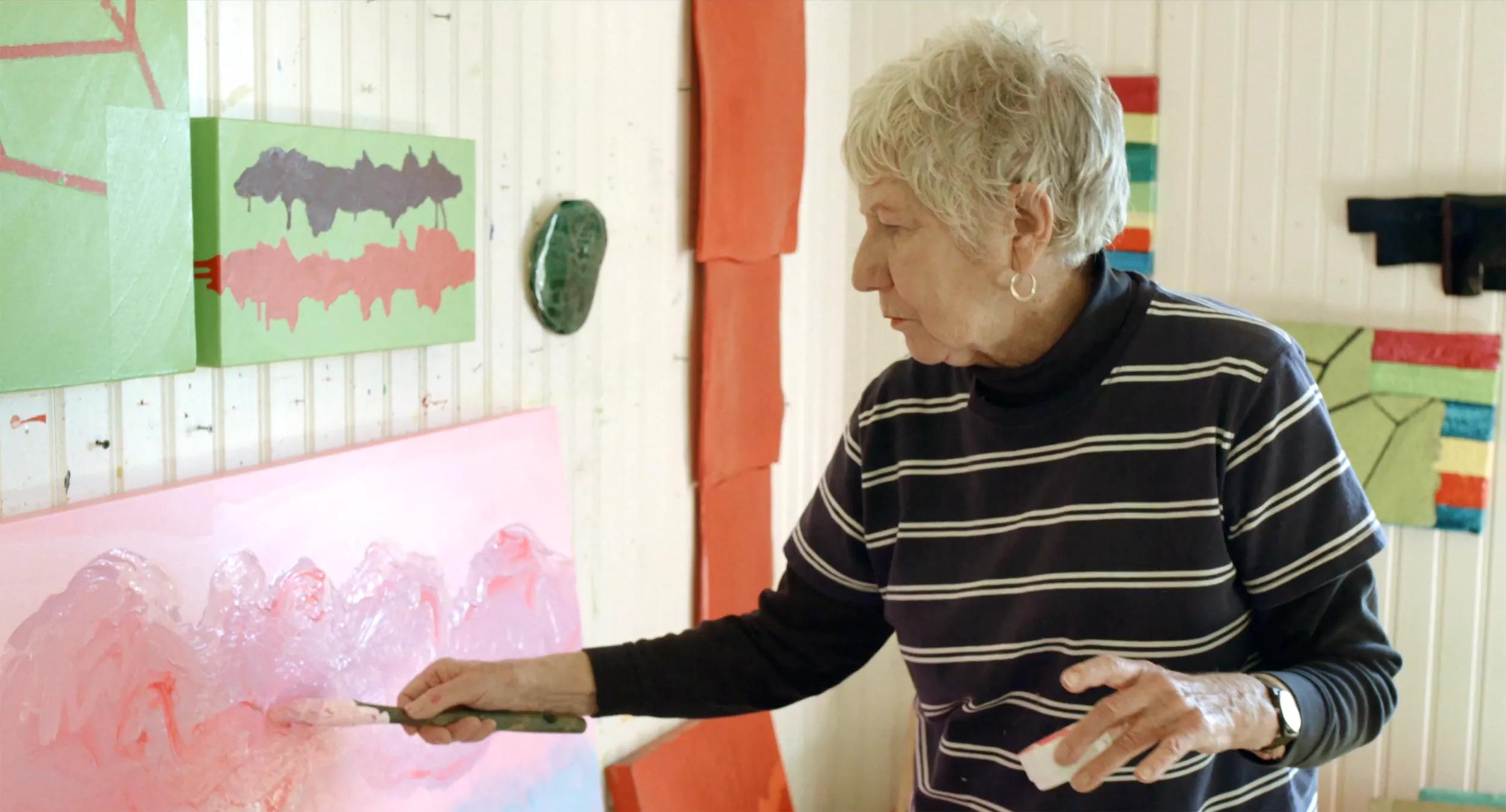
'Mary Heilmann: Waves, Roads & Hallucinations' (film still), 2024 Artwork Mary Heilmann. Courtesy the artist, Hauser & Wirth, and 303 Gallery, New York.
Screening Room: ‘Mary Heilmann: Waves, Roads & Hallucinations’
In honor of beloved artist Mary Heilmann please join us for a day of looping screenings of the documentary ‘Mary Heilmann: Waves, Roads & Hallucinations’ by Matt Creed in our amphitheater at Hauser & Wirth 18th Street.
Over six decades, Heilmann forged a singular position in contemporary art through a rigorous and pioneering approach to abstraction. Moving across painting, ceramics and sculpture, her sustained experimentation with color, form, surface and scale challenged artistic conventions and resulted in a formally and technically original body of work rooted in memory and lived experience. A much-loved artist, teacher, mentor and friend, she leaves an extraordinary legacy and an enduring influence upon generations of artists.
This documentary offers an intimate and vivid experience that followed Heilmann for seven years in her natural environments, from her studios in Bridgehampton and Tribeca to her installation at the Hamburger Bahnhof Museum in Berlin. Incorporating rare archival material, found footage, and original in-studio moments of Heilmann at work, the film creates an immersive odyssey into the mind and work of the legendary artist.
MARY HEILMANN: WAVES, ROADS & HALLUCINATIONS
Directed by Matt Creed
73 min
Saturday screening schedule (approximate):
10 AM – 11.13 AM
11.13 AM – 12.27 PM
12.27 PM – 1.41 PM
1.41 PM – 2.55 PM
2.55 PM – 4.09 PM
4.09 PM – 5.23 PM
All screenings are free, and the film will play on loop Saturday 19 September in the amphitheater at Hauser & Wirth 18th Street. No registration is required.
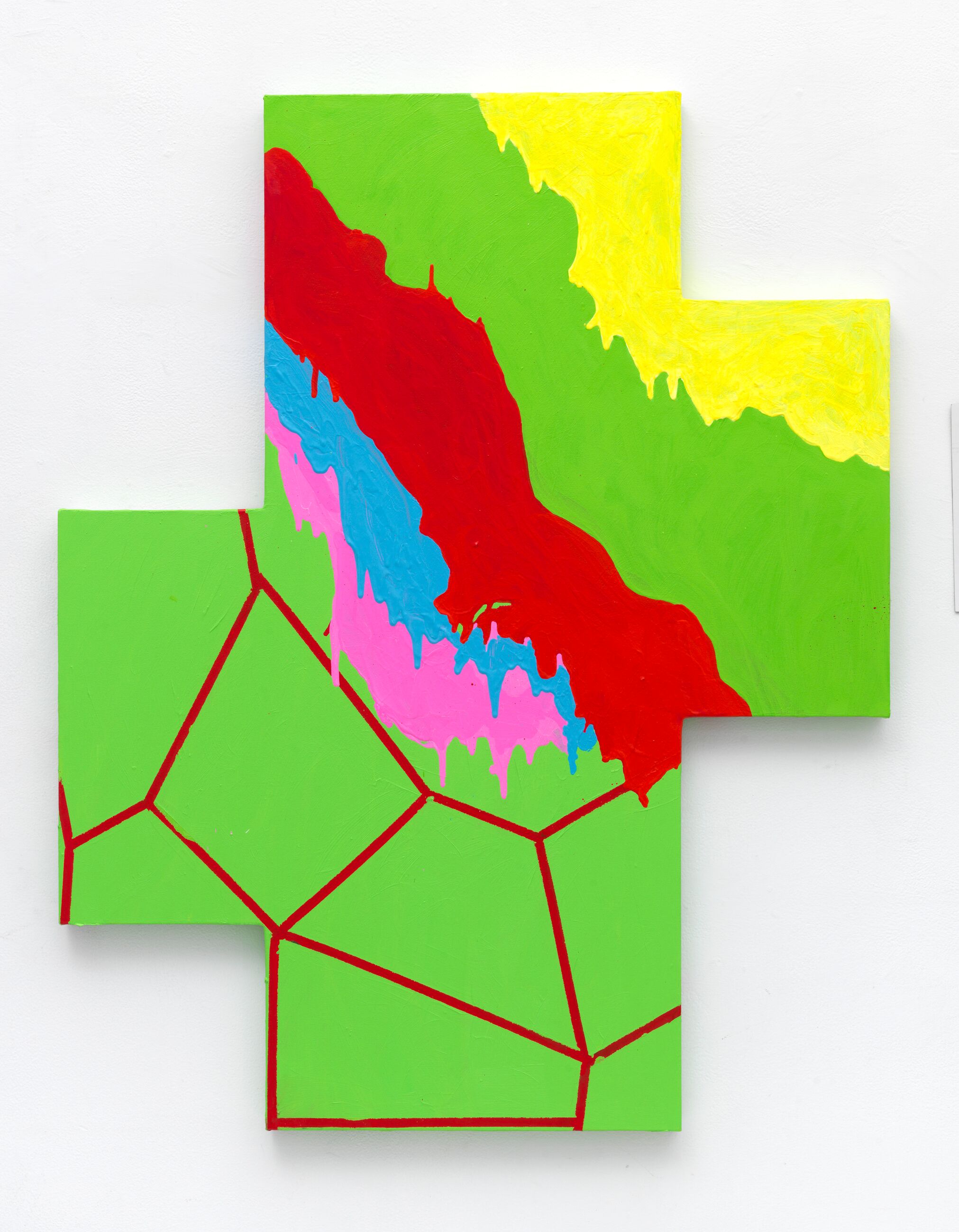
Positive-Negative, 2011, Oil on canvas, 127 x 102.235 cm / 50 x 40.24 in © Mary Heilmann. Collection of Bonnefanten Museum, Netherlands. Image courtesy of the artist, 303 Gallery, New York, and Hauser & Wirth. Photo: Thomas Müller
About Mary Heilmann
Influenced by 1960s counterculture, the free speech movement, and the surf ethos of her native California, Mary Heilmann ranks amongst the most influential abstract painters of her generation. Considered one of the preeminent contemporary Abstract painters, Heilmann’s practice overlays the analytical geometries of Minimalism with the spontaneous ethos of the Beat Generation, and are always distinguishable by their often unorthodox—always joyful—approach to color and form.
Raised in San Francisco and Los Angeles, Heilmann completed a degree in literature, before she studied ceramics at Berkeley. Only after moving to New York in 1968 did she begin to paint. While most artists at that time were experimenting with the concept of dematerialization and demanding that painting should avoid any references to experience outside the material presence of the work itself, Heilmann opted for painting, rebelling against the accepted rules. ‘Rather than following the decrees of modern, non-representational formalism, I started to understand that the essential decisions taken during the creative process were more and more related to content. The Modern movement was over…’
Since then, Heilmann has created compositions that evoke a variety of associations. Her work may be non-representational and based on an elementary, geometrical vocabulary—circles, squares, grids and stripes—but there is always something slightly eccentric, casual about them. The simplicity of the forms is played down by a deceptive form of nonchalance: the contours are not clearly defined. In some paintings, amorphous forms appear to melt into each other like liquid wax. Splashes of color can be discerned, sharp edges bleed for no apparent reason, and the ductus of the brushstrokes is always perceptible. Heilmann’s casual painting technique conceals a frequently complex structure that only gradually reveals itself to the viewer.


