

Essays
The Air Itself
A speculative inquiry into the friendship between Alexander Calder and Georgia O’Keeffe
By Alexis Lowry
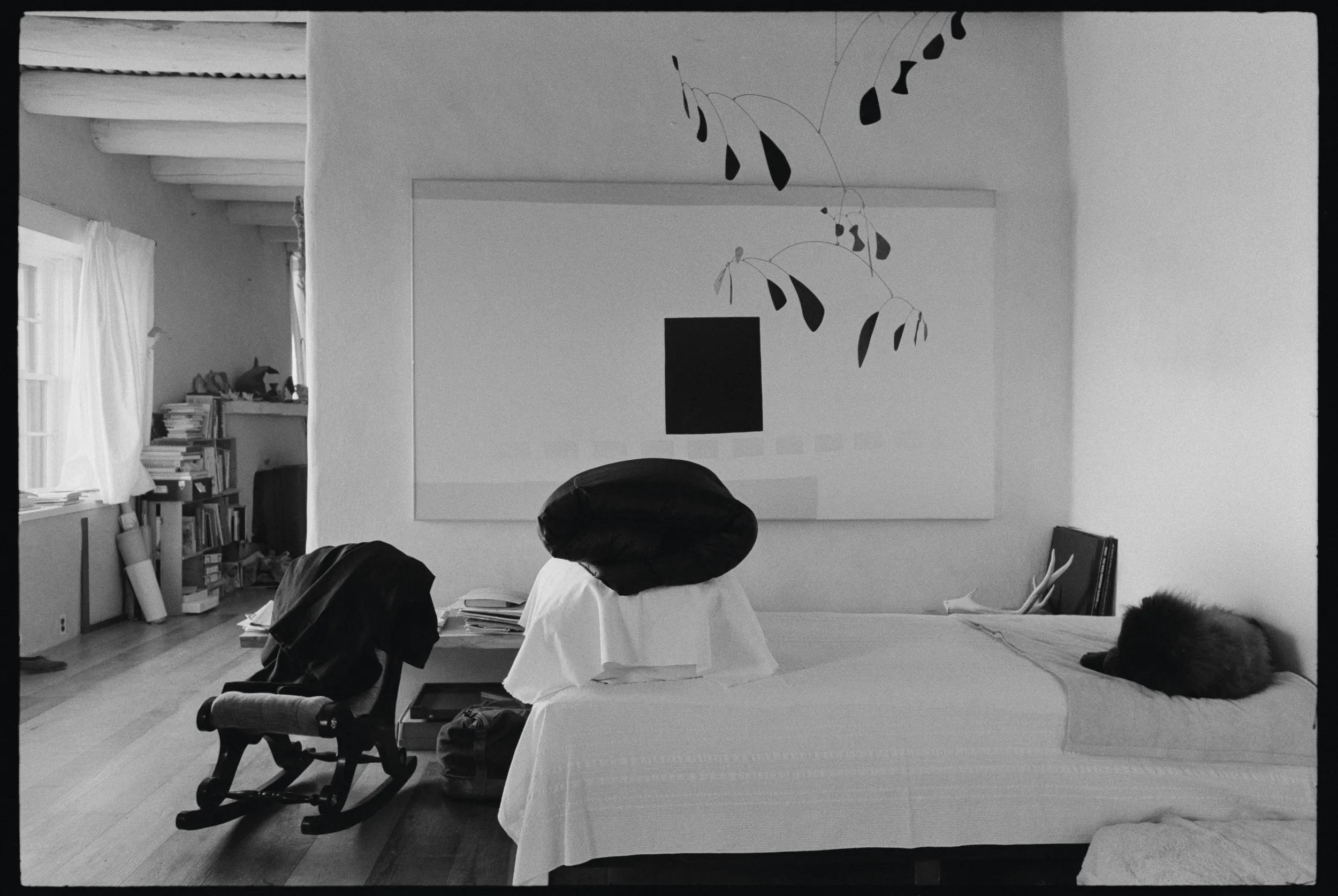
John Loengard, Bedroom, Ghost Ranch, 1967 © 2026 Calder Foundation, New York / Artists Rights Society (ARS), New York © 2026 Georgia O’Keeffe Museum / Artists Rights Society (ARS), New York. Photo: courtesy Loengard Photography LLC
Leafing through Wanda Corn’s catalogue for her revelatory 2017 Brooklyn Museum exhibition, “Georgia O’Keeffe: Living Modern”, you find a surprising photograph of O’Keeffe’s bedroom at her home in Ghost Ranch, New Mexico. The image was taken by John Loengard in 1967, and it shows a pile of pillows and dark blankets at one end of O’Keeffe’s neatly made bed. At the other end, one of her black chow chows lies sleeping. To the right is a packed bookcase and to the left, beside the bed, a pair of antlers on a chair. O’Keeffe’s My Last Door (1952–54) hangs behind the bed. The painting is an abstract rendering of the walled courtyard and front door of her Abiquiú house—a monochromatic expanse articulated by a dotted gray line and a central black rectangle. Above, the elements of a black mobile by Alexander Calder (1942) float on air currents.
On the facing page of Corn’s catalogue is another photograph documenting the living room of the Abiquiú home, taken by Myron Wood in 1980. Quintessentially O’Keeffe in its aesthetic calibration, the scene features neither the artist nor her work. Instead, compositionally, it recalls My Last Door, with a simple adobe wall punctuated by a black rectangle, this time in the form of a small fireplace. Inside the fireplace, kindling is vertically stacked into a sculptural mass. Next to it, a lush jade plant and an assortment of rocks and other objects are arranged on a mantel. And once again, the Calder mobile hangs overhead.
O’Keeffe, Corn argues, made no distinction between her painting and her personal life. Her mode of dress, her domestic surroundings and the places she chose to live were all part of “the amazing continuity” that defined her world. Likewise, Calder’s studio and home were deeply interconnected. Calder designed and built his own furniture, and other domestic objects. Moreover, the expansive landscapes of his surroundings in Roxbury, Connecticut (where he purchased a home in 1933) exerted a profound influence on his sculptural decision-making, inspiring him to create his first outdoor works. In her Abiquiú and Ghost Ranch homes O’Keeffe combined a minimal austerity with an emphasis on material warmth, qualities that also describe her work and the New Mexican landscape itself. She populated her sparse environments with rocks and bones that she picked up on walks (something Calder also did), objects that would become source material in the studio. Simple geometric furniture and a small selection of her own paintings filled out the rooms. A paper lantern by Isamu Noguchi hung over her bed in Abiquiú, but otherwise she rarely lived with other artists’ work.
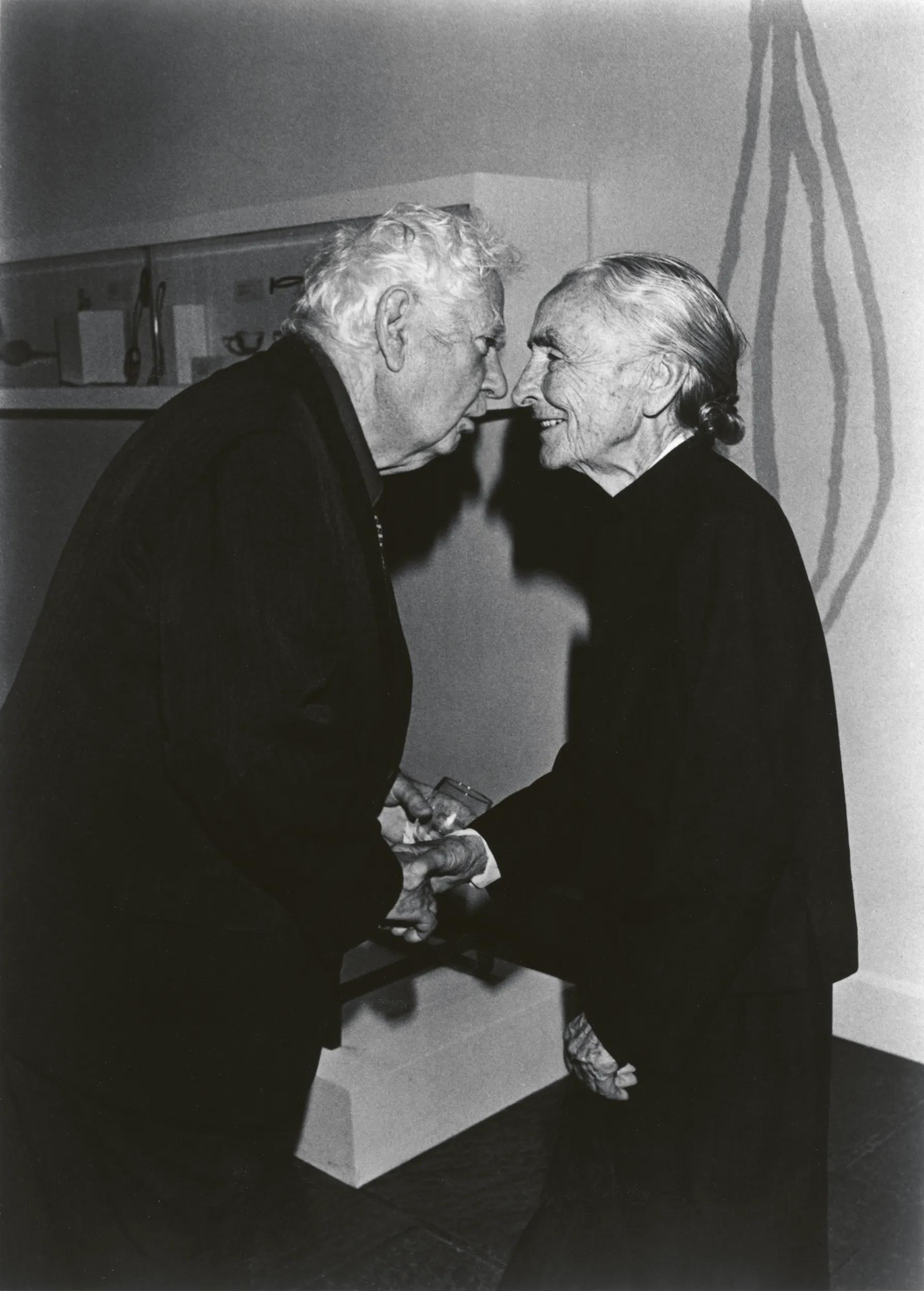
Calder and O’Keeffe at a dinner in Calder’s honor at the Whitney Museum of American Art, New York, 1976 © 2026 Calder Foundation, New York / Artists Rights Society (ARS), New York. Photo: Abner Symons © Women’s Wear Daily. Fairchild Archive via Getty Images. Courtesy Calder Foundation, New York
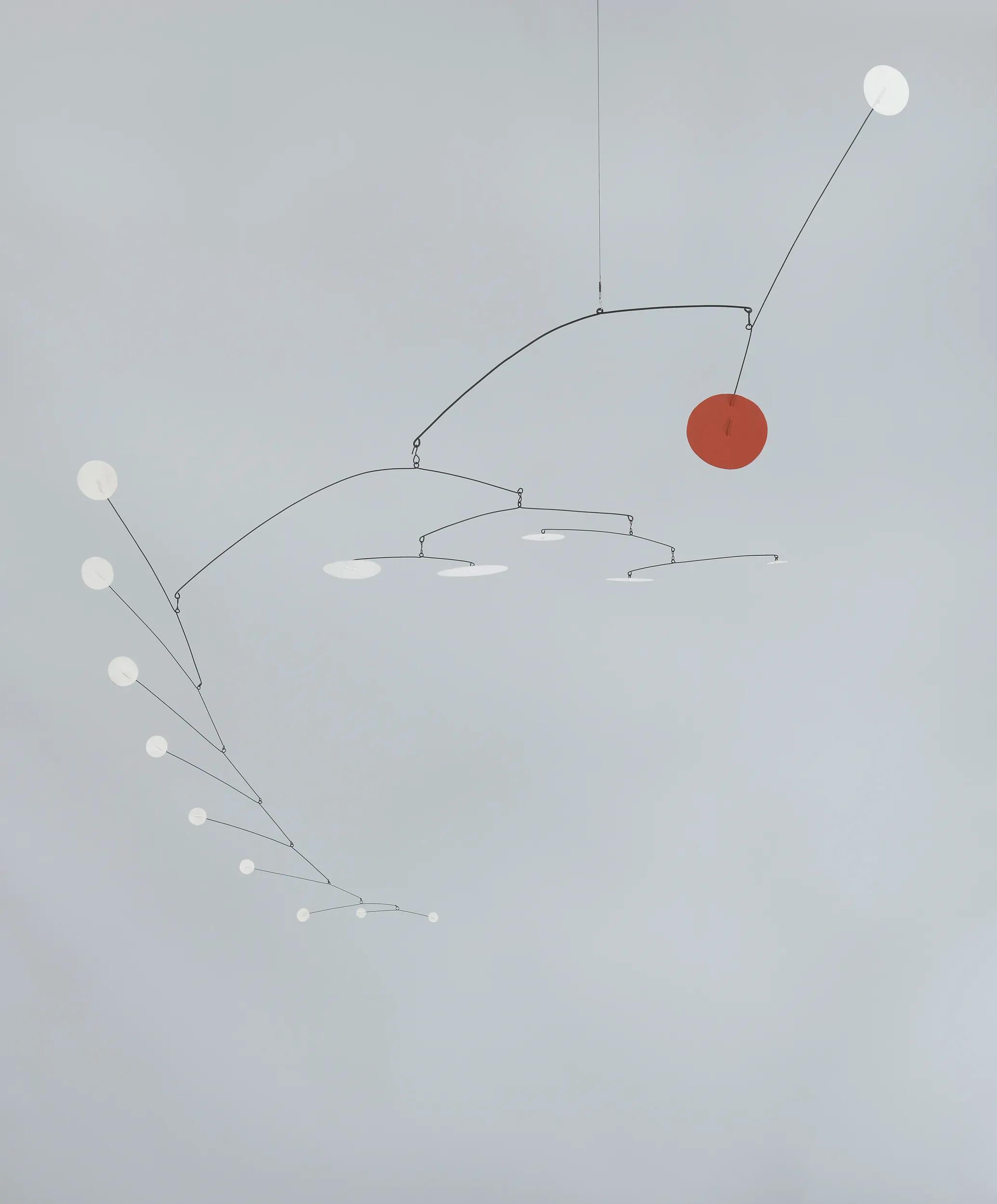
Alexander Calder, Untitled, 1969 © 2026 Calder Foundation, New York / Artists Rights Society (ARS), New York. Photo: courtesy of Calder Foundation, New York / Art Resource, New York
“Both artists, in distinct yet unexpectedly aligned ways, engaged with abstraction as a means of translating and conveying the embodied experience of the built and natural world.”
This is what makes the presence of the Calder mobile in these two photographs so striking. O’Keeffe not only chose to live with the work but at one point also placed it in direct dialogue with her own painting. She hung the mobile in one home, then reinstalled it in another. When she moved the mobile from Ghost Ranch to Abiquiú, she re-created the aesthetic dynamics of the Ghost Ranch bedroom in her Abiquiú living room, using the Calder as a centerpiece.
In fact, the mobile was not the only Calder work in O’Keeffe’s possession. She also owned a tin ashtray from Calder and a brass brooch that he gave her sometime in the late 1930s, formed wittily using the first two letters of her last name, “OK.” As we know from the many photographs of O’Keeffe wearing the spiraling object (and later a replica she had made in silver to match her gray hair), the brooch, like the mobile, was a focal point of her own self-fashioning.
Taken together, the presence of these objects in O’Keeffe’s life clearly indicates an exchange of some note, yet to this day astonishingly little is known about the friendship between these two titans of American modernism. As a starting point, we are able, at the very least, to map a provisional series of points of contact. The facts as they are known are outlined here.
The two artists ran in differing but overlapping circles. Calder’s cosmopolitan world included Marcel Duchamp, Hans Arp and other leading European luminaries. O’Keeffe was more closely associated with figures of American modernism such as Alfred Stieglitz, Arthur Dove and later Agnes Martin. According to O’Keeffe biographer Laurie Lisle, the two met through a mutual friend, the painter William Einstein, sometime between 1932 and 1938. Calder’s gift of the brooch occurred during this period. O’Keeffe visited several of Calder’s New York shows in the 1940s and wrote to Maria Chabot about them. O’Keeffe saw Calder’s 1943 retrospective at the Museum of Modern Art, which she described to Chabot as “amazingly ingenious.” C. S. Merrill recounts that O’Keeffe then asked art dealer Curt Valentin (with whom both she and Calder worked) if she could trade a Gaston Lachaise sculpture she owned for a Calder. Calder visited New Mexico once in 1948, though there is no record that he stopped at O’Keeffe’s. He sent her casual and familiar postcards in the 1960s and 1970s. And then there is a famous photograph of the two artists greeting each other at Calder’s 1976 Whitney retrospective. Nose to nose, they smile warmly at each other, and as The New York Times noted at the time, O’Keeffe exclaimed, “Oh Sandy, how are you? It seems like we’ve known each other forever!”
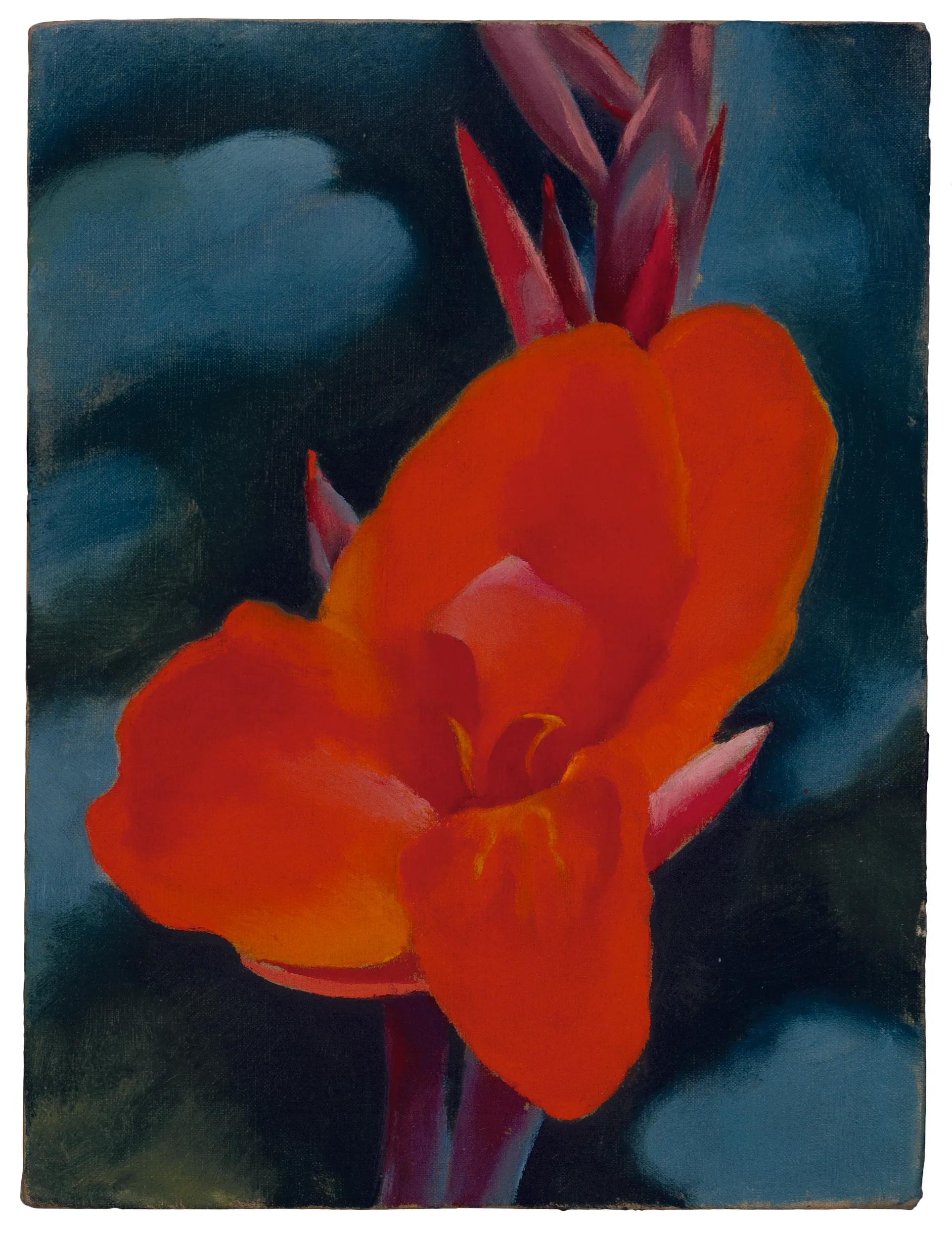
Georgia O’Keeffe, Red Canna, 1919 © 2026 Georgia O'Keeffe Museum / Artists Rights Society (ARS), New York. Photo: Georgia O’Keeffe Museum, Santa Fe / Art Resource, NY
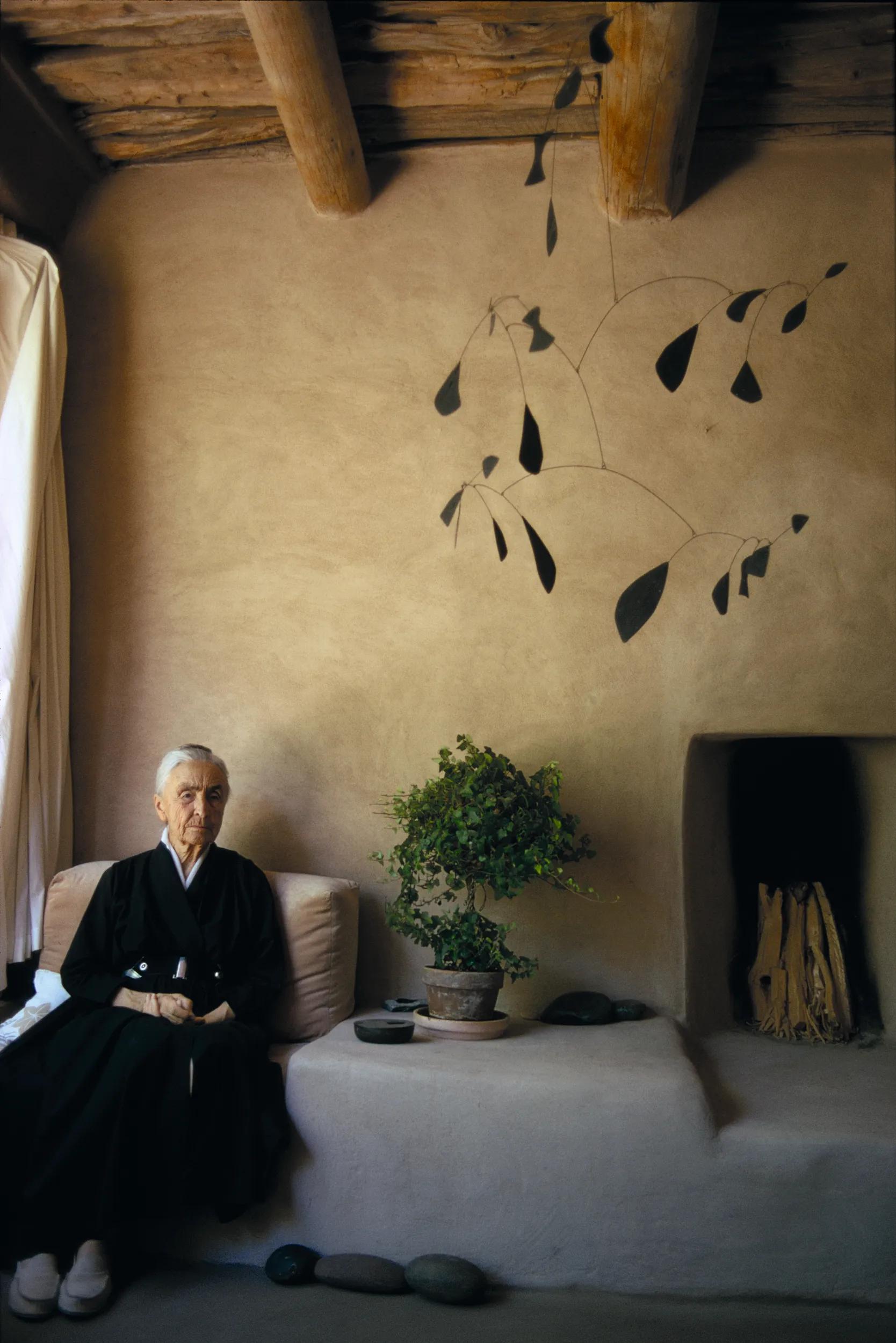
Georgia O’Keeffe at her home in Abiquiú, New Mexico in 1974, beneath Untitled (1942) by Alexander Calder ©️ 2026 Calder Foundation, New York / Artists Rights Society (ARS), New York. Photo: Christopher Springmann
“Calder’s kinetic forms and O’Keeffe’s paintings reveal a shared sensitivity to rhythm, interval and spatial poetics.”
Calder evidently admired O’Keeffe enough to make her the piece of jewelry (and possibly a second brooch)—something he did for those in his inner circle. And O’Keeffe clearly felt an affinity for Calder’s forms. With the documentary record still so fragmentary, however, we are left to flesh out the story primarily through their work. Already in 1936 they were being grouped together conceptually by figures like Alfred Barr at the Museum of Modern Art, who categorized them as “Artists independent of the Dada and Surrealist movements.” Both artists, in distinct yet unexpectedly aligned ways, engaged with abstraction as a means of translating and conveying the embodied experience of the built and natural world. O’Keeffe channeled the shifting skies and lithic hills of the Southwest into distilled, vibrating imagery, condensing landscape and organic form to essential structures charged with tactile sensation. Calder, by contrast, invited the invisible forces of the world—air currents, gravity, motion—directly into the creative process. His mobiles are activated by atmosphere itself, making movement a collaborator in shaping the work, while his jewelry responds to bodily motion and organic growth. Read in relation to one another, Calder’s kinetic forms and O’Keeffe’s paintings reveal a shared sensitivity to rhythm, interval and spatial poetics, suggesting that the affinity in the photographs on these pages extends outward into the very logic of their practices.
In the absence of more detail around their personal and artistic dialogue over the years, we are left to read possibilities into their work and their words. In a letter to Alfred Stieglitz, O’Keeffe once wrote: “I like the wind—it seems more like me than anything else—I like the way it blows things around—roughly—even meanly—then the next minute seems to love everything.” In 1955, on the occasion of an exhibition in Caracas, Calder emphasized once again the vital importance to him of movement in art—“spheres of different sizes, densities, colors and volumes, floating in space, surrounded by vivid clouds and tides, currents of air….”
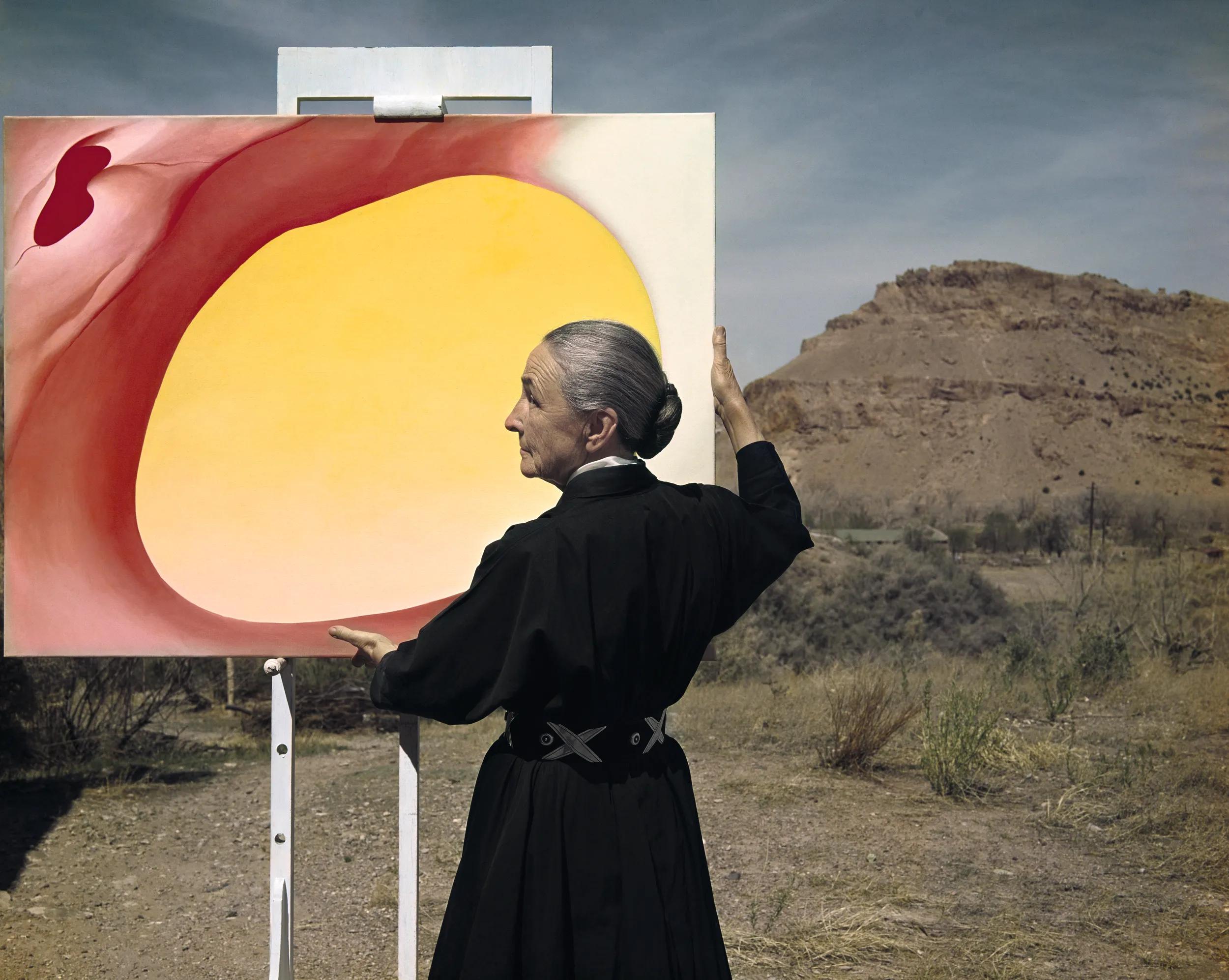
O’Keeffe with Pelvis Series, Red with Yellow (1945), Albuquerque, New Mexico, 1960 © 2026 Georgia O’Keeffe Museum / Artists Rights Society (ARS), New York. Photo: Tony Vaccaro / Getty Images
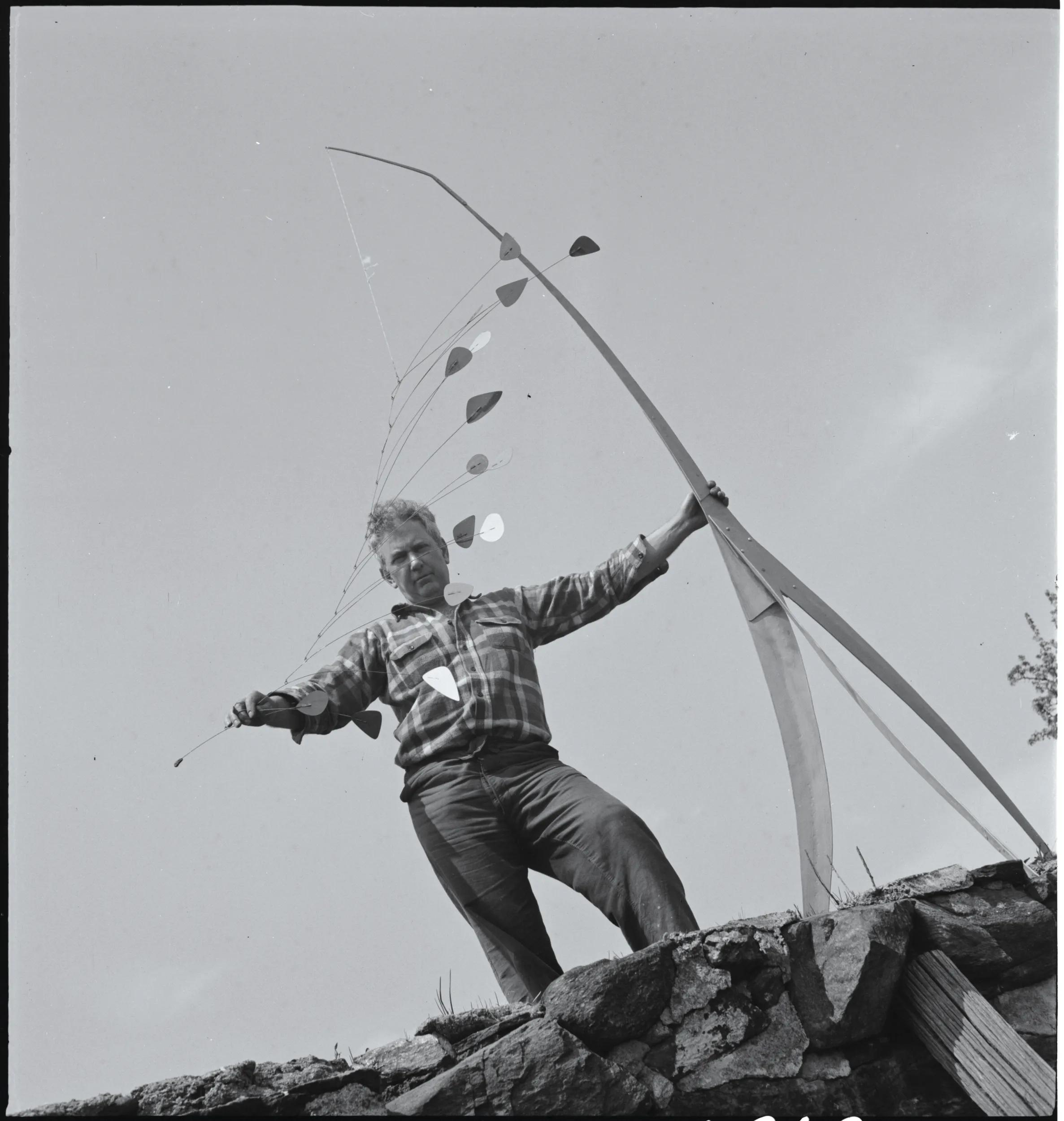
Calder with Giraffe (1941), Roxbury, Connecticut, 1941 © 2026 Calder Foundation, New York / Artists Rights Society (ARS), New York. Photo: Herbert Matter
–
Hauser & Wirth’s newest California location will open in downtown Palo Alto on October 3, 2026, inaugurated by the first ever exhibition devoted to the mutual admiration and artistic kinship between Alexander Calder and Georgia O’Keeffe. Developed in close collaboration with the Calder Foundation, "Calder | O'Keeffe" will bring together exceptional works by both artists, complemented by archival materials documenting their decades-long friendship.
–
Alexis Lowry is Curatorial Senior Director at Hauser & Wirth, where she develops and implements artist-driven programming and collaborations. She was previously a curator at Dia Art Foundation, where she oversaw commissions, exhibitions, public programs and the permanent collection. Lowry holds a PhD in art history from the Institute of Fine Arts, New York University.