
Conversation
Rare Specimens
Andrew Roth on the power of the book as object
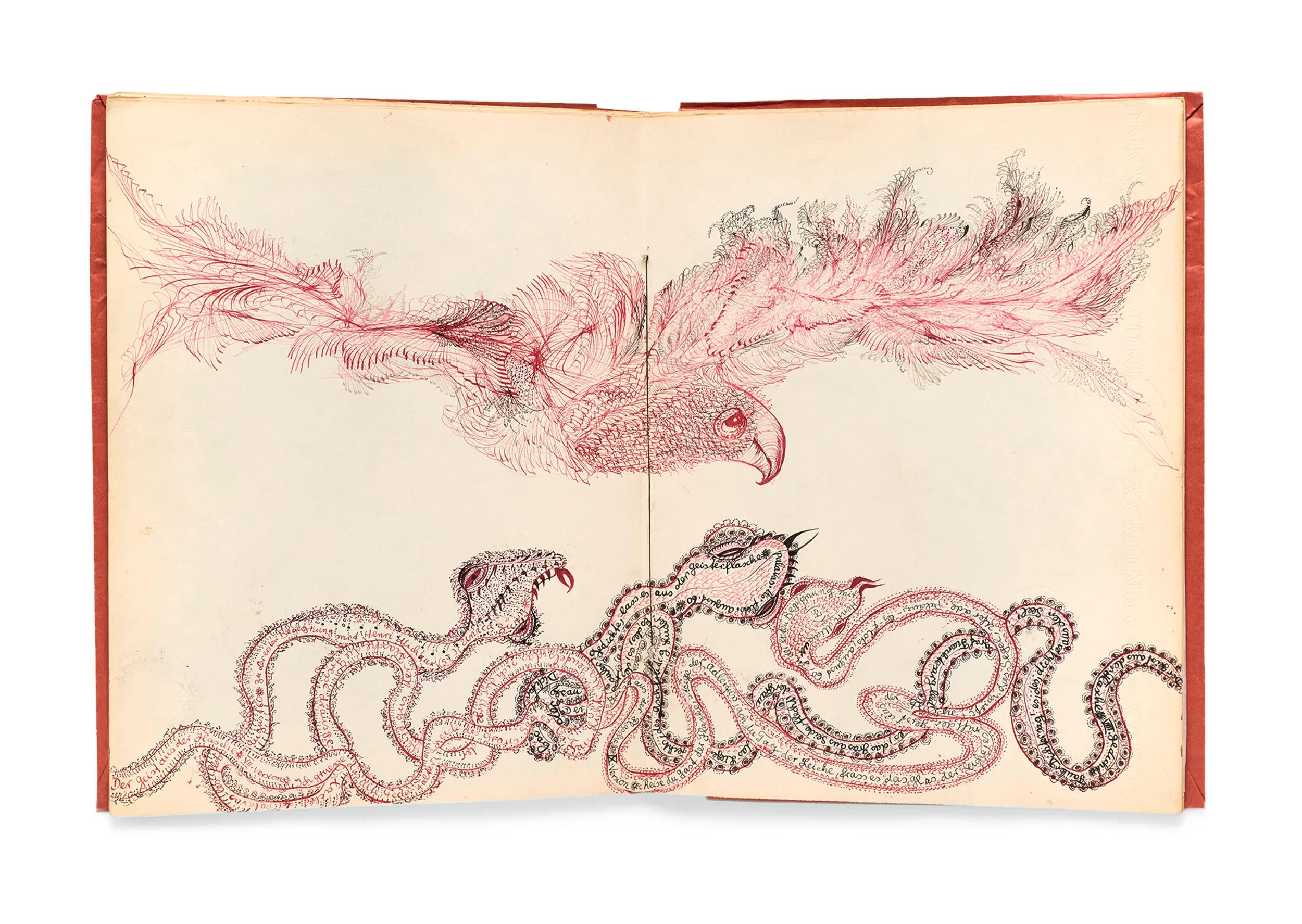
Unica Zürn, Orakel und Spektakel, IV. Buch: Anagramme und Zeichnungen (Oracle and Spectacle, Book IV: Anagrams and Drawings), 1960. Unique artist’s book, 12 13/16 × 9 13/16 in. The Museum of Modern Art, New York. Gift of Helen and Sam Zell. Photo: Ben Blackwell. ©️ Verlag Brinkmann & Bose, Berlin, Germany
The intimacy of objects made to be held is one reason that artists have been drawn to work with—and play with—the book. A connoisseur of the artist’s book and its history, Andrew Roth—erstwhile operator of an Upper East Side gallery and project space, editor of Artists Who Make Books (2017) and The Book of 101 Books (2001) and publisher of PPP Editions—has spent over twenty years applying his expertise, enthusiasm and familiarity with avant-garde book-making to building the Helen and Sam Zell Collection. A selection from its 200-plus volumes will be on public view for the first time this fall in “The Surrealist Book: Tomorrow Lives in Mirrors” at The Museum of Modern Art in New York. Here, Roth talks to Alexander Scrimgeour about his life and work.
Alexander Scrimgeour: I want to talk about your relationship to the book, because I know you as a book dealer, a book scout, someone who has built collections for people and someone who’s also published a lot.
Andrew Roth: Let’s go with “book curator.”
AS: How did you get started in the world of books?
AR: There used to be a bookstore in SoHo, New York, called A Photographer’s Place, which was owned by a curmudgeon of a man named Harvey Zucker. One day I just decided to go in and insist he hire me to work in the store, and in fact he did, on the spot. What was interesting about that job was that Zucker kept a pretty serious inventory of out-of-print books. Every time he would sell one, he would mark the date it sold and what it sold for on an index card. And then the next time he got one in, he would up the price, but only slightly. These increases seemed silly to me. I’d say to Harvey, “These are too cheap. You’re not marketing these properly.” I really worked to create and to promote photographic books as collectibles, and I added a monetary value to them because I saw that as a way to build a market. During this period, the early 1990s, I would also go to the rare book room at the Strand on my own time. I built up a group of private collectors, and at a certain point I realized I could leave Zucker to focus on my work with them. One of the clients I made at the time was curator and writer Neville Wakefi eld and his then wife, Camilla Nickerson, the fashion editor and stylist. I would bring bags of books to sell to them in their loft. In fact, a few years later Camilla introduced me to Karl Lagerfeld, whom I worked with for many years.
AS: You later went back to bookstores, eventually running your own. How did that come about?
AR: At A Photographer’s Place, I met Adam Boxer. He owned Ubu Gallery on the Upper East Side. He had an incredible Filofax; he knew everyone in the art world. He connected me with his friend Glenn Horowitz. I had already been buying books from him, so he knew I was a dealer. Glenn kind of seduced me. He said, “Look, I want you to move to East Hampton and manage the bookstore I have out there.” I told him I had no desire to move to the Hamptons. And he said, “Well, okay, then you keep your place in New York. I’ll set you up in East Hampton. You go there for the weekends.” So I decided to do it and I really developed my skills as a rare-book dealer working in that store and building a client base in the city with collectors I met out there. At that time, no one compared with Glenn as a rare-book dealer—he was the best in the field. One of the things I learned from him was “marrying” a collector, meaning making repeat visits to one collector and working on building a collection for them—as opposed to just buying books and trying to find someone to sell them to. Glenn understood how critical condition was, and the added value of an important inscription or association, and also provenance. It was in East Hampton that I met the great artist’s book collector Philip Aarons, with whom I still work. After four years in East Hampton, I wanted to open a space in New York. Glenn was close to Elaine Lustig Cohen, who owned Ex Libris and was one of the great rare-book dealers in New York. All the important avant-garde material from Europe came to the States through Elaine and her husband, Arthur Cohen. She offered us the space on the ground floor of her brownstone on East 70th Street. We took about six months to renovate it and then opened our space, Roth Horowitz, in 1999, which eventually became ROTH in 2005. Having Elaine living upstairs in the building was like having my own Wikipedia, because she knew so much of the material.
AS: And you started doing exhibitions there too, right?
AR: I treated it as an intimate project space where I could show art and photography, rare books, film and performance. I basically just did what I wanted to do. For the first exhibit, I paired Ed Ruscha’s vintage photographs from his artist’s books, which had never been exhibited before, with a beautiful series that photographer Robert Adams made in 1968 called Eden. I had the idea and I thought, “I’m just going to call Ruscha and ask him if I can meet him.” And he agreed. So early in 1998, I went out to L.A. and had lunch with him at his favorite Chinese restaurant. He loved the idea of the paired exhibition. I then drove from L.A. up the coast to Oregon to meet Adams, who, when I mentioned Eden, pulled out a box with the vintage, master set of seventeen photographs, and I said, “I want to buy these.” So the show came together.
AS: By exhibiting these different works together, you were also creating a different form of value for the books.
AR: Exactly. When I met Ruscha, he gave me, to sell, a perfectly pristine first-edition complete set of his artist’s books and signed them all. It was the first time anyone exhibited the full set of his artist’s books along with the original photographs. The price I put on the complete run of the books may have been high at the time, but it also created a market that hadn’t existed before. So I take a bit of credit for making that market, not only for his books, but for photographic books and artist’s books more generally. That exhibition also began my publishing program, as I printed a limited edition book to scale, of the suite of photographs from Eden.
AS: To move closer to the present, one of the collections you’ve built was recently acquired by MoMA in New York and will be exhibited there this fall.
AR: True. The Helen and Sam Zell Collection is the most complex collection I’ve worked on. Helen and I have collaborated together for over twenty years. The first book I sold them was when Sam wanted to give Helen a rare book for her birthday. It was a wonderful early Surrealist gem, Mr. Knife, Miss Fork (1931), a collaboration between René Crevel and Max Ernst. That was the start of a long and fruitful relationship, which is ongoing. The core of the collection is unique Surrealist artist’s books, but it also integrates works by later artists—William Burroughs, Hans-Peter Feldmann, Dieter Roth, Isa Genzken—who saw the book as object the way the Surrealists did. Whenever we acquired something, we were always looking at the whole, really the big picture. For me, book dealing is about learning, essentially. In order to sell a rare specimen, you have to fully understand its importance, its historical and aesthetic value. And you have to be seduced by it; ultimately, you have to love it.
AS: Is it sometimes chance that brings something your way? Or is it more that you —
AR: Sometimes it’s serendipity. Sometimes I’ve hunted something down. But I think what’s most unique about this collection is that it’s not me imposing my taste on the collector. It’s really figuring out who they are, what they’re about, what most intrigues them, why they’re doing this. And what’s fortunate about my relationship with Helen is that we really are in sync. Not only do I get what she likes and what she’s about, but I really met my match. Yeah. And I would say essentially that it is about the book as object: Before you open the thing up, it’s got to hold its own, as a physical object that has a fetishistic quality about it. That appeals to both of us. And that’s where we begin.
-
“The Surrealist Book: Tomorrow Lives in Mirrors” opens at The Museum of Modern Art, New York , on October 4, 2026 , and remains on view through January 23, 2027 .
–
Andrew Roth is a private, rare-book dealer and publisher of PPP Editions, based in New York. He owned Roth gallery on the Upper East Side from 1999 to 2014. He publishes scholarly reference books on the history of artist’s books and photography books and collaborates with contemporary artists to create limited edition artist’s books.
Alexander Scrimgeour is an editor for Hauser & Wirth Publishers in Zurich. He has previously worked for Artforum in New York, Spike Art Magazine in Berlin and independently as a freelance book and magazine editor and writer specializing in contemporary art.