
Essays
Art for Everyday Life
A look inside the art commissions for Chicago’s newly opened Obama Presidential Center
By Annette LePique
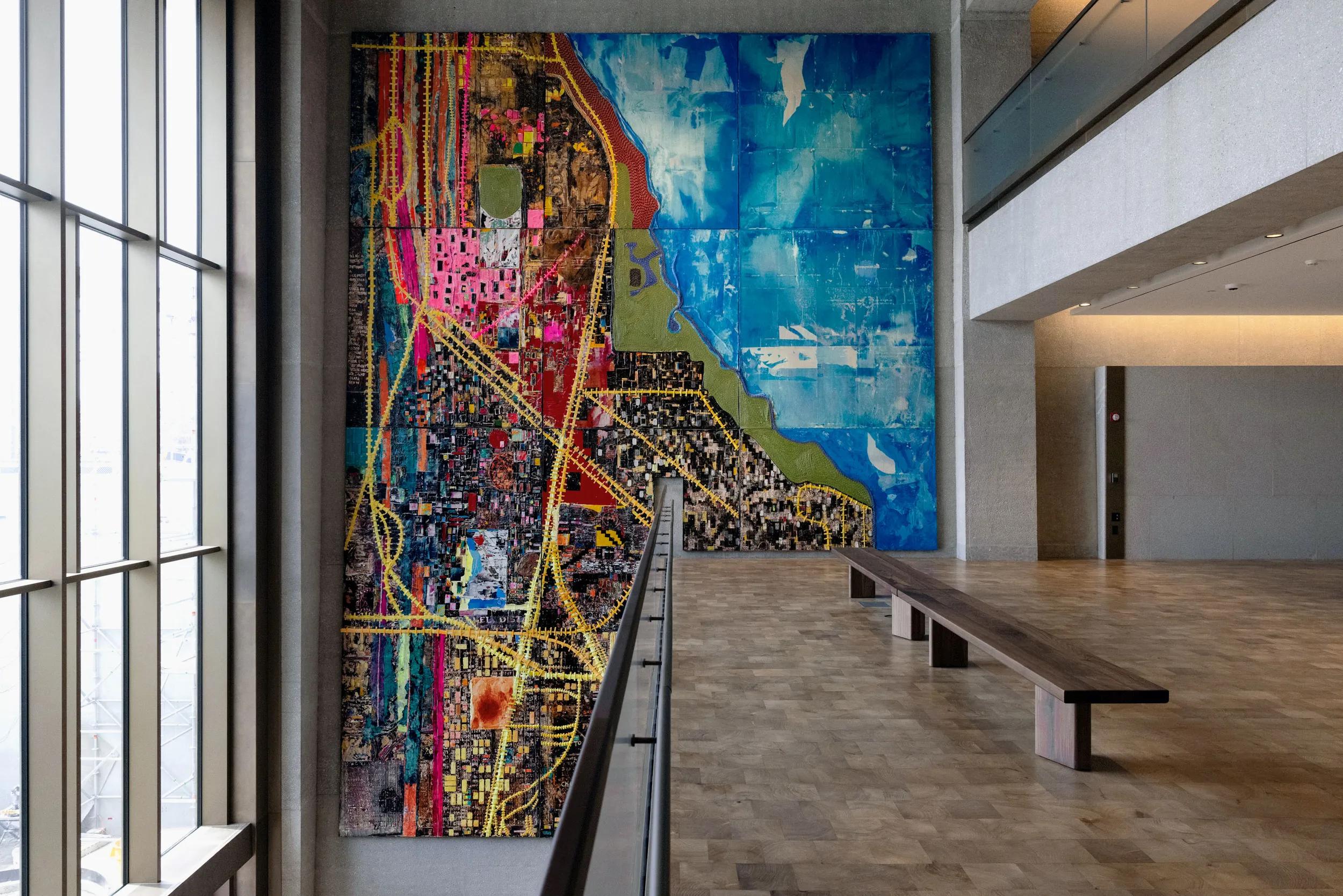
Mark Bradford, City of the Big Shoulders, 2026 © Mark Bradford. Photos courtesy the Obama Foundation except where noted.
I arrived at the Obama Presidential Center the morning of Juneteenth, the center’s first day open to the public. The nineteen-plus-acre campus in Chicago’s Jackson Park, on the city’s South Side, was humming with excitement. Lines of people waiting to enter the center’s museum and public forum building stretched several blocks, yet everyone appeared to be in good spirits, with strangers wishing one another a happy holiday. In the center’s John Lewis Plaza, the South Shore Drill Team performed to a massive crowd, and children shrieked upon discovering the playground.
The center is, to put it mildly, immense. That same immensity lends itself to a feeling that the new institution has created something in Chicago with a footprint even larger than the life of a history-making American president, a site in which diverse communities and neighborhoods can flourish. One example of this civic largesse: the center’s Worker Appreciation Wall, located on the lower level of the forum. Over thirty feet long and six feet high, the wall contains the names of some 4,500 people who helped (and continue to help) plan, build and bring the center to life. The wall is an apt metaphor not just for the overall feeling of inclusion being fostered in Jackson Park but also for how the public artworks that are spread throughout the center function together to create a distinctly Chicago example of public art’s possibilities.
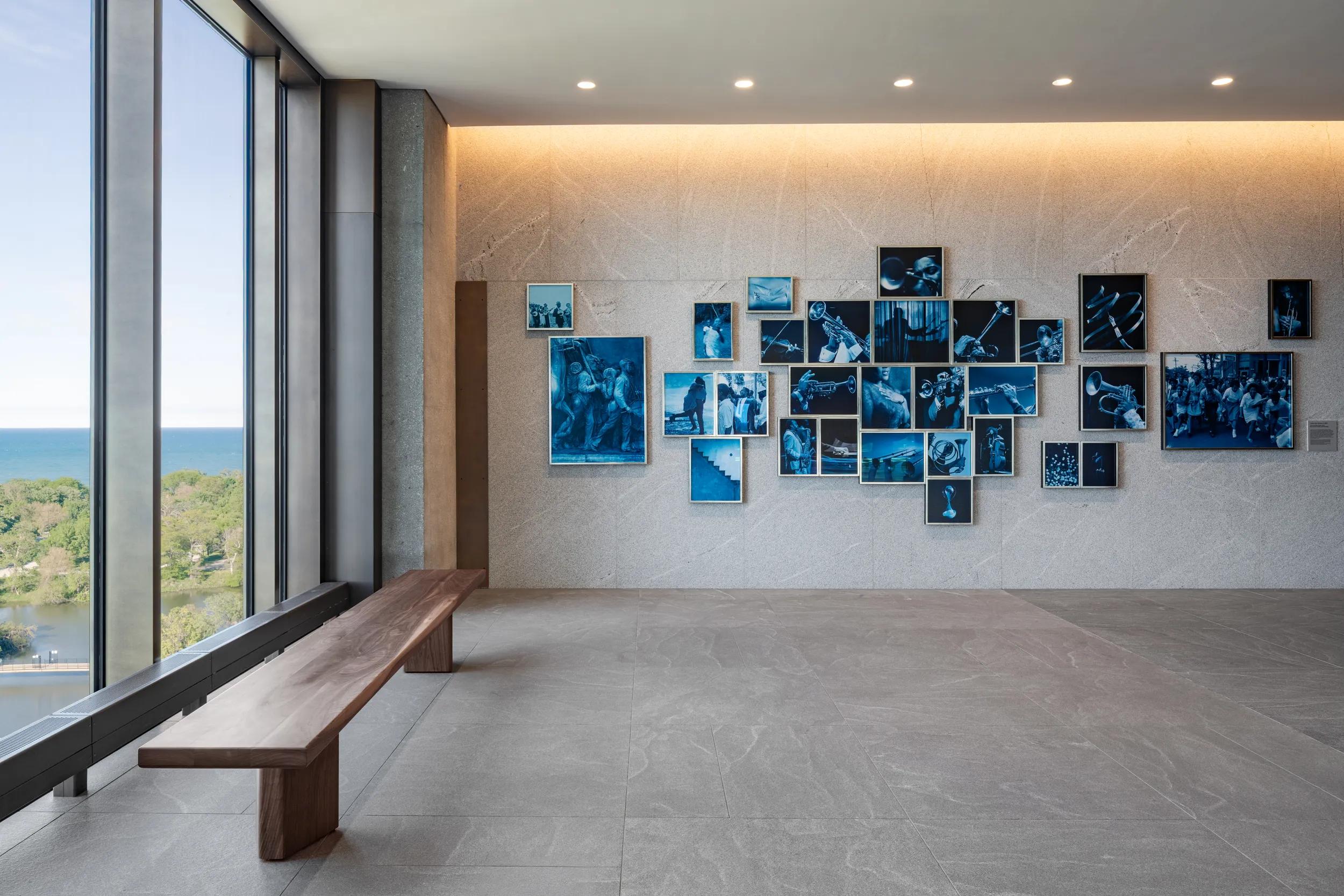
Carrie Mae Weems, The Cool Blue Wind, 2026, installed in the Museum’s Sky Room Vista.
The center’s collection features twenty-eight artworks by thirty artists, among them many highly recognizable names: Mark Bradford, Jeffrey Gibson, Jenny Holzer, Rashid Johnson, Julie Mehretu, Martin Puryear, Lorna Simpson, Kiki Smith and Carrie Mae Weems. Virginia Shore—the center’s curator of commissions, who served during the Obama administration as chief curator for the State Department’s Office of Art in Embassies—says she took the center’s commitment to placemaking and community-building on the city’s South Side deeply to heart. “All of the art commissions amplify the center’s mission by reinforcing a core belief that ordinary people, working together, can create meaningful change,” Shore told me recently. She also proposed and oversaw the two collaborative works in the collection: Sam Kirk and Dorian Sylvain’s Pass It Forward and Nick Cave and Marie Watt’s This Land, Shared Sky.
Given the sheer size of the campus and the logistical challenge of organizing and displaying works, Shore said she contemplated how “art would function across different contexts: indoors and outdoors, in moments of gathering and in spaces of quiet reflection. The integration of a playground, fruit and vegetable gardens, athletic center, teaching kitchen, auditorium, recording studios and even a branch of Chicago’s public library also reinforced the idea that art should be encountered as part of everyday life.”
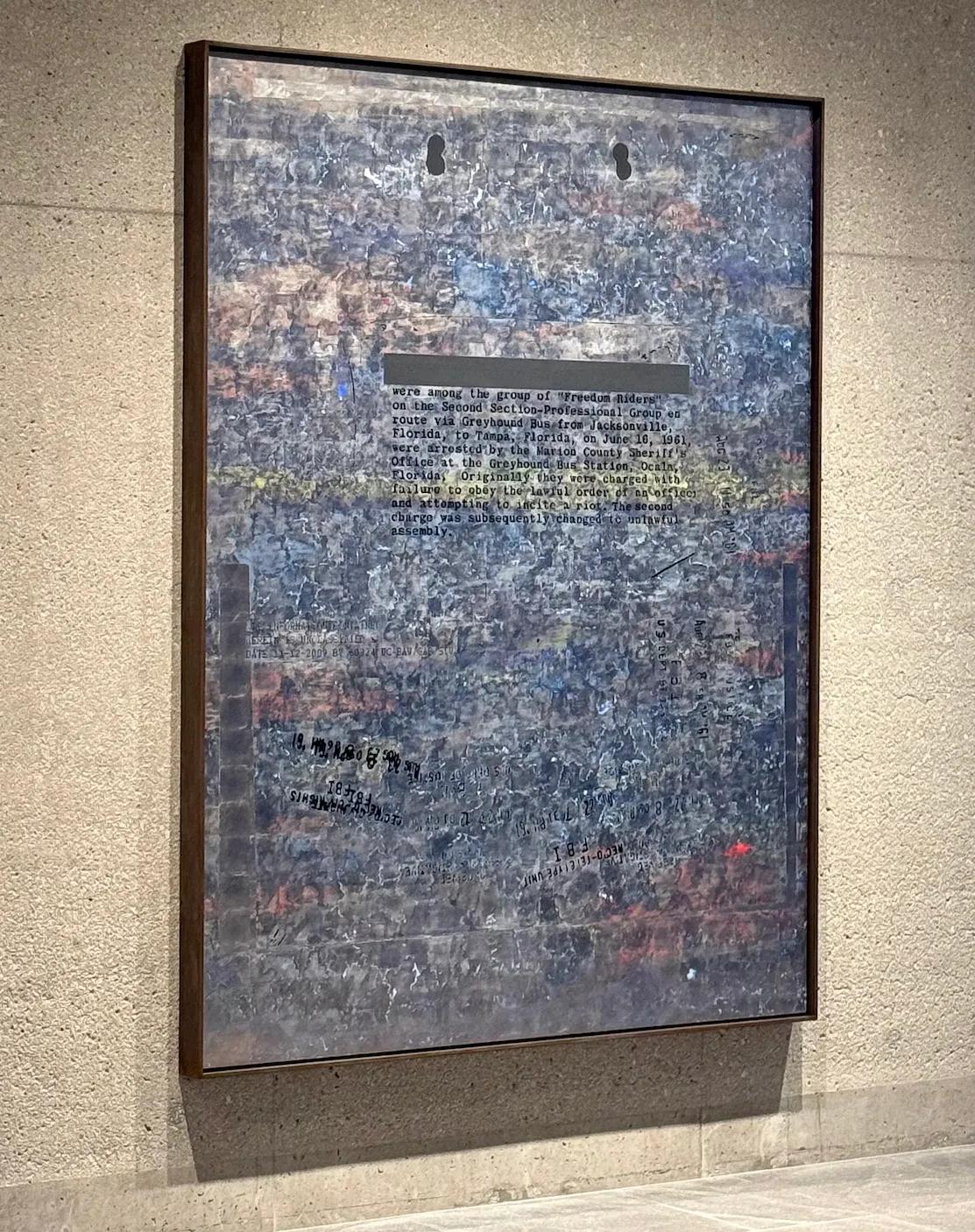
Jenny Holzer, Freedom Riders, 2025 © 2026 Jenny Holzer, member Artists Rights Society (ARS), NY. Photo: Bill Jenkins. Courtesy the artist
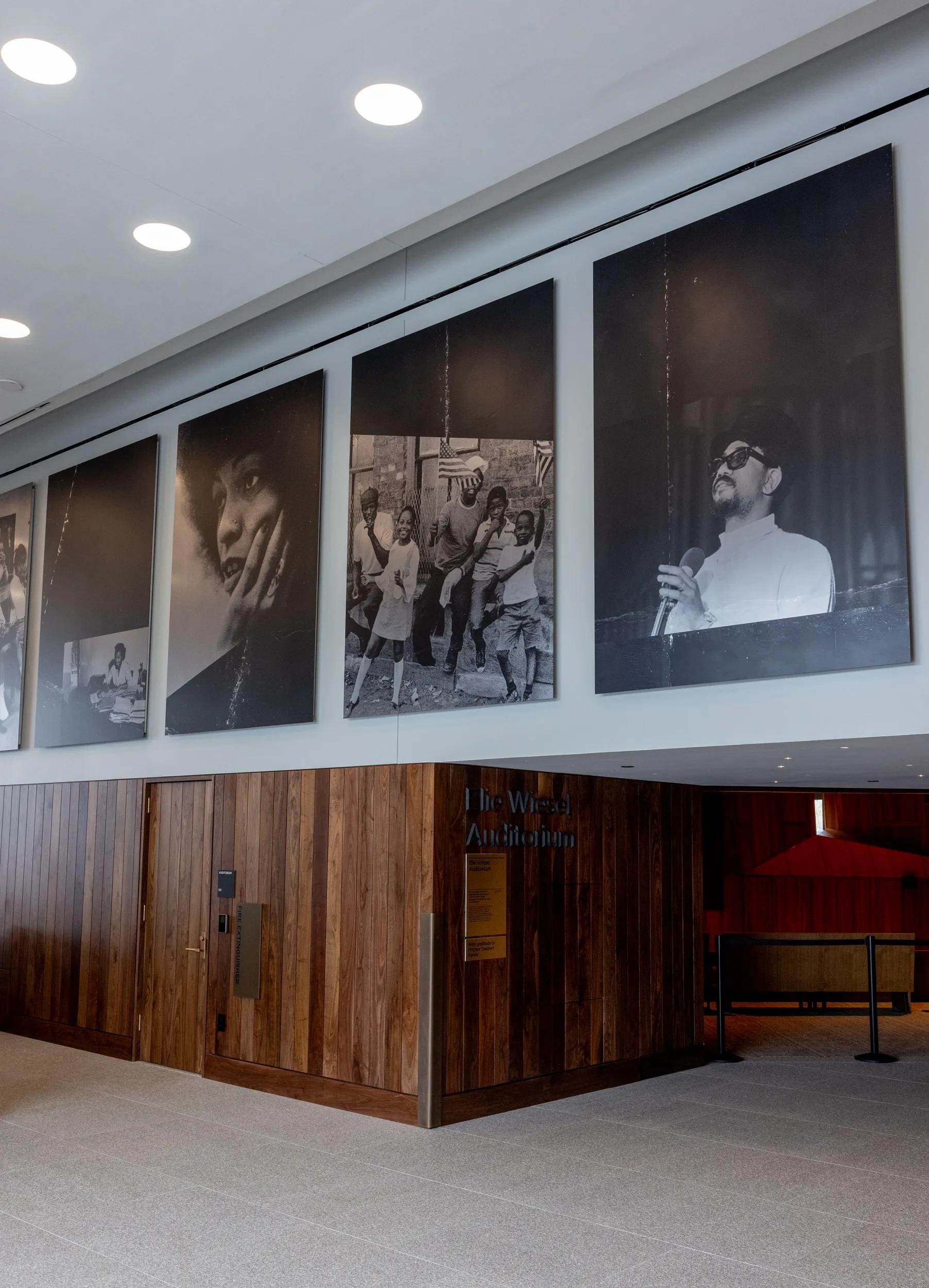
Theaster Gates, To See What They Could See, 2026, installed in the Forum’s Hadiya Pendleton Atrium.
The idea of belonging, a feeling that was palpable on the center’s opening day, immediately brings to mind Mark Bradford’s massive thirty-eight-foot-tall painting titled City of the Big Shoulders, housed in the museum’s atrium. The painting is Bradford’s interpretation of a map of Chicago. I use the word interpretation intentionally, as Bradford has long explored the ways in which maps are not just factual documents but tools for concentrating power, showing who holds it and erasing those who don't. In his depiction of Chicago, graphic lightning-yellow tracks swell north, south, east and west, representing the Illinois Central Railroad, which brought millions of African Americans to the city during the Great Migration of the early 20th century.
The city’s seventy-seven neighborhoods are rendered in a cacophony of colors. Burnt sienna, blush, cerulean, ink-blue, slate, umber and olive jut against one another, and a massive swirl of cobalt symbolizing Lake Michigan dominates the painting’s eastern quadrant. The colors, as Bradford explained to The New York Times, are inspired by the public art projects of the Works Progress Administration (WPA)—a fitting corollary, as the map stands in opposition to the city’s longstanding practice of racial discrimination, illuminating histories long disregarded in official records. (It comes as no surprise that Chicago artist Amanda Williams was chosen to be a member of the center’s design team. Williams, originally from the Auburn Gresham neighborhood on the South Side, first received national renown for her 2015 Color(ed) Theory series, a work that also focused on the city’s long history of redlining and segregation, practices that have kept the South Side underserved to this day.)
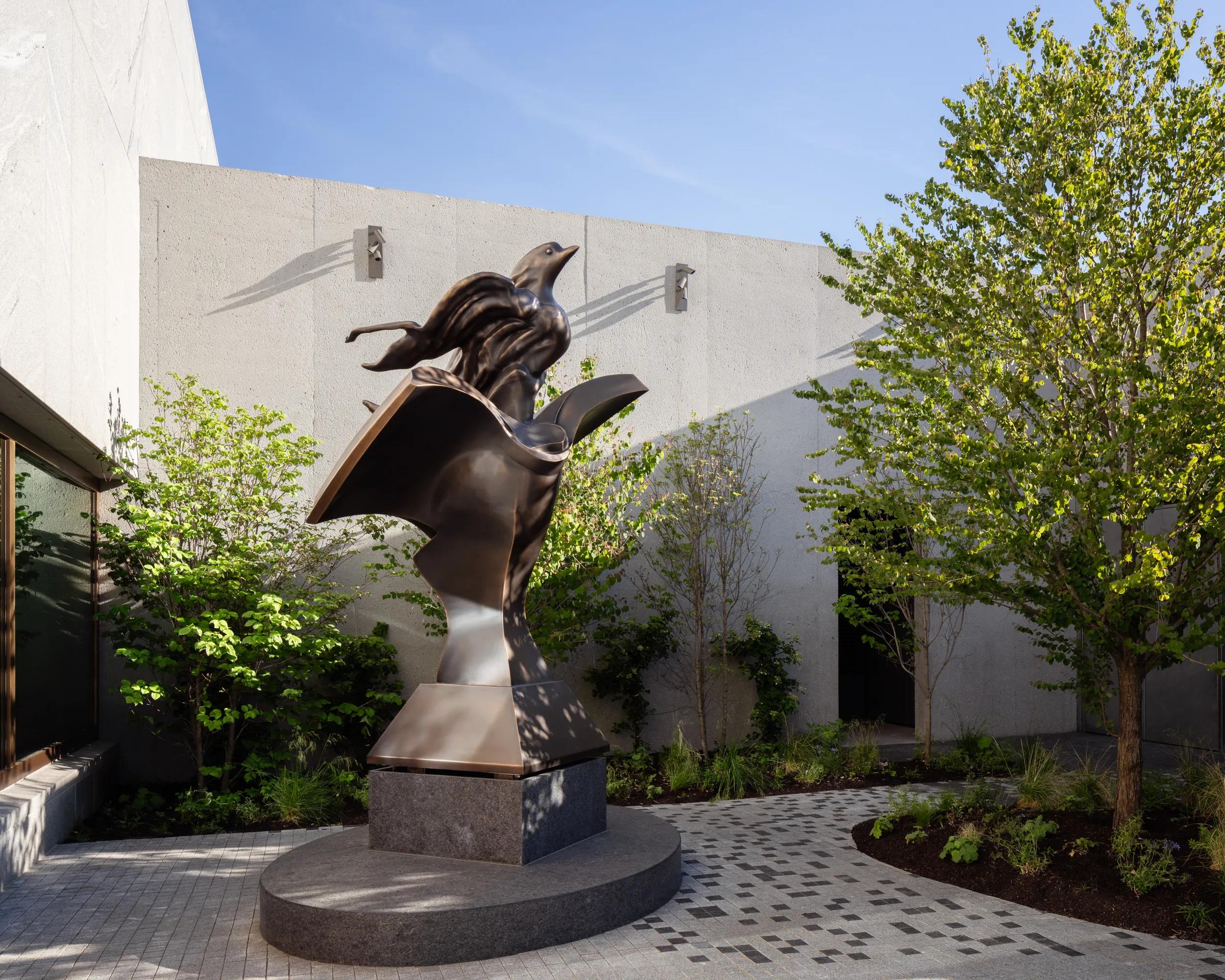
Richard Hunt, Book Bird, 2023, installed in the Library Reading Garden. © 2026 The Richard Hunt Estate/Artists Rights Society (ARS), New York
There’s an obvious grandiosity to a thirty-eight-foot-tall painting and a pictorial sweep reminiscent of Pollock or Rauschenberg. But such grand gestures are juxtaposed in the museum’s built environment with a level of attention to spaces and objects that can often go unnoticed and underappreciated, transforming such things into marvels in their own right. The walnut benches created by Norman Teague are a perfect example of this attention. Teague, a designer, visual artist and professor of industrial design at the University of Illinois Chicago, created the benches as inclusive places of rest within the museum. One of the benches is placed so that visitors can watch footage of President Obama’s 2015 “You are America” speech, delivered to commemorate the fiftieth anniversary of the Selma marches. Teague equipped the benches with dividers of various lengths to create seats of varying widths for different types of bodies. Though the rails resemble the guards placed on public benches to discourage unhoused people from sleeping, Teague’s actually function as handrails for the elderly and other people who might need help in standing up. Each of the benches is accented with a string of lights running across its base, illuminating it like a ship at sea, elevating a public convenience into a focal point.
The impossibly smooth lines of Teague’s benches provide a conceptual echo of Richard Hunt’s sculpture Book Bird, located in the library’s garden. The first artwork commissioned for the center, Book Bird is a cast bronze statue of a bird emerging from an open book, an image meant to symbolize the freeing power of the written word. Though the work might seem on-the-nose when compared to Hunt’s well-known abstract public sculptures, it possesses a poise and a sense of purposeful emotion, especially considering that Hunt’s mother was an artist and one of the city’s first Black librarians. Hunt himself was committed to teaching the legacy and histories of Black achievement, accomplishments too often structurally dismissed.
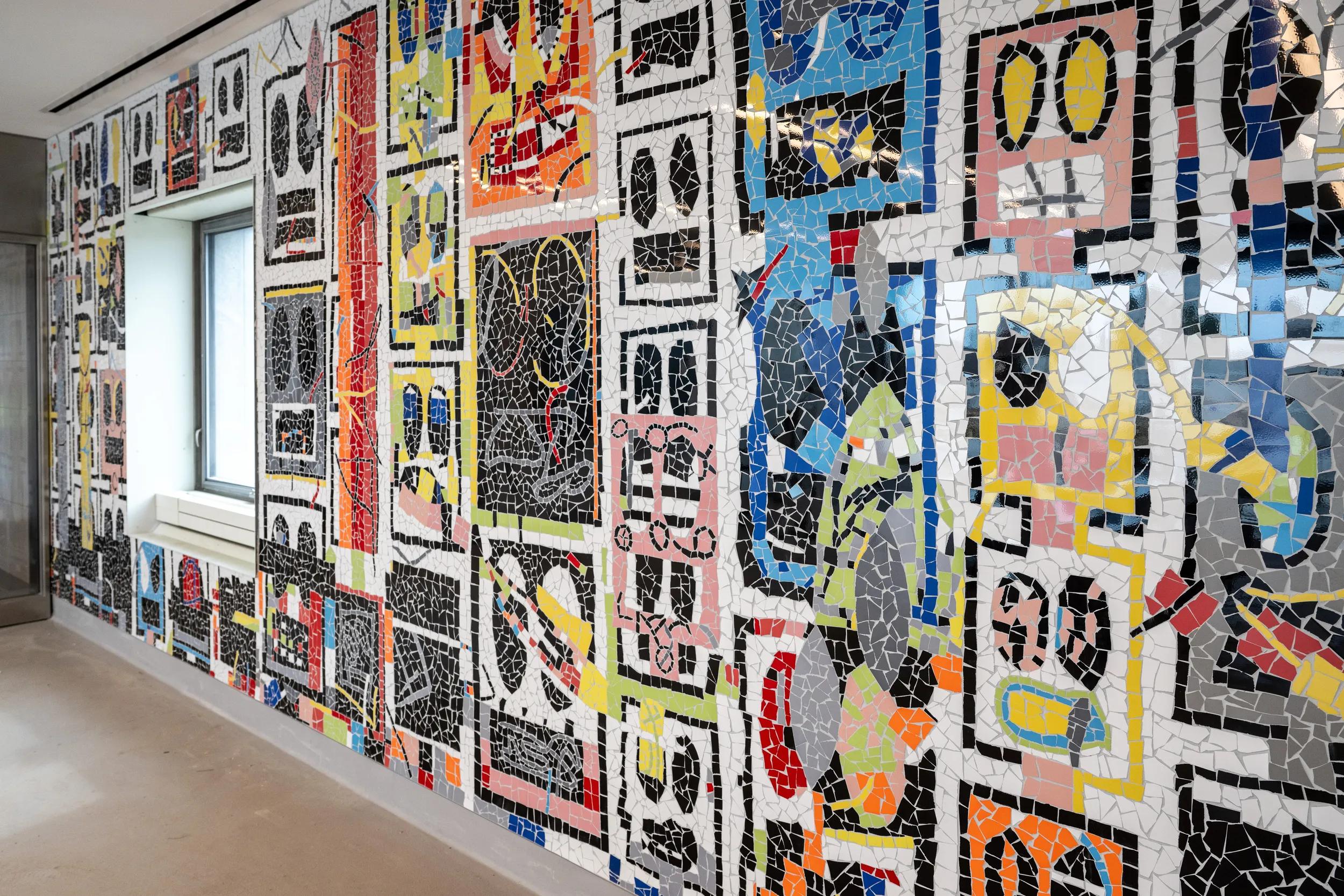
Rashid Johnson, Broken Crowd “The President’s Audience,” 2026, installed in the Center's Teaching Kitchen.
Elsewhere in the Center, Rashid Johnson’s tile mosaic Broken Crowd “The President’s Audience” explores identity through abstracted faces. An outgrowth of Johnson’s Broken Men series, the figures’ expressions—ranging from anxious to open, guarded to unreadable—suggest the emotional and experiential complexity within every person. The faces bear signs of brokenness, yet their reassembled forms suggest the possibility of healing and renewal. Installed in the Center’s Teaching Kitchen, a space that embodies Michelle Obama’s concept of the “kitchen table” as a place of care and communal exchange, the figures appear within an environment devoted to nourishment and gathering.
Chicago has long been considered a birthplace of social-practice art, with a lineage that runs from Jane Addams’s Hull-House settlement, founded in 1889, to Jim Duignan’s Stockyard Institute, founded in Back of the Yards in 1995, and, more recently, Theaster Gates’s Dorchester Projects and Stony Island Arts Bank, both now South Side neighbors to the center. Social practice—which brings art into a particular context and makes that context an indispensable part of the art—is a distinct, profound aspect of the city’s artistic sensibility. With twenty-three of the center’s commissions available to see in non-ticketed parts of the museum—as well as the works’ shared commitment to recognizing and illuminating the experiences of the cultural collective—the center follows directly in the footsteps of that Chicago heritage.
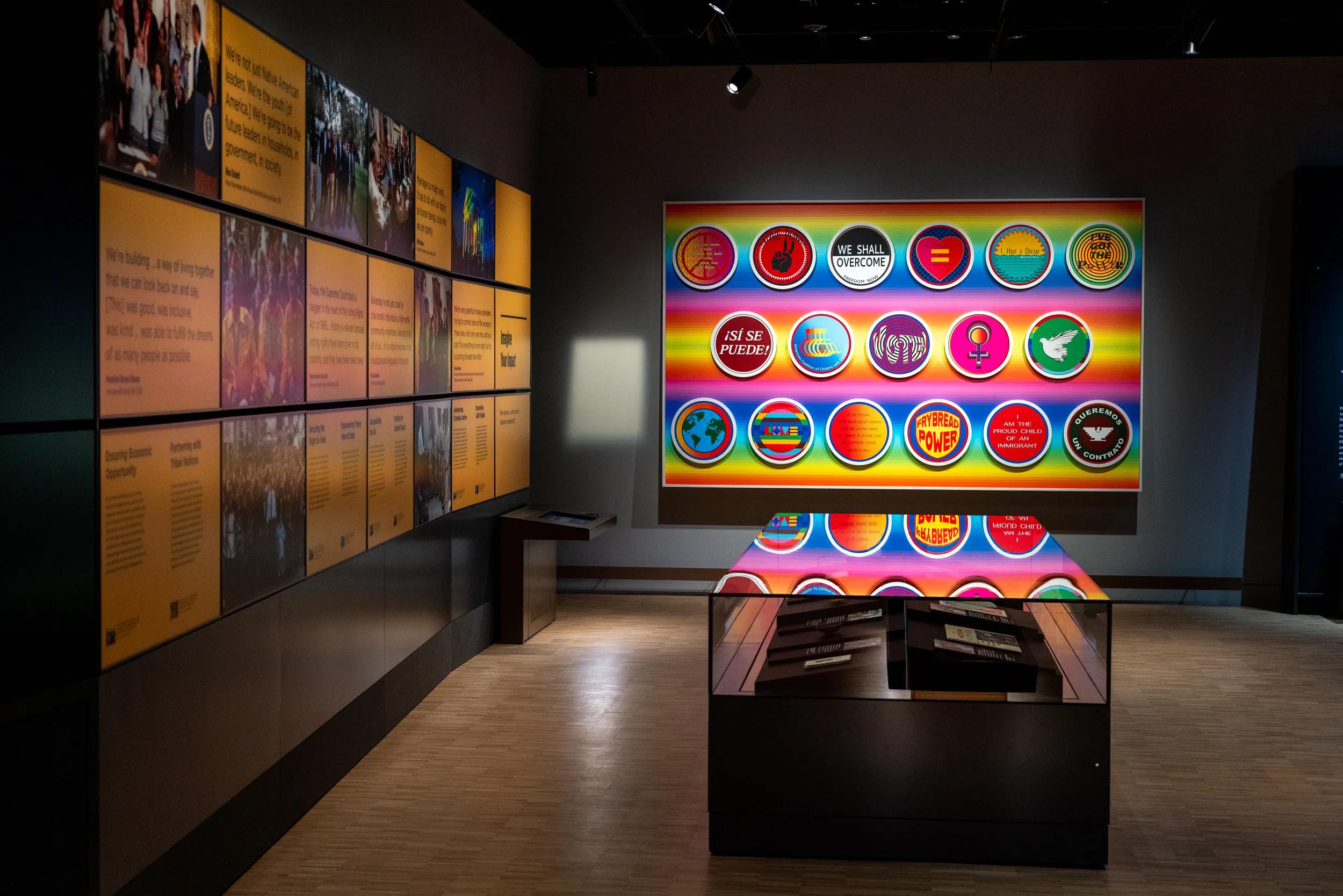
Jeffrey Gibson, Yet With a Steady Beat, 2026, installed at the Obama Presidential Center Museum, with interpretive displays visible at left.
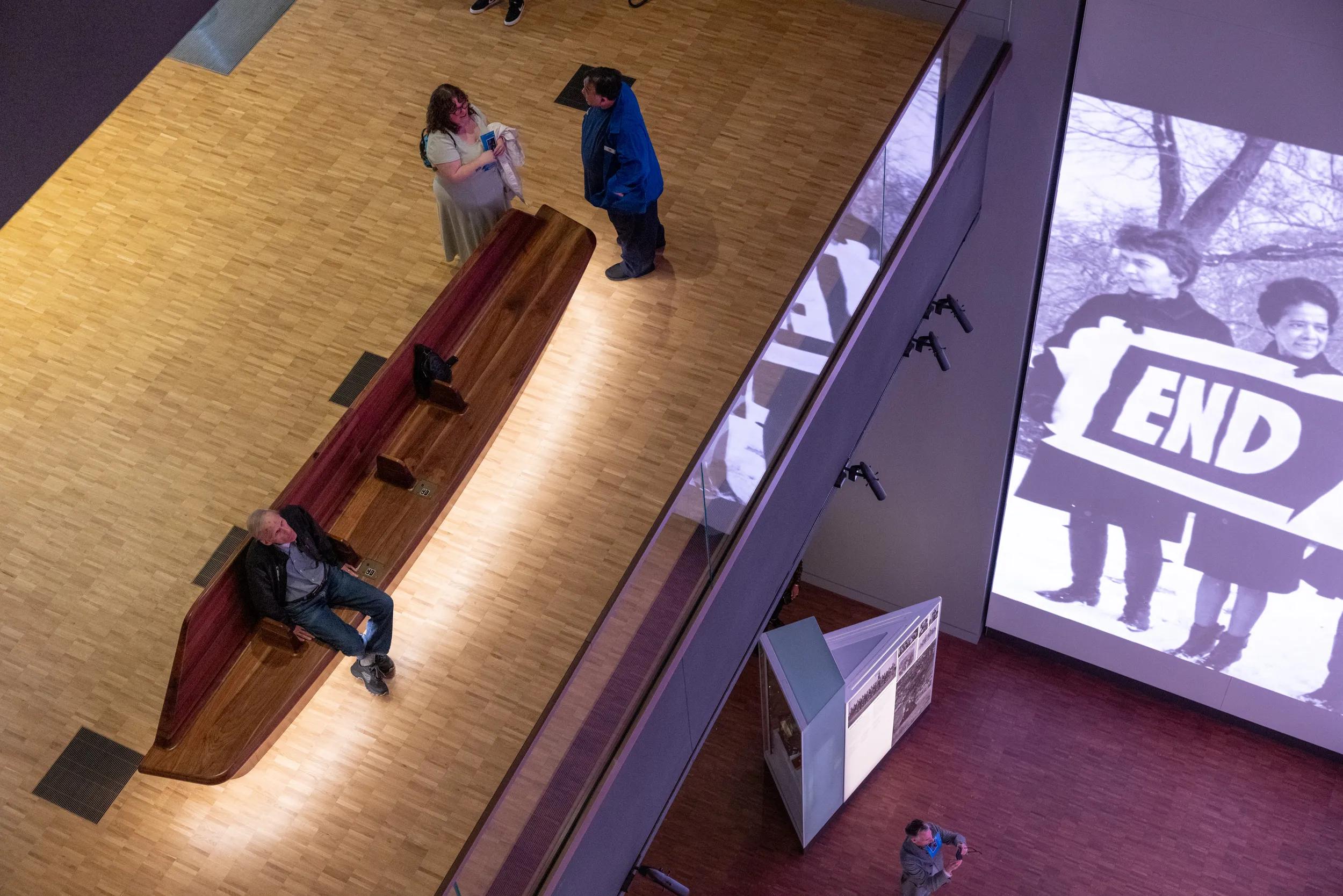
One of eight walnut wooden benches designed by Norman Teague
Carl Sandburg’s poem “Chicago,” from which Bradford’s painting takes its name, contains a line that I love. Sandburg writes: “Come and show me another city with lifted head singing so proud to be alive.” I think of this line when presented with the vision of Chicago and art offered up by the Obama Presidential Center: a city, a place, an art and a people exuberantly, undeniably, alive.
–
Annette LePique has contributed to Cleveland Review of Books, Frieze, Momus and ArtReview. She is a board member of Sixty Inches From Center and a member of the International Association of Art Critics. In 2023, she received a Rabkin Prize for Arts Journalism.