

Letters
Shalom, Big Phil!
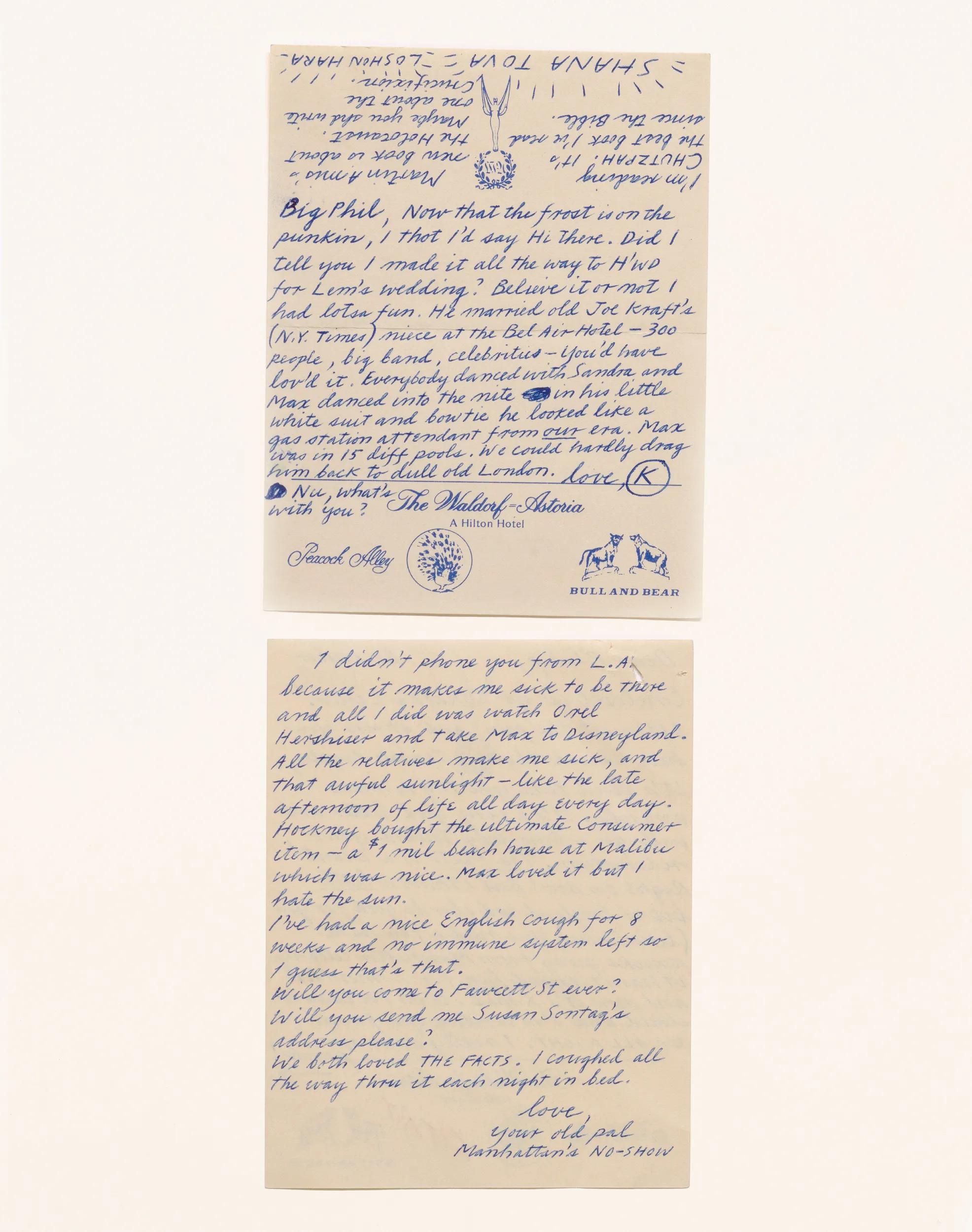
R. B. Kitaj writes to Philip Roth from the Waldorf Astoria, 1991
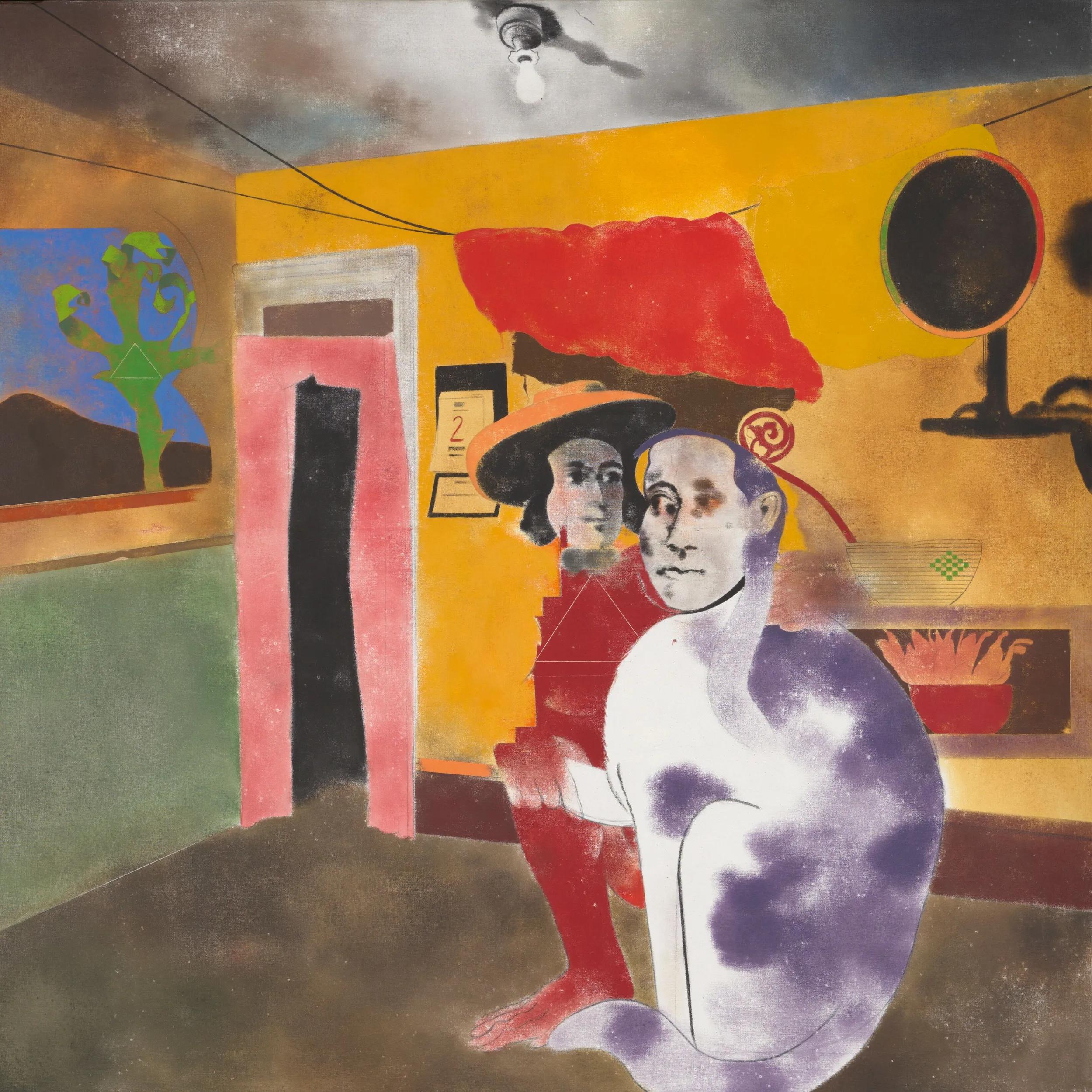
R. B. Kitaj, The Man of the Woods and the Cat of the Mountains, 1974 © R.B. Kitaj Estate. Courtesy Tate
R. B. Kitaj was born in 1932 in Ohio and joined the Merchant Marine at seventeen before studying art in Vienna, New York, Oxford and finally, London, where he settled down and met a young David Hockney. It was Kitaj who came up with the appellation School of London for himself and his fellow painters Frank Auerbach, Leon Kossoff, Francis Bacon, Lucian Freud and Michael Andrews. Kitaj often supplied text with his paintings, and critics bristled at both his immense self-regard and his tendency to instruct writers in how to think about his work. As he grew older, he became increasingly alienated from British society and absorbed with matters of Jewish identity, publishing his First Diasporist Manifesto in 1989.
Philip Roth spent much of the 1980s in London with actress Claire Bloom and met Kitaj through a mutual friend, the novelist David Plante. Roth and Kitaj met regularly at Tootsies, a now closed American-style diner known for its hamburgers. They were around the same age, both highly opinionated and highly regarded in their respective fields, and they reveled in each other’s company. Roth loved to hear about Kitaj’s naval experiences, and both men were keen observers of British antisemitism in all its manifestations.
In the late 1980s, Roth moved back to New York City and launched a late-career surge of novels that would include Sabbath’s Theater (the character of Mickey Sabbath may share DNA with Kitaj), American Pastoral, The Human Stain and The Plot Against America, which rank among his finest works.
This letter from Kitaj to Roth, written from the Waldorf Astoria in New York and dated September 30, 1991, describes a visit Kitaj made to Los Angeles for the wedding of his son from his first marriage, Lem Dobbs, best known as the screenwriter of the Steven Soderbergh films Kafka and The Limey. Kitaj, accompanied by his second wife, Sandra Fisher, and their son Max, recounts dancing at the wedding, taking Max to Disneyland and visiting Hockney’s Malibu beach house (which he snidely disparages as “the ultimate consumer item”).
© R.B. Kitaj Estate. Courtesy Philip Roth Papers, Manuscript Division, Library of Congress
It is clear from the letter the affection Kitaj has for Roth, calling him “Big Phil” and signing off as “your old pal,” and it is also clear that he misses the closeness of their London days. Kitaj apologizes for not phoning Roth in New York while he was stateside, calling himself “Manhattan’s No-Show.”
In the letter, Kitaj portrays himself as a kind of comic Jewish character, a crank who hates the outdoors and is intermittently under the weather: “All the relatives make me sick and that awful sunlight.”
The irony is that while Kitaj spends a good deal of the letter slighting Los Angeles, he would move there permanently in 1994 following the death of Fisher and would take long daily walks around his Westwood neighborhood.
The letter’s addenda showcase Kitaj’s deadpan wit as well as his philo-semitism. “I’m reading Chutzpah. It’s the best book I’ve read since the Bible,” he says, referring to Alan Dershowitz’s 1991 best-seller, a book about all things Jewish in the United States, written at the peak of Dershowitz’s legal and media reputation.
Then Kitaj mentions Martin Amis’s 1991 novel Time’s Arrow, which narrates in reverse chronological order the story of a German doctor who served at Auschwitz. Kitaj comments that if Amis, a non-Jew, is writing a novel about the Holocaust, then perhaps Roth should write one about the Crucifixion.
—Tom Teicholz
–
Tom Teicholz is an award-winning journalist and best-selling author whose popular Substack The Enthusiast covers arts and culture in Los Angeles and beyond.