
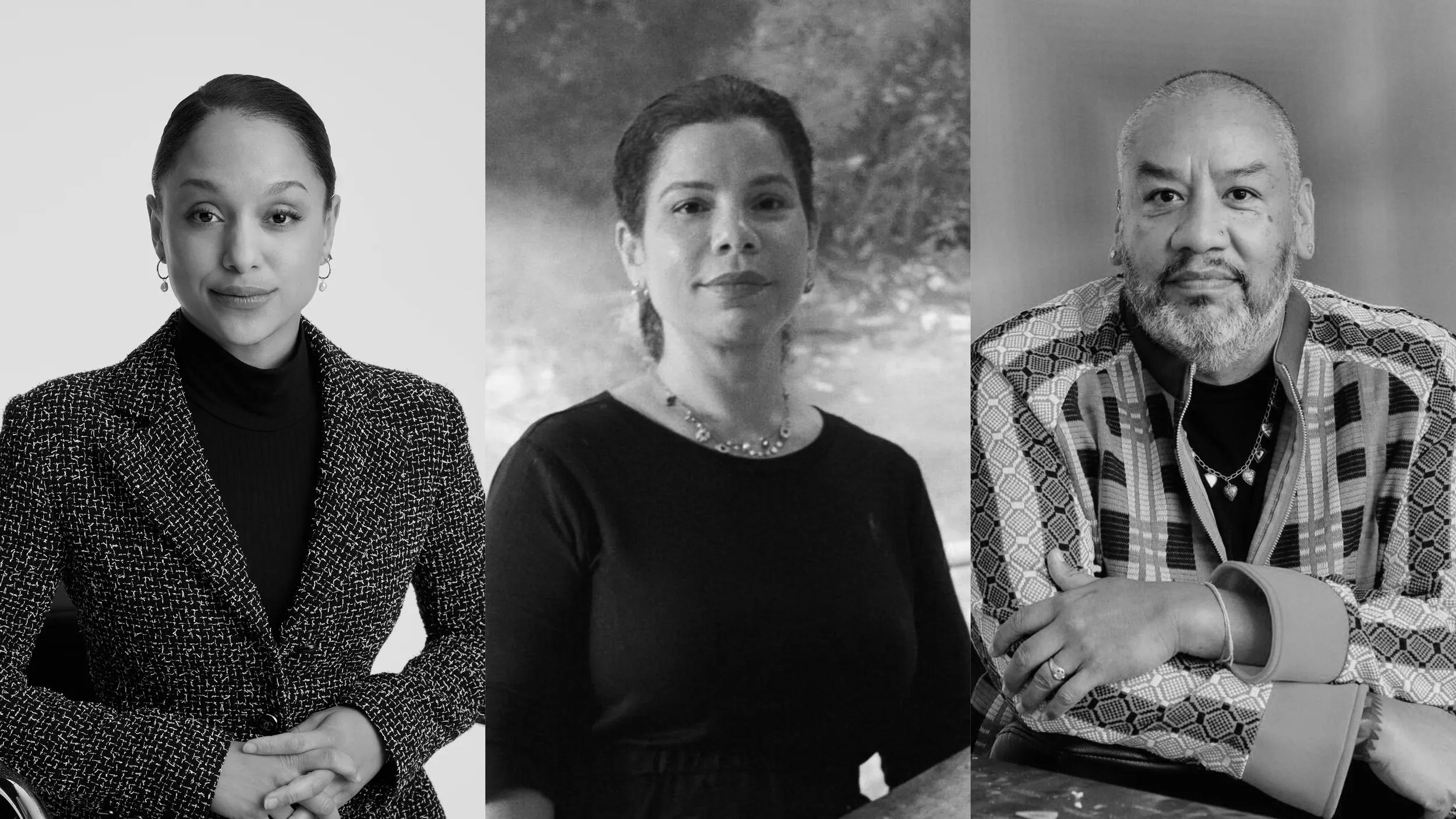
Portrait of Legacy Russell. Photo: Jason Schmidt; Portrait of Firelei Báez. Photo: Spencer Pazer; Portrait of Jeffrey Gibson. Photo: Emiliano Granado © Jeffrey Gibson Studio.
In Conversation: Firelei Báez, Jeffrey Gibson & Legacy Russell at Cooper Union
On the occasion of ‘Firelei Báez. Feet squelching on wet grass, nourished by uncertainty,’ the artist’s first exhibition with Hauser & Wirth in New York, please join us for a rich conversation, in the historic Great Hall at The Cooper Union, touching on art, the cosmos, nature, world building and more with Firelei Báez, artist Jeffrey Gibson and Executive Director & Chief Curator of The Kitchen Legacy Russell.
On the heels of two major solo museum exhibitions in 2025, Firelei Báez’s exhibition at our 22nd street gallery in Chelsea unveils an ambitious, enveloping constellation of radiant new paintings and works on paper, along with new large-scale bronze sculptures. Across two floors, Báez extends her ongoing engagement with colonial legacies and the natural, spiritual and cosmic reverberations of the African diaspora. A storyteller and world maker, Báez works within the tradition of history painting while quietly undoing the very conventions through which histories are fixed and made legible. In this presentation, she subtly shifts her focus away from the discernible, if chimerical, figures that occupy her previous bodies of work to achieve a more atmospheric sensibility, one that invites a broader, deeper understanding of how bodies and nature shape our experience of being in the world.
Reservations are required for this free event co-presented with The Cooper Union School of Art.
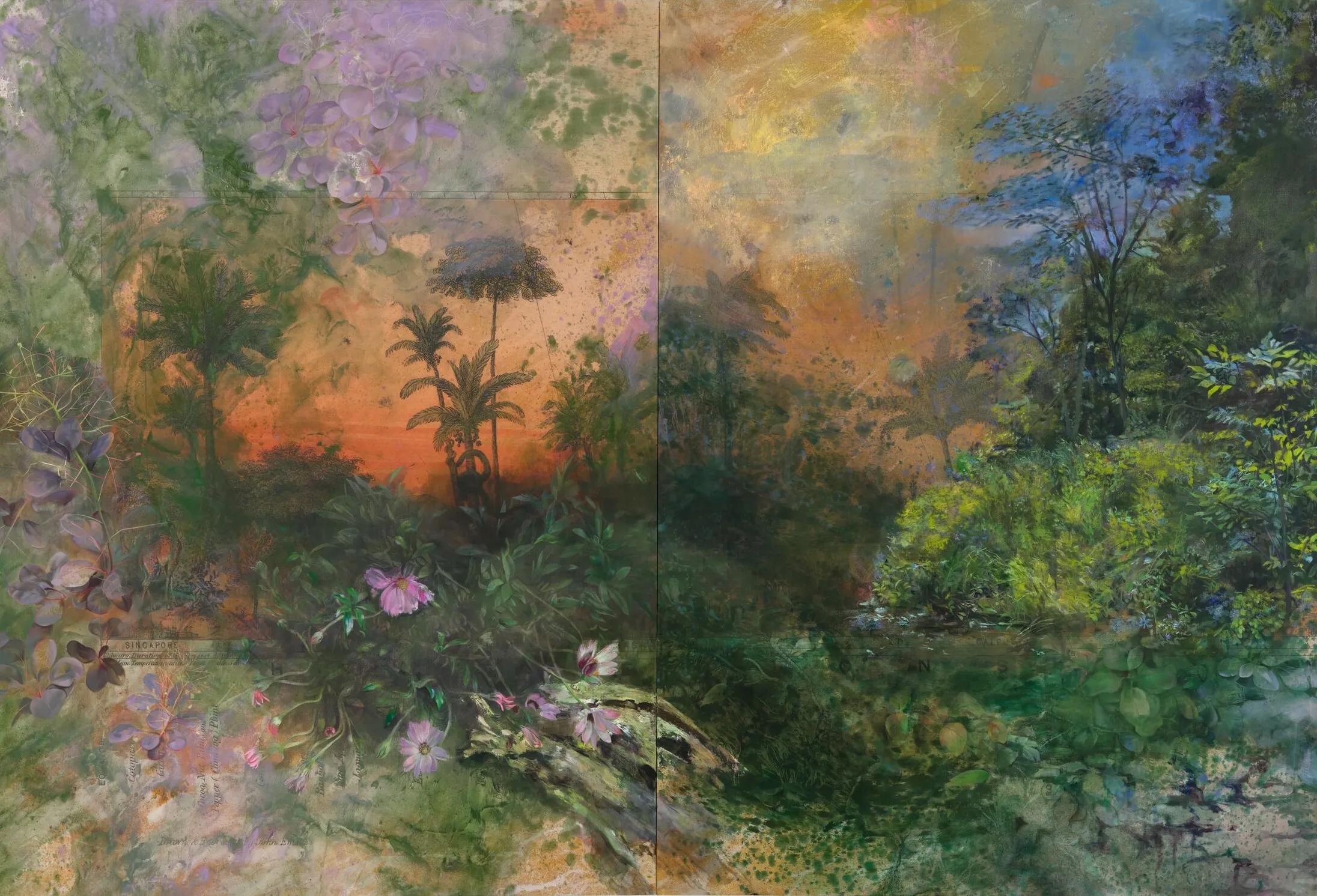
View of Nature (1), 2026 © Firelei Báez. Photo: Elisabeth Bernstein
About Firelei Báez
Firelei Báez draws upon African diasporic histories, reimagining them to explore new possibilities for the future. Báez received an MFA from Hunter College, a BFA from The Cooper Union School of Art, and attended the Skowhegan School of Painting and Sculpture. Since 2024, Báez has been the subject of her first major U.S. survey, organized by the Institute of Contemporary Art, Boston, and presented at the Vancouver Art Gallery and the Des Moines Art Center, before traveling to the Museum of Contemporary Art Chicago, where it remains on view through May 2026. Her work has been featured in major international exhibitions, including ‘The Milk of Dreams’ at the 59th Venice Biennale (2022), curated by Cecilia Alemani, and the inaugural installation of the ICA Watershed in Boston (2021). Recent solo exhibitions have been held at the Louisiana Museum of Modern Art, Humlebæk; Kunstinstituut Melly (formerly Witte de With Center for Contemporary Art), Rotterdam; The Museum of Modern Art, New York; The Studio Museum in Harlem; The Andy Warhol Museum, Pittsburgh; and Pérez Art Museum Miami.
Báez has participated in numerous group exhibitions at institutions including the National Gallery of Art, Washington, DC; the Art Gallery of Ontario, Toronto; the Cleveland Museum of Art; the Baltimore Museum of Art; and the Rockbund Art Museum, Shanghai. She is the recipient of several major awards, including the Herb Alpert Award in the Arts (2020), the Artes Mundi Prize (2021), the Philip Guston Rome Prize (2021), and the Cooper Union President’s Citation (2022). Her work is held in prominent public and private collections worldwide, including the Baltimore Museum of Art; Crystal Bridges Museum of American Art; Dallas Museum of Art; Fine Arts Museums of San Francisco; The Solomon R. Guggenheim Museum; Institute of Contemporary Art, Boston; Nasjonalmuseet, Oslo; Pérez Art Museum Miami; San Francisco Museum of Modern Art; Tate, London; the Whitney Museum of American Art, New York; and The Metropolitan Museum of Art.
About Jeffrey Gibson
Jeffrey Gibson grew up in major urban centers in the United States, Germany, and Korea, where he absorbed the transgressive soundtrack of the 1980s through limited access to MTV. Gibson graduated from the School of the Art Institute of Chicago in 1995 and received a Master of Arts in painting at the Royal College of Art, London, in 1998. While in Chicago he also worked as a research assistant on the Native American Graves Protection and Repatriation Act (NAGPRA) for the Field Museum, a formative experience that fostered an ongoing interest in questions of ownership and notions of cultural translation. Though trained as a painter, Gibson began incorporating materials and techniques that deliberately reference his heritage—such as raw hides and bead work—around 2010. A major turning point in his career, in 2012 he presented ‘one becomes the other,’ his first solo exhibition of sculpture and video, at Participant Inc. Sculpture, moving image, and sound have since become an integral aspect of his practice. He is known for his immersive, multi-sensory installations that invoke and interweave such disparate contexts as faith-based spaces of communion and night clubs.
About Legacy Russell
Legacy Russell is a curator and writer. Born and raised in New York City, she is the Executive Director & Chief Curator of the experimental arts institution The Kitchen. Her academic, curatorial, and creative work focuses on gender, performance, digital selfdom, internet idolatry, and new media ritual.
A selection of recent exhibitions include Code Switch: Distributing Blackness, Reprogramming Internet Art (2024-25, The Kitchen, in collaboration with the Schomburg Center and MOCAD) ; Harmony Holiday: BLACK BACKSTAGE (2024, The Kitchen); Matthew Lutz-Kinoy: Filling Station (2023, The Kitchen); Samora Pinderhughes: GRIEF (2022, The Kitchen); satellite projects The Condition of Being Addressable (ICA LA, 2022); The New Bend (Hauser & Wirth, 2022-2023); Sadie Barnette: The New Eagle Creek Saloon and madison moore: Nightlife-in-Residence (2022, The Kitchen) Projects: Kahlil Robert Irving (2021), Projects: Garrett Bradley (2020), and Projects: Michael Armitage (2019), all with The Studio Museum in Harlem in partnership with The Museum of Modern Art; Thomas J Price: Witness (2021); Dozie Kanu: Function (2019), Chloë Bass: Wayfinding (2019), and LEAN with Performa's Radical Broadcast online (2020) and in physical space at Kunsthall Stavanger (2021).
She is the recipient of the Thoma Foundation 2019 Arts Writing Award in Digital Art, a 2020 Rauschenberg Residency Fellow, a recipient of the 2021 Creative Capital Award, a 2022-23 Pompeii Commitment Digital Fellow, a 2023 Center for Curatorial Leadership Fellow, a 2024-25 Lunder Institute for American Art Fellow, and a 2025-2026 Obama Leader awardee. In 2025, Russell was appointed to Mayor-elect Zohran Mamdani's Arts & Culture Transition Committee for New York City in late 2025, bringing her expertise in contemporary art and institutions to help shape NYC's future cultural policy alongside other leading arts figures.
Her first book is the critically acclaimed Glitch Feminism: A Manifesto (Verso Books, 2020). Her second book BLACK MEME (Verso Books, 2024) was shortlisted for the 2024 The National Book Critics Circle Award. Russell's first chapbook of poems is GAY POMPEII from GenderFail, published in 2025.
About The Great Hall of The Cooper Union
The Great Hall of The Cooper Union, located in The Foundation Building, 7 East 7th Street, between Third and Fourth Avenues, has stood for more than a century as a bastion of free speech and a witness to the flow of American history and ideas. When the hall opened in 1858, more than a year in advance of the completion of the institution, it quickly became a destination for all interested in serious discussion and debate of the vital issues of the day.
The Great Hall was the platform for some of the earliest workers' rights campaigns and for the birth of the NAACP, the women's suffrage movement and the American Red Cross. To the Great Hall's lectern has come a pageant of famous Americans — rebels and reformers, poets and presidents. Before they were elected, Presidents Lincoln, Grant, Cleveland, Taft, Theodore Roosevelt and Barack Obama all spoke there. Besides Woodrow Wilson, two other incumbent presidents have spoken in the Great Hall: William Jefferson Clinton, who, on May 12, 1993, delivered a major economic address on reducing the federal deficit and Barack Obama, who, on April 22, 2010, gave an important speech on economic regulation and the financial markets.
During the past century's times of tremendous upheaval, it was through meetings in Cooper's famous auditorium that the politics and legislation necessary to build a humane city took shape.


