

Pairings
An Artist and An Astrophysicist Walk Into a Bar
Keith Tyson in conversation with Pedro Ferreira
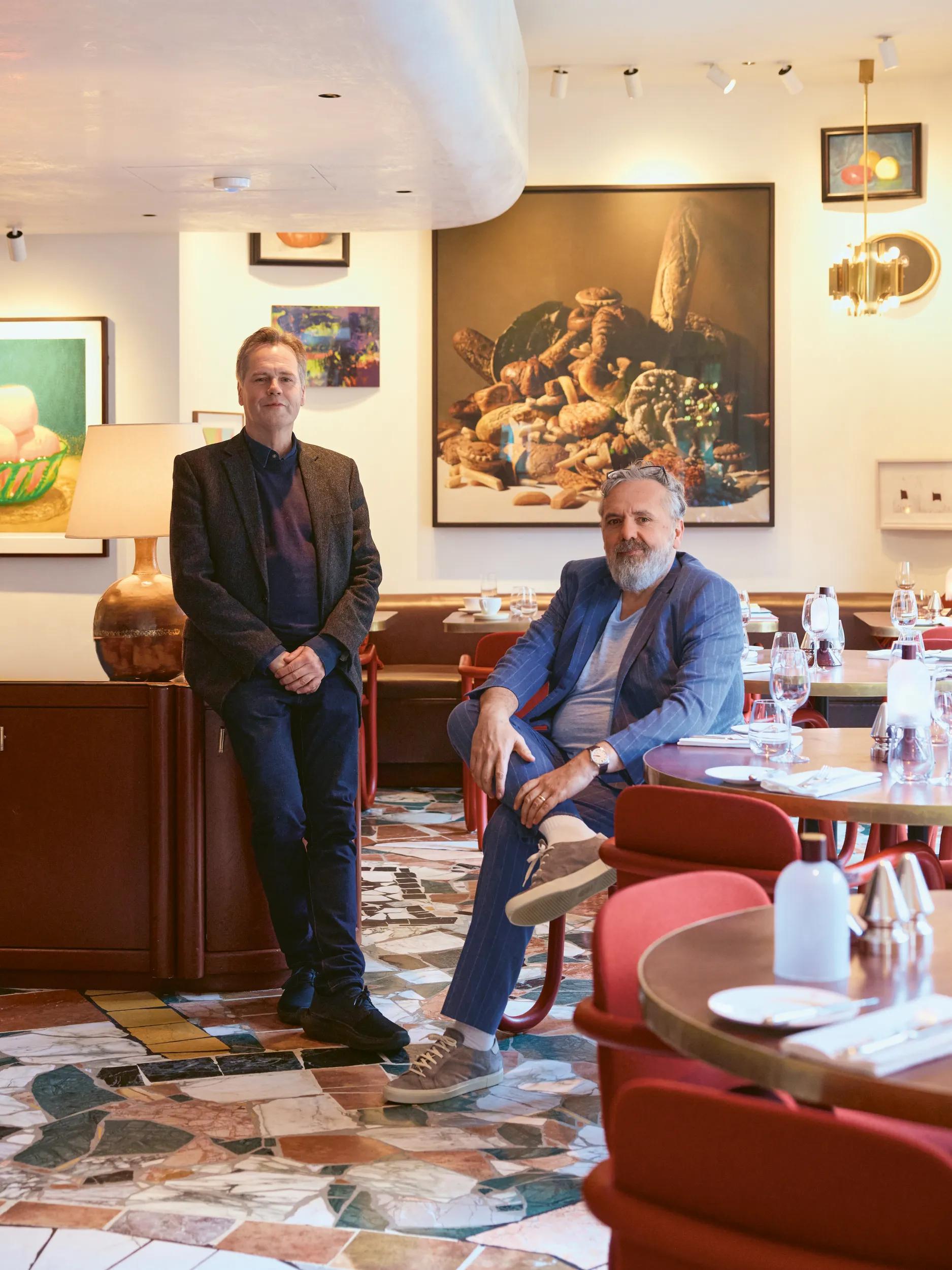
Ferreira and Tyson at Mount St. Restaurant, London, 2026. Photography by Lesley Lau
British artist and Turner Prize winner Keith Tyson has long explored the structures underlying perception and experience, from generative systems to immersive, site-specific installations. His solo exhibition currently on view at Hauser & Wirth Downtown Los Angeles continues his investigation into the forms that arise when ideas, chance and material processes intersect.
Theoretical cosmologist and astrophysicist Pedro Ferreira, a professor at the University of Oxford, studies the structures that govern the universe. His work, which includes subjects like the formation of galaxies and the mysteries of dark matter, navigates the tenuous border between mathematics and imagination.
The two have been friends and professional colleagues for twenty years; their relationship began when Ferreira invited Tyson to participate in an artist-in-residence program he oversaw at Oxford. In late February, they met for lunch at Mount Street in London for the third installment of Ursula’s Pairings column, which brings artists and guests together to share ideas over a meal. Building on their mutual fascination with patterns in the universe, Tyson and Ferreira focused on the currents that drive experimentation in both art and science.
Keith Tyson: It’s great to see you, Pedro—especially over lunch, since that’s how we first met. That must have been twenty years ago now.
Pedro Ferreira: Exactly twenty years! It was 2006. I was running the artist-in-residence program at BIPAC [Beecroft Institute for Particle Astrophysics and Cosmology] at Oxford. I did one with Jem Finer, who’s a sound artist—and one of the Pogues, the folk-punk band—and he was brilliant. After that, I started getting requests from people who wanted to do the residency, but I just didn’t like their work. So I went to our friend Michael Archer, who was running the Ruskin School of Art then, and asked who I should work with. He said, “Keith Tyson.” I told him I already knew your work—I’d seen it after you won the Turner Prize.
KT: The Studio Wall drawings.
PF: That’s right—I’ve always loved those. Michael gave me your email and I got in touch. We met for lunch, and then we kept the conversation going.
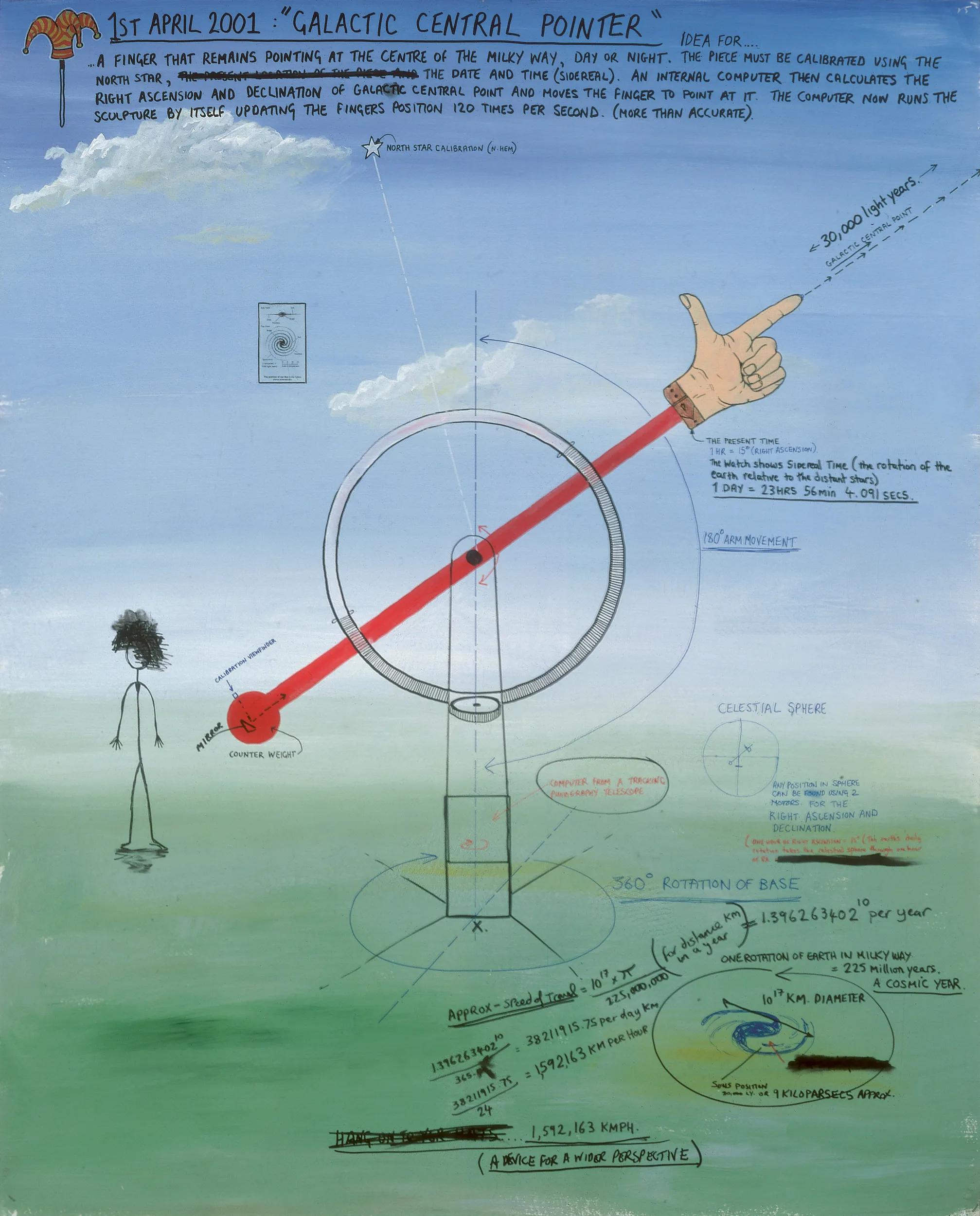
Keith Tyson, Studio Wall Drawing: 1st April 2001 “Galactic Central Pointer,” 2001 © Keith Tyson
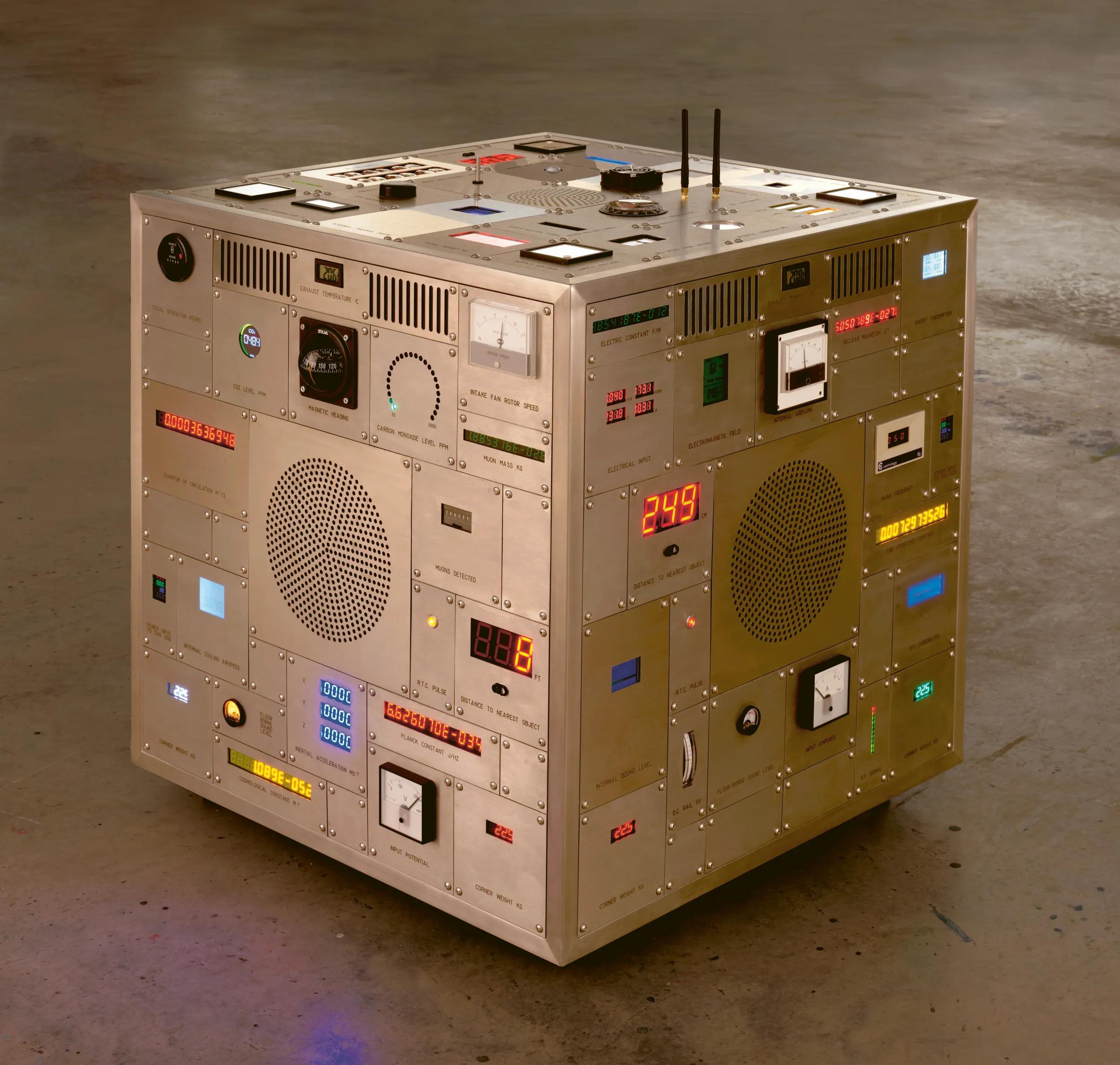
Keith Tyson, Everything, 2024 © Keith Tyson
KT: I remember coming to Oxford not long after. You were doing a lot of computer modeling—simulations of the early conditions of the universe and how galaxies were formed—and that fascinated me. I had always thought of astronomy as looking through telescopes, or perhaps radio astronomy, but you were using computation to predict things. At the same time, I was working with algorithms, trying to make generative art and push things a bit outside the usual boundaries.
PF: It related closely to the work I was doing.
KT: And I’ve picked your brain many times when I’m working on something, just to check that I’m right—
PF: Sending me WhatsApp messages in the middle of the night! [Laughter.]
KT: Early on, we worked on a sculpture together. I’d come up with the idea around 2000—a finger I wanted permanently pointing at the center of the Milky Way. At the time, it wasn’t known whether there was a black hole there or not.
PF: It was suspected, but by the time we first met, it had been confirmed.
KT: Right. The device for my sculpture was developed with your engineering team.
“Science and mathematics are often seen as distant and unemotional. But the best description I ever heard of mathematics is that it’s the study of pattern. Once you get into the deeper areas, things like phasing, interference and symmetry emerge—extraordinary structures that are very beautiful, not unlike abstract painting.”—Keith Tyson
PF: That was fun, because you asked if I could help, and of course I can’t help! I’m hopeless when it comes to building things. But we have incredible engineers and instrument builders and observers. We had a session where you pitched the idea and they all scratched their heads, then came up with a solution. It was a beautiful synergy.
KT: A theoretical idea that turned into something that was actually built.
PF: It made me think about the similarities between what you do and what I do. Though I mostly work with the theoretical, the most interesting part for me is stepping over and seeing what those ideas look like in the real universe. In a different way, that’s something your work does—starting from systems or ideas and seeing what they produce.
KT: In science there’s theoretical physics or pure mathematics, and then applied mathematics and engineering that take advantage of what’s been discovered. Quantum mechanics, for example, leads to semiconductors and electronics. The arts aren’t that different. Artists and musicians may not be working toward a specific function in society—they’re often driven by aesthetics or philosophical questions. But later, those ideas can filter into architecture, design or other applied forms and become part of the way the world is.
PF: There’s a big crisis at the moment—which you’ll probably recognize—that more and more sciences are being pushed toward application, too. And the whole blue-skies thinking fueled by curiosity and interest is basically being wound down. Increasingly, that kind of science isn’t funded. And it’s incredibly short-sighted, because if you look at some of the greatest things—mobile phones, semiconductors—and also one of the worst, the atom bomb, all of them came out of pure speculation and theorizing.

KT: In the arts, there has been a push toward more social function and activism, which is all great. But what I do tends to be about the pure side of things—following ideas and seeing where they lead, without necessarily knowing what they’re for.
Science and mathematics are often seen as distant and unemotional. But the best description I ever heard of mathematics is that it’s the study of pattern. Once you get into the deeper areas, things like phasing, interference and symmetry emerge—extraordinary structures that are very beautiful, not unlike abstract painting. It’s often overlooked how inspiring that is. Science is often framed in pragmatic terms—like the discovery of a particle—but for me, even just understanding the scale and intricacy of the world we live in is deeply poetic.
PF: And mathematics sits right at the heart of that, too. One of the things that intrigued me when we first met was when you told me you had hired a mathematics tutor.
KT: I had to. I’d read a lot of science and eventually reached the point where equations felt impenetrable.
PF: That’s when I realized you were serious. Mathematics really is the language of what we do. And yet it puts people off. I remember once being at dinner with someone who asked why the universe has to be explained using mathematics. I said, “That’s simply the language the universe speaks—nothing I can do about that!” But there’s absolutely a beauty and an elegance to it.
KT: It’s like an almost Platonic, otherworldly structure—something fundamental to our existence—but then it gets reduced to a set of rules you learn at school to solve problems. In that process, the mystery and wonder can get lost, especially now with STEM being pushed so hard.


PF: Exactly—part of the problem is how it’s taught. I think the physicist Richard Feynman once said that understanding the physics behind something doesn’t diminish its beauty; it enriches it.
KT: A lot of what first turned me on to science when I was young came from television. In the U.K., we had the BBC and the Open University broadcasts early in the morning. There were presenters like Johnny Ball, and of course there was Carl Sagan’s Cosmos. I remember hearing about relativity—things like simultaneity of clocks and time dilation—and later quantum mechanics. It was electrifying. Suddenly the world seemed mysterious. Science wasn’t secular; it was like a portal, like religion.
PF: I don’t think we’ve ever talked about this, but when I was a teenager, I didn’t want to be a scientist at all. I wanted to be a composer. I was immersed in 20th-century music—[Arnold] Schoenberg, [Karlheinz] Stockhausen, that whole world. I was serious about it for several years. But I was a good middle-class boy from Lisbon, so in the end I went and studied engineering. Eventually, I realized I probably wasn’t very good at music and was better at mathematics.
KT: And I came at it from the other direction. Before going to art school I worked in engineering, building nuclear submarines in a shipyard. When I later encountered conceptual art—artists like Sol LeWitt, where the idea becomes the system that produces the work—it opened something up for me. I began thinking about art almost as a set of parameters that you could define, a system that you could run.
“It’s considered uncultured not to know Mozart or Shakespeare, yet perfectly acceptable to be unfamiliar with Dirac or Heisenberg, who shaped quantum mechanics. Math rarely commands the reverence of high art, and its power is lost to most.”—Pedro Ferreira
PF: The same thing can be said about the contemporary music I’m drawn to. You hear a difficult piece for the first time and have an immediate reaction, but then you want to understand how it works. What system produced it? What was the composer thinking?
KT: Exactly. If you think about a blank canvas, there are almost infinite things you could paint. You can imagine a kind of configuration space of all the possible artworks that could exist. Part of what I do is define a set of parameters within that space and see what emerges.
PF: We’ve talked about how this is a bit like a wave function in physics: Before any measurements are made, there are many possible states, but the moment you make a measurement, you lock onto one of them.
KT: Once it’s there, that’s what it is.
PF: One difficulty to keep in mind is that mathematics has been beaten out of a lot of artistically inclined people in school. They were never shown what was interesting about it, so they end up turning away from it completely.
KT: And then you get this split between the arts and the sciences.
PF: I heard something years ago that has stayed with me: It’s considered uncultured not to know Mozart or Shakespeare, yet perfectly acceptable to be unfamiliar with [Paul] Dirac or [Werner] Heisenberg, who shaped quantum mechanics. Math rarely commands the reverence of high art, and its power is lost to most.
KT: It’s almost like two separate cultures. Do you think that’s a consequence of specialization over the past couple of centuries? In Leonardo da Vinci’s day, you could be a painter, an engineer and a natural philosopher—because it was still all one thing.

Keith Tyson, Pixel, 2024. © Keith Tyson
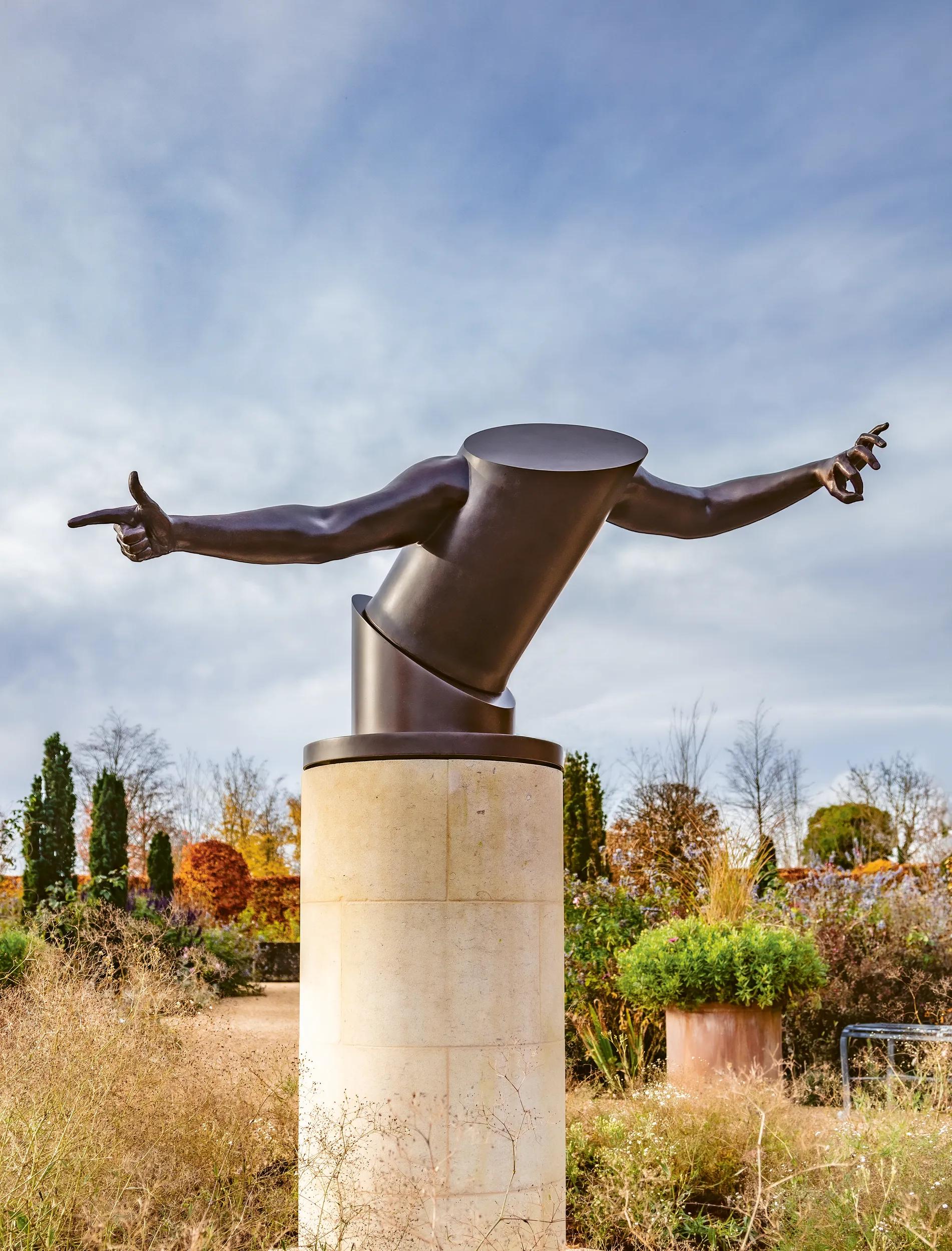
Keith Tyson, Dark Sundial, 2024 © Keith Tyson
PF: That must be part of it. Fields have become so specialized that even physicists in related areas can barely follow each other’s work.
KT: Do you think there was a kind of golden age in physics, when there was still a lot of low-hanging fruit—when people like Einstein could make those enormous breakthroughs?
PF: There are periods like that. When someone like Einstein—or [Erwin] Schrödinger and Heisenberg—uncovers a fundamental part of nature, suddenly you have equations that describe how the universe works. Then a whole generation of scientists can start solving them. With quantum mechanics it was the same: Once the equations existed, people began working out concrete problems—what the hydrogen atom looks like, what electrons do in a magnetic field. It was indeed a period of low-hanging fruit.
KT: What I find extraordinary is that discoveries like that are so profound, yet they haven’t really changed the way most people think about the world.
PF: As you mentioned, quantum physics led to semiconductors and the digital technologies built on them, which transformed our lives. Or take particle physics, where they use huge accelerators at CERN [the European Organization for Nuclear Research] outside Geneva. The scientists there had to find ways of moving data around and giving people access to it, and out of that the web emerged. But that connection isn’t always visible to people.
KT: Yes, but I’m thinking less about engineering applications and more about the psyche—how we understand ourselves. These discoveries show that matter is essentially frozen energy and that the universe works in ways far stranger than common sense suggests. To me, that feels like a kind of secular cosmology—every bit as mysterious as the cosmologies people believed in earlier centuries.
“Chance has always been part of art. That energy of randomness, the accident, is what gives things life. In that sense generative systems aren’t really new—they’ve been present throughout the history of art. What’s new is that some of these processes are now automated and greatly accelerated.”—Tyson
PF: For want of a better word, almost spiritual.
KT: Exactly. And one thing I find difficult at the moment is this increasingly dystopian view of ourselves—as if we’re some kind of virus in the natural world, just consuming resources and achieving very little. You see it in Hollywood and science fiction movies, with narratives that cast science and technology as part of the problem rather than the solution. Whereas when you look at what we’ve collectively done, there’s still a lot of reason for hope.
What interests me isn’t so much the technologies themselves, but the fact that we haven’t had a corresponding transformation in how we see ourselves—in how inventive and resourceful we are, and in how much we’ve come to understand.
PF: So you’re a techno-optimist?
KT: No, but I think we’ve ended up in two camps. In the show in L.A., I’m really talking about a generative universe. I’ve always worked with generative systems—the idea that art emerges from underlying processes.
But the debate around AI has become very binary. On one side you have the Luddites, saying it’s terrible, it’s stealing jobs, it can never match human creativity. On the other, the techno-evangelists say human beings are basically irrelevant, that all our problems will be solved.
PF: It’s either completely bad or completely transformative.
KT: It seems more likely there’s a middle ground—almost a cybernetic relationship—where these tools become widely available in a genuinely democratic way. And that’s a good thing. It still feels to me that a human being begins and completes the circuit of expression. Even with AI, you still have to interpret and decide whether something is meaningful. So the idea that everything becomes automated feels too simplistic.
PF: We don’t really know what it is yet.
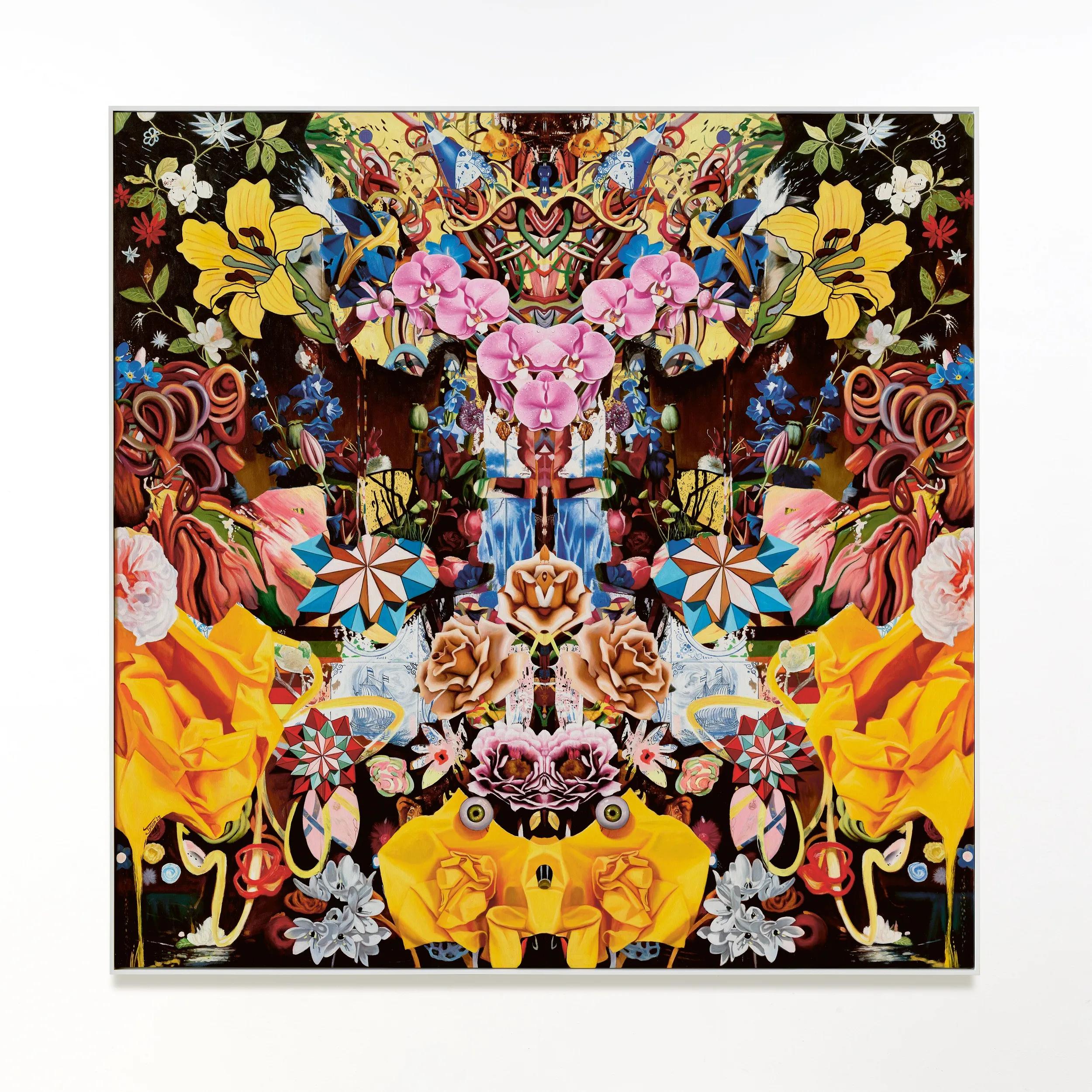
Keith Tyson, Pareidolic Still Life with Entities, 2025 © Keith Tyson
KT: It’s like the internet—when it first came along, we thought it would be a great repository of human knowledge that would liberate us. But in a way, it became the training ground for what we have now.
PF: There’s this enormous body of human knowledge compressed into these systems—relationships between ideas—and that only happened because everything was digitized. So AI as it exists now may just be a step toward something else.
KT: A big question is whether it turns everyone into a kind of director. If you think about Jackson Pollock, there’s a space between the movement of his hand and the canvas where unpredictable things happen. Or the cut-up technique David Bowie used when writing lyrics, cutting and rearranging fragments of text to give himself new ideas, something he learned from William Burroughs and Brion Gysin. Chance has always been part of art. That energy of randomness, the accident, is what gives things life. In that sense generative systems aren’t really new—they’ve been present throughout the history of art. What’s new is that some of these processes are now automated and greatly accelerated.
PF: It’s interesting because nowadays so much work seems to prioritize the spectacle—the screens, the effects—over engaging with those underlying processes.
KT: What really interests me are the fundamentals, the mathematics behind a tree rather than the tree itself. My hope is that my work can open up some of that wonder from a different perspective. Much of what I do isn’t a representation of things but a manifestation of processes. I’m trying to create something emergent. My exhibitions are almost like immersive theaters—you move through the space and begin to sense how the systems relate to one another. It’s not for everyone.
PF: Neither is the work I’m doing. [Laughter.] Let’s see how we feel about it in twenty years.
KT: It’s a date.
–
“Keith Tyson: The Generative Universe” is on view from 28 May through 16 August 2026 at Hauser & Wirth Downtown Los Angeles.
–
Pedro G. Ferreira is a professor of astrophysics at the University of Oxford, specializing in theoretical cosmology. His research examines the origin of large‑scale structure in the universe, general relativity and the nature of dark matter and dark energy. He is the author of The Perfect Theory, a biography of general relativity.
Keith Tyson is a British artist whose artistic philosophy rejects the notion of a fixed self or singular style. His highly diverse practice—spanning drawing, painting, installation and sculpture—explores how art emerges from interconnected systems and processes, creating works that form distinct universes while reflecting the complexity of our world.
–
Mount St. Restaurant
41-43 Mount St, London W1K 2RX
mountstrestaurant.com