

The Art That Made Me: Thelma Golden
Ekow Eshun sits down with the director and chief curator of the Studio Museum in Harlem
A native New Yorker, Thelma Golden is one of the most influential curators and museum leaders of her generation. Shortly after graduating from Smith College, in Northampton, Massachusetts, Golden began working at the Studio Museum in Harlem and then joined the Whitney Museum of American Art in 1988. During her decade there, she organized several seminal exhibitions, including the landmark “Black Male: Representations of Masculinity in Contemporary Art” in 1994. A longtime champion of Black art and artists, she has helped re-shape the landscape of contemporary art not only in the United States but around the world.
Golden returned to the Studio Museum in 2000 and now serves as its Ford Foundation Director and Chief Curator, leading the museum as a globally recognized home for artists of African descent and a vital cultural anchor in Harlem. Last fall, the museum opened a celebrated new building after a seven-year construction project that yielded the first purpose-built home in the institution’s fifty-seven-year history.
The Art That Made Me, an editorial series created in partnership between Genesis and Ursula, initiates dialogues among leading artists and visionaries, illuminating the critical inquiries and reflections that are foundational to their practice. For the third installment of the series, Golden sat down with Ekow Eshun to reflect on the influences—from literature and music to the pop culture of her childhood—that have shaped her vision.
Ekow Eshun: When you were in the fifth grade, your teacher took you and your class on field trips to museums. You’ve said that when you were in those museums you felt alive and that you knew that these were places that you wanted to work in. That’s quite a revelation for a ten- or eleven-year-old.
Thelma Golden: Well, it was a revelation for me. It was also the gift of having been raised here in New York City and having cultural institutions be part of my life. Our teachers saw museums, performing arts centers and libraries as extensions of our classrooms. And while I’m not sure I actually had the full thought “I want a career in museums,” what I knew was that I wanted to spend my life in spaces with not only art but with people and art. That’s what made me want to pursue a career in this field.
EE: I want to think about another moment from your childhood. When you entered eleventh grade, the head of your school gave you a copy of Invisible Man by Ralph Ellison and said, “Come and visit me every week and we’ll talk about this book.” This is of course one of the foundational texts about Black consciousness. What did you think then and what do you think now about having been given this book?
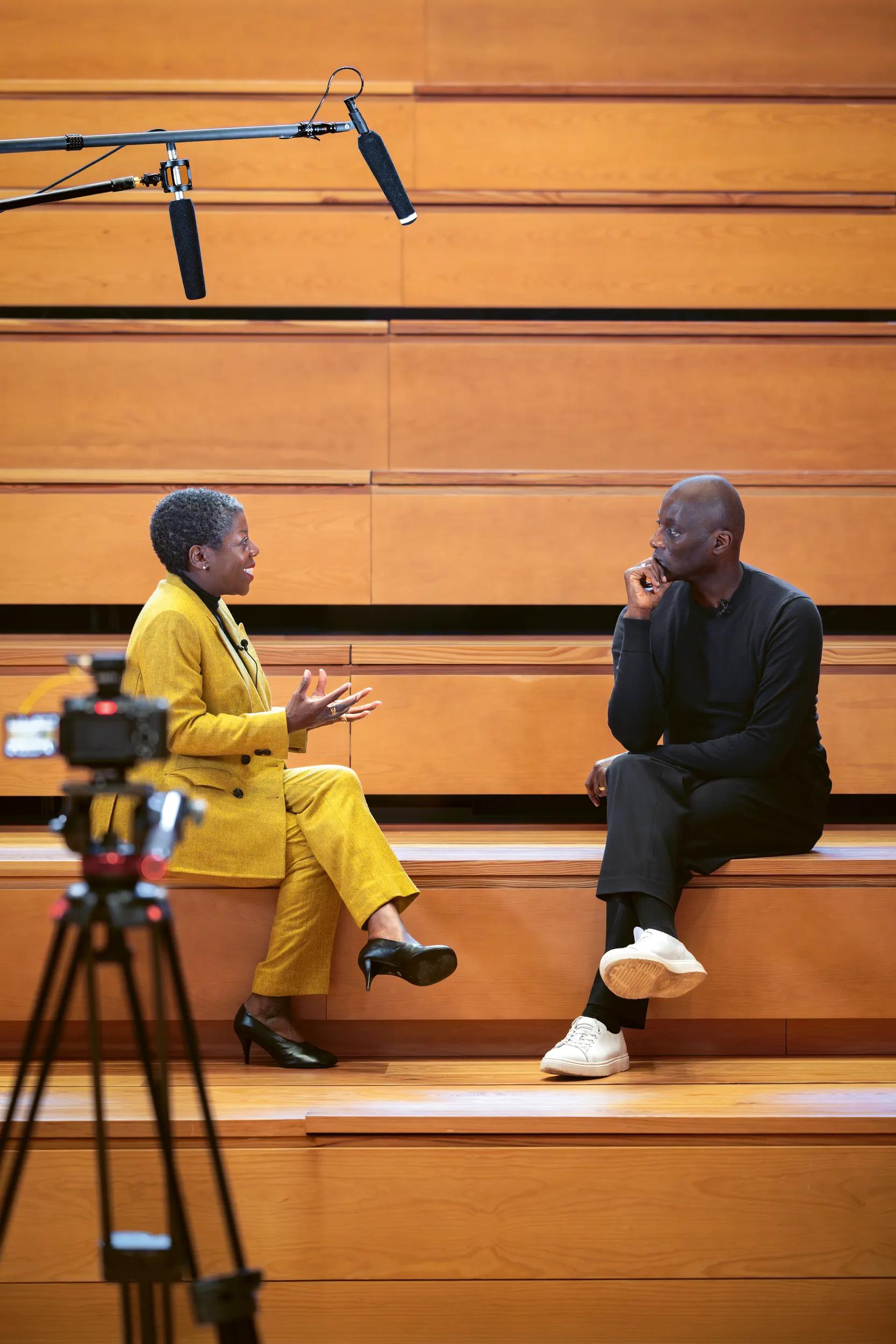
Thelma Golden and Ekow Eshun at the Studio Museum in Harlem, New York, 2026. Photo: Beatriz Meseguer / On White Wall
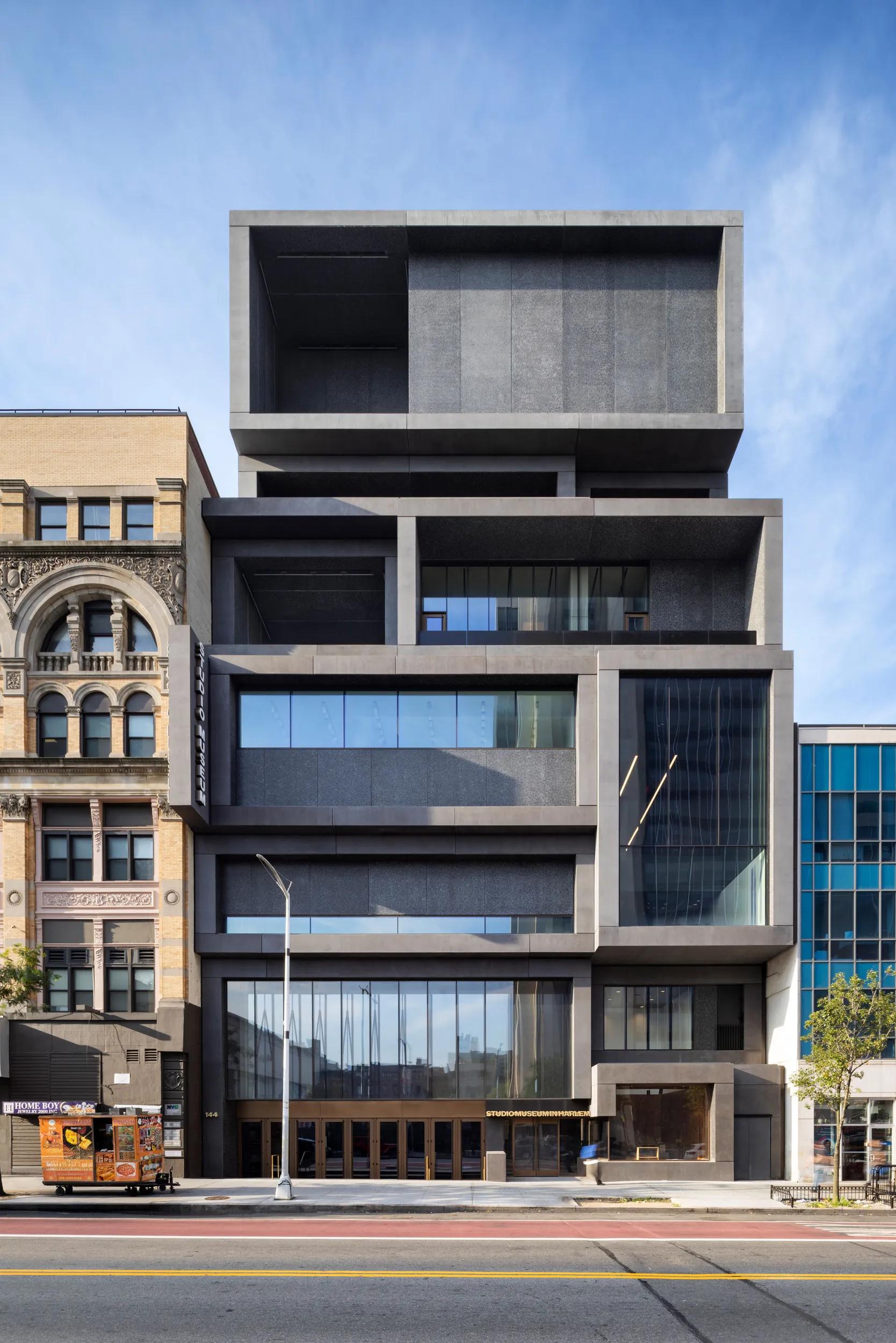
Exterior view of the Studio Museum in Harlem’s new building. Photo: © Albert Vecerka / Esto. Courtesy Studio Museum in Harlem
“We all are informed by art, we all are informed by culture. And quite often it comes in this way, as a gift from someone else.”—Thelma Golden
TG: It was a passport for me. I was a transfer student. I entered the school in tenth grade and entering at that point, with other students who’d been there together forever, was not smooth for me. I did not feel a part of the life of the school at all. My teacher also told me later in life that she could already see the ambitions I had for myself. That combination made her say, “Come see me.” That teacher, Verne Oliver, was an African American woman who was educated at Howard University, a historically Black university in Washington, D.C. When she was head of our school in the early ‘80s, she was one of the few African American women running a New York City private school. She offered me the opportunity to understand that academic life was not just one that was bound around classes and grades and the SATs. She was creating an intellectual life rooted in Black culture. That was a gift that I can never repay her for.
I remember reading Invisible Man and not understanding very much of it, at least not in the way that I understand it now. What I did understand were the conversations that we had, and how she used the book not only as a way for me to understand the African American experience, but to begin to understand my own. I think back to this often—it helped me think about the ways in which we all are informed by art, we all are informed by culture. And quite often it comes in this way, as a gift from someone else. That was my gift from Verne Oliver.
EE: As a curator, you’ve had a singular role in helping build the careers of Black artists. How do you think about exhibitions as platforms for introducing and holding culture, and also as ways to explore ideas about representation and place and being?
TG: I think of exhibitions as an important way to create and form narrative. For me, as a curator, they have been a way not simply to answer questions, but also to ask them. The hope is that those questions prompt a dialogue. I know there’s a certain idea now in curatorial practice about making definitive statements. But I have never looked for definitiveness as much as I have always been invested in openness. I think about the fact that exhibitions that I made thirty years ago are still being discussed, and they’re often being discussed in different ways than they were at the time. I love that because it adds to the narrative.
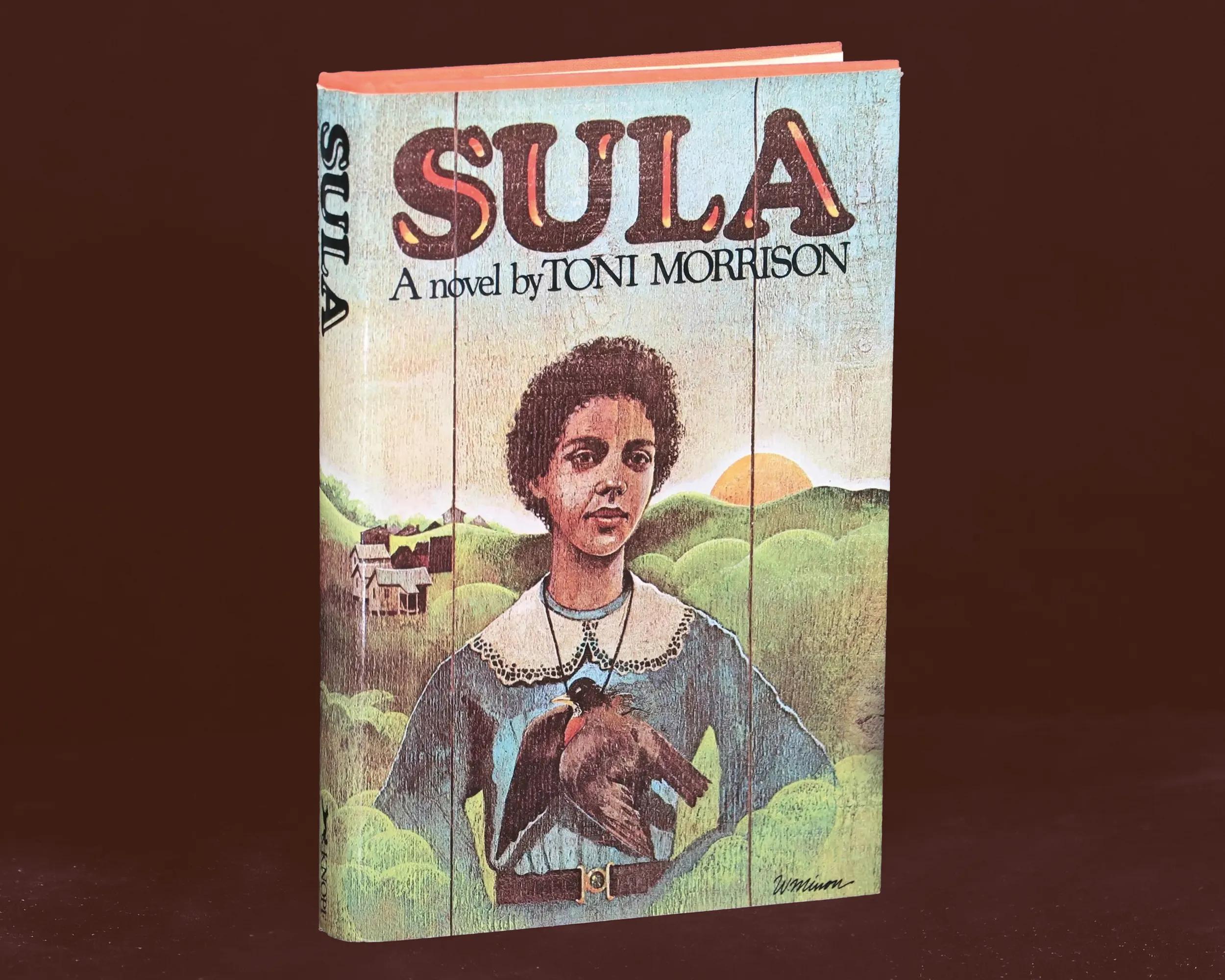
Cover of the first edition of Toni Morrison’s Sula, 1973. Courtesy the publisher
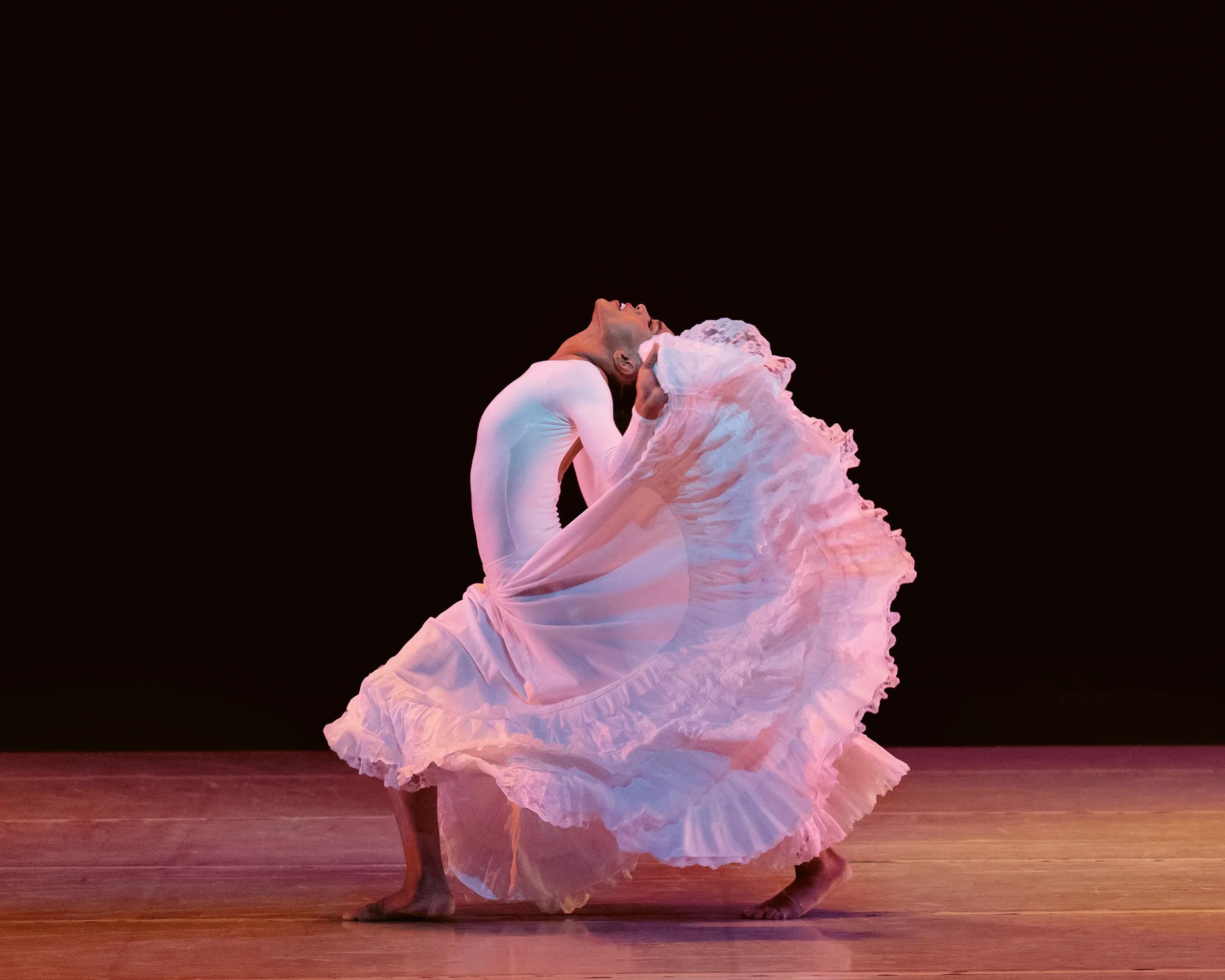
Alvin Ailey’s Cry with performer Samantha Figgins, Alvin Ailey American Dance Theater, New York, 2025
EE: You’ve worked across a remarkable range of roles: curatorial work, museum leadership, roles at foundations and other civic institutions. Which of your core principles have remained constant across these, and how has moving between these roles reframed your thinking?
TG: I think I actually exist the same way in all of those roles, and that is as someone who is guided fully by a deep passion for—and by my own sense of the power and possibility of—art. That’s what’s made it possible. I often see my role refracted through all these lenses, and they’re all the same, right?
EE: How do you maintain equilibrium?
TG: Well, I think I maintain equilibrium because at the core, I am the same person I was in fifth grade. The same person who is deeply inspired by art and artists. That’s how I am always able to center myself.
EE: The title of this series of interviews is The Art That Made Me. Could you talk about any figures or works that have inspired you or influenced you? These don’t necessarily need to be from the visual arts, but from art and culture more broadly.
TG: So many. We could start in my childhood. My parents were invested in the ways in which culture, particularly African American culture, was able to teach us and allow us to feel and experience Black history. So I grew up going to the Negro Ensemble Company and the Alvin Ailey American Dance Theater. I grew up in a home where music was always playing: My father listened to jazz, my mother listened to R&B. And then hip-hop was being born right here in this city during my childhood, which was part of the formative years of both my brother and me.
My parents believed deeply in education. When I was young, they both gave me books that were important to them. The first James Baldwin book that I read was Go Tell It on the Mountain, from my father. From my mother, it was Paule Marshall’s Brown Girl, Brownstones. In many ways, I think that was a way for them to tell me about where they came from, and about our cultural heritage. I found it and understood it through these novels.
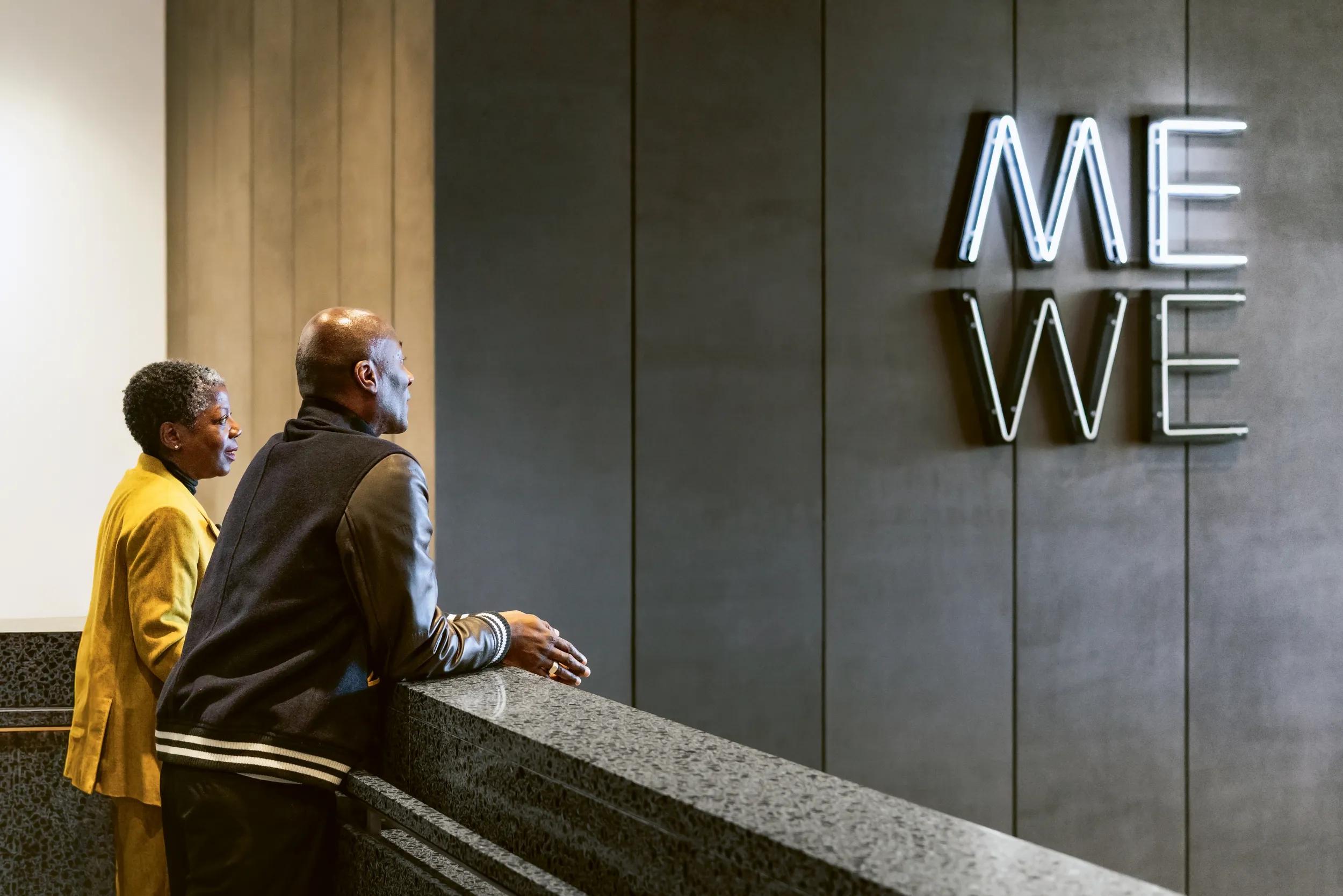
Thelma Golden and Ekow Eshun at the Studio Museum in Harlem, New York, 2026. Photo: Beatriz Meseguer / On White Wall
I also was raised on pop culture. The first time I saw a Black artist was through watching Good Times and seeing the character J.J.—whose work was created by Ernie Barnes, an artist I had the pleasure to meet and know when I became a curator. But as a child, watching that amazing show, created by Norman Lear, and watching J.J. pursue an artistic career clearly was an early influence on me.
By the time I got to college I knew I wanted to be an art history major, but I double majored in African American studies and that’s where I engaged more deeply in a canonical study of African American culture. In those years, I had the privilege—another gift—of being a student of James Baldwin. I sat in a classroom with him.
Of course, as director and chief curator of the Studio Museum, I have the immense privilege of maintaining a rich, sustained engagement with the remarkable works of art that make up this museum’s expansive permanent collection, all of which speak to the depth and breadth of art by artists of African American descent and to our mission more broadly. I’m thinking, in particular, of Faith Ringgold’s Echoes of Harlem, which represents the varied lives and life stories that make up this vibrant neighborhood. Glenn Ligon’s Give Us a Poem, a neon light sculpture that alternately flashes “ME” and “WE,” also remains top of mind. This sculpture was made for the lobby in the museum’s old building, and today it hangs in the lobby of our new, purpose-built home, imbuing our museum with a sense of familiarity. It also speaks to the ways in which the individual and the collective inform and often make up one another—an ethos the museum believes in and reaffirms through its various programs. Lastly, there’s Barkley L. Hendricks’s glorious portrait Lawdy Mama, which in so many ways redefined the contemporary art canon by asking viewers to reconsider the icons of the Byzantine and Renaissance eras, elevating everyday Black women to the divine. In these ways and so much more, my entire life has been shaped by works of art that I continually return to.
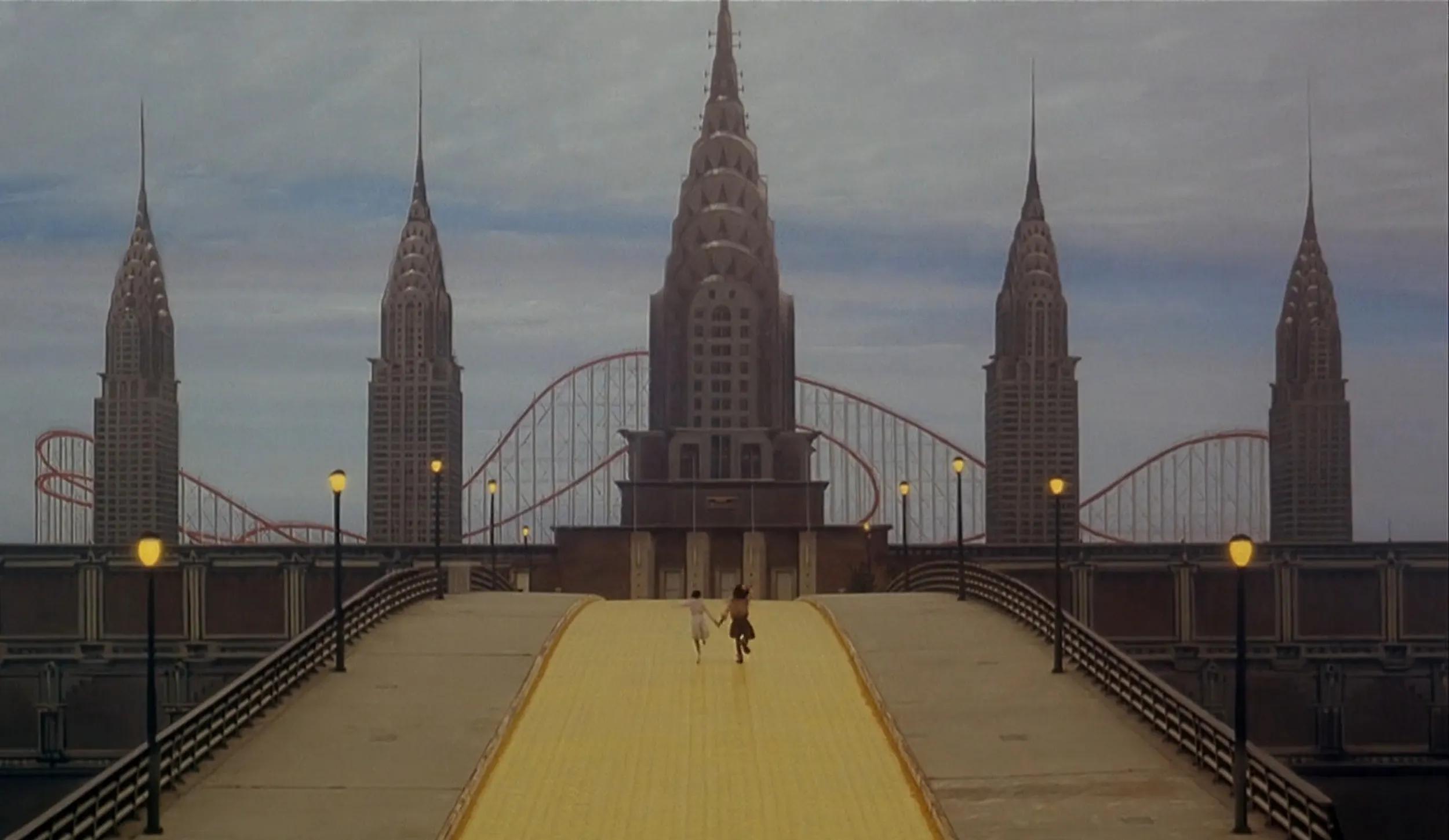
Still from The Wiz, 1978 © 1978 Universal City Studios, Inc. Courtesy Universal Studios Licensing LLC
“I wanted to spend my life in spaces not only with art but with people and art. That’s what made me want to pursue a career in this field.”—Golden
EE: If you had to pass on any works, books, music, to someone else, to other generations, what would you name?
TG: Oh, gosh. If I imagine what those might be, I end up tracing these different moments through my young adult life. There is Toni Morrison’s novel Sula and Monet’s Water Lilies as they existed, and still do, on the walls of MoMA. Joni Mitchell’s album Blue, which I played on repeat through all four years of college. There is Alvin Ailey’s epic work Cry, which I will never miss an opportunity to see. Then there are more contemporary works, like Lin-Manuel Miranda’s Hamilton. I’m continually amazed to rediscover my relationship to works that I think about in my memory and then come back to them as an adult, like the movie The Wiz.
I saw The Wiz as a young person. It came out in 1978. I had already seen The Wizard of Oz and understood its transposition into Black culture. I didn’t have a full sense of the iconography, but it worked on me in such a deep way. And it’s only with time—and repeated viewings—that I realized how much that film helped me commit to a worldview that understood the power of Black culture.
EE: Were there any transformational moments when you were in your twenties that shaped your aspirations in art?
TG: I was in high school in the early ‘80s. I went to school on 77th Street in Manhattan and at that time the Whitney Museum of American Art was on 75th. I went there sometimes three, four times a week after school. I saw the 1981 and 1983 biennials over and over again. By the time I was in college, I had fully articulated my aspiration to be a curator of contemporary art at the Whitney Museum. That was my goal. I graduated from college in 1987. By 1989, I was working at the Whitney as an assistant on the 1993 biennial, on a team with Elisabeth Sussman, Lisa Phillips and John Hanhardt. So that period, my late teens into my early twenties, was a time of intense becoming. So much of what I was feeling, thinking and experiencing went into those exhibitions. When I revisit them, I am so profoundly struck by that fact.
EE: Does the work of artists still surprise you?
TG: Oh, absolutely. If it didn’t, I don’t know that I would be able to continue to think in the ways that I always have as a curator. I’m also deeply heartened by the fact that I have relationships with works of art that are decades long, and that I can go back to a point in time or a source of inspiration that’s profound. But at the same time, I walk into studios and exhibitions all the time and I am surprised, and that is equally inspiring.
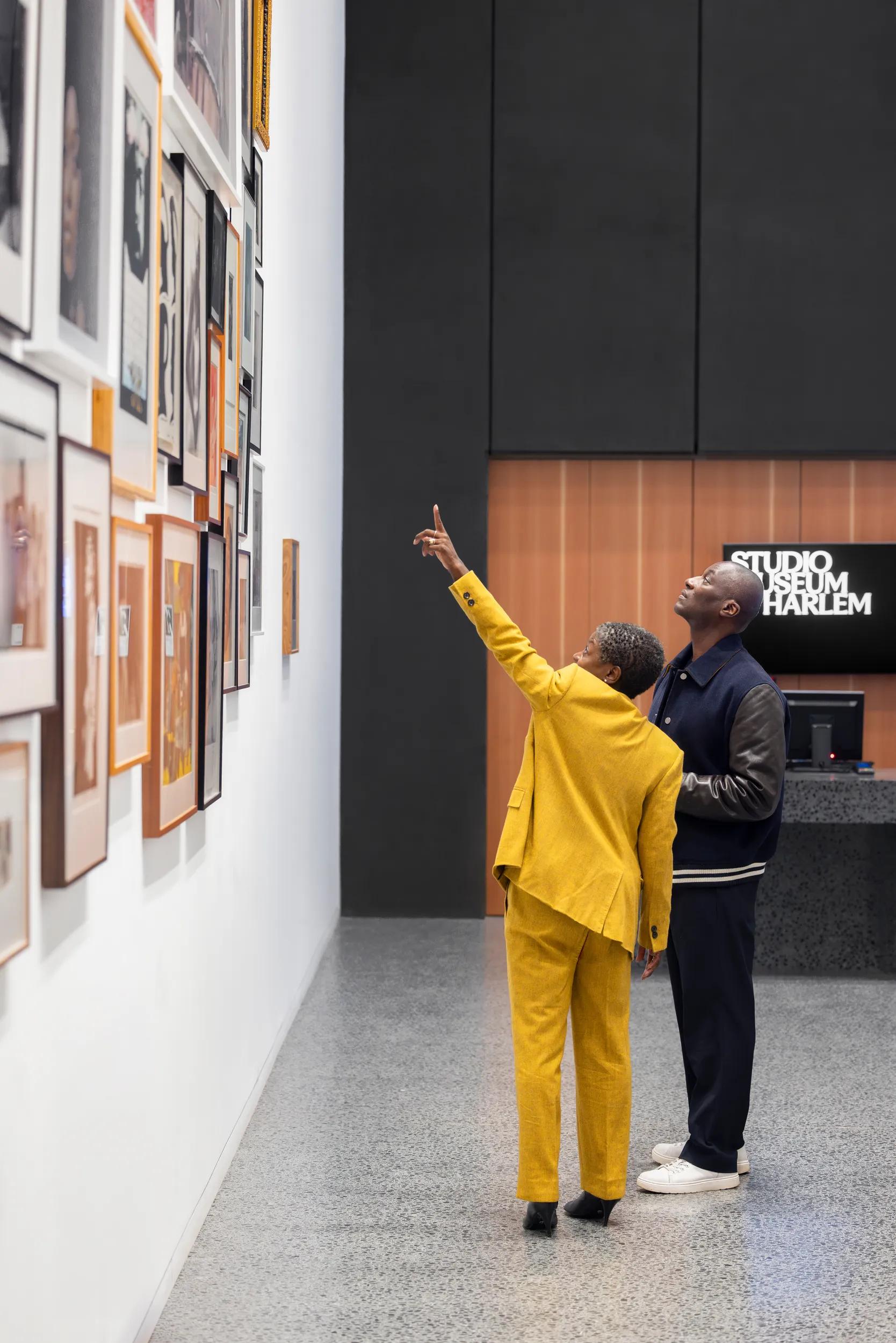
Thelma Golden and Ekow Eshun at the Studio Museum in Harlem, New York, 2026. Photo: Beatriz Meseguer / On White Wall
EE: In June, you’ll join Michael Govan in conversation for The Genesis Talks at LACMA to reflect on what it means to lead museums in this era. The Studio Museum recently reopened its new building, after being closed for seven years. As this museum enters a new chapter, how does this moment register culturally? How might museums respond to these changing times?
TG: I have taken an incredible amount of inspiration from our founding. The Studio Museum opened in 1968. Our founders had a very bold vision in the midst of the political turmoil that was underway at that time in this country, in this city, in this community. They understood that the fight for liberation necessitated thinking about the arts at the center, and that’s what drove the founding of this museum. I see how they understood that they needed to be guided by the moment but also needed to create a place and a space for the futures that could be imagined. And I think that’s what it means to be opening now. We very much believe that we are creating a space for an important dialogue with ourselves, with each other, with the past, with our present, but we’re also creating a space informed by the vision and voices of artists to be able to chart new futures.
EE: What conversations do you believe we need more of in the years ahead? And where do you see the greatest opportunity for those conversations?
TG: I think we need more conversations that allow us to hold complexity with each other in ways that are bound by respect and understanding. And I think we need more places that allow that to happen. For me, museums are an ideal place because they give us, through our engagement with art, an opportunity to analyze and learn from the past, but also to sit in our present in ways that are often not possible in our day-to-day lives. I love the way that being in a museum often shifts our space-time continuum. We can walk through them quickly and allow ourselves a small amount of engagement or lose ourselves in one work, one idea. But most importantly, we can do that in community. The community that can happen in museums is one that formed me as a young person and one that I have been so privileged and proud to be able to form, to be able to make over these decades that I have worked in museums, and particularly in the quarter century that I have been here at the Studio Museum.
–
The Genesis Talks is a public program at LACMA that brings director and chief executive Michael Govan together with some of the most influential artists, architects and cultural leaders shaping how we see and experience art today.
Reflecting a commitment to authenticity, Genesis seeks to foster dialogue on issues that transcend spatial and temporal boundaries, inspiring people to discover the profound through the arts. Genesis Art Initiatives supports institutions and visionaries with an understanding of contemporary challenges and timeless values. To learn more, follow #GenesisArtInitiatives
–
Ekow Eshun is an author and curator. His book The Strangers: Five Extraordinary Black Men and the Worlds That Made Them was published in 2025. He was the curator of the 2025 exhibition “Black Earth Rising” at the Baltimore Museum of Art. Eshun was awarded an OBE in December 2025 and was recently appointed curator of the 13th Site Santa Fe International Biennial, opening in summer 2027.
Thelma Golden is the Ford Foundation Director and Chief Curator of the Studio Museum in Harlem, the world’s leading institution devoted to visual arts by artists of African descent. Under her leadership, the Studio Museum has gained renown as a global leader in the exhibition of contemporary art and a cultural anchor in the Harlem community.