

Fiction
The Parisian Heist
An exclusive preview of a forthcoming novel by Jo Piazza
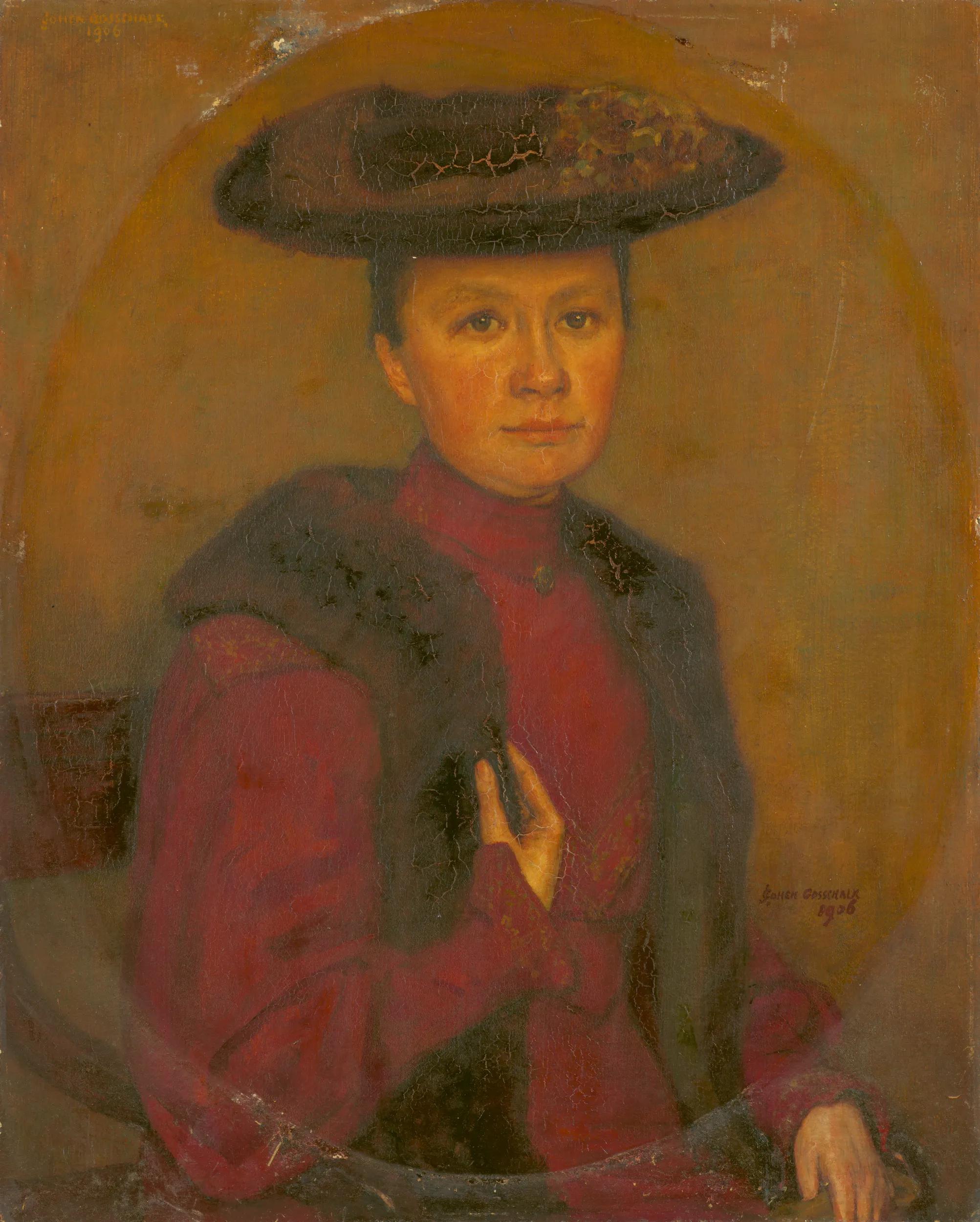
Johan Cohen Gosschalk, Portrait of Jo Cohen Gosschalk-Bonger [Jo van Gogh] in a Red Dress, with a Fur Hat and Shawl, 1906, Oil on canvas, 50 x 40 cm. Van Gogh Museum, Amsterdam (Vincent van Gogh Foundation)
Ursula is pleased to present an exclusive excerpt from The Parisian Heist, the forthcoming novel by international bestselling author Jo Piazza, to be published by Penguin Random House in July. This excerpt is the novel’s first chapter. The fictional work unfolds across two timelines, moving between the present-day Paris art world and the late 19th century, when Jo van Gogh was working to secure her brother-in-law Vincent’s legacy. As ambition and betrayal thread across centuries, the story builds toward a high-stakes crime inside the Musée d’Orsay.
Claire
1891
I’ve been watching her for months. I know her habits, her routines. I know she leaves in the morning to fetch milk for her son, takes him with her to meetings throughout the day. She returns home at night looking bone-tired and defeated.
Her husband, Theo, begged me to check in on her, to try to protect her.
But for months I only watched.
The night I properly meet Jo van Gogh is the night I save her life.
It’s late, but I have only just finished with work. When I walk past her apartment, I notice candles burning in the window. As I shift my gaze down from the attic flat, the door to the street opens and a hooded silhouette slips into the entryway. The apartment still burns bright, but it is Jo’s tiny figure slowly stumbling over Pigalle’s cobblestones. I follow in silence. Why is she leaving so late?
Jo hesitates at the corner and continues uncertainly up the hill toward the unfinished dome of Sacré-Coeur on the Butte Montmartre. It is the time of night when even women like me are usually in bed, the hours when the streets are turned over to stray cats and men intent on bad deeds and harm. On this night in particular the city is filled with a certain bloodlust. The papers have dubbed it guillotine frenzy, as today was the public execution of a notorious murderer, one whose crimes have been well documented and much gossiped about throughout Paris. His beheading in the Place de la Roquette was attended by thousands, a jeering and enthusiastic mob of mostly men who then retired to the bars and brothels, bloated with savage hunger.
A hulking figure emerges from the darkness of a doorway and grabs Jo by the arm. The man is massive, and even from a distance I can tell he is intoxicated. Jo attempts to shove him away, but he slaps her face with an open palm, sending her reeling to the ground. At this time of the night he must have assumed she is a worker like me. No proper lady would be out alone at this hour.
He yanks her tiny body into an alley. My heart gallops against my ribs. I glance around for anyone to help her, but the streets are empty, the bars and cabarets dark. This man will be able to do whatever he wants with Jo and leave her for dead.
Jo screams out in pain. “No! Stop!” My eyes finally land on a shattered wine bottle, the long neck intact but the bottom a thick, sharp shard. It will have to do. As I slide around the corner, the man is pinning her small frame to the wall and hiking up her skirts as his thick fingers wrap around her delicate throat. I don’t think twice before lunging at his side with the bottle. He startles and wails in pain as the glass slices into his abdomen.
“Run!” I scream at Jo.
The monster is injured and shocked, his ugly features contorted in fury. Jo manages to slip from between him and the wall. Our eyes meet and she takes off. I spin on my own heel and follow, leaving the brute to bleed in the alley. The bottle did not make it that far beneath his skin. He will live. Unfortunately.
My ankle twists on the uneven stones and I collapse. Jo turns at my cry and hesitates before doubling back to help me up.
“You saved my life,” she rasps in disbelief, her gaze darting in the direction of her attacker.
I’m in too much pain to speak. Jo slings my arm over her shoulders as if she is an expert at lifting others. I wonder how many times she had to lift a weakened Theo into bed before he was put into the institution.
“Where do you live?” she asks in her husky Dutch accent. “Can I get you home?” I nod up the hill in the direction we’d come from.
“That will be impossible. He will be waiting there for us.” Jo shakes her head. “But I think I can get you to my place and look at your leg.”
Together we make it up her stairs into her small and cozy flat. It’s only a few rooms. The floors are rough, the wood planks slightly slanting to the south. A thick, dusty curtain separates the sitting room from the hallway leading to the bedrooms.
She leads me to a sofa and removes my battered boot with the care of a mother. I look away from her in shame. The sole has begun to peel away and there’s no money to have a new one put on. The madam I work for keeps all of us in fashionable dresses and lingerie, but walking shoes are an unnecessary expense for her. Beneath the leather my ankle is red and angry.
“You will need to elevate this, and I can bind it,” Jo says. “When the swelling goes down we shall put your boot on as tightly as possible and you should be able to make it home. I can give you some sherry for the pain.”
“Thank you,” I say, considering all her features up close for the first time, her broad face, apple-dumpling cheeks and strong nose. She is a tiny thing, frail like a baby bird. Purple bruises bloom against the pale white of her neck.
“I am Jo,” she finally introduces herself as she wraps my ankle in a brightly patterned silk scarf.
“Claire,” I say.
My name inspires no recognition for her. I shouldn’t be surprised. Theo wouldn’t have spoken of me to his wife. “Why were you on the streets so late, Claire? I am grateful, but surprised that anyone was awake to find me.”
“I could ask the same of you. Why were you walking so late?”
Jo glances down the narrow hallway and I hear a muffled wheeze. “My boy is sick. I was hoping to reach the midwife’s home to see if she could prepare something for his cough. He’s barely more than a year old.”
Vincent. Her little boy, named after his uncle the artist. Theo had been overjoyed when Jo delivered a son. I remember him telling me what a gift the boy had been to both of them as his own health declined.
I want to give her a more noble reason for my being out in the middle of the night, but there is not one. I was there for her, watching for her. There is another truth I can tell her. I’m not proud, but also not entirely ashamed. “I was returning home from work.” It takes Jo a minute to understand and I wait for the disgust to cross her face, but it never comes.
“You should not walk alone so late.” Jo pours the two of us generous glasses of sherry.
“Neither should you.”
“I know.” She sighs. “But lately I’ve found myself wandering more than once in the middle of the night. My husband passed some months ago and sleep has eluded me. I stay awake and worry. I walk and think perhaps I will never return, but my boy needs me.”
I want to hear about her boy. I want to hear about her. I miss Theo in ways I should not, but I cared for him much more than I should have. Whenever we spent time together, he confided in me. Not all of my customers want to talk, but many do. They pay for the conversation, camaraderie, and care as much as they pay for the other things. Many times talking was all Theo wanted to do when we were together. He longed for a woman’s opinion about Jo before they married. He was desperate to be a good husband to this woman he was completely enchanted by. He stopped seeing me once she moved to Paris, but I worried for Jo when I learned of Theo’s confinement not even two years later. He sent word for me from the institution in Utrecht. And I scraped together money to make the long trip to Holland to see him. It was the first time I’d left Paris. His official diagnosis had been dementia paralytica, caused by a type of syphilis. His pupils were small and unequal and they’d tied him to his padded cot to protect him from his seizures, but he was in a state of reasonable calmness when I arrived and confided in me that Jo would be left with very little if he succumbed to his many illnesses. “You are so strong. You have built a life for yourself from nothing. Watch out for her for me, please,” he begged me.
“Of course,” I’d agreed. And now I’m here. But I have no idea how I can truly be of service to this widowed young mother.
Theo’s child coughs again in his sleep, and it echoes down the hallway. “Tell me about your boy,” I say to Jo.
“His name is Vincent. Named for an uncle who has also passed. He is the sweetest angel I could have asked for. When he stares at me, I see the eyes of an adult and I am certain he will grow up to be a great mind. I feel he is smarter than I am.”
“Then I’m sure he wouldn’t want you to go wandering through the streets of Montmartre at the withing hour,” I say with a gentle smile.
“No. I should not have gone. But that cough . . . I was not prepared to be doing this alone.”
“I am sorry for your losses.”
“Thank you. It has not been easy for me. My husband was a good man, but very ill at the end.” She stands then and walks down the hallway to open a door and peek inside at her sick child. When she disappears, I allow myself to look around. Barely an inch of wallpaper is visible between the many, many paintings hung from floor to ceiling. More canvases crowd every available surface, leaning against the walls and furniture. I even see some stacked beneath the couch. Most are signed with a single name—Vincent. I know Theo’s brother was an artist, not a terribly successful one, and that Theo worked as his dealer. Vincent also visited the brothel when he came to Paris, but I never spent time with him. He preferred the older and more domineering women. They always complained about how he would lecture them about how by visiting them he was giving the fallen women the opportunity for redemption through the cycle of sin and forgiveness. He was the subject of great mockery among the ladies. I also saw him once late at night at Café du Tambourin, my friend Agostina’s restaurant. She feeds us once the paying customers have retired. By the time I arrived that evening, Vincent was quite drunk, sitting in a corner, sketching and staring into the depths of a glass of absinthe. I noted how far the other patrons sat from the sturdy, broad-shouldered man. It was well-known, among the other prostitutes, that he rarely bathed and that his smell was often repulsive. Tina still had a soft spot for him and kept his paintings on her walls as a favor, she told me. He traded them for food. Years earlier they’d been lovers, but she put an end to it quickly. His manners were terrible, she said. He was too unpredictable and he needed too much of her that she wasn’t willing to give. But Tina gave Vincent space on her walls for his canvases, just in case they might catch the eye of some eager buyer. She maintained affection for him and his work. “There’s something about his paintings,” she said once. “I just don’t think anyone has truly seen it yet.”
The sherry is doing its job of taking away the pain in my ankle. I manage to stand when Jo returns.
“I should go.”
“Are you sure you are able?” she asks, clearly concerned.
“I am,” I say, though I know it will be a difficult walk back to my quarters.
She helps me with my coat and takes both my hands in hers. They’re so tiny and fragile. Soft and unmarred by labor. “Thank you for what you did tonight, Claire. You saved my life.”
Perhaps I have now fulfilled my duty to Theo. I could leave and never see her again. I meet her eyes with a warm smile. “I am happy I was there when you needed me. And thank you, Jo. It was wonderful to meet you.” I mean that more than she knows.
••
I stay away from her for a week after that and then finally return to the apartment to bring back the scarf she bound my ankle with. Jo welcomes me in for a bit of tea, but she is agitated. Her hands tremble as she pours me my drink.
“Are you bearing up?” I ask her.
“No. I cannot say that I am. I just returned from a most difficult meeting.”
“With whom? No. I am sorry. I do not mean to pry.”
“It is fine. You are not overstepping. I do not have anyone else to talk to here in Paris. Theo had many friends, but I am afraid I did not have many of my own besides my brother and his wife, and I fear I have exhausted them with my troubles.”
“I would love to hear more about the meeting you had.”
She sucks in a deep breath. “It is all worthless. Everything my husband left me. All of these paintings by his brother. Theo had such faith in Vincent. I assumed I could sell these and build a comfortable life for myself.” She is sobbing now. I reach over to place my hand on hers. “Some days I wish he had thrown them in the Seine and spared me the trouble of having to stumble around them in here. These paintings killed my husband, the stress of them, the stress of caring for Vincent.”
“His brother was also ill?” My throat tightens around the question I already know the answer to.
“Very much so. Also brilliant. I think. Oh, I do not know anything any longer.” A sob shakes her body. “In loving my husband, I had no choice but to love his brother. They were a pair, bonded more tightly than we would ever be, and I have to love these paintings as Theo did, because in loving them I can keep him alive.”
I stand and make my way over to the wall to stare at a painting of a lone peach blossom struggling in the wind.
“I think this one is beautiful,” I say.
Jo stands next to me and lifts her finger to trace the delicate boughs of the tree and the blossoms that appear so real they could fall off the canvas and into the palm of your hand.
“When I first saw his work, I thought they were such strange things. These paintings are supposed to make you feel many emotions all at once,” she says. “That is what Theo always told me art was supposed to do. For him, he said it often felt like listening to a great symphony —that the colors are like two melodies in counterpoint.”
“Do they? Make you feel that way?”
“I wish they made me feel more. I want to. Theo wanted me to.”
Another twinge of guilt strums at my heart because I want her to talk about Theo. I miss him and our conversations. He had seen me as a person who was worthy, and that was rare. It is obvious Jo wants to talk about him too. “What was your husband like?” I prod her.
“Before I met Theo, I believed I was completely ordinary and for that fact unlovable,” she says.
I didn’t expect her to be so honest. I also didn’t expect to relate to her so deeply.
“But Theo made me feel special,” she continues. “He could somehow put into words all the things he loved about me. He made little poems about the expressions on my face, the sounds of my voice, my helpfulness, my feel for goodness, my openness to both joy and sadness, and even the fact that I wanted him for a husband. He said he could hardly imagine that last fact because at times his head felt as though it were made of cork, and he was unworthy of me.”
I close my eyes, and I can hear Theo’s voice. He had also told me these things about Jo. You would think it could have made me jealous, but it was not like that between us. I believe we had both a business relationship and a friendship, nothing truly romantic. I like hearing her side of their love story now.
“Until I met Theo, I walked through life with my eyes half closed. It was he who opened them,” she says softly. “We were stronger together than alone, that’s what he always said, and he filled my days with great artists. He believed their sculptures and paintings had the ability to touch people’s souls. It was through these visits that I began to understand how the artists saw and felt things differently than the average person.”
“It sounds lovely.”
“It was. He was. We were used to each other from the very first moment I moved here. Nothing forced, nothing strange. I wouldn’t trade those happy days for anything. He used to tell me that we matched one another so well. ‘You’re a little woman made just for me,’ he’d say. And it was true. He helped me to find my way in what I found to be such an overwhelming world. Without him I am once again very aware of all my imperfections.”
“Will you stay in Paris?” I ask.
“We cannot. It isn’t just the money that is quickly running out or the unhealthy air in this apartment and this city that is bad for little Vincent’s lungs. As a widow I don’t have many options to make money.”
She pauses, embarrassed for me because she is clearly thinking of my line of work.
“We all do what we need to do, madame. Do you have family you can return to?”
“It is an option, though I do not want to return as someone who needs looking after. Thinking about it fills me with dread and exhaustion.” She sighs. She’s revealing so much, but I can’t say that I’m surprised. People want to talk. They’re desperate for an ear. “I should have planned better. We should have planned better. My son and I need so many things.”
Jo sits in front of the fire, shivering even as she gets closer to the flames.
“We’re nearly out of wood,” she says, her eyes glassy with tears and melancholy. They finally land on a canvas of a vast golden wheat field under a dark, turbulent sky. It gives me a feeling of both isolation and unease.
She picks up the painting so that it is at eye level and walks over to the fire. Her eyes flash with fury and fear as she stares into the dying flames.
“Perhaps I should just burn all of them for heat.”
–
Jo Piazza is an international bestselling author of twelve books, including The Sicilian Inheritance. She’s also the host of the critically acclaimed podcast, Under the Influence. Her work has been featured in The New York Times, among other publications. She lives in Philadelphia with her husband and three feral children.