

Essays
Witches All
In the Arctic Circle, Louise Bourgeois and Peter Zumthor hold ghostly vigil for the unjustly condemned
By Jane McFadden and Catherine Taft
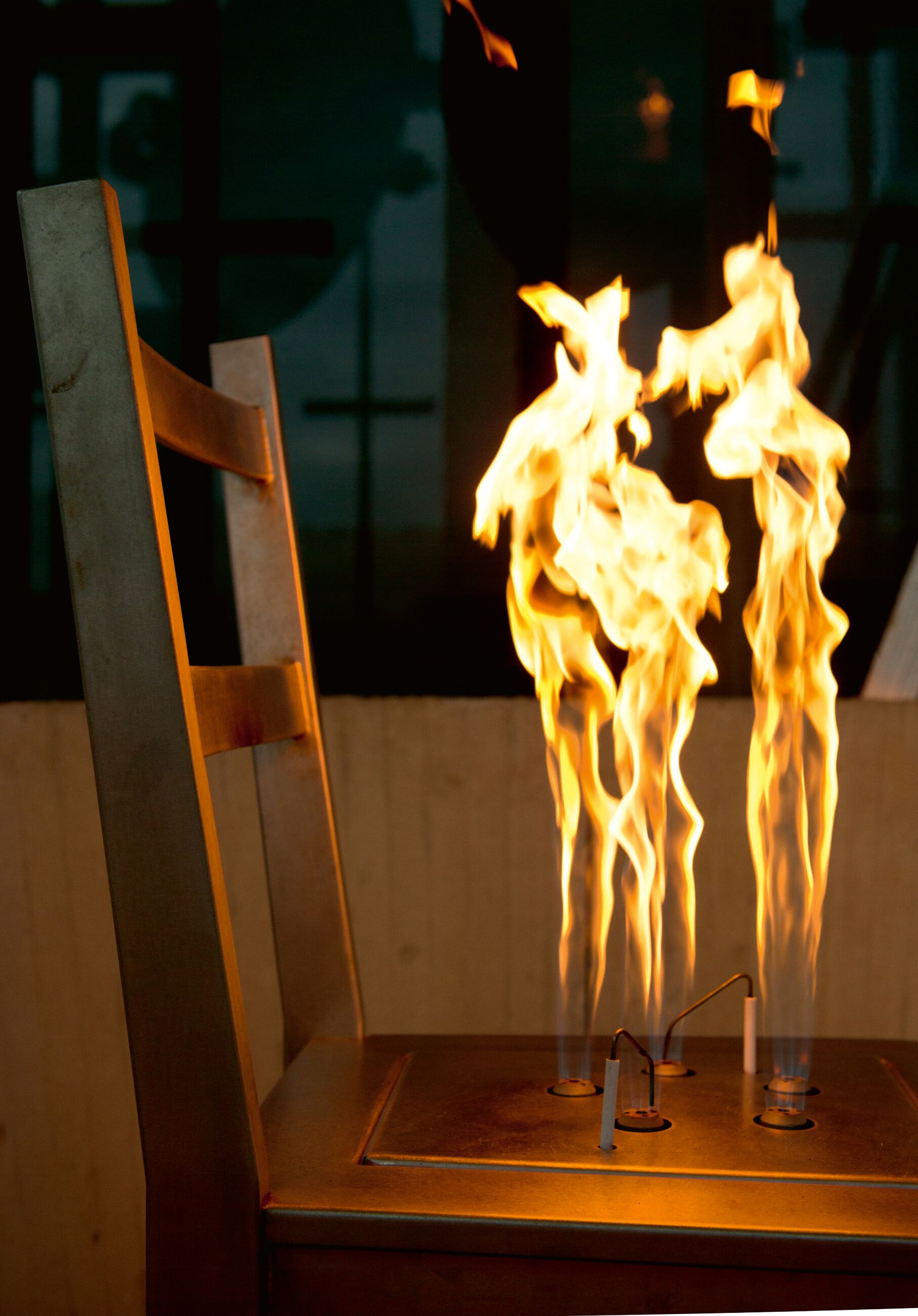
Louise Bourgeois, The Damned, the Possessed and the Beloved, 2010 (detail). Photos: Bjarne Riesto
We did not expect to see the floating flames—a witchy evocation if there ever was one. But looking out from Louise Bourgeois’s The Damned, the Possessed, and the Beloved (2010), we saw firelight shimmering on the glass walls of its pavilion and seeming to flare out into the Barents Sea. Looking out over the frigid arctic waters, we imagined the forsaken lives commemorated by these flames: Ninety-one people (mostly women and some men, including Indigenous people) executed for witchcraft in the Finnmark region of Norway some 400 years ago. The fatal choice of the accused? To sink and drown or to float and be put to death at the stake. And herein lay our first dilemma: We had traveled here to remember those persecuted as witches, yet we ourselves were tempted by the witchy. The condemned, we know, were executed for a variety of crimes we might commit ourselves—those of independence, of knowledge (that of healer or midwife), of sexual desire or even of simple need for community aid. Who among us would survive?
Situated within the Arctic Circle on Vardøya—a vaguely Rorschach blot-shaped landmass that includes the 300-acre town of Vardø—The Damned, the Possessed, and the Beloved sits as close to the end of the earth as one can possibly imagine. Vardø is farther east than Saint Petersburg, Kyiv and Istanbul and is neither easy to reach nor traditionally scenic by the standards of Norway’s fjords and vistas. Unveiled in 2011, the memorial is a collaboration between the Swiss architect Peter Zumthor and Bourgeois (1911–2010). It was Bourgeois’s last major artwork.
Arriving on Vardøya is like finding yourself lonely and adrift. Our group of four—a coven of sorts comprising artists Francesca Gabbiani and Connie Walsh, art historian Jane McFadden and curator Catherine Taft—approached by sea in the long, gray light of midsummer. The landscape was punctuated by a dramatic church steeple, the satellite dishes of an unmarked government research facility and a mural reading, “Make the North Great Again.” In the 19th century, the area was a booming fishing village and market center that served as a long-standing barter crossroads for Sámi, Russian and Norwegian travelers. Now, the town of roughly 1,700 inhabitants is economically depleted but still fiercely safeguarded by its impassive citizens (some of whom trace their ancestry to victims of the Finnmark witch trials).
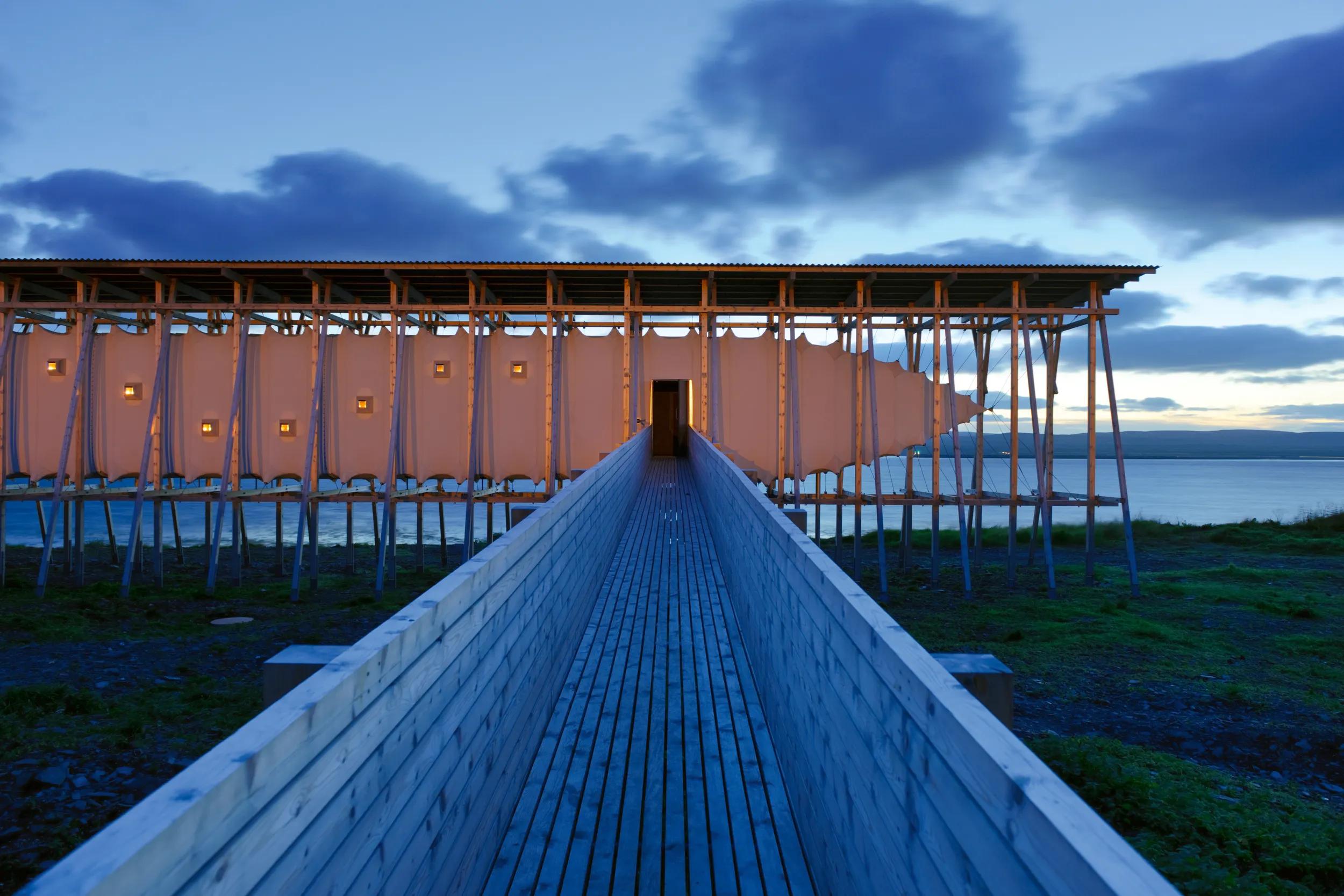
Peter Zumthor’s memorial hall, 2011, Steilneset Memorial, Vardø, Norway
Our first visit to Steilneset was more intimidating than we expected. We approached Zumthor’s idiosyncratic structure—a fabric tunnel approximately 400 feet long, suspended inside a pine-beam scaffold—from below its exterior belly. From our vantage point, its form echoed the seafaring cultures of the region, suggesting both a boat and the horizon; it also evoked the nearby fish-drying racks crucial to the local economy for centuries. Standing back from the structure, we saw small, square portholes cut at varying heights, creating a kind of waveform along the two exterior facades. Looked through from the inside, these ninety-one oculi reveal narrow views of the arctic landscape: from one side, the town’s old church and cemetery; from the other, the ocean’s black depths.
On either end of this structure are narrow wooden ramps, seemingly one-way paths that recall the chutes along which animals are led to slaughter, or planks for boarding ships. At the top of one ramp, we opened a heavy steel door, which slammed shut behind us, and entered Zumthor’s dark hall. The interior evoked the “witch’s hole” of historical legend: a dark, claustrophobic prison space where women were held indefinitely while awaiting trial for their transgressions. We strained to see out, feeling bound within the space. Inside, we also got the facts: a chronology of crime and punishment narrated in Norwegian on silk banners that hang along the narrow corridor. Victims’ names are listed, dispassionately, along with the accusations against them, the improbable confessions forced from them and their sentences. An English guidebook translated from Norwegian catalogued the offenses:
Mari, Østen’s wife
Brought before the court at Vardøhus Castle on 31 July 1638
Accused of having cast a deadly spell on Oluf Pedersen and his four men sailing eastward in 1636 […]
Confessed that she was in the likeness of a white swan on that occasion
Convicted of practise of witchcraft
Sentenced to death in fire at the stake
The condemned, we know, were executed for a variety of crimes we might commit ourselves—those of independence, of knowledge (that of healer or midwife), of sexual desire or even of simple need for community aid. Who among us would survive?
Other offenses included floating on water; conducting evil deeds “by tying, and then undoing, knots on a piece of string;” transforming into animals; dancing and allegedly cursing others with illness and death.
If Zumthor sets the historical scene as a kind of boat adrift on a stormy sea, Bourgeois calculates the precise psychological cost of the binds placed on women by the patriarchal state. Adjacent to and visibly intertwined with Zumthor’s tunnel is the smoked-glass pavilion Zumthor designed to house Bourgeois’s The Damned, the Possessed, and the Beloved. This crystalline cell contains a metal chair in the center of a truncated concrete cone. Rising from the seat of the chair, five flames burn continuously. Seven large mirrors ominously surround the space above, reflecting and distorting the fire below. They remind us that we are not just witnessing the pain of history but living it. “Don’t kid yourself,” as Bourgeois liked to note.
She began making Cells in the early 1990s, a series of elaborate and psychologically charged spaces. Often featuring found chairs, symbolic stand-ins for the body, these constructions were a form through which Bourgeois explored pain in its multiple dimensions. A cell is the biological building block of life and also the essential unit of a prison. Bourgeois’s Cells are both sculpture and tableau. At Steilneset, the tableau is pared down to a few discrete parts, evoking a hut on a hill, a type of domestic alternative to Zumthor’s vessel. The chair in this case is not a found object; it is slightly larger than a regular adult-sized chair and is constructed to withstand the heat and elements. It is also unreachable within the concrete ring that encircles it. Centered in its forty-foot-tall glass cell, Bourgeois’s form serves as both a funerary monument and a judgment seat of history.
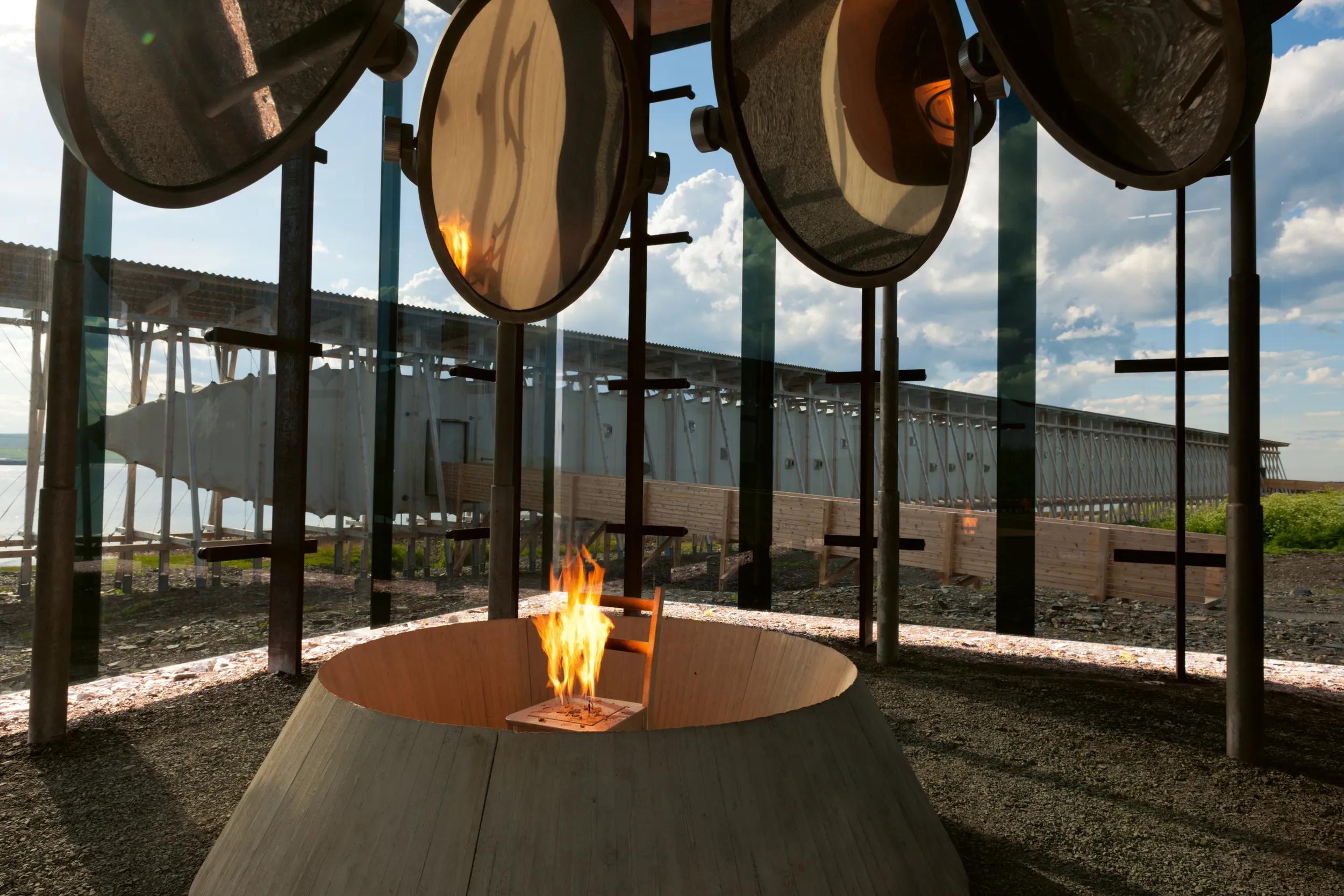
Louise Bourgeois, The Damned, the Possessed, and the Beloved, 2010, foreground, and Peter Zumthor’s memorial hall, 2011, in the background, Steilneset Memorial, Vardø, Norway
Rising from the seat of the chair, five flames burn continuously. … They remind us that we are not just witnessing the pain of history but living it. “Don’t kid yourself,” as Bourgeois liked to note.
The collaboration between Bourgeois and Zumthor allows us to think about how best to remember and reconsider the darker moments of our collective histories. One’s time with memorials is often contained and temporal, a symbolic pause before turning back to the larger world. But Steilneset makes additional demands. Its architecture ingests your body, holds you captive and puts you on trial. The memorial holds you between the terra firma of reality and the gentle disorientation of some otherworldly dimension. As Zumthor has said: “The real has its own magic.… What I’m talking about here is something I often find even more incredible: the magic of things, the magic of the real world.” Indeed, the “magic” that made women into witches at this very site was nothing more than the real world slipping ever out of human control. “I am also a witch!” Bourgeois noted while working on the project at the end of her life, no doubt thinking of both the distortion of the everyday and the alchemy of art itself.
What one comes to understand when learning about the sociocultural moment of witch hunts here is that women—left alone when their partners died or went to sea—became scapegoats, blamed for the harsh life of this barren realm. Local Indigenous cultures were persecuted as well. Climate scientist Kate Marvel has hypothesized:
In the late 16th century, the winters in Europe were so cold that birds froze and fell from the sky.… In the Northern regions, advancing glaciers swallowed farmland, and everywhere shortened growing seasons caused food shortages and famines. Like suffering people everywhere, they were looking for someone to blame. To many 16th century Europeans, the culprit was obvious: witchcraft.
Linking the witch scares in northern Europe to the Little Ice Age—a period of global cooling that took place from the 1300s to the early 1800s—we can consider the ways in which women shouldered blame for the weather as a sign of greater historical anxieties. With the emergence of capitalist culture in this same period, the material and social form of the female or minority body was controlled and its relationship to capital and knowledge curtailed. As theorist Silvia Federici has observed: “The threat of being burned at the stake erected formidable barriers around the bodies of women….”
In Vardø, conditions of the land and control of bodies seem inextricably intertwined. Even though we traveled in 21st century comfort and visited in the middle of July, we could sense the power of the land, where any shelter was a relief. The Indigenous Sámi people of this region have known this all along: The land is a body. Sámi artist Jenni Laiti and activist Victoria Pratt have written: “The land and the body are sites of simultaneous land-based violence and we feel the land-body trauma in our bodies, because we are the land, land is us.”

Steilneset Memorial, Vardø, Norway
What one comes to understand when learning about the sociocultural moment of witch hunts here is that women—left alone when their partners died or went to sea—became scapegoats, blamed for the harsh life of this barren realm.
As human-caused climate change accelerates, the Arctic is warming four times faster than the rest of the planet, and the glacial landscape is disappearing. It is grieved by its inhabitants as a battered body might be. Laiti and Pratt, like others, see art as a vehicle for collective grief and healing, writing that through it humans can “create another world beyond destruction, loss and crisis.” In this sense, Bourgeois’s epic sculpture might be read as both tribute and cure, a remedy to systems of power that continue to operate on the land and its historical subjects. She breaks the autobiographical binds that critics so often placed upon her, bringing us all into a process of guilt, pain, mourning and transmutation.
Bourgeois commemorates the sorrow of each individual victim and of us all. Yet, as the work’s flames flicker across the tundra and the sea, beauty also becomes apparent. The three words of the work’s title—damned, possessed, beloved—echo Bourgeois’s mantra: I do, I undo, I redo. And so do we, here, undo and redo our relationships with place, art, self, history and violence. Our visit to the site, otherworldly and breathtaking, was not so much about the commemoration of history as about making connections across time.
Bourgeois—ever the nonconformist, evading tidy categories like “feminist” or “modernist”—is hauntingly prescient in our fraught political present, reminding us why and how we might let our friends, neighbors, children and mothers burn. The destructive ignorance of the mob echoes across centuries, as does the figure of the witch itself. We must ask ourselves again: Should we cast off or embrace the difference, difficulty or disagreeability that the witch suggests? Bourgeois herself seemed to offer an answer during a 2008 interview: “It is difficult to be a woman and be likeable … how are you going to be likeable and be yourself?”
–
This essay is adapted from Jane McFadden and Catherine Taft’s Life on Earth: Art & Ecofeminism, forthcoming from Inventory Press in spring 2026.
“Louise Bourgeois: Gathering Wool” is currently on view at Hauser & Wirth New York 22nd Street.
–
Jane McFadden is an art historian who serves as dean of interdisciplinary studies and a professor of humanities and sciences at ArtCenter College of Design. Her book Life on Earth: Art & Ecofeminism,co-authored with Catherine Taft, will be published by Inventory Press in 2026.
Catherine Taft is a curator and writer and the deputy director of The Brick in Los Angeles. Her 2024 traveling survey of ecofeminist art, “Life on Earth,” received an Andy Warhol Foundation for the Visual Arts Research Fellowship, among other notable grants. Her book, Life on Earth: Art & Ecofeminism, co-authored with Jane McFadden, is forthcoming in 2026.