
Exhibition Learning Notes: ‘Tetsumi Kudo. Microcosms’
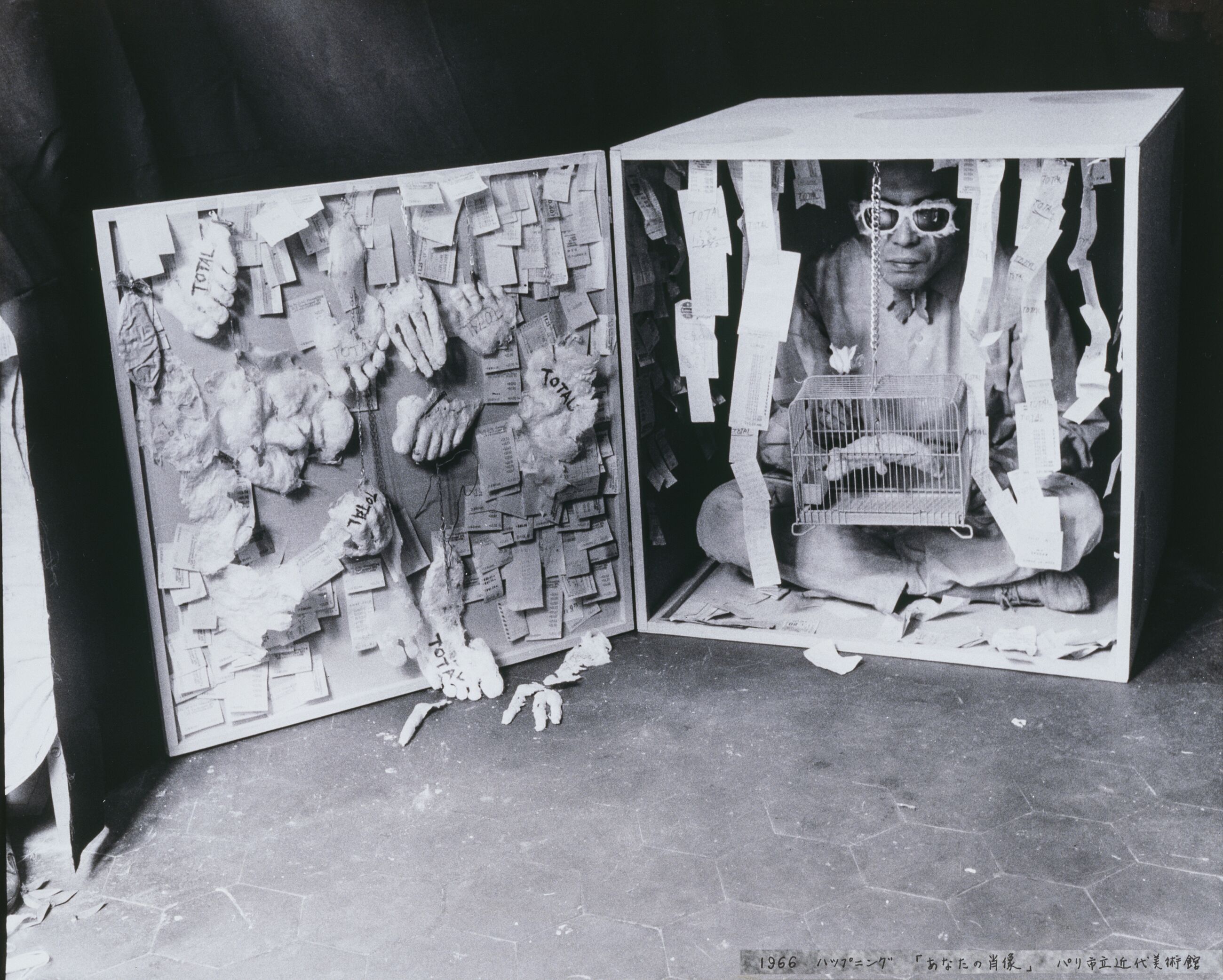
Tetsumi Kudo performs the ‘Your Portrait’ Happening in his studio in Torcy, France in 1965 © Hiroko Kudo, the Estate of Tetsumi Kudo / Artists Rights Society (ARS), NY / ADAGP Paris 2026. Courtesy Hiroko Kudo, the Estate of Tetsumi Kudo and Hauser & Wirth
Exhibition Learning Notes: ‘Tetsumi Kudo. Microcosms’
This resource has been produced to accompany the exhibition ‘Tetsumi Kudo. Microcosms’ at Hauser & Wirth London from 5 February – 18 April 2026.
About Tetsumi Kudo
Tetsumi Kudo was born in Osaka, Japan in 1935 and grew up during the Second World War and its aftermath, which strongly shaped his world view. He studied at Tokyo National University of Fine Arts in the 1950s but rejected traditional approaches to art, positioning himself against established ideas and hierarchies.
In 1962, Kudo won the grand prize at the 2nd International Young Artist Pan-Pacific Exhibition, which enabled him to move to Paris, France where he lived and worked for most of his life. In Europe, he described himself as an observer of Western society, questioning human-centered world views and the belief in progress through technology.Kudo is best known for creating enclosed environments using cages, boxes and domes. Inside these structures, he combined plastic plants, electronic waste, everyday consumer goods and handmade body parts. These unsettling microcosms reflect what he called a ‘new ecology,’ where nature, humanity and technology are inseparable.
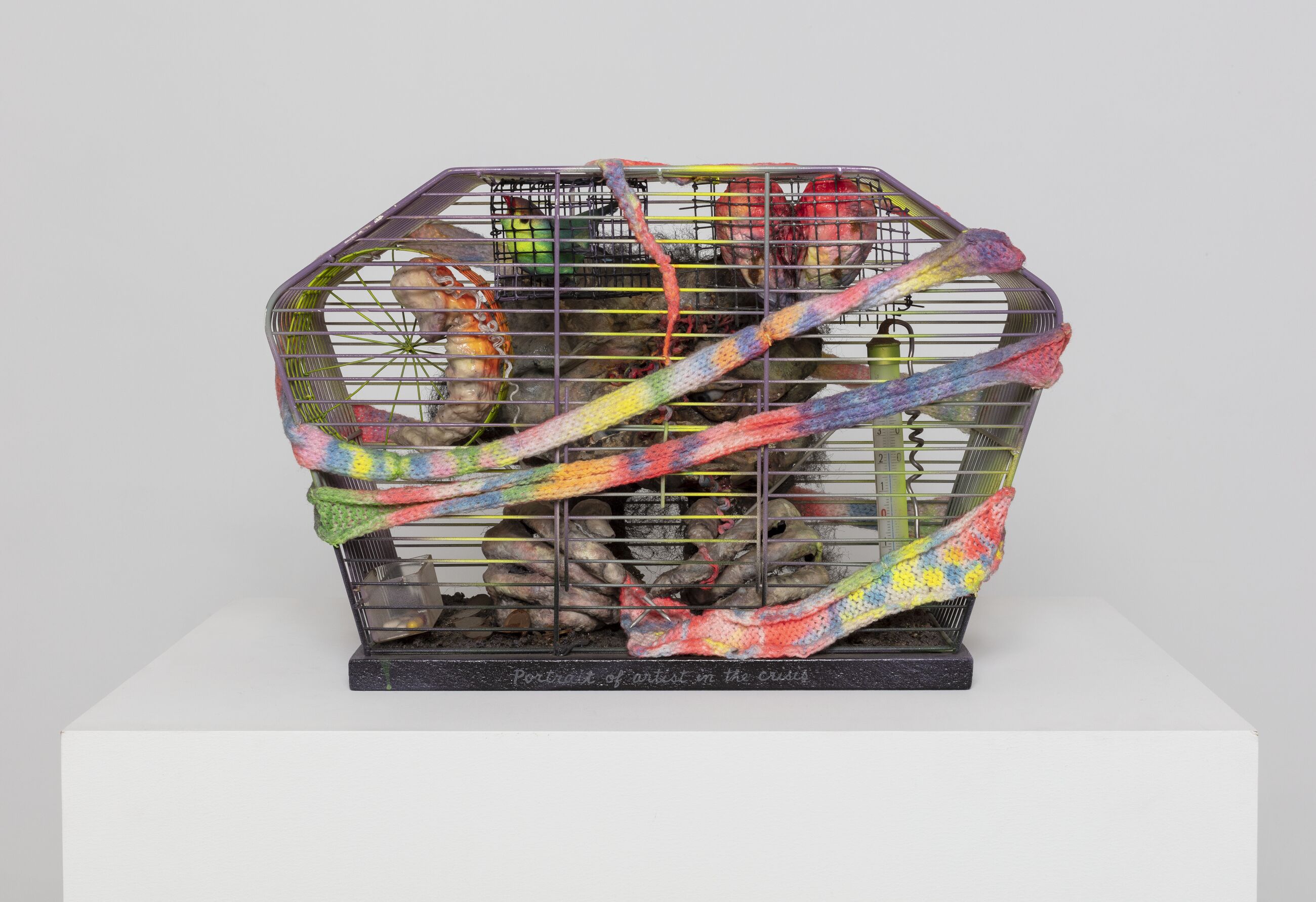
Tetsumi Kudo, Portrait of Artist in the Crisis, 1978 © Hiroko Kudo, the Estate of Tetsumi Kudo / Artists Rights Society (ARS), NY / ADAGP Paris 2026. Courtesy Hiroko Kudo, the Estate of Tetsumi Kudo and Hauser & Wirth. Photo: Unknown
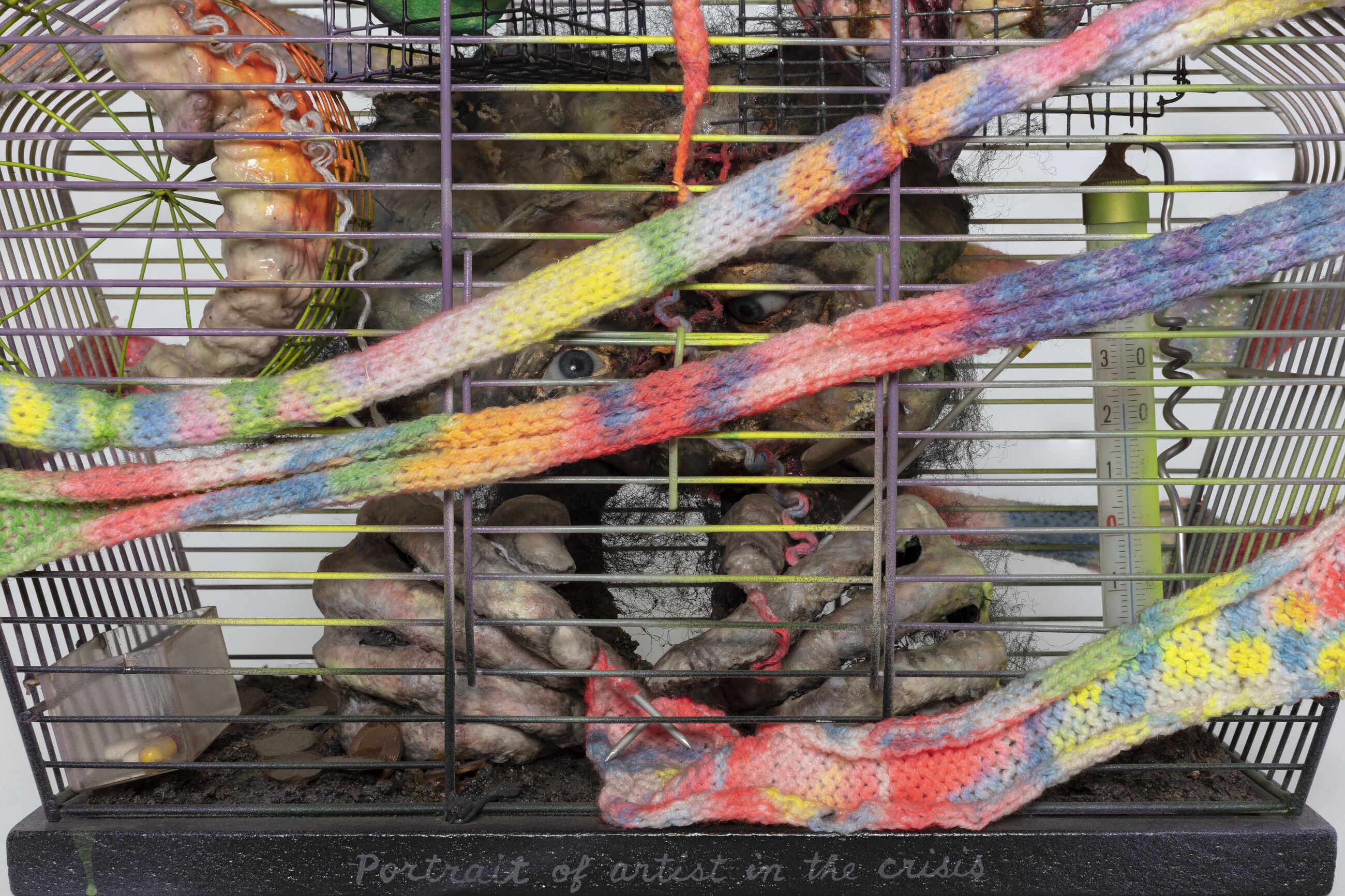
Tetsumi Kudo, Portrait of Artist in the Crisis (detail), 1978 © Hiroko Kudo, the Estate of Tetsumi Kudo / Artists Rights Society (ARS), NY / ADAGP Paris 2026. Courtesy Hiroko Kudo, the Estate of Tetsumi Kudo and Hauser & Wirth. Photo: Unknown
What does the exhibition look like?
The exhibition presents a series of enclosed environments made from cages, cubes, domes and garden-like structures. These works resemble small ecosystems or time capsules containing artificial plants, soil, technological debris, store-bought objects and sculpted body parts. Bright, acrid colors such as greens and pinks create an atmosphere that feels polluted, synthetic and unsettling.
Rather than traditional sculpture, the works feel like carefully staged micro-worlds.
Kudo described art as a ‘maquette’ through which we reflect on the world, and these environments invite viewers to peer inside and consider their own position within a damaged and interconnected system.
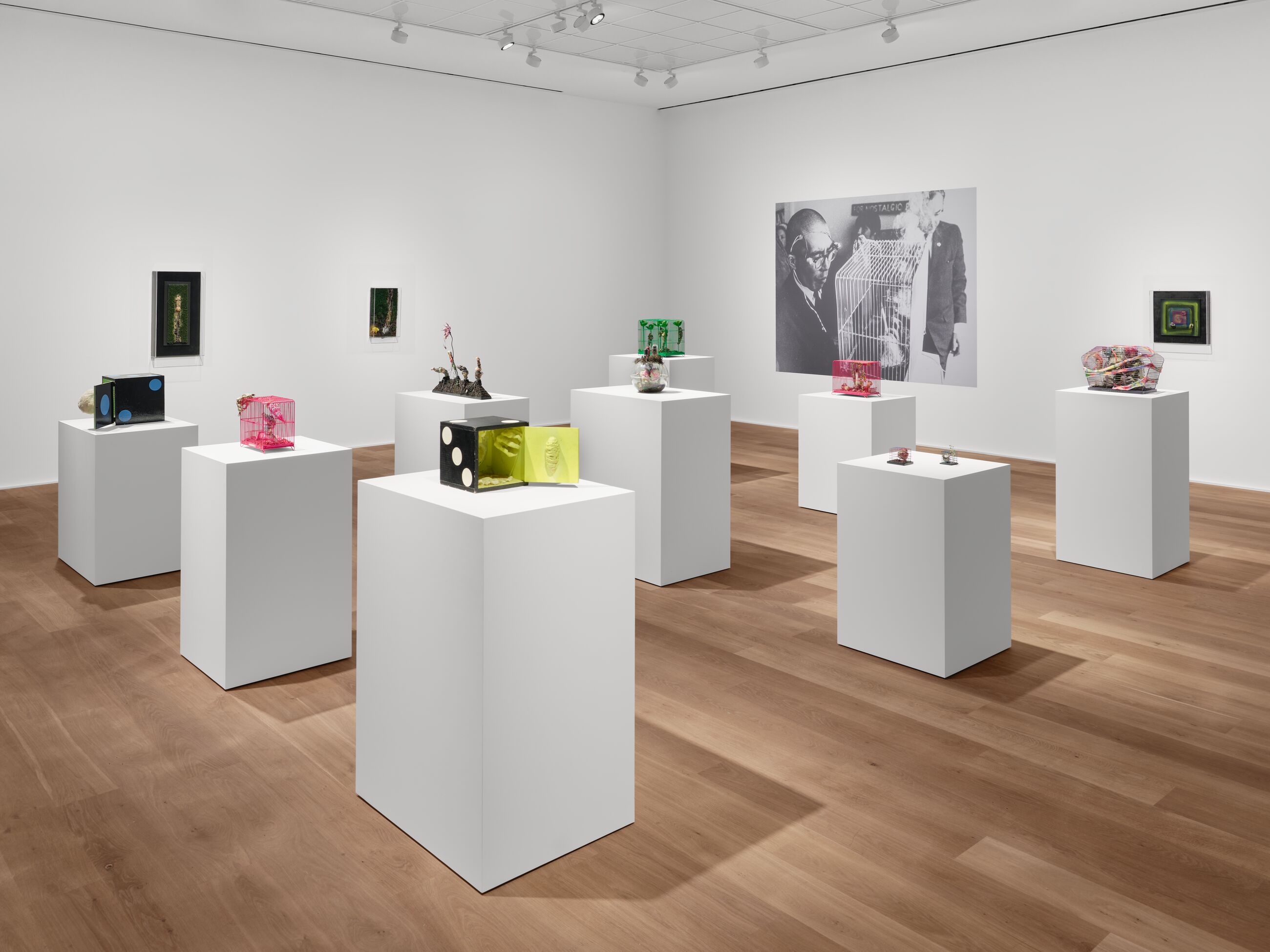
Installation view, ‘Tetsumi Kudo. Microcosms,’ Hauser & Wirth London, 2026 © © Hiroko Kudo, the Estate of Tetsumi Kudo / Artists Rights Society (ARS), NY / 2026 ADAGP, Paris and DACS, London. Photo: Eva Herzog
How does he make his work?
Kudo assembled his works using found materials, store-bought items and hand-made elements. He frequently used cages, vitrines, pet accessories, plastic plants and domestic objects sourced in Paris, France, combining them with body parts molded from materials such as paper mache, cotton and resin.
His method was meticulous and deliberate. Each object was carefully placed to form an allegorical scene rather than a random collection. Earlier in his career, Kudo also worked through happening-like performances, using action and duration as part of the work’s meaning. Across his practice, experience and process were valued over commercial finish.
‘Art must be one of the media that serve to provoke doubt and defiance in us: it is a provocative communication between you and me, who are living in the septic pit of technology.’—Tetsumi Kudo
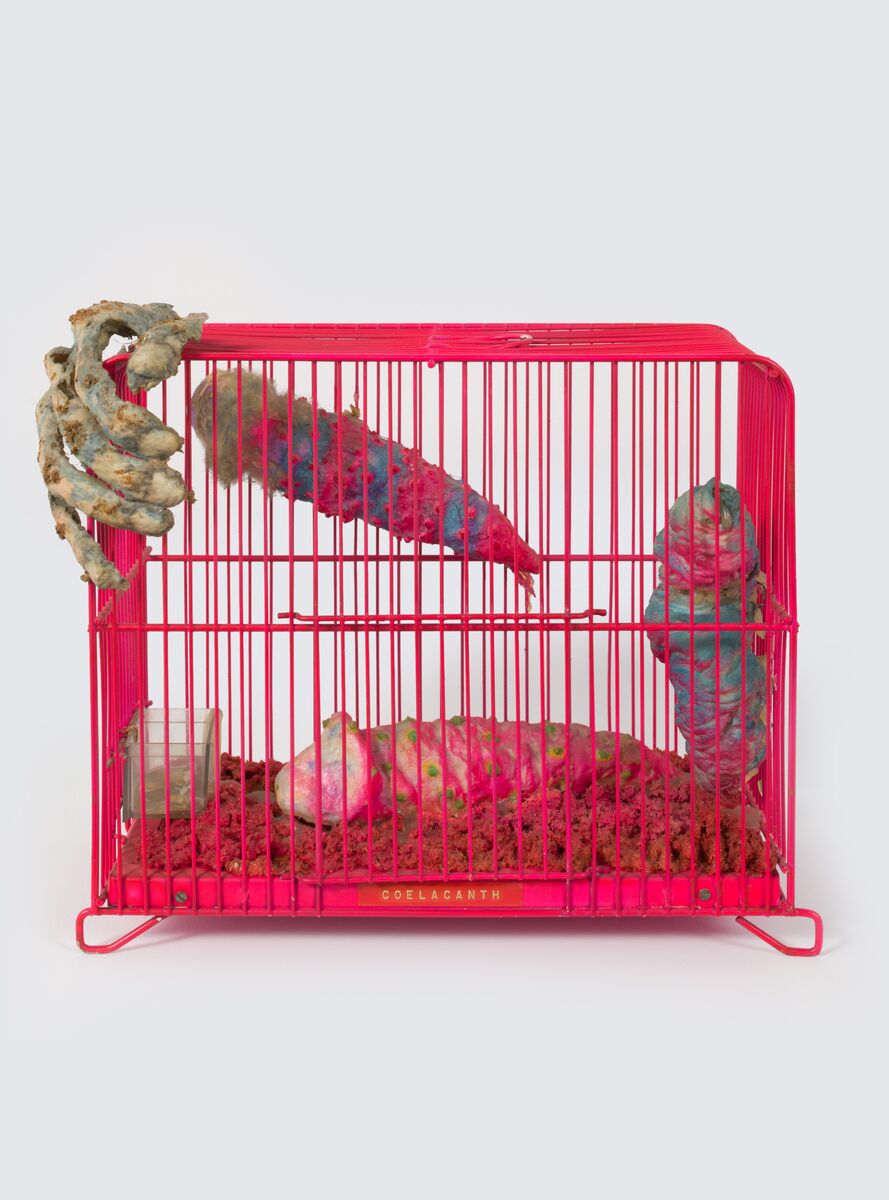
Tetsumi Kudo, Coelacanth. 1970 ©️ Hiroko Kudo, the Estate of Tetsumi Kudo / Artists Rights Society (ARS), NY / ADAGP Paris 2026. Courtesy Hiroko Kudo, the Estate of Tetsumi Kudo and Hauser & Wirth. Photo: Pierre Le Hors
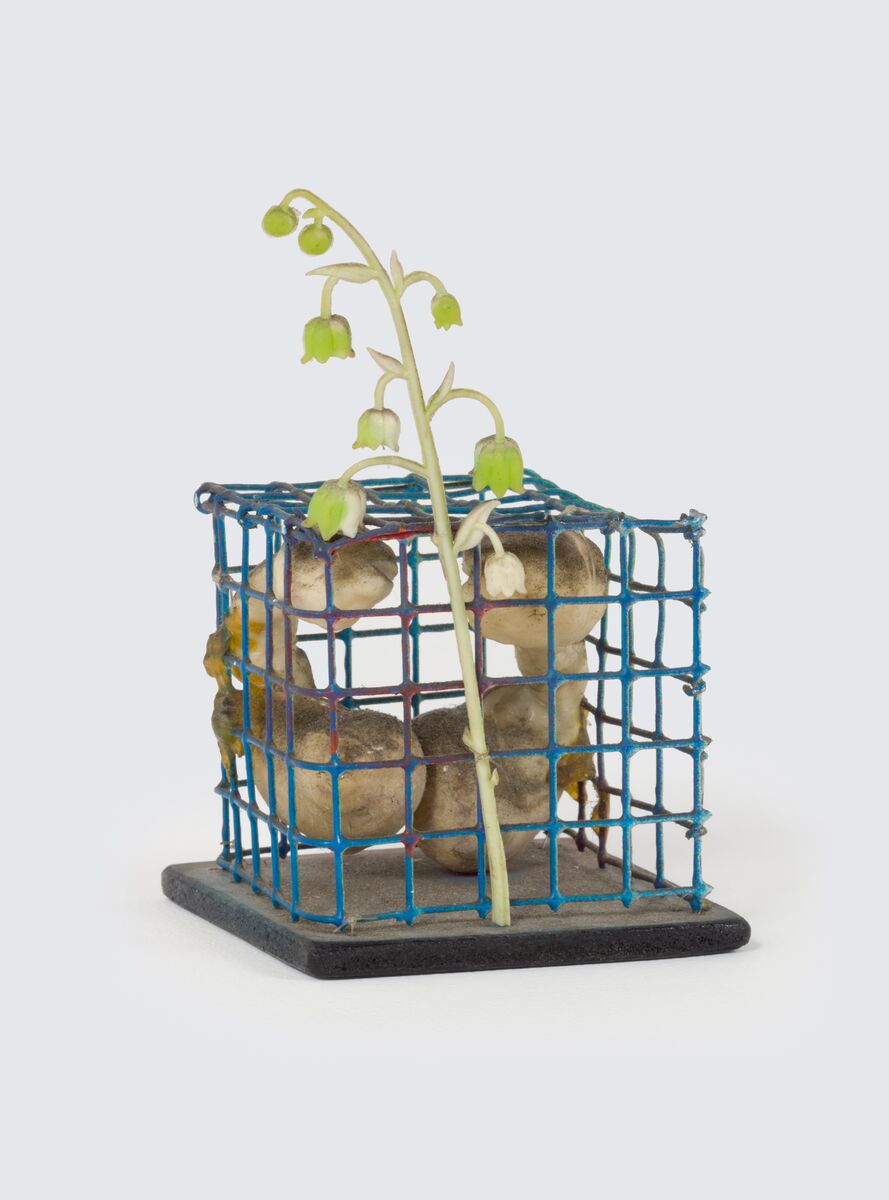
Tetsumi Kudo, Untitled, 1975 © Hiroko Kudo, the Estate of Tetsumi Kudo / Artists Rights Society (ARS), NY / ADAGP Paris 2026. Courtesy Hiroko Kudo, the Estate of Tetsumi Kudo and Hauser & Wirth. Photo: Pierre Le Hors
What are the sources of his subject matter?
Kudo’s subject matter comes from the conditions of postwar and late 20th-century life. His work responds to mass consumption, environmental pollution, technology and the domestic spaces of urban society. References to the living room, pet cages and everyday consumer goods locate his work within ordinary experience.
He believed that humanity, nature and technology had become inseparable, a closed circuit he called the ‘new ecology’. As Kudo has stated, it was important to think about ‘the relationship of polluted nature to the proliferation of electronics’ and the decomposition of traditional humanist values. Many works also draw on cycles of life, transformation and metamorphosis, using cocoon-like forms and distorted body parts.
‘Art must be one of the media that serve to provoke doubt and defiance in us: it is a provocative communication between you and me, who are living in the septic pit of technology.’—Tetsumi Kudo
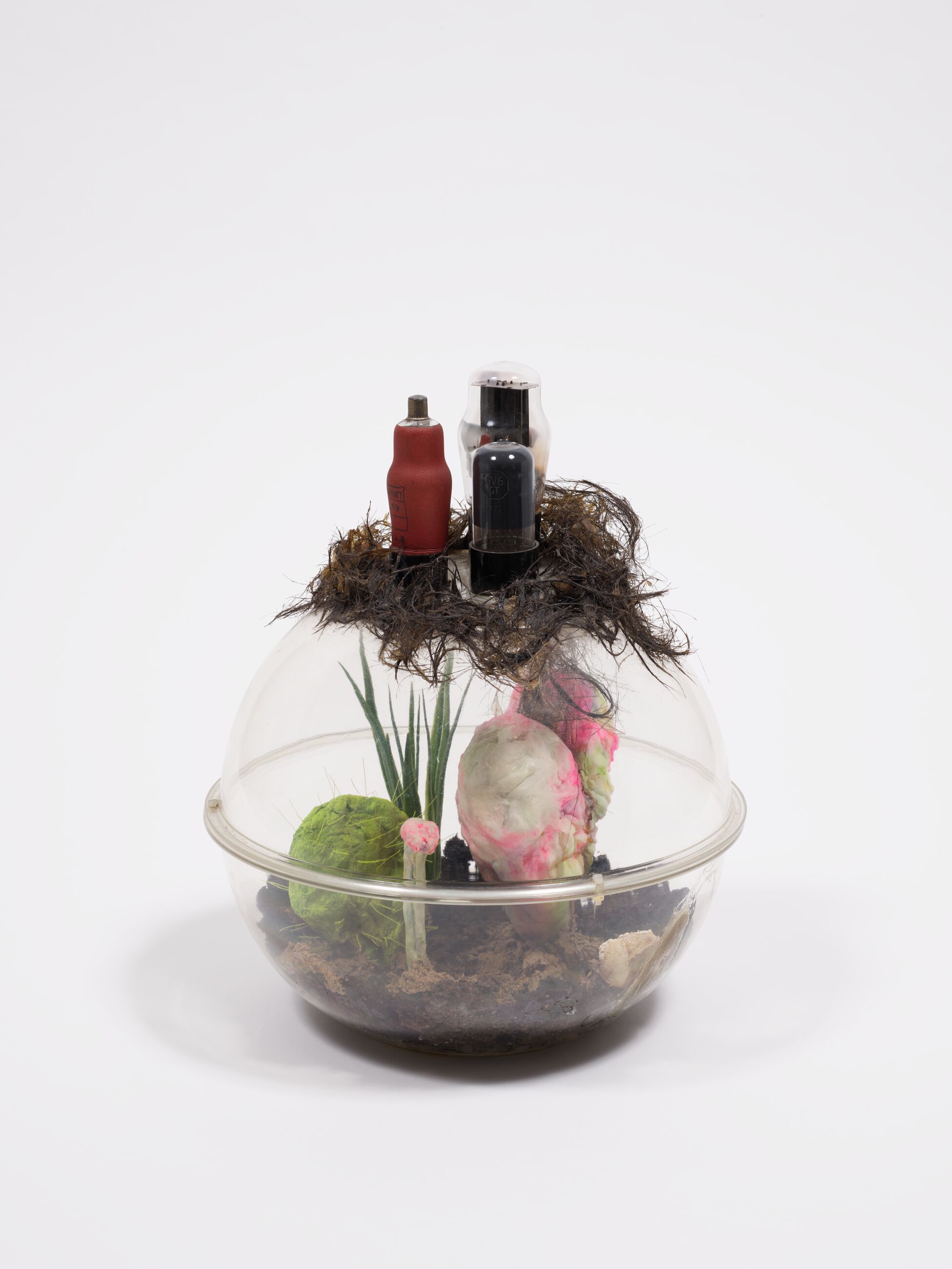
Tetsumi Kudo, Cultivation of Nature & People Who Are Looking at It, 1970 – 1971 © Hiroko Kudo, the Estate of Tetsumi Kudo / Artists Rights Society (ARS), NY / ADAGP Paris 2026. Courtesy Hiroko Kudo, the Estate of Tetsumi Kudo and Hauser & Wirth. Photo: Thomas Barratt
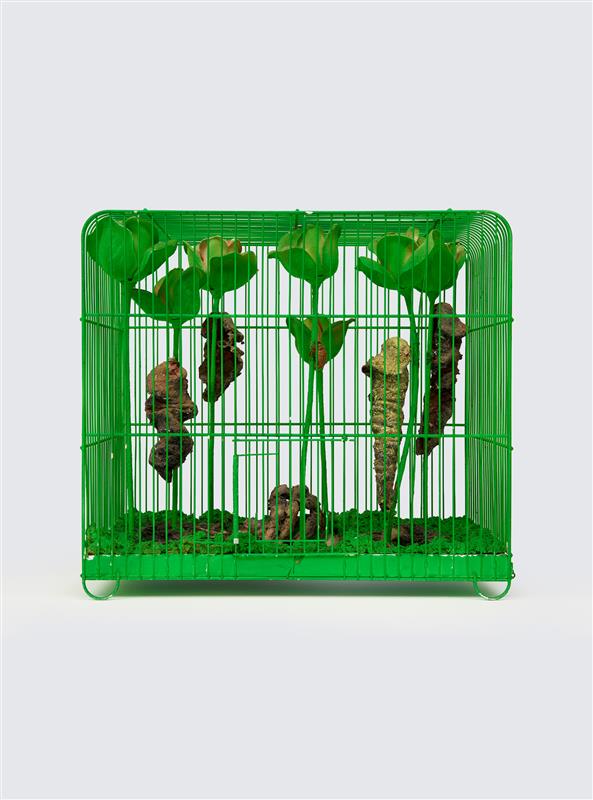
Tetsumi Kudo, Souvenir ‘La Mue’ – For Nostalgic Purpose – For Your Living Room, 1967 © Hiroko Kudo, the Estate of Tetsumi Kudo / Artists Rights Society (ARS), NY / ADAGP Paris 2026. Courtesy Hiroko Kudo, the Estate of Tetsumi Kudo and Hauser & Wirth. Photo: Theo Niderost
What are the major themes?
Major themes include environmental degradation, the loss of human agency and the breakdown of distinctions between natural and artificial. Kudo questioned the idea that humanity stood above nature or could fully control its destiny, a belief he saw as central to European humanism.
Chance plays a key role, particularly in the cube works painted as dice, which symbolize uncertainty and society’s increasing reliance on technology, drugs and media. By addressing the viewer directly in titles such as ‘Your Portrait’ (1974), Kudo implicates audiences in the systems he critiques. His work aims to provoke discomfort and doubt rather than offer reassurance. As he stated, art should provoke ‘doubt and defiance’ and question freedom at both individual and societal levels.
‘No matter how, it is important to think about the relationship of polluted nature to the proliferation of electronics, the decomposition of humanity (humanism) and the old and traditional hierarchy of values.’—Tetsumi Kudo
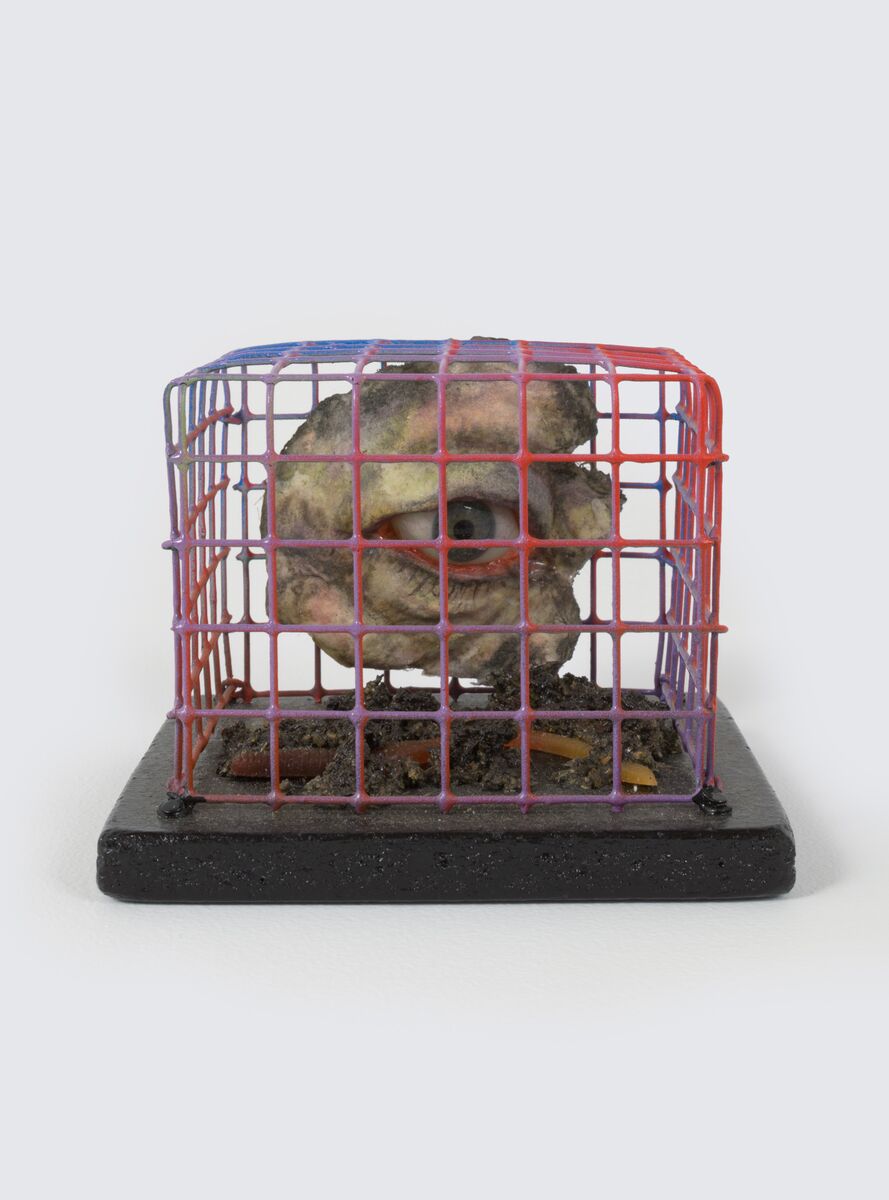
Tetsumi Kudo, Untitled, 1978 © Hiroko Kudo, the Estate of Tetsumi Kudo / Artists Rights Society (ARS), NY / ADAGP Paris 2026. Courtesy Hiroko Kudo, the Estate of Tetsumi Kudo and Hauser & Wirth. Photo: Pierre Le Hors
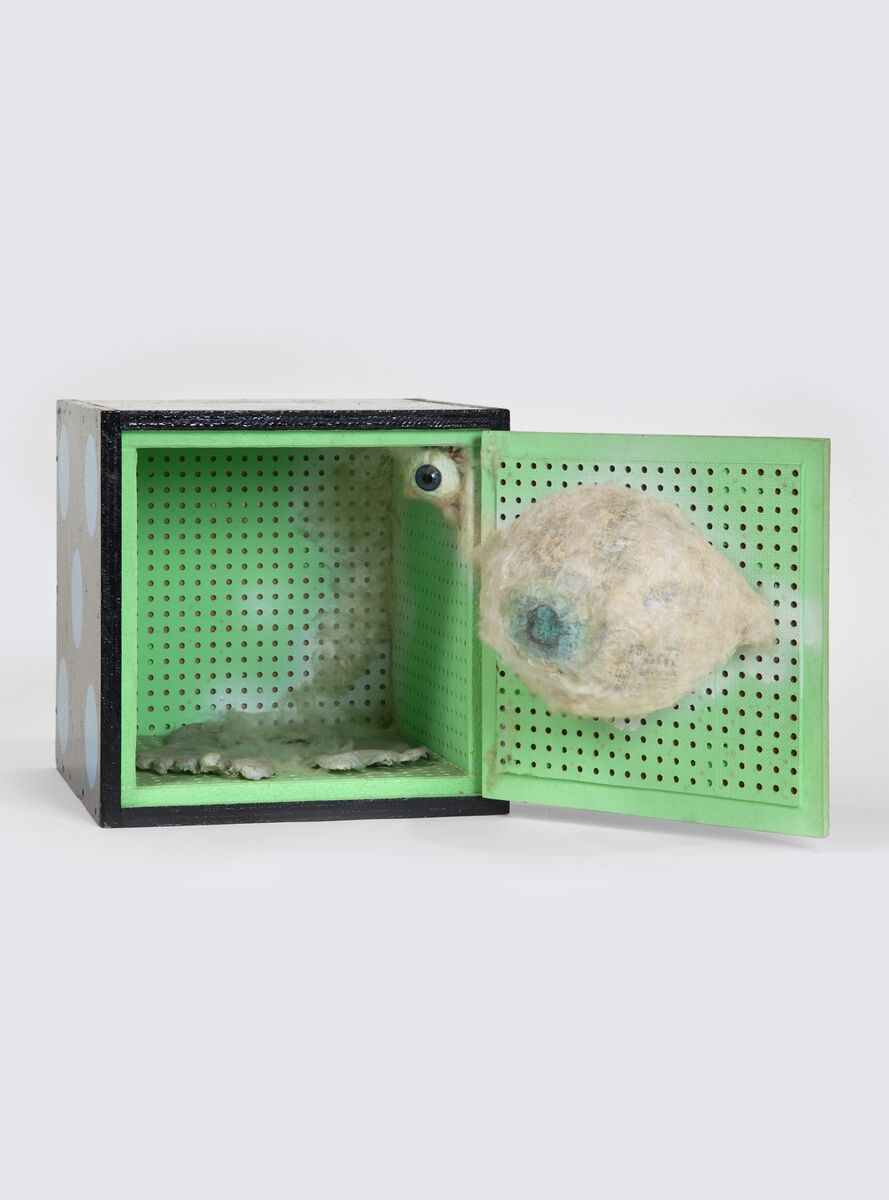
Tetsumi Kudo, Your Portrait, 1966 © Hiroko Kudo, the Estate of Tetsumi Kudo / Artists Rights Society (ARS), NY / ADAGP Paris 2026. Courtesy Hiroko Kudo, the Estate of Tetsumi Kudo and Hauser & Wirth. Photo: Unknown
Glossary
Allegorical
Using images or objects to suggest wider ideas beyond what is shown. In Kudo’s work, materials stand in for systems such as consumer culture, technology and human behaviour.
Anthropocene
A term used to describe the current geological age in which human activity has become the dominant influence on climate, environment and ecosystems. Kudo anticipated this condition long before the term was widely used.
Cage or vitrine
Enclosed structures frequently used by Kudo to stage his works. They function as micro-ecosystems, laboratories or psychological traps rather than protective display cases.
Consumerism
A social and economic system driven by mass production, consumption and disposability. Kudo critiqued consumer culture by incorporating cheap, store-bought items into his work.
Dice (cube works)
Sculptural forms painted as dice, symbolising chance, risk and lack of control in modern life, particularly in relation to technology, drugs and political systems.
Humanism (European humanism)
A philosophical tradition that places humans above nature and values reason, progress and mastery. Kudo rejected this hierarchy, seeing it as a root cause of colonialism, environmental damage and social violence.
Happenings
Performance-based artworks popular in the 1960s that emphasised action, time and audience experience. Kudo’s happenings were theatrical, unsettling and often ritualistic.
Maquette
A small-scale model or prototype. Kudo used the term metaphorically to describe art as a testing ground for ideas about society, freedom and existence.
Metamorphosis
A recurring concept in Kudo’s work referring to transformation, mutation and the breakdown of fixed identities, particularly between human, nature and machine.
New ecology
Kudo’s concept describing a world in which nature, humanity and technology are inseparably entangled, forming a polluted yet ongoing ecosystem rather than a clear division between natural and artificial.
Terrarium
A sealed environment for plants or animals. Kudo’s works resemble dystopian terrariums in which synthetic materials and mutated life coexist.
Questions for discussion
How do cages, domes and vitrines shape your emotional and physical response to the works?
Kudo believed humanity could not separate itself from pollution it had created.
How is this idea visible in the materials and forms used here?Many works combine attraction and discomfort. How does this tension affect how you engage with them?
Kudo described art as a ‘maquette’ for questioning society. What kinds of questions do these works raise for you today?
Supplementary research
‘Tetsumi Kudo’s New Ecology’ (Ursula, Issue 6. Spring 2020)
‘Tetsumi Kudo’s Sculptures of a Damaged World’ (Frieze, 2020)
‘Tetsumi Kudo: Metamorphosis’ (Ocula, 2021)
‘Tetsumi Kudo. Cages’ (Hauser & Wirth Hong Kong, 2024)


