

Profiles
Stilled Without Stopping
Entering the quiet revolution of Troy Town Art Pottery
By Charlotte Jansen
Photography by Dunja Opalko
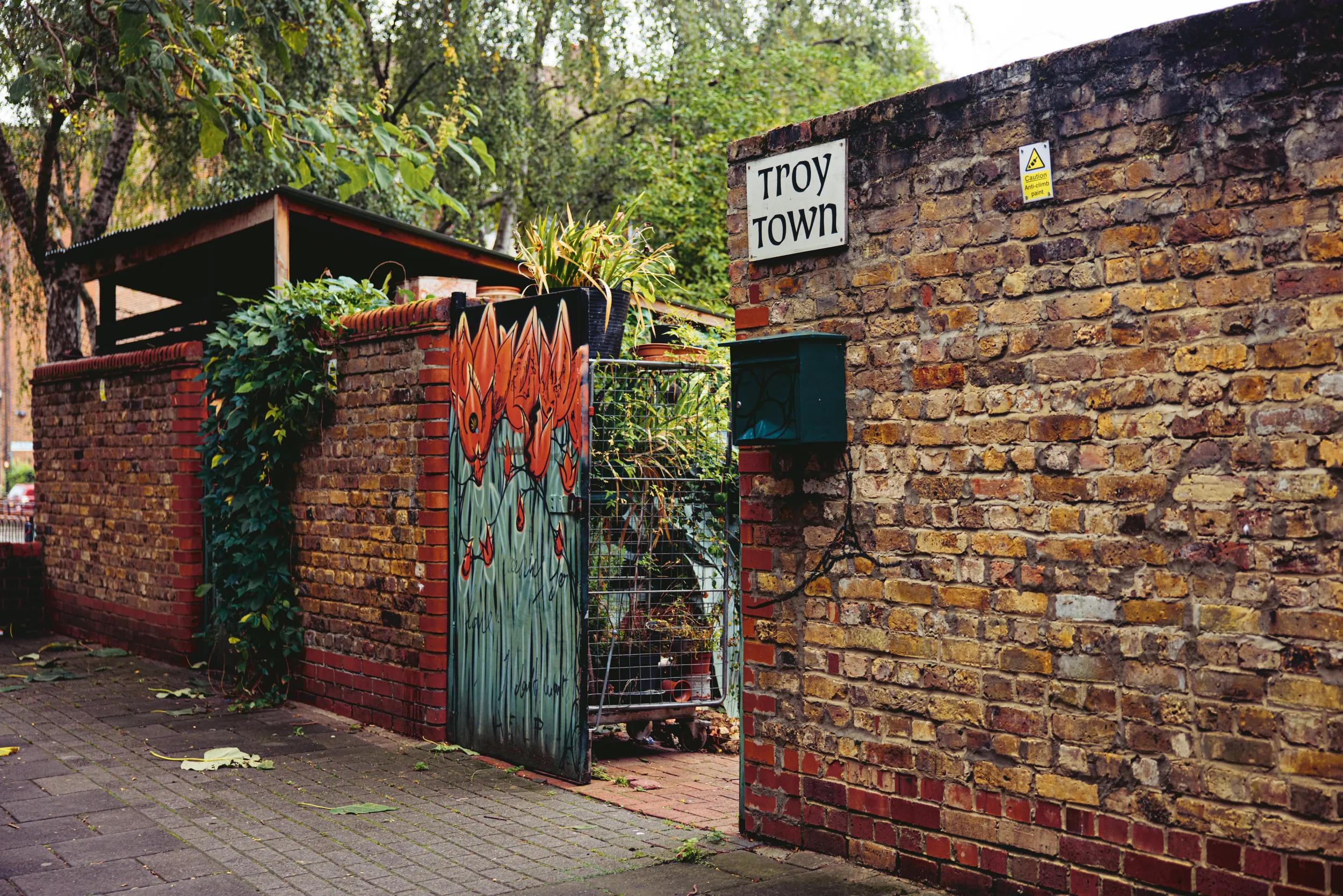
Beyond Hoxton Street’s jumble of barber shops, Jamaican restaurants and discount storefronts, the City of London rises like the Land of Oz, its gleaming geometries puncturing the distant skyline. Stumbling from this dense urban milieu into the home of Troy Town Art Pottery feels like finding an ancient habitat, perhaps one belonging to a hobbit. As I walk through the gates, a giant Agave americana greets me just inside the entrance (it has never flowered, I hear). I wander through a deserted cobblestone courtyard, past greenhouses and buckets of clay slop, through the same site where the gardener Thomas Fairchild in 1717 engineered the first artificial plant hybrid (dubbed “Fairchild’s Mule,” a cross between a sweet William and a carnation).
Given this history, madcap experimentation and pioneering hybridity seem preordained within the walls. Troy Town is a ceramic studio unlike any other in the United Kingdom—the country’s first workshop devoted to sculpture and a host of free residencies for artists who want to make high-quality, non-functional, anti-craft clay pieces. Since 2019, the studio has also produced Anglo-Japanese-style stoneware with traditional Eastern techniques and sold mostly online to support the non-profit’s program.
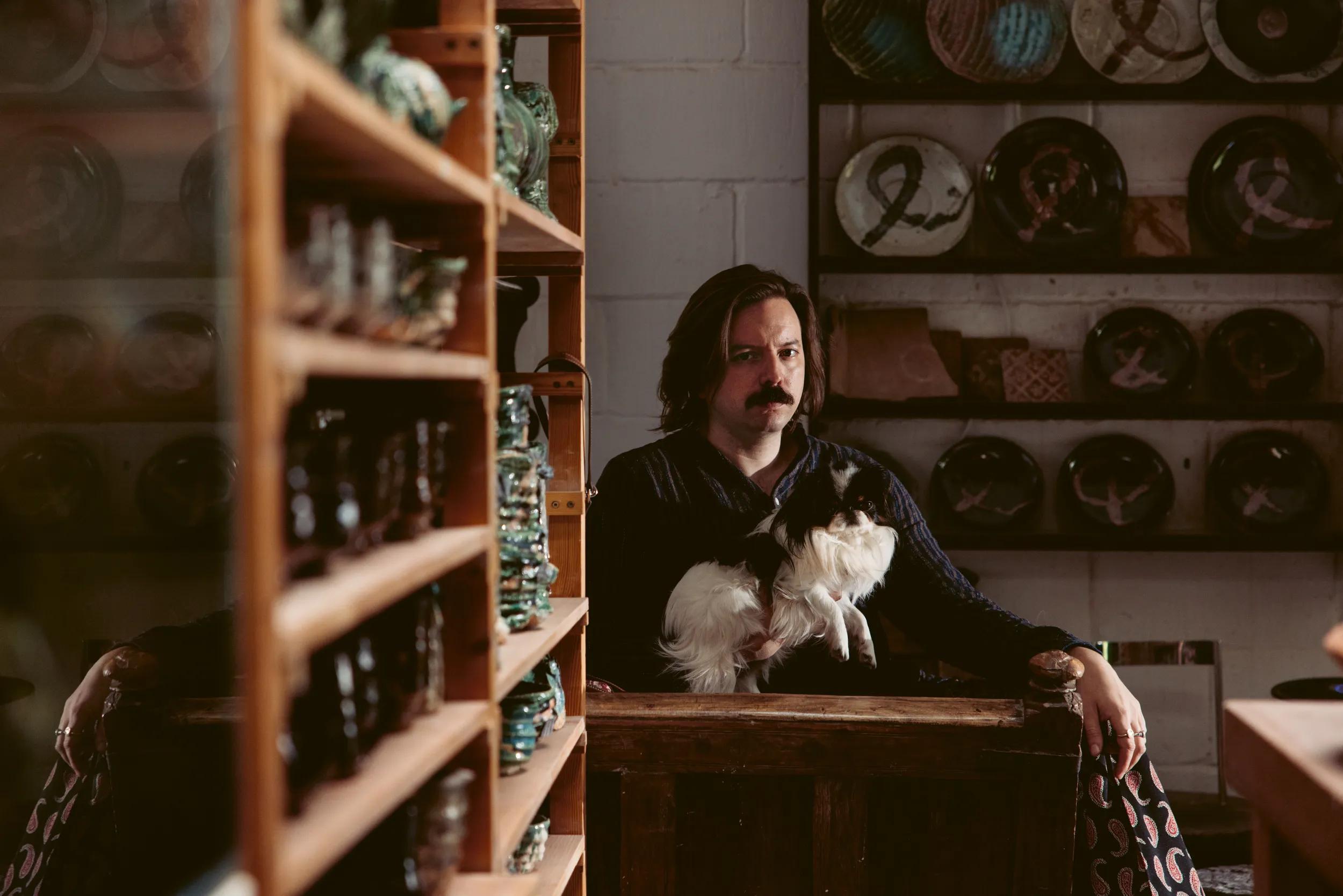
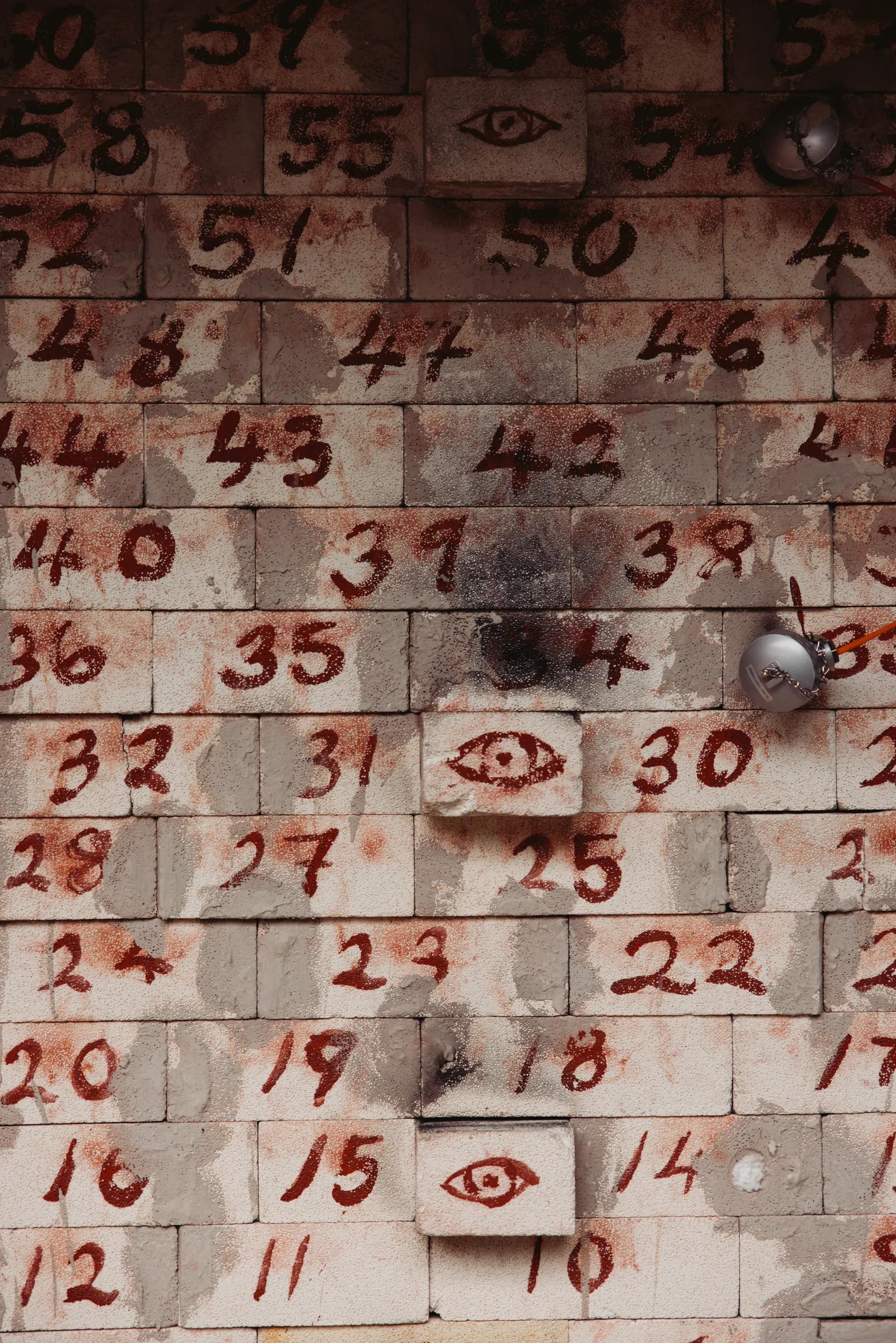
Around a corner from the entrance rises a sturdy gas-fired kiln—a rarity in London, permitting firing at higher temperatures than are possible with an electric kiln. “It looks like a pile of bricks, but it’s quite a well-tuned machine,” Troy Town’s founder, thirty-seven-year-old artist Aaron Angell, tells me. We first meet inside the workshop, where disco music is wafting and Angell is sitting at a wheel, appearing to burn something with a small blowtorch.
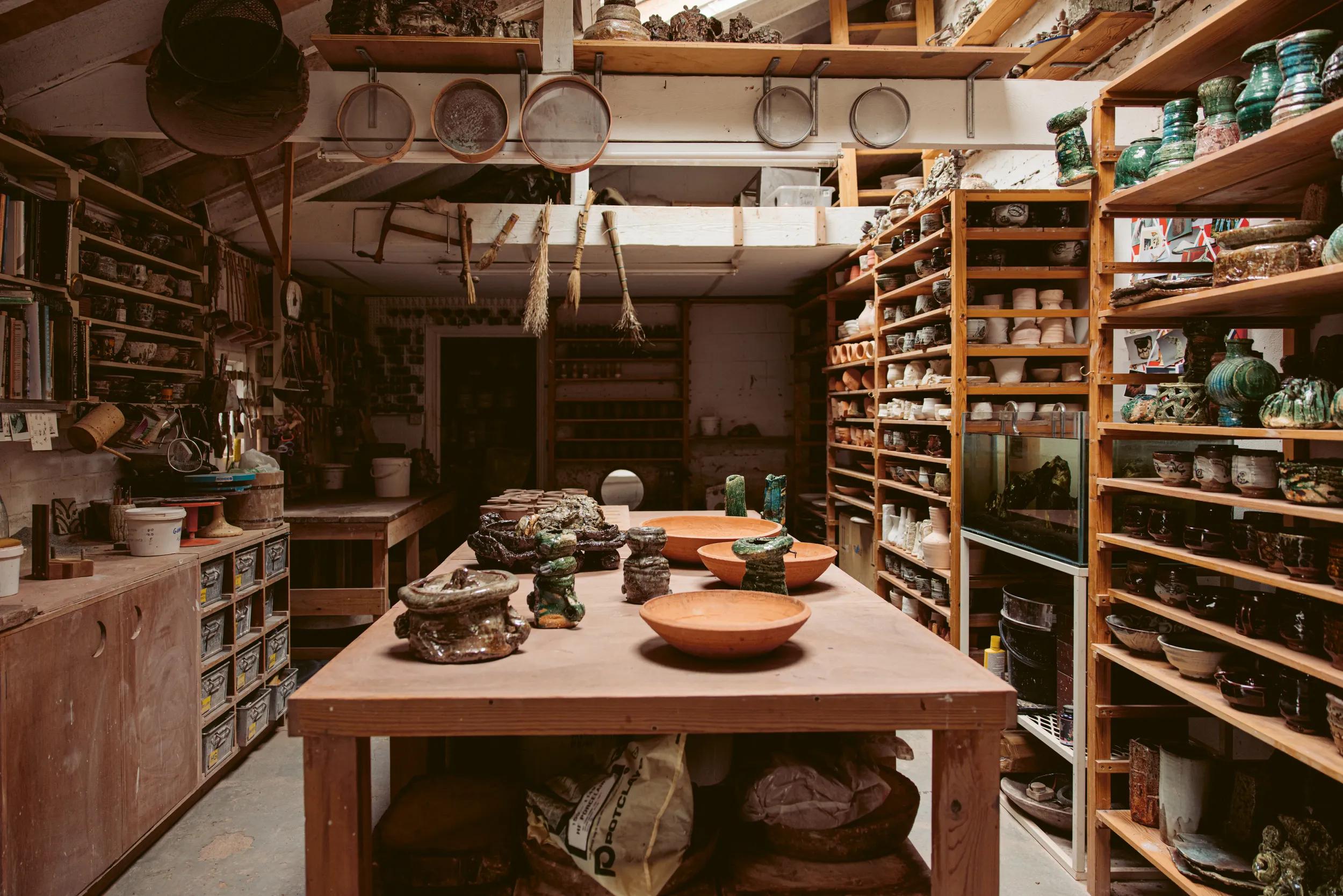
I gaze around the packed shelves, heavy with Troy Town’s stoneware, mugs, and tea bowls, all dripping with gorgeously rich, deep, earthy colors. They sit alongside distinctive psychedelic Shiga Oribe pieces with rough, bumpy surfaces and green-hued glazes made from pine-needle ash. An old axolotl named Millponds blinks at me from its tank. The entire space seems to sit half outside of time, giving the kind of feeling that Edmund de Waal describes in one of his best essays: “Things can be stilled, without stopping.” Other shelves groan with books, a library that roams from medieval English pottery to ash glazes to the Nippon Toji Zenshu, the encyclopedia of Japanese ceramics. Angell, who is entirely self-taught, tells me, self-deprecatingly, “You can learn everything from books.”
While Troy Town’s quarters might evoke a charming English village, Angell has dedicated himself over the past thirteen years to wresting ceramics from the clutches of old-fashioned quaintness. When it comes to clay, he doesn’t believe the medium should be the message, shrugging off the idea of the “heroic craftsman” and the social context of making. With the studio, he has helped transform the mood of pottery from an “incredibly parochial place with bad taste and really bad ideas” into a place of possibility, alive with invention and ideas.
Through making, curating (exhibitions such as “That Continuous Thing: Artists and the Ceramic Studio, 1920–Today,” a survey at Tate St Ives in 2017) and critical writing, Angell says his goal is simply to forge “a better context for ceramics.”
“I knew I didn’t want to have any potters in here. It wasn’t for ceramicists. I wanted to see what running a sculpture-only pottery was like.”—Aaron Angell
He first got into the field in his early twenties. He was preparing to graduate from London’s Slade School of Fine Art and had seen some clay works by Lucio Fontana “and I just thought it would be a good vehicle for sculpture.” Since the Slade had no ceramics department or facilities, he returned to his secondary school and followed the ceramics technician around for three weeks. “I wanted to learn the basics: the differences between stoneware and earthenware, the temperature you fire glazes at, and how to stop things falling to bits,” he says. From that point on, it’s been a process of learning by failing. “I’ve made every mistake, and I’m really happy about that.”
He removes the bandana he uses to keep his hair back from his work, and dusts off a chair. “There’s a knowledge gap of nearly twenty years in ceramics in the U.K.” he tells me. “Between the 1990s and early 2000s, a lot of the people who knew stuff were already old, and not a lot of people were getting into it at a young age. All the equipment was being sold off. Ceramics departments were closing down.” In the 1990s, the explosion of new technology in society meant that “folksy things were pushed out—no one wanted to think about the 1970s. But now there’s a big revival underway.”
Angell has been partly responsible for that revival over the past decade. Yet while a return to the analogue and to craft across culture has brought about a resurgence of interest in ceramics, Angell bemoans what he sees as a persistent lack of criticality about the medium. The Hayward Gallery’s 2022 survey of contemporary-art ceramics was “terrible,” he says—and he was in it. And don’t even ask about what he calls the “craft corner” at the British Art Show 8, which he also participated in. “That lumping-together thing is annoying,” he says, laughing. “These curators are not stupid, and even they’ve done this!” He adds: “Ceramic is the context—that’s not the interesting thing. People are being turned off by ceramics because they’ve been presented with so much bad stuff, it’s lost its value.”
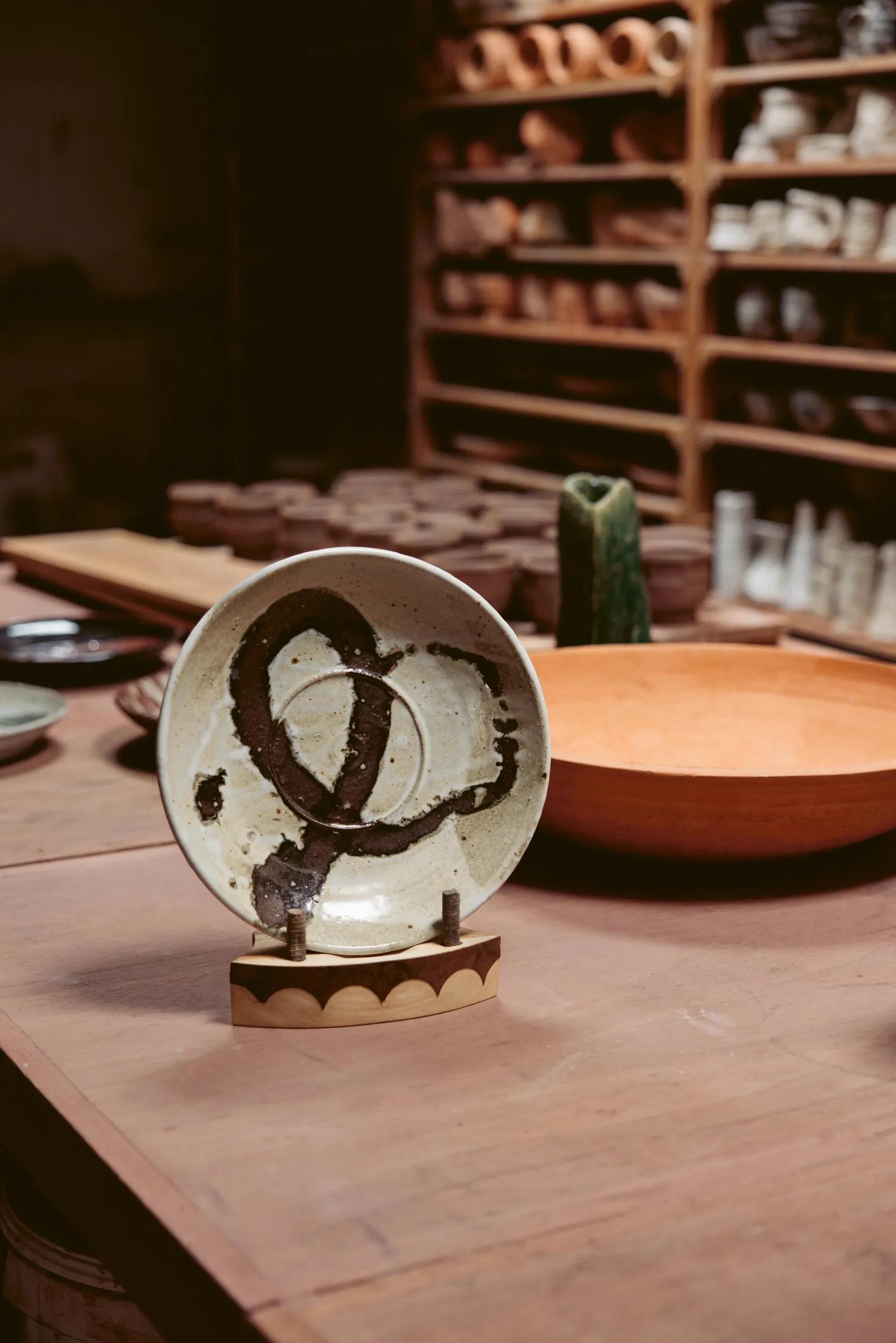
When he set up Troy Town, he says, he conceived of it as a kind of laboratory in which sculpture could collide with clay. He began a residency program for artists who wanted to experiment but had neither the knowledge nor the equipment. “I knew I didn’t want to have any potters in here,” he says emphatically. “It wasn’t for ceramicists. I wanted to see what running a sculpture-only pottery was like.” The structure for the residencies was loose but guided by one clear rule: “No functional ware.”
At the beginning, Angell hosted as many as five artists at a time. Among the early cohort was Renee So, who spent two weeks at Troy Town in 2016. “I liked Aaron’s focus on ceramics as sculpture rather than as a functional object,” says So, who is now known for her obsidian-sculpted ceramic busts. “Ceramics was gradually becoming more visible in contemporary art, but as an artist with no training in ceramics, it was still really hard to access resources and information. I had a lot of technical questions and nobody to direct them to. There were no community pottery centers with kiln-hiring services back then and not a lot of artists working predominantly with clay to talk to.”
Over the years, Troy Town has hosted more than a hundred artists, a group that includes Anthea Hamilton, Jess Flood-Paddock, Candice Lin and Allison Katz. Angell works with artists according to the needs of the projects they bring with them. For example, So was already familiar with hand-building clay but not with surface decoration. “I was keen to mix my own glazes, which I’d never done before and was always intimidated by,” she says. “I made small, non-precious things that I could experiment with glaze-wise.” Angell also admits to “guinea pigging” with artists’ pieces to test out new glazes for the studio. “It’s worked out fine … most of the time.”
“You get it a lot with craft—people become myopic. They become dismissive of things. Not everything has to be technically high-level.”—Angell
Enrico David, the most recent resident, came in to work on pieces for a forthcoming solo exhibition. A few of the prawns he made are nestled on the shelves, their wispy tendrils poking out. They look perfectly at home in Troy Town. “You can usually tell when something has come from our studio, because we have glazes no one else has,” Angell says. The next resident will be the eighty-four-year-old British Pop artist Colin Self, with whom Angell hopes to make ceramic pieces based on unrealized sketches from Self’s archive.
“What can a specific set of materials and a base of knowledge do for your work?” Angell asks, explaining that all the residencies have essentially revolved around this question. Rebecca Akroyd, another early resident, tells me in an email: “It’s so important to have spaces that encourage experimentation and also create community around them while being rooted outside of ‘craft.’”
When it comes to the craft aspect of the equation, however, Angell is able to draw from an encyclopedic knowledge of glazes. He is currently developing an Oni Hagi glaze that he seems very excited about. As we talk, he disappears into a corner to find a work in progress. The glaze originated in Japan 700 or 800 years ago but that version was “bastardized from an even older Korean glaze.” It is made with ash from burnt stalks of rice, which the studio has to import. The ash gives the effect of a glossy white with a milky opacity.
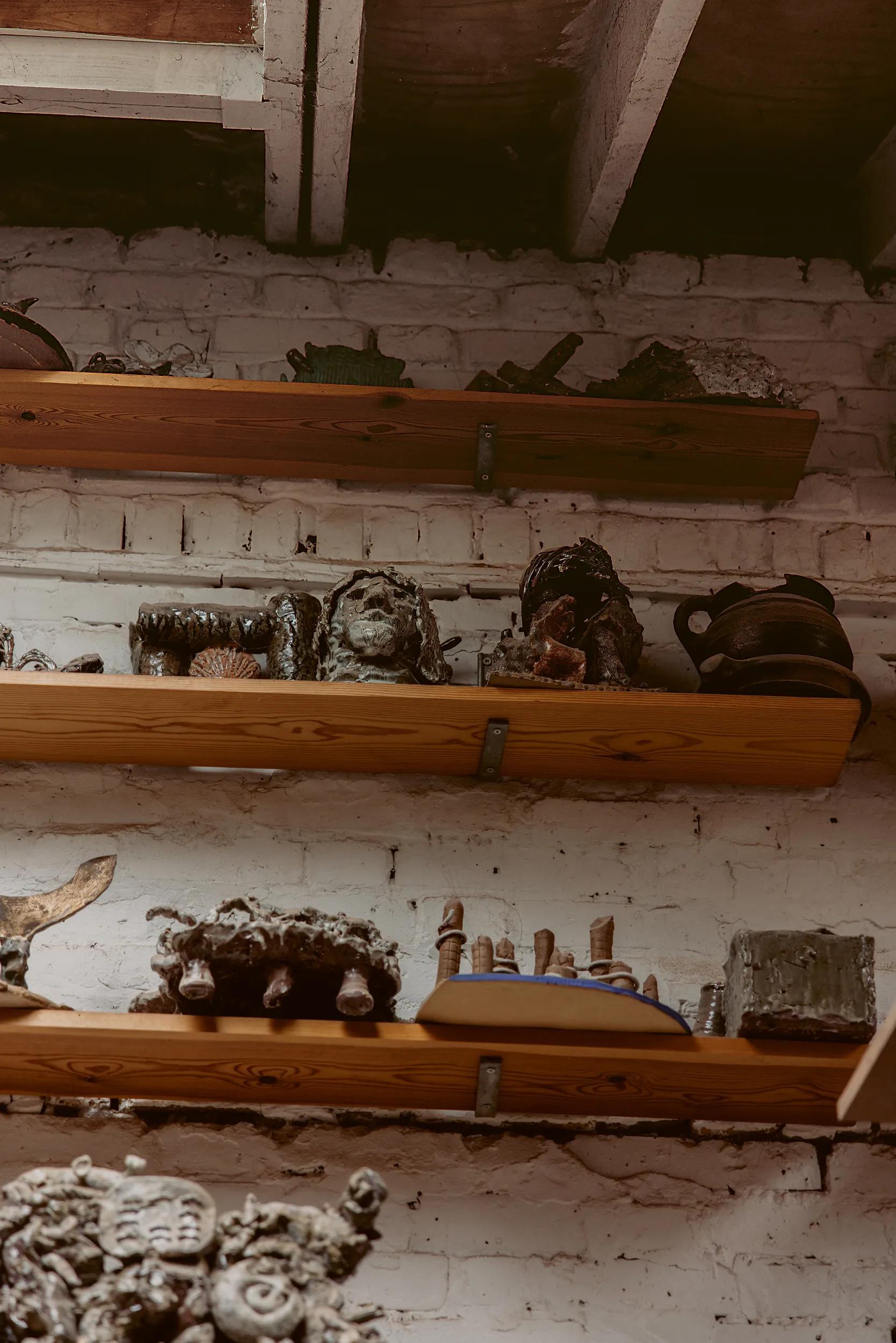
“This is the first time it’s been done outside Japan—and I would know, as I’ve been so obsessed with this glaze,” he tells me animatedly. “I don’t know if people will be into it or not. My tea friends are excited about it,” he says. Tea friends? “People who are into teaware … it’s like seven or eight people I know. They’re like: ‘People are going to go crazy for this!’” (The new pieces will be sold at two pop-ups in December, at the studio and at Sadie Coles, with prices that start at £40.)
Angell pulls a book from the shelf, a well-worn volume from the Nippon Toji Zenshu series. Published in the 1970s, the set’s thirty books contain a detailed historical account of Japanese regional pottery techniques and traditions. He enthuses about the “long history of quite radical tea pottery in Japan that goes back to the 1400s. It was very ironic for the time, very self-aware.” He turns to a page of vases from the 1580s. “They’re made to look like they were dug up, but it is a lot of work to achieve that,” he says. “There’s a lot of intention, though it looks accidental. It was not imitating another form. To make something that deliberately looks like that in the 1580s was way ahead of its time.”
“It’s so important to have spaces that encourage experimentation and also create community around them while being rooted outside of ‘craft.’”—Rebecca Akroyd
Spending time at Troy Town, it’s easy to understand why Angell has inspired so many people to work with and see the medium through a much wider lens. “You get it a lot with craft—people become myopic,” he says. “They become dismissive of things. Not everything has to be technically high-level.” He admires innovative potters like Lisa Hammond, Francis Lloyd-Jones and Martin Brothers (1873–1914), all of whom pushed ceramics well beyond stale, purist notions.
A work of art tends to be a success when the balance is right, when a position of poise is reached between precision and freedom, skill and mistake, high and low, the familiar and the unknown. Troy Town has made itself into the embodiment of this kind of balance, and the clay is still there, waiting to be molded.
–
Charlotte Jansen is a British Sri Lankan author, journalist and critic. She writes about art and photography for The Guardian, The New York Times and British Vogue. She is the author of Girl on Girl: Art and Photography in the Age of the Female Gaze (2017) and Photography Now (2021).