

Films
Horizon West
Arshile Gorky and the making of an inner landscape
- 13 February 2026
Arshile Gorky: Horizon West (2026), 24 min
Directed by Cosima Spender
Edited by Valerio Bonelli
Produced by Peacock Pictures and the Arshile Gorky Foundation
Ursula presents a new short film, produced on the occasion of “Arshile Gorky. Horizon West” at Hauser & Wirth’s West Hollywood gallery, exploring the origins and development of Arshile Gorky’s abstract landscapes. Directed by the artist’s granddaughter Cosima Spender, the film interweaves personal recollections from Gorky’s wife Agnes “Mougouch” Magruder along with insights from curator Claire Howard, to trace a pivotal chapter in the artist’s life and work.
In diary entries from the late 1930s and early 1940s, Gorky was an artist in search of a visual language rooted in experience and place. Describing the directional force in his paintings, he wrote, “American plains are horizontal. New York City, which I live in, is vertical.” Leaving New York in 1941 for his first extended journey across the United States since his arrival in 1920 as a refugee fleeing from the Armenian genocide, Gorky encountered a terrain that challenged and transformed his perception.
“I was taken away from my little village when I was five years old. Yet all my vital memories are of these first years… these memories have become iconography…”—Arshile Gorky

Arshile Gorky, Untitled (Mojave), 1941 – 1942. Los Angeles County Museum of Art, gift of Burt Kleiner © 2026 The Arshile Gorky Foundation / Artists Rights Society (ARS). Photo: Museum Associates/LACMA
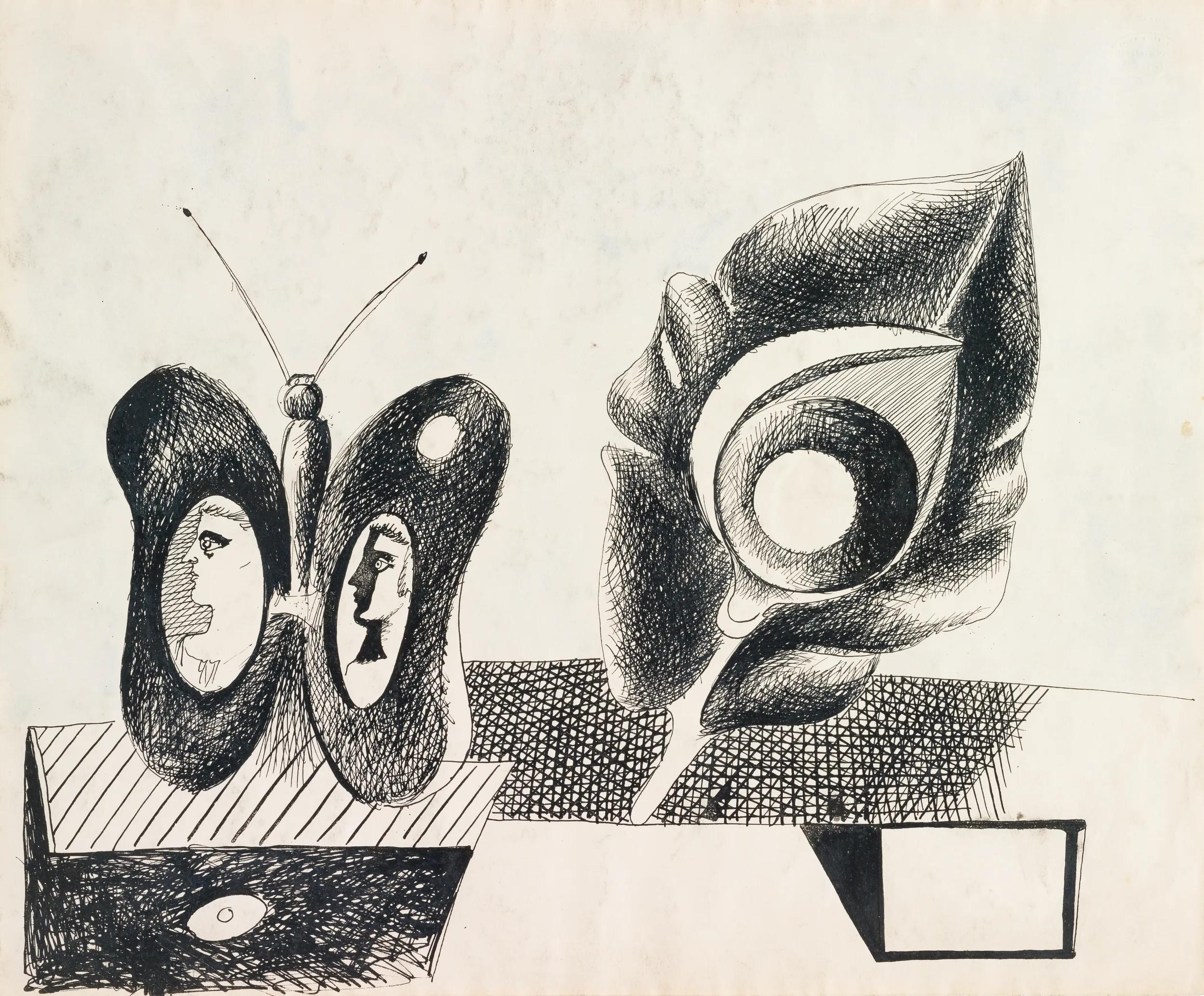
Arshile Gorky, Untitled (Butterfly and Leaf), ca. 1932 – 1934 © 2026 The Arshile Gorky Foundation / Artists Rights Society (ARS). Photo: Peter Schälchli
The film follows this westward road trip with Isamu Noguchi and Mougouch—a journey that marked Gorky’s first prolonged encounter with the American landscape. As Claire Howard notes, the vastness of the Grand Canyon and the High Sierras initially left him unmoved; only through close observation—grass, leaves, adobe ovens at a Hopi reservation that echoed his Armenian village—did he begin to connect memory and motif.
In 1941, the artist’s first solo museum exhibition at the San Francisco Museum of Art is “a turning point in his career,” says Howard, exhibiting works that are simultaneously abstract and autobiographical. An artist negotiating his own past while responding to the topography of America, “you could see how nature was alive to him” says Mougouch, “as a mixture of his early memories and his new perceptions.”
Works from before and after this trip, on view in “Horizon West,” reveal the evolution of Gorky’s landscapes: from abstract surface to horizon line, from weight to breath. “The looseness of his paint handling is what allows him to really channel his emotions and translate the feelings he’s having before nature,” reflects Howard. “His real genius was making it look effortless and spontaneous.” In Gorky’s unique visual language, memory and terrain converge, yielding forms that are at once personal and universal—a horizon seen not only in space, but also within.
–
“Arshile Gorky. Horizon West” is on view at Hauser & Wirth Los Angeles, West Hollywood, 21 February – 25 April 2026.
Claire Howard is the Hansjörg Wyss Curator of Modern Art at the Museum of Fine Arts, Boston and was previously Associate Curator, Collections and Exhibitions at the Blanton Museum of Art, where she organized exhibitions including Arshile Gorky and Isamu Noguchi: Outside In and Long Live Surrealism! 1924–Today. She holds a PhD in art history, has published widely on modern and postwar art, and is a founding board member of the International Society for the Study of Surrealism.
Mougouch (Agnes Magruder Gorky) was an artist, writer and the wife of Arshile Gorky, whose presence was central to his life and work during his final years. Following Gorky’s death, she became an important steward of his legacy, preserving his writings and offering an intimate perspective on his life and artistic practice.
Cosima Spender is an award-winning documentary filmmaker whose work explores identity, tradition and creative lives, including Palio (2015), Sanpa: Sins of the Saviour (2020) and Andrea Bocelli: Because I Believe (2024). A graduate of the UK National Film and Television School, she also directed Without Gorky (2011), a film about her grandfather, Arshile Gorky.
Valerio Bonelli is an award-winning film editor whose work spans feature films, television and documentary, including Darkest Hour, Philomena, The Martian and Florence Foster Jenkins. He won Best Documentary Editing at the 2015 Tribeca Film Festival for Palio and has collaborated frequently with Cosima Spender on projects including Sanpa: Sins of the Saviour and Andrea Bocelli: Because I Believe.